Financial institutions funding nuclear weapons – theme for June 20

Nobody except a few erratic multi-billionaires is willing to gamble their money on “peaceful” nuclear power. Still, your taxes are going to so-called “commercial” nuclear power, if you live in a nuclear country.
But banks, pension funds, insurance companies and asset managers are investing in nuclear weapons – and you wouldn’t even know that your money is going there. Don’t Bank on the Bomb has listed institutions around the world with substantial investments in nuclear arms producers. Fo example From 2013 to 2016, United States 226 Financial Institutions made an estimated USD$ 344 billion available to 27 nuclear weapon producing companies .
International Campaign to Abolish Nuclear Weaspons, (ICAN) has identified financial organisations funding nuclear weapons The report Don’t Bank on the Bomb, updated annually by PAX, provides details of financial transactions with companies that are heavily involved in the manufacture, maintenance and modernization of US, British, French and Indian nuclear forces.
ICAN is appealing to financial institutions to stop investing in the nuclear arms industry, as any use of nuclear weapons would violate international law and have catastrophic humanitarian consequences. By investing in nuclear weapons producers, financial institutions are in effect facilitating the build-up of nuclear forces. This undermines efforts to achieve a nuclear-weapon-free world and heightens the risk that one day these ultimate weapons of mass destruction will be used again.
Engaging in dialogues with financial institutions about their investments in nuclear weapons companies can help to raise their understanding of the effects of nuclear weapons and their status under international law. Here are some tips for letter-writing:
- How to begin: Let the financial institution know who you are. Do you hold a bank account with them? Are you a member of their superannuation plan? Do you own shares in their company? Are you writing as a representative of a particular organization? Are you simply a concerned citizen?
- What to include: Inform the financial institution that you are aware of their investments in nuclear weapons companies. Specify which companies and briefly describe the activities these companies are engaged in. Outline why you believe that financing nuclear weapons is illegitimate.
- Ask for information: Inquire as to whether the financial institution has a policy on investing in the arms industry. If you are already aware that such a policy exists, ask the institution to explain how its investments in nuclear weapons companies can be justified under the terms of the policy.
- Call for action: Call on the financial institution to divest from all nuclear weapons companies. Explain that nuclear weapons are illegal to use and have catastrophic humanitarian consequences. End by making it clear that you expect a response. – Don’t Bank on the Bomb
Mysterious, manipulative and corrupt process whereby Napandee was selected for nuclear dump site

Name Withheld, National Radioactive Waste Management Amendment (Site Specification, Community Fund and Other Measures) Bill 2020 [Provisions] Submission 39 [Excerpt] “…..So we examine briefly the nomination process in Kimba. When the 28 nominations were received in 2015, the number were then by a mysterious and yet to be released process whereby 6 sites were ultimately deemed suitable by the Federal Government. This announcement occurred in early 2016 and after another round of processes which were just as mysterious, the two sites in Kimba and one site in Hawker were selected to go to the the next round.
But just as quickly as they were announced – Cortlinye (Current MP at that time and now Rowan Ramsey’s land) and Pinkawillinie (Jeff Baldock’s
land) in Kimba, and Barndioota (former senator Grant Chapman and Philip Speakman pastoral lease), suddenly it was noted that Rowan Ramsey’s nomination of Cortlinye was in direct conflict with Section 44 of the Constitution, so his land nomination was withdrawn. Pinkawillinie, which was Jeff Baldock’s nomination was not accepted as suitable because of lack of community support.
So that left Barndioota as the only candidate. That meant Kimba was taken completely off the list as a possible site announced April 29th 2016. And that should have been the end of it.
https://www.eyretribune.com.au/story/3878053/kimba-not-going-nuclear/
Then following the Federal Election in July 2016, just a few months later, the portfolio of Minster of Resources was shifted from Josh Frydenberg and given to Matt Canavan. And then the goalposts for nomination were changed…. and suddenly Kimba was on the list again, with three different nominations – Napandee (Jeff Baldock’s land), Tola Park (Jeff Baldock’s land) and Lyndhurst (Brett and Michelle Rayner).
So effectively Jeff Baldock seemingly pursued this dump and the nomination process if you look at how many sites he submitted! And he became proactive by being an active member of the newly formed Working for Kimba’s Future (in 2016) AND one of the members of the Kimba Consultative Committee!
There was no apparent submissions required for these nominations in this “second intake” or at least it was not advertised! Many people in Kimba assumed that the previous ones submitted when Cortlinye and Pinkawillinie were nominated would be used for these two new sites of Napandee and Lyndhurst. Tola Park was not taken any further after the nominations were announced possibly because it had too many neighbours to deal with.
To bring the point absolutely to point – Jeff Baldock was intent on making this happen, by submitting his land, not once, not twice but three times! And inserting himself into the Working for Kimba’s Future Committee AND an active member of the Kimba Consultative Committee! Rowan Ramsey did not do this when nominating his land. Brett and Michelle Rayner did not do this when nominating their land. (And go to Hawker – Grant Chapman and peter Speakman did not do this when nominating their land – although granted they do not actually live in the area either!)
Why would you allow an OBVIOUS INVESTED PERSONAL INTEREST be on the Kimba Consultative Committee – where the members WERE SELECTED BY THE GOVERNMENT! And it gets worse than that – the required NUMBERS OF PEOPLE REQUIRED – 6 FOR, 6 AGAINST and 6 NEITHER – were not achieved for the committee when the selected names came back, and when questioned why this is so, were told that it didn’t matter because they were a non voting body. However that is not true as the Committee was used to decide the boundaries for the voting.
“5.20 Mrs Toni Scott outlined her concerns with the allocation of places to the Kimba Consultative Committee: Bruce McCleary…informed people at the meeting that the committee would consist of six people opposed, six people supportive and six people who are neutral. That was also again given to members of our group by the Minister—that that’s how the makeup of the committee would be. On the day that the committee was announced, we were extremely concerned that there were only four people who had expressed opposition who were actually on that committee…
Bruce Wilson took my concerns on board and told me that the makeup of the committee didn’t really matter because it’s a non-voting body.15 5.21 However, it does appear that the Kimba Consultative Committee (KCC) has
been asked to make at least on significant decision: We were told by Bruce McCleary that the KCC would be a non-decision making body. However, our concerns probably came to light a bit in the May meeting, when the KCC was asked to vote on whether we should request that the Minister consider altering the boundaries for the ballot.”
https://www.aph.gov.au/Parliamentary_Business/Committees/Senate/Economics/Wastemanageme
ntfacility/~/media/Committees/economics_ctte/Wastemanagementfacility/report.pdf
Which leads to the use of the Local Government Act in the ballot process. It was not an accident of fortune that it was used to conduct the community ballot – as this meant that it could be used also to exclude Traditional Owners as well – particularly the Barngarla people in the case of Kimba.
“5.21 However, it does appear that the Kimba Consultative Committee (KCC) has been asked to make at least on significant decision: We were told by Bruce McCleary that the KCC would be a non decision making body. However, our concerns probably came to light a bit in the May meeting, when the KCC was asked to vote on whether we should request that the Minister consider altering the boundaries for the ballot.16 5.22 By contrast, Dr Susan Andersson explained how the Barndioota Consultative Committee had effectively been sidelined by DIIS and the Minister in relation to defining the boundaries of the community vote: …we spent hours deciding what community is and who will get the vote and whether that includes Quorn, whether outback areas get in and how broad this should be. We had an expert there to help us define community for two sessions. Plus it was on the agenda two or three times: you will get a vote; BCC will be inputting into what area gets a vote.
Then Minister Canavan arrived on his surprise visit and said, ‘The area will be this.’ At a BCC meeting we said, ‘Hang on, we haven’t had our vote yet.’ ‘Oh, haven’t you? You can still have your vote; we’ll listen to it.’ But he’d already made media and public announcements as to what the area was. The BCC had been working towards contributing to what defined the community.17”
https://www.aph.gov.au/Parliamentary_Business/Committees/Senate/Economics/Wastemanageme
ntfacility/~/media/Committees/economics_ctte/Wastemanagementfacility/report.pdf
Although the Act as it stands requires consultation with Traditional Owners, freezing them deliberately out of the community ballot should not the intention of what is considered a right and Australian way of doing things in this day and age – given the scope and timeline of the nuclear waste being considered! Especially when the Local Government Act is only primarily used for Roads, Rates and Rubbish…and electing new council members!
Although the Barngarla people’s Native Title claim was determined on January 22nd 2015, their formal ownership occurred in June 2018, after first being lodged in 1996! Now when was the community ballot originally meant to be conducted for this dump? August 2018. This again is a reason why the Barngarla people are angry. When they conducted their very own ballot in 2019, through an independent ballot agent Australian Election
Company, after being denied one through the Council ballot with boundaries determined by the Minister, their results showed NO VOTES IN FAVOUR OF THE DUMP ON THEIR LAND – 209 eligible to vote, 83 voted NO 0 voted yes! So under Matt Canavan’s loose usage of figures, 100% NO and
0%YES.
But the real kicker are two other points. One that the Baldocks are now actively selling land with three neighbouring famers in Kimba in a large lot called the “Cunyarie Collection”, 9000ha as
advertised February 14, 2020 https://www.adelaidenow.com.au/business/sa-businessjournal/
large-parcel-of-eyre-peninsula-cropping-land-on-the-market/newsstory/
74188105d449d5920685cdd74637780c
So much for all the media gab about it being good for the community! Actions speak louder than words!
And that the historical information about the announced site, as under the AECOM site study used some historical information from Jeff Baldock himself, who had had the land only for less than 10 years! “The soils at the site are a sandy loam on a relatively impermeable calcrete/silcrete layer at a depth of approximately 0.3m with no known localised flooding or water logging issues (source Jeff Baldock 22 Feb 2018). This is based on approximately 6 years on the property.” Page 72
https://www.industry.gov.au/sites/default/files/2019-
04/nrwmf_site_characterisation_technical_report_napandee.pdf
This is a flawed proposal from start to end. Having ONE person nominate their land is not the best way of dealing with nuclear waste. This is not considering the very best geological site for this waste.Nor the very safest site for this waste. Just a lottery for the landowner who would “win” the
nomination!
And the goal posts were forever changing. The neighbouring areas were farcical as the diameter of the inclusion zone became smaller and smaller…until it was only the immediate fence lines and have a road in-between and you’re not a neighbour! That is how the 100% neighbour figure was achieved. There were four immediate or direct neighbours to Napandee, but that became 3 after this ruling was used. And those 3 neighbours agreed with the site. The neighbour with the road in-between did not! https://www.aph.gov.au/DocumentStore.ashx?id=4211af77-bacf-4cb7-b03c-
98ba573b179b&subId=565156
The Conservation Parks nearby Napandee (Pinkawillinie Conservation Park and also the Gawler Ranges National Park) were not allowed a say as “neighbours” as they are State owned…. as determined by the guidelines set up Department of Industry, Innovation and Science, with advice from Geoscience Australia, independent market research company ORIMA Research the Kimba Consultative Committee… “A neighbour cannot be the Crown in any capacity, a district council or any
other State or Commonwealth government body”
https://www.industry.gov.au/sites/default/files/2019-11/nrwmf-neighbour-sentiment-surveyguidelines.
pdf
Senate should reject Nuclear Waste Bill and recommend new consultation involving all Barngarla people.
Carol Faulkner National Radioactive Waste Management Amendment (Site Specification, Community Fund and Other Measures) Bill 2020 [Provisions] Submission 53 . I am totally opposed to any legislative change that would allow a radioactive waste repository to be built on Barngarla traditional land in South Australia. The Barngarla people were not properly consulted. The consultation breached aboriginal regional consultation guidelines in not including all Barngarla people in the consultation process. The limits imposed on the consultation represents a denial of natural justice for the Barngarla people.
The consultation was manifestly flawed by not including all Barngarla people. The Barngarlapeople have a deep connection to their land. The consultation process was flawed in setting an arbitrary government-imposed distance from the proposed repository for the purpose of consultation.The Committee should reject the Bill and recommend a new round of consultation involving all Barngarla people.
In a corrupt and undemocratic process, the Napandee nuclear waste decision has ignored environmental safety dangers
Neville Reid National Radioactive Waste Management Amendment (Site Specification, Community Fund and Other Measures) Bill 2020 [Provisions] Submission 55 I can not believe the Government has not realized how Poorly positioned the Kimba on Eyre Peninsula site proposal is if there is a major leak which there is every chance of it happening with the transporting of old waste containers made of copper concrete and lead full of High Level waste even if the Government thinks naming it intermediate some how make it safer is naive at best and hardly well thought out .
And then storing it above ground near major industrial centers and transport route’s Road and Rail and Export ports is such an ill conceived plan by the LNP, that only understands the needs of commerce but they are putting the whole SA Economy at risk.
A Major leak will shut down these centers as it travels on prevailing winds whichare predominantly from the North West/ South West Whyalla 110km East, Pt Pirie 140km East, transport will be cut through the Eyre Highway then a strong cold front would push it north east to Pt Augusta 160 km North East north south east and west and south to the Eyre Peninsula.
As each cold front and trough passes over the state it will affect the Eyre Peninsula, the Mid North, the Far North, York Peninsula it will make it to Adelaide on a hard blowing North Westerly. Point what these areas contribute to the SA economy if they were affected this state’s would shut down. Get weather maps of prevailing winds and show them it well drift on the wind to Adelaide as well.
I am prepared to help with collating this information with the help of your office ifneed be.I have worked on the waters in this state since I was 14 years old I am now 55 Iknow how the winds prevail in this state.If this dump must go ahead the most logical place to put it is somewhere remoteas possible and stable in the desert some where it cannot affect ground water willnot be affected by Flooding and is safe from any attempt of attack by air fromTerrorists, How could they think in a shed above ground is safe even if they incase it concrete it is still a target.
I do not believe one small town that has been bribed by the Government can make this decision for the whole state this is one of the most corrupt and undemocratic processes I have seen in this country you as members for the people in the Australian Parliament have a duty to prevent such a foolish plan for some one off payments for toxic imported waste look further into their plans there Please protect us My children their Children this is a 50,000 to 100,000 year legacy it must go underground in an ISOLATED PLACE!!!!!If any one would like to discuss any points I have made in greater detail please contact me.
Senator Rex Patrick provides Federal Parliament with another option for nuclear waste storage
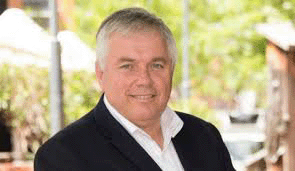 Nuclear dump debate resumes, Stock Journal , QUINTON MCCALLUM, 18 Jun 2020, HOPEFUL: No Radioactive Waste on Agricultural Land in Kimba or SA secretary Toni Scott said the group were glad Rex Patrick had provided Federal Parliament with another option for the proposed radioactive waste facility. Nuclear dump debate resumes, Stock Journal , QUINTON MCCALLUM, 18 Jun 2020, HOPEFUL: No Radioactive Waste on Agricultural Land in Kimba or SA secretary Toni Scott said the group were glad Rex Patrick had provided Federal Parliament with another option for the proposed radioactive waste facility.
SA Senator Rex Patrick’s move to allow the Woomera Prohibited Area to be selected as a site for the National Radioactive Waste Management Facility has been welcomed by No Radioactive Waste on Agricultural Land in Kimba or SA secretary Toni Scott, who said it was good he had provided Federal Parliament with another option. “We believe this facility should be in the right place, not the only place that is nominated by an individual,” she said. “The government have looked into the WPA before and it has a lot of suitable attributes, with waste already there, federal security, road and rail access, as well as being remote and not on productive agricultural land. “We believe it’s likely the most suitable place in SA if our state really wishes to pursue the path of hosting a radioactive waste facility.” With a senate inquiry into the Nuclear Radioactive Waste Management Facility ongoing, the dump’s location is still subject to debate, despite the federal government declaring Napandee, 20 kilometres west of Kimba, as the site in February. SA senator Rex Patrick has announced he plans to move amendments to the National Radioactive Waste Management Facility Amendment Bill to allow for the nomination of land within the Woomera Prohibited Area as the site, rather than Kimba. “The Federal Parliament will be given a choice on whether the site should be on prime agricultural land on the Eyre Peninsula, in a community bitterly divided about it being built there, or in the remote and highly-secure WPA where a significant amount of low and intermediate level radioactive waste has been stored for more than two decades,” he said. Mr Patrick described the previous site selection process as “highly-flawed” and one that “pitched local against local”. He also said appropriate location prerequisites of 65 per cent community support, and support from neighbouring landholders and traditional landowners were never achieved. Mr Patrick said Woomera was the obvious choice for the site, being remote, having “enormous tracts of land that are not used for weapons testing” and already storing a significant amount of radioactive waste……..https://www.stockjournal.com.au/story/6796460/nuclear-dump-debate-resumes/?cs=4894&fbclid=IwAR0Q0ch76TbATXYQo5hKuI7fMl12p9Sn9VXBgBu0Dm4A3aZQ5HcHJKVKlMs |
|
|
South Australia outlaws nuclear facilities, but yet not S.A. Liberal MP voted against the waste dump!
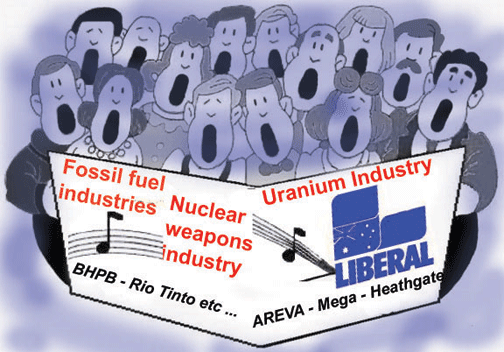
Kim Mavromatis No Nuclear Waste Dump Anywhere in South Australia
Time to let ANSTO sink!
Paul Waldon Fight To Stop Nuclear Waste In The Flinders Ranges, 20 June 20,
A farmer come nuclear profiteer maybe reckless and foolish enough to embrace a radioactive dump in the agriculture backyard of his community.
But remember that backyard could be your pantry!
When the Department of Industry, Innovation and Science has reduced the value of Kimba and South Australia’s premium agriculture environment to that of a sacrificial anode, it’s time to let ANSTO sink. https://www.facebook.com/groups/941313402573199/
Pacific leaders do not want the coronavirus pandemic to distract from work on climate change
 Pacific leaders fear climate change campaign will ‘lose momentum’ amid COVID-19 pandemic, ABC, By foreign affairs reporter Melissa Clarke 19 June 20 Pacific leaders fear climate change campaign will ‘lose momentum’ amid COVID-19 pandemic, ABC, By foreign affairs reporter Melissa Clarke 19 June 20
Pacific leaders have said action on climate change “cannot and should not” take a back seat during the COVID-19 pandemic and have appealed for Australia to help rally global support for more emissions cuts.
Key points:
Senior political leaders from both the Fijian and Samoan governments have raised concerns that climate change is being overlooked while global leaders and the media focus on the coronavirus. The Fijian Government, which has been a strong critic of Australia for not doing more to reduce carbon emissions, has said the urgency for addressing climate change has not abated. “It may appear that climate change has taken a back seat, but it cannot and should not,” Fiji’s Attorney-General Aiyaz Sayed-Khaiyum said. Coronavirus update: Follow all the latest news in our daily wrap.Taking part in an online forum hosted by the Australian National University (ANU) on Thursday, Mr Sayed-Khaiyum said the impacts of climate change were being felt every day by Fijians.
Pacific nations regard climate change as an existential threat, with changing weather systems affecting sea levels, fish stocks, water quality and the frequency of severe weather events. Samoa’s Deputy Prime Minister Fiame Naomi Mata’afa, speaking on the same forum, said it is important attention isn’t diverted from climate change. “We’re talking about a pandemic, but… climate change impacts us in all aspects of our lives, including health as well.”…….. Pacific Island nations have been trying to get all countries to agree to register more ambitious emissions reductions targets under the Paris Agreement on climate change. Ms Mata’afa is concerned their campaign could “lose momentum” during the pandemic and appealed for Australia’s help. “I think it is very important for Australia, as a member of the Pacific [Islands] Forum, that it comes in strongly as one of our larger members, with the Pacific and the message: to ensure that the 1.5 [degree] objective that we’ve been advocating for and that we raise the global ambition in regards to [cutting] emissions.” Pacific nations have previously expressed their disappointment that Australia has not fully embraced their calls for more global action……… https://www.abc.net.au/news/2020-06-18/pacific-leaders-fear-coronavirus-distraction-climate-change/12371182 |
|
Is Australia getting a second wave of Coronavirus?
 As coronavirus cases rise in Victoria, how do we know when a second wave is starting? ABC By Casey Briggs 20 June 20 The curve has been flattened, nay crushed, and we’re slowly getting back to normal.
But we’re left with the fear that all the hard work we’ve done could be undermined by a second wave of the coronavirus pandemic.
This week, Australia has registered more than triple the locally acquired cases of the previous week, and almost all of them are in Victoria.
In the past seven days there were 21 community transmission cases where a source of infection can’t be found, up from just six the week before, although health authorities may yet find a source for some of these.
A big second wave of infections isn’t inevitable, but the possible consequences could be huge, and it’s worth doing as much as possible to avoid it.
So how would we know if Australia is about to start rising up another curve?
Facing a second wave
That’s precisely what occurred in the last global pandemic on this scale: the 1918 Spanish Flu pandemic. Its second wave was more severe than the first outbreak.
But that doesn’t mean we should expect the same thing this time around.
Associate Professor Hassan Vally from La Trobe University says there are some big differences between the influenza virus and SARS-CoV-2, the virus that causes COVID-19.
We know that influenza viruses prefer winter, and they also mutate much more dramatically than SARS-CoV-2.
“For the Spanish flu, what you saw was the seasonal effect of the virus actually disappearing,” Dr Vally says.
“Then it came back and what people speculate is that it had taken a pretty significant mutation… [it] was more virulent and caused all of the damage.”SARS-CoV-2 has not been mutating anywhere near as quickly.
“So what people are referring to as a second wave here is not actually a second wave,” he says. “It’s not going to disappear and then come back in a different form, the way influenza does.”
That makes things a little more predictable, but it doesn’t stop the possibility of a resurgence……….
In Australia, it helps that infections were down to a trickle when restrictions started to be eased. Iran’s best day in the pandemic still saw far more cases recorded than on Australia’s worst.
The more a virus has spread within a community when shutdowns end, the higher the chance of a second serious outbreak.
Nonetheless, the Federal Government has been desperate to avoid a new wave of infections, fearing both the public health cost and the damage it will do to businesses that have already endured lengthy shutdowns.
Where many countries are now trying to cope alongside the virus, Australia wants to keep it suppressed.
The warning signs
Dr Katherine Gibney from the Doherty Institute and Royal Melbourne Hospital says the chance of a resurgence will increase if community transmission rates pick up.
When there are a lot more cases, and a lot of them don’t have an identified source, is the time that you’d think there’s a lot of transmission going on in the community that you haven’t detected,” Dr Gibney says.
“At the moment I definitely don’t think we’re there.”
The country-wide slowdown bought health authorities important time to build testing and hospital capacity. That vastly improves the country’s chances of catching the further outbreaks before it is too late.
But of course all outbreaks start somewhere, and Australia has seen a small lift in locally-acquired cases this week. ……..
Spotlight on Victoria
Most of Australia’s cases are being imported from overseas, but Victoria in particular is still uncovering cases of community transmission.
Victoria’s public health authorities have conceded the higher levels of community transmission do make them “nervous”……….
Some community transmission is to be expected, but the state hopes this week’s numbers will stabilise.
“If we have case numbers like we’ve had in the last couple of weeks bubbling along that would be manageable,” she said.
More restrictions are due to be lifted in the state on Monday. ……… https://www.abc.net.au/news/2020-06-20/coronavirus-second-wave-australia-victoria/12372938
Morrison government just doesn’t get it, on climate change
Hewson’s View: How long can Morrison deny the undeniable? https://www.canberratimes.com.au/story/6793657/how-long-can-the-pm-deny-the-undeniable/?cs=14246#gsc.tab=0
John Hewson, 19 June 20, The government is doing little to ensure that our soils are more drought resistant and resilient.
Unfortunately, the Morrison government just doesn’t get it when it comes to the imperative for urgent climate action.
Sure, the worst of the drought is over. Sure, the bushfire season has ended. Sure, Morrison has handled the COVID-19 pandemic well, certainly better than expected, but only so far – the more difficult economic and social challenges are yet to come, and the risk of a pick-up in the infection rate is omnipresent.
But, what has the government actually learned from these experiences such as to encourage them to embrace longer-term strategic thinking and planning to better respond to the inevitability of more of these crises in the future? Apparently, very little!
Climate was an important cause of the drought, and the climate predictions are that droughts will occur more frequently and with even greater intensity. Climate was an important cause of the bushfires, again the predictions are for more and worse to come. COVID-19 was very much a dress rehearsal for what awaits us if we continue to ignore the science and the urgent demands of the climate threat. The government has a “tin ear” to all this, not really accepting the significance of the science; certainly not doing much to ensure that our soils are more drought resistant and resilient, or to better prepare for the next bushfire season; and clearly failing to seize the opportunity in developing its COVID Recovery Strategy to accelerate our transition, sector by sector, to a low carbon Australia by mid-century.
They are totally self-absorbed in short-term politics, cynically relieved that they have been able to “survive” their mismanagement of both the drought and the fires, and are now making anti-climate decisions, perceiving some sort of short-term political advantage from paying out to certain vested interests and political supporters, against our longer-term national interest.
Australia is now clearly a laggard in response to climate ...
Australia is now clearly a laggard in response to climate, having squandered the opportunities to lead over the last three decades, thereby forgoing billions of dollars of investment and growth, and hundreds of thousands of jobs.
A new survey (based on digital news) released this week by the University of Canberra and conducted at the end of the bushfire season earlier this year, found that the number of climate deniers (8 per cent) in Australia is more than double the global average (3 per cent), and of the 40 countries surveyed, behind only the US (12 per cent) and Sweden (9 per cent).
While 58 per cent think climate is an “extremely or very serious problem”, this is lower than the global average of 69 per cent, and only one-quarter of the countries surveyed are less concerned than we are.
This clearly reflects the reliance on commercial AM radio and Sky/Fox News – more than one-third who listen to these outlets consider climate to be “not at all” or “not very” serious. It also reflects the government’s failure to encourage and sustain a mature debate on climate, including “threats” of job losses and disruption.
Moreover, as our government is sticking with support for more coal and gas projects, including new coal and gas-fired power projects, large fossil fuel companies are accelerating the transition away from fossil fuels. Following on from the likes of BHP and Rio Tinto, global oil giant BP this week announced the write down of its exploration and production assets by some A$25 billion, as it reassesses the global energy market – post COVID – and the increasingly rapid shift to clean energy.
The finance and investment sectors are also driving the essential climate transitions, with most major banks refusing to finance new fossil fuel or dirty energy projects; major insurers becoming increasingly reluctant to insure them; and the big global investors, fearing the possibility of “stranded assets”, are shifting their investments towards less climate-exposed assets – for example, the largest sovereign wealth fund, the Norwegian Fund, has quit coal, and Blackrock, the world’s largest funds manager, has adopted its Climate Action Strategy. Also, major corporates such as Unilever have urged Morrison to join the climate fight.
Morrison is clearly focused within the “Canberra Bubble”, mostly taking his much lauded “Quiet Australians” for granted. His short-term political game is grossly irresponsible, selling out our national interest, and stealing from future generations, to whom he will happily leave the increasingly difficult task of cleaning up his mess, probably in the context of lower living standards.
John Hewson is a professor at the Crawford School of Public Policy, ANU, and a former Liberal opposition leader.
Time to act on Dr King’s call to tackle evils of racism, economic exploitation, and war — IPPNW peace and health blog

While acknowledging that progress had been made in civil rights, King called us to address “Three major evils—the evil of racism, the evil of poverty and the evil of war” to the consternation of the establishment. He noted that progress that had been made in dealing with civil rights in “shaking the entire edifice of segregation” should not “cause us to engage in a superficial dangerous optimism.” He urged that we must also deal with “the evil of poverty”…[and] the “evil of war” declaring that “somehow these three evils are tied together.
Time to act on Dr King’s call to tackle evils of racism, economic exploitation, and war — IPPNW peace and health blog
June 19 Energy News — geoharvey

Opinion: ¶ “The Tide Is Turning (And Is It Ever!)” • Something really important was buried in FERC’s latest Energy Infrastructure Update, and though SUN DAY Campaign mentioned it, the rest of the media let it slip. In the US, renewables are expected to see fifty times as much net capacity added in the next […]
June 19 Energy News — geoharvey
Tokyo Olympic Games (Message to President Thomas Bach) — limitless life
Dear Friends, I am sending you my message addressed to President Thomas Bach, President of the IOC. I pointed out that “ a new change in conformity with the law of history that does not allow immorality to last indefinitely seems to be around the corner.” With warmest regards, Mitsuhei Murata Former Japanese Ambassador to […]
Tokyo Olympic Games (Message to President Thomas Bach) — limitless life
South Australia: The first big grid where rooftop solar could eliminate all demand — RenewEconomy

South Australia breaking new ground in share of solar and management of the grid. And cautious market operator wants to be able to switch off rooftops if needed. The post South Australia: The first big grid where rooftop solar could eliminate all demand appeared first on RenewEconomy.
South Australia: The first big grid where rooftop solar could eliminate all demand — RenewEconomy
South Australia fast-tracks energy plan to dodge blackouts and meet 100% renewables goal — RenewEconomy

South Australia to fast-track new link to NSW, and allow rooftop solar to be “shed” by market operator as it faces becoming first gigawatt scale grid in world to face zero operational demand. The post South Australia fast-tracks energy plan to dodge blackouts and meet 100% renewables goal appeared first on RenewEconomy.
South Australia fast-tracks energy plan to dodge blackouts and meet 100% renewables goal — RenewEconomy
1 This month
7 April – WEBINAR – Australia and the Doomsday Clock – Preventing nuclear war through NoFirstUse and other policies
Online | Tuesday April 7, 4:00-5:30pm, Australian Eastern Time / 8:00-9:30am Central Europe Time
– Access the registration link
15 April – Zoom –Nuclear Power is Not the Solution
Apr 15, 2026 01:00 AM in Canberra, Melbourne, Sydney

Join the International Physicians for the Prevention of Nuclear War (IPPNW) on Tuesday, April 14th for a timely webinar exploring the risks associated with nuclear power and challenging the myth that it offers a simple, safe, carbon-free solution to the climate crisis

21 April Webinar: No Nuclear Weapons in Australia
Start: 2026-04-21 18:00:00 UTC Canberra, Melbourne, Sydney (GMT+10:00)
End: 2026-04-21 19:30:00 UTC Canberra, Melbourne, Sydney (GMT+10:00)
Event Type: Virtual
A virtual link will be communicated before the event.
Host Contact Info: australia@icanw.org

of the week – Australians for War Powers Reform (AWPR)
To see nuclear-related stories in greater depth and intensity
 Antinuclear