Doubts that a Kimba nuclear dump will really bring jobs to the area
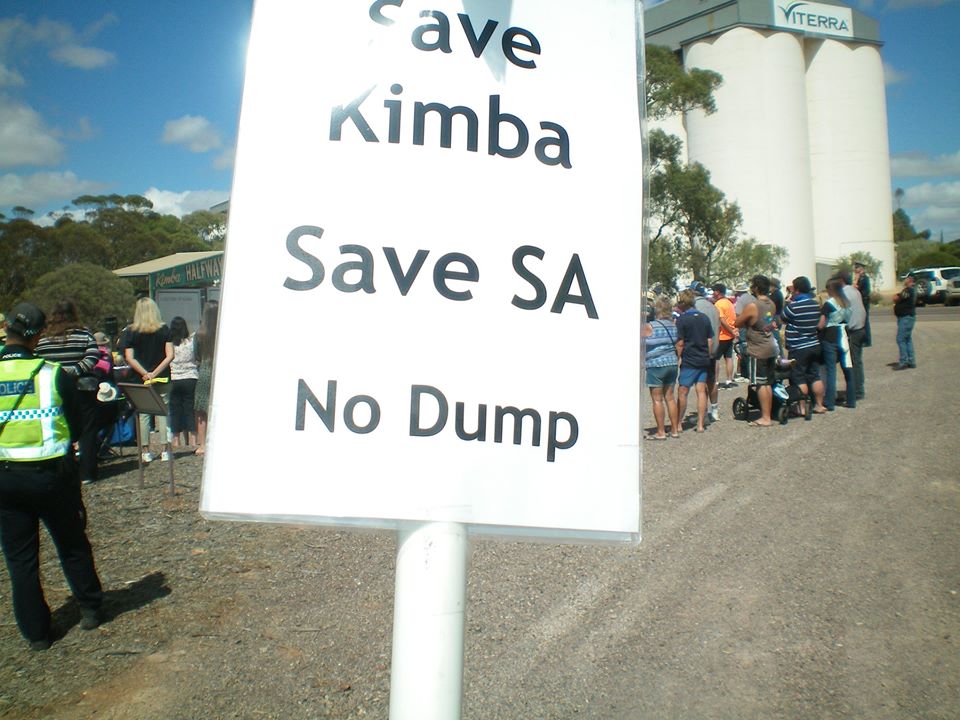 Kimba jobs a hot topic, Whyalla News, Louis Mayfield, 29 July 20,
Debate has ensured over the federal government’s promise of bringing 45 jobs to Kimba with the establishment of a nuclear dump at Napandee, after the latest Senate inquiry revealed there is no legislative requirement to continuously staff a low-level radioactive waste facility.
The Senate Inquiry into the federal government’s Nuclear Radioactive Waste Management Facility (NRWMF) met on Tuesday, with Centre Alliance Senator Rex Patrick reading the following statement from ARPANSA:
“There is no explicit requirement in the ARPANSA or ANSTO legislation or guidance that prescribes that a low-level radioactive waste disposal facility requires continuous presence of staff for either security or safety purposes.”
Senator Patrick was questioning the agency over whether the NRWMF at Kimba could be run remotely.
The federal government has long promised that the facility will create 45 jobs, and while Senator Patrick does not dispute the idea that the jobs will be available, he doubts they will last.
“The CEO of the site may end up being repatriated back to the Australian Radioactive Waste Agency in Adelaide, and I think some of the other roles may be pulled back and the site will turned into a remote facility two or three years down the track,” Senator Patrick said.
“Kimba locals should look at how the government is willing to shift 700 submarine jobs from Adelaide to Perth on a political whim.
“Having seen federal and state government services evaporate from country towns time after time, we know governments can’t be trusted to keep their promises.
“The writing is on the wall, and the wall hasn’t even been built yet.”
Senator Patrick believes this will be a likely course of action for the government because it’s a way to trim costs and achieve savings.
“They will look at those ARPANSA rules and say ‘this is not a bad option,'” he said……. https://www.whyallanewsonline.com.au/story/6855823/kimba-jobs-a-hot-topic/Debate/?fbclid=IwAR0KJkx1ynVTY_3MxehtRridHdfIu0G5eJYhurXHE6eunG7AdtHgbst2IOs
ABC Radio interview focusd on Kimba nuclear waste dump plan
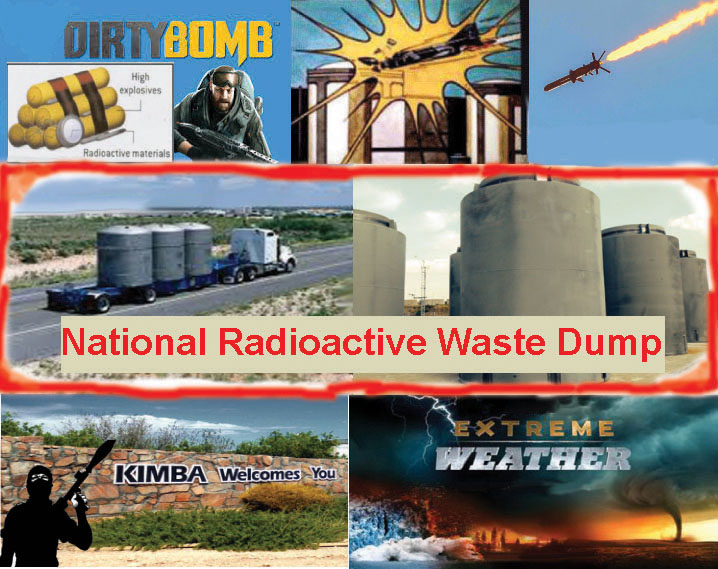 Evenings With Peter Goers ABC radio pm ABC Radio South Australia 30 July
Peter Goer first interviewed Keith Pitt, Minister for Resources. Pitt was confident about the Kimba nuclear waste dump plan. He stressed that it is essential for Australia’s medical care. He claimed strong community support for the plan, and said that it “meets all the technical requirements”. ” My advice is that the temporary waste can’t stay at Lucas Heights.” “The Kimba facility is a critical national infrastructure” “Necessary for people who receive cancer care”.
Peter Goer : “Strange that you have approved this new Adelaide agency whiled the matter still being discussed in the Senate.
Keith Pitt: “It will take time to put together the necessary team. It will take overseas and domestic research”.
Goer: “Have you read all the submissions to the Senate Inquiry?
Pitt avoided the question, and returned to the medical theme – “2 out of 3 of every Australian will utilise that type of technology, will need the Lucas Heights reactor”
Goer: It’s the temporary storage of ILW [Intermediate Level Waste] that worries people.
Pitt: ” Very small amounts. If we accept that we want to use nuclear medicine, then we must manage the by-product”
Peter Goer then interviewed Eddie Hughes, Labor federal member from South Australia
Hughes. We’ve had 3 separate Ministers. Sites that were nominated were all in the seat of Grey. First Rowan Ramsey offered his land – conflict of interest? Then another Liberal politician offered his land, did not consult local community, nor Aboriginal groups.
Aboriginal community- Barngarla not eligible to vote.They conducted their own vote, unanimoously against.
Not essential for a nuclear waste facility to be at this location. Medical waste doesn’t need to be transported to a national facility.
Goers. ILW [Intermediate Level Wastes) we are leaving that problem to our grandchildren.
Hughes. The ILW. This process should have been discussed broadly, including Aboriginal community.
Senate Inquiry going on,, but govt is pushing ahead with this plan, Kimba is not necessarily the solution
Calls. Bob from mid-north said that the vast majority of medical waste is very short-lived. There are also nuclear materials used in industry, universities. At Woomera there are 44 gallon drums rotting, materials transported from Fishermens Bends. Legacy waste from the cold war. Ws don’t know what is in it.
Goers – concern that this might led to importing nuclear waste.
Hughes – I don’t imagine this. Facility at Kimba is above ground, not suitable for deep geological disposal.
Jay Weatherill’s government gave space for Aboriginal people, gave power of veto. In the present case Barngarla people have been treated with contempt.
Goers. Kimba known as a nice little town. Will become known as the “dump town’
Hughes. I understand that people see the business activity. But I don’t think that 45 jobs will eventuate. Some overseas dumps have much smaller number of workers.
Goer. Rural communities are shrinking. Has Kimba been bribed?
Hughes. A lot of money has been put on the table for facilities – a big effort to get people onside. Sad that the only way a town can get the needed services is to offer itself for a nuclear dump. Federal govt hasn’t addressed the far more important issue of shortage of doctors across regional South Australia. Medical treatment will continue whether or not the dump goes ahead
Goers. Rowan Ramsey has the view that the local people are the best educated about this. Keith Pitt has a similar view. Seems to be a distrust of anyone who’s not local to Kimba.
Hughes. This is a South Australian issue. Very arrogant to say that only local people can have an opinion. Liberal govt ruled it out, and that legislation still stands. We need to go back and look at this whole process. Both those in favour or against this plan agreed that we need to deal with radioactive wastes in a responsible way.
Many texts received. – Reconciliation with Aboriginals – only lip service. Medicalisotopes can be made with cyclotrons – nuclear reactor not necessary. ANSTO could have promoted synchrotons producing isotopes for Australian use.- instead opted for building an export business from Lucas Hreights nuclear reactor.
The Australian government continues its war on the national broadcaster, the ABC
OFFICIAL AUSTRALIAN state policy since 2014 on its public broadcaster, the ABC, has been to throttle it through withdrawing its budget by stages while abusing it with propaganda through Liberal-linked commercial media — News Corp newspapers, 2GB radio network and Sky News pay television. There is also a subplot that involves, while the ABC survives, pressing it to deliver positive messaging for the government of the day.
It is a changed scene since broadcasting regulations providing oversight or program guidelines were dropped from the 1980s, the same as with the former Federal Communications Commission standards in America. The present-day barrage of extravagant opinion-making on commercial media is one result — different to the ABC, which being publicly-owned has to retain standards of accountability and fairness.
ABC broadcasters know they have formidable public support. Audience research over the decades shows that high proportions of the population from all walks of life use the service, depend on it, like it and respect it. It is sometimes conditional support; they do not like everything, but it gives the ABC, despite the six years of official abuse, breathing space to fall back on prepared positions as it has done through crises past.
………. the continuing pattern of the ABC. It provides service on many fronts, often service the commercials will never give, provided by broadcasters consulting their professional values, like the journalists guided by received news values — new and interesting, important and informative with no snide agendas.
Hatred?
So why this hatred of it? The answer is that a political and financial ideology which preoccupies certain people is obstructing the rest of us just getting a good range of services from the ABC — value for money, Australian culture first.
On one hand, the government of the day believes in privatising economic life to the direct benefit of wealthier constituents so it foregoes revenue – as with the scheme to cut company taxes – and will sell off public assets where it can. Some might watch and listen to the ABC, but that clearly gets outweighed by loyalty to party, money and power, so selling off is on the books.
Secondly, government trades favours with corporate backers, in the case of media indulging the demands of commercial broadcast interests for market protection, by pushing down the ABC — “people’s choice” not coming into it.
The relationship is being demonstrated by the trend for conservative ministers to make declarations or announcements through 2GB or Sky, where they can get the easiest, most matey, often fawning form of interview. The ABC is much less favoured, as it is independent and still does critical interviews; they look for the new information, hold the speaker to account, don’t run it on-and-on.
It does itself have a small co-operative part in this game by giving away slavish credits. Where ministers will only talk with 2GB or Sky, the audio or vision has to be recorded for replay and credited to them by name; they get a free ad on ABC. That goes against the alternative, that often if you take an allowable short excerpt – and copyright laws give fair leeway on this – you say it was “on radio”, or “on commercial television”……. https://independentaustralia.net/business/business-display/the-war-on-the-abc-and-its-options-for-survival,14161
International Red Cross and Red Crescent Movement urges all nations to end the nuclear era
 International Red Cross and Red Crescent Movement urges all nations to end the nuclear era https://reliefweb.int/report/world/international-red-cross-and-red-crescent-movement-urges-all-nations-end-nuclear-era , Geneva, 31 July 2020 –Seventy-five years ago, on the morning of August 6, 1945, a B-29 warplane released a terrifying new weapon on Hiroshima.
The nuclear bomb wiped out the city, instantly killing an estimated 70,000 people and leaving tens of thousands more suffering horrific injuries. Three days later, on 9 August, a second nuclear bomb devastated the city of Nagasaki, immediately killing 39,000 people.
By 1950, an estimated 340,000 people had died because of the bombs’ effects, including from illnesses caused by exposure to ionizing radiation. The International Committee of the Red Cross (ICRC) and the Japanese Red Cross Society witnessed the unimaginable suffering and devastation, as medical and humanitarian personnel attempted, in near-impossible conditions, to assist the dying and injured.
The 75th anniversary of the bombings of Hiroshima and Nagasaki comes even as the risk of use of nuclear weapons has risen to levels not seen since the end of the Cold War. Military incidents involving nuclear states and their allies have increased in frequency, and nuclear-armed states have made explicit threats to use nuclear weapons.
Additionally, agreements to eliminate existing arsenals are being abandoned as new nuclear weapons are being developed, putting the world on the dangerous path of a new nuclear arms race. These developments add urgency to the international community’s efforts to prohibit and eliminate these unacceptable weapons. The indisputable evidence of their catastrophic impact makes it extremely doubtful that their use could ever comply with international humanitarian law.
The horror of a nuclear detonation may feel like distant history. But today the risk of nuclear weapons being used again is high. Treaties to reduce nuclear arsenals and risks of proliferation are being abandoned, new types of nuclear weapons are being produced, and serious threats are being made. That’s an arms race, and it’s frightening. We must push all states to ban nuclear weapons and push nuclear weapons states to negotiate, in good faith, steps towards their elimination,” said Peter Maurer, president of the International Committee of the Red Cross (ICRC).
“The international community would not be able to help all those in need after a nuclear blast. Widespread radiation sickness, a decline in food production, and the tremendous scale of destruction and contamination would make any meaningful humanitarian response insufficient. No nation is prepared to deal with a nuclear confrontation,” said Francesco Rocca, president of the International Federation of Red Cross and Red Crescent Societies (IFRC).
Proving the wide support for a nuclear-free world, 122 states in July 2017 adopted the Treaty on the Prohibition of Nuclear Weapons (TPNW). The treaty will become legally binding for countries that ratify it after 50 do so; to date 40 have. The treaty prohibits the development, testing, production, stockpiling, stationing, transfer, use and threat of use of nuclear weapons. For nuclear-armed states that join the treaty, it provides for a time-bound framework for the verified elimination of their nuclear weapons program.
Mr Maurer and Mr Rocca commended the states that have already joined the TPNW and encouraged all others to follow suit, ensuring the events of 1945 never occur again. The two leaders said it was crucial that the TPNW becomes a new norm of international humanitarian law.
“Not since the end of the Cold War has it been more urgent to call attention to catastrophic consequences and fundamental inhumanity of nuclear weapons. We must signal in a clear and unambiguous manner that their use, under any circumstances, would be unacceptable in humanitarian, moral and legal terms,” said Mr Rocca.
There are over 14,000 nuclear bombs in the world, thousands of which are ready to be launched in an instant. The power of many of those warheads is tens of times greater than the weapons dropped on Nagasaki and Hiroshima.
“Weapons with catastrophic humanitarian consequences cannot credibly be viewed as instruments of security,” said Mr Maurer.
Hiroshima survivor, Setsuko Thurlow continues her campaign against nuclear weapons
“That’s extremely, extremely disappointing — so disturbing,” said the Hiroshima survivor who has been actively campaigning against nuclear weapons for more than 60 years.
“It’s not just me. There’s a lot of people disappointed. And that’s not the way the prime minister should be behaving. If this is a democracy, he (Trudeau) should be sharing his ideas and encouraging debate.”
The world is marking the 75th anniversary this month of the atomic bombings of Hiroshima and Nagasaki, events that still haunt and propel Thurlow in her passion for the disarmament cause.
On June 22 she sent a letter to Trudeau asking that he acknowledge that Canada helped to produce the first atomic weapons and has copied the letter to all 338 parliamentarians in Ottawa. She is still waiting for a reply.
So far the only time Trudeau has ever spoken about nuclear weapons policy was to mock efforts to declare the weapons illegal, Thurlow said…..
Trudeau was not in attendance later that year when Thurlow accepted the Nobel Peace Prize on behalf of the International Campaign to Abolish Nuclear Weapons. Nor did anyone in his government congratulate her.
The Trudeau government fell in line with U.S.-dictated NATO policy and refused to participate in United Nations negotiations leading to the Treaty to Prohibit Nuclear Weapons in 2017.
Canada voted against the treaty while 122 nations voted it in. Since then 40 states, including the Vatican, have ratified the treaty. Once 50 countries have ratified it, the treaty comes into legal force.
As one of a dwindling number of hibakusha, or survivors of the first two nuclear weapons, Thurlow has become an important face of the treaty and the campaign that brought it to the UN.
Her drive for a nuclear-free world began almost from the moment she woke up amidst the rubble left by the bomb that killed at least 70,000 people in a flash of heat and blinding light in Hiroshima.
She was then a 13-year-old school girl, bused downtown with 30 classmates to help crack coded messages for the Japanese military. She woke up to a world of pain under a pile of debris that morning of Aug. 6, 1945. Continue reading
More nuclear scandals in USA, more legal cases coming
 What about the criminal investigation of the project’s failure?
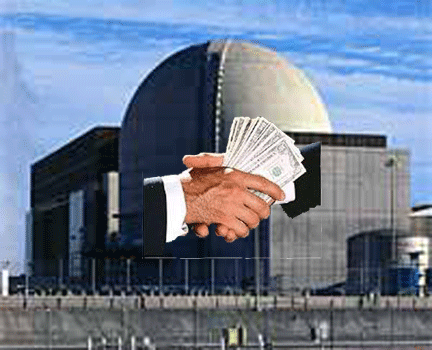
It’s heating up.
The U.S. Attorney’s Office in South Carolina also indicated more charges are coming,
And don’t forget — as a result of the federal investigation, the U.S. Securities and Exchange Commission has sued the company, Marsh and Byrne — alleging they “repeatedly deceived” investors and regulators by hiding the project’s mounting flaws.
That lawsuit is on hold as the criminal probe unfolds.
3 years later: How the fallout from SC’s $9 billion nuclear fiasco continues Post and Courier, By Avery G. Wilks and Andrew Brown awilks@postandcourier.com abrown@postandcourier.com, Jul 31, 2020
- It has been three years since two of South Carolina’s largest electric utilities abandoned their $9 billion effort to build two nuclear reactors, but the legal, political and financial consequences continue to ripple across the Palmetto State.
The scuttled V.C. Summer expansion in Fairfield County is now widely considered one of the biggest business failures in the state’s history. The announcement of the project’s cancellation on July 31, 2017, shook South Carolina’s power industry, state government and business community.
The two homegrown S.C. utilities that partnered on the project were thrown into disarray. Investigations were initiated by state lawmakers, financial regulators and federal law enforcement officials.
The state and federal court systems were flooded overnight with lawsuits by investors, ratepayers, construction workers and lenders. The state regulatory system that backed the project for nearly a decade was called into question.
And more than 1.7 million utility customers with S.C. Electric & Gas, Santee Cooper and the state’s 19 local electric cooperatives realized they might be forced to pay billions of dollars more for a power plant that will never produce a watt of electricity.
Much has changed since Santee Cooper and SCE&G’s leaders suddenly announced the project’s collapse. But the saga isn’t over quite yet. Here is a breakdown of where things stand. Continue reading
Global sea level rise: we need to start planning now
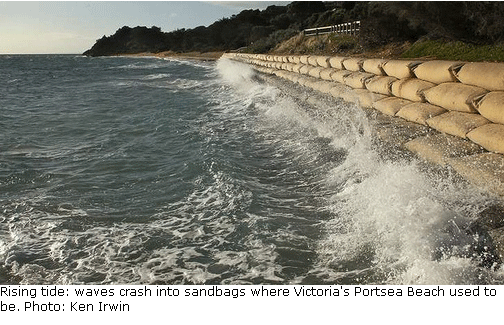 RISING GLOBAL FLOOD RISK DEMANDS ACTION, PURSUIT, 31 Jul 20,
By the end of the century tens of millions more people and trillions of dollars more of the world economy will be at risk of being flooded as sea levels rise We know climate change will cause rising sea levels and increase the frequency of storms and extreme waves, putting large stretches of land at greater risk of flooding. But just how bad will it be?
It is the sort of question that has long frustrated strong policy action on countering and mitigating climate change……
In what is the most comprehensive effort yet to assess the global risks of rising sea levels, researchers have now estimated that in the next 80 years the flood risk across the world will rise by around 50 per cent, putting millions more people and trillions of US dollars more of infrastructure at risk.
In addition, by 2100, extreme floods now thought of as being one-in-100-year events, will be occurring as frequently as every 10 years across much of the world – an increased risk of ten times.
According to the University of Melbourne-led study now published in Nature: Scientific Reports, the land area exposed to an extreme one-in-100-year flood event will increase by more than 250,000 square kilometres, an increase of 48 per cent to over 800,000 square kilometres.
In concrete terms the study’s estimates translate into about 77 million more people being at risk of experiencing flooding, a rise of 52 per cent to 225 million.
The economic risk in terms of the infrastructure exposed will rise by $US3.5 trillion, an increase of 46 per cent to $US11.3 trillion…….
According to the University of Melbourne-led study now published in Nature: Scientific Reports, the land area exposed to an extreme one-in-100-year flood event will increase by more than 250,000 square kilometres, an increase of 48 per cent to over 800,000 square kilometres.
In concrete terms the study’s estimates translate into about 77 million more people being at risk of experiencing flooding, a rise of 52 per cent to 225 million.
The economic risk in terms of the infrastructure exposed will rise by $US3.5 trillion, an increase of 46 per cent to $US11.3 trillion………..
It’s showing that whole coastal communities are at risk of being devastated so we need urgent action.
“Curbing rising greenhouse gases is critical, but much of the predicted sea level rise is already baked-in – it will happen irrespective of what happens with greenhouse gases. So we need to adapt.
“This may mean building coastal defences like those already undertaken in the Netherlands. In other locations it may involve retreating populations from coastal areas.”
And Ms Kireczi notes that like many of the consequences of climate change, some low and middle income countries (LMICs) are particularly exposed.
For example, major populations in South-east and South Asia are at risk. But major populations in wealthier regions are also at risk including parts of China, Northern Europe and the United States.
“We need to start planning now the long-term investments in coastal defences, like dykes and sea walls, that we are going to need to protect vulnerable populations and assets.” https://pursuit.unimelb.edu.au/articles/rising-global-flood-risk-demands-action
Heat shuts down nuclear reactors in France

 EDF warns heatwave may force brief outage for 2.6 GW Golfech reactors, S and P Global, London — Rising temperatures may lead to output restrictions at France’s 2.6 GW Golfech nuclear power plant from July 31, operator EDF warned. “Due to the temperature forecasts on the Garonne, production restrictions are likely to affect EDF’s nuclear power plant at Golfech,” it said July 27. 28 Jul 2020 Author Andreas Franke , Editor Felix Fernandez
HIGHLIGHTS
Restrictions focus on July 31 to August 3 period.
Mini-heatwave only forecast to last until weekend
July’s nuclear average above expectations at 30 GW
London — Rising temperatures may lead to output restrictions at France’s 2.6 GW Golfech nuclear power plant from July 31, operator EDF warned.
“Due to the temperature forecasts on the Garonne, production restrictions are likely to affect EDF’s nuclear power plant at Golfech,” it said July 27.
This could lead to “unavailability of both units” until August 2.
France’s most southerly reactors, located between Toulouse and Bordeaux on the Garonne river, were some of the most impacted units during an extended heatwave last summer when air temperatures rose above 40 C in late June.
The current spell of hot weather is not forecast to stretch beyond the weekend with Meteo France not yet characterizing it as heatwave despite measuring the highest temperature so far this year at nearby Albi at 39.9 C on July 27.
In 2019, temperatures briefly peaked in late June above 40 C amid extended spells of extreme hot weather, increasing river temperatures above critical levels.
Grid operator RTE forecasts power demand to peak above 55 GW on July 31 with average weighted temperatures 7 C above norms.
In June 2019, French demand spiked close to record summer highs of 59.5 GW as temperatures reached 45 C in some regions of southern France.
Around two-thirds of France’s 56 reactor units are river-cooled, with some restrictions due to high temperatures stretching into autumn during past summers…. https://www.spglobal.com/platts/en/market-insights/latest-news/electric-power/072820-edf-warns-heatwave-may-force-brief-outage-for-26-gw-golfech-reactors.
Big doubts about the future of nuclear energy in the UK

 Ministers challenged on future of UK nuclear energy
Industry dogged by doubts about China and rise of renewables calls for clarity, Ft.com, Harry Dempsey in Somerset and David Sheppard in London 31 Jul 20,
Safety concerns about the rush to put nuclear reactors on the moon
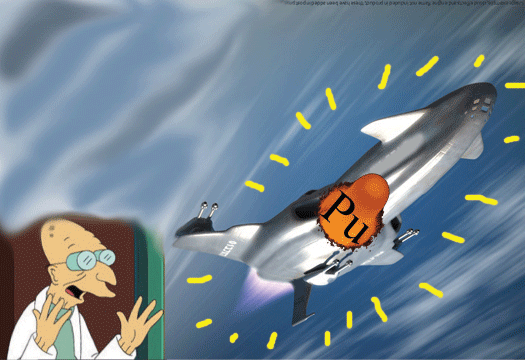 America Wants to Put a Nuclear Power Plant on the Moon
What happens to all that highly enriched uranium in space? Popular Mechanics, BY CAROLINE DELBERT, JUL 30, 2020
- The U.S. Department of Energy (DoE) is looking for technology partners to help power the moon.
- This could begin a project that later includes powering a Mars surface mission.
- The Union for Concerned Scientists doesn’t want highly enriched uranium in space.
Scientists at the U.S. Department of Energy’s (DoE) Idaho National Laboratory have a new design for a nuclear power plant they say could allow humans to more easily live on the moon. As part of a form plan, the scientists say they want to have the fission reactor, safe launch, and landing system ready by 2027
What are the challenges of generating nuclear energy on the moon?
Design Development Today reports that the Union of Concerned Scientists expressed, well, concerns:
“Edwin Lyman, director of Nuclear Power Safety at the Union of Concerned Scientists, a nonprofit, said his organization is concerned the parameters of the design and timeline make the most likely reactors those that use highly enriched uranium, which can be made into weapons. Nations have generally been attempting to reduce the amount of enriched uranium being produced for that reason.”
While the Idaho National Laboratory and the DoE broadly are pushing for “advanced” reactor technology in terms of issues like modularity and safety, the “parameters of the design and timeline” they refer to—in this case advocating for a small, reliable, space-friendly design in just 6 years—almost definitely rules out the modular reactors being developed and certified now.
To fully test and regulate these reactors—and design the special edition to send to the moon in this timeframe—is probably impossible. To rush any nuclear approval is a terrible idea, not just for safety, but also for a public that’s already shy about nuclear energy.Technology like thorium fuel is still far from ready for the market….
Drones could be a real danger to nuclear facilities

What Happens When A Drone Comes For A Nuclear Reactor? Forbes, Kelsey D. Atherton, 31 Juky 20.
How seriously, exactly, should a nuclear reactor take the threat from a quadcopter?
This question sits at the center of a long investigation by The War Zone, built upon a trove of documents about a curious pair of incidents in September 2019. As the authors report:How seriously, exactly, should a nuclear reactor take the threat from a quadcopter?
This question sits at the center of a long investigation by The War Zone, built upon a trove of documents about a curious pair of incidents in September 2019. As the authors report:
The observed drone flights on September 29th were followed by multiple reported sightings on the night of September 30th. The full tale, about what action was taken, and what risks were prioritized, is worth reading in full, as it gives a deep sense of prioritization and uncertainty in the face of novel concern.
No more Hiroshima! No more Nagasaki! — limitless life
July 2020 We Hibakusha [A-bomb survivors] call the atomic bombs ‘weapons of the devil.’ We cannot allow even a single bomb to exist on this planet…. The pain of the victims of that day must not be forgotten. […]
No more Hiroshima! No more Nagasaki! — limitless life
Victoria delays setting interim emissions targets, again, as Covid digs in — RenewEconomy

Victoria Labor delays for a second time its decision on interim emissions reduction targets for the state, citing focus on curbing the spread of Coronavirus. The post Victoria delays setting interim emissions targets, again, as Covid digs in appeared first on RenewEconomy.
Victoria delays setting interim emissions targets, again, as Covid digs in — RenewEconomy
Australia’s two renewable export mega-projects say there is room for both, and more — RenewEconomy

Australia’s two largest renewable energy export projects, planning 25GW of wind and solar between them, see the growing Asian market as more than big enough for both. The post Australia’s two renewable export mega-projects say there is room for both, and more appeared first on RenewEconomy.
Australia’s two renewable export mega-projects say there is room for both, and more — RenewEconomy
Market operator’s 20-year transition plan remains an orphan without Taylor’s backing — RenewEconomy

AEMO’s Integrated System Plan is a fine piece of work, but may lack bite in the absence of support from Angus Taylor, and with Australia’s backward regulatory regime. The post Market operator’s 20-year transition plan remains an orphan without Taylor’s backing appeared first on RenewEconomy.
Market operator’s 20-year transition plan remains an orphan without Taylor’s backing — RenewEconomy
1 This month
15 April – Zoom –Nuclear Power is Not the Solution
Apr 15, 2026 01:00 AM in Canberra, Melbourne, Sydney

Join the International Physicians for the Prevention of Nuclear War (IPPNW) on Tuesday, April 14th for a timely webinar exploring the risks associated with nuclear power and challenging the myth that it offers a simple, safe, carbon-free solution to the climate crisis

21 April Webinar: No Nuclear Weapons in Australia
Start: 2026-04-21 18:00:00 UTC Canberra, Melbourne, Sydney (GMT+10:00)
End: 2026-04-21 19:30:00 UTC Canberra, Melbourne, Sydney (GMT+10:00)
Event Type: Virtual
A virtual link will be communicated before the event.
Host Contact Info: australia@icanw.org

of the week – Australians for War Powers Reform (AWPR)
To see nuclear-related stories in greater depth and intensity
 Antinuclear