No. The U.S. did not need to drop a second nuclear bomb on Japan
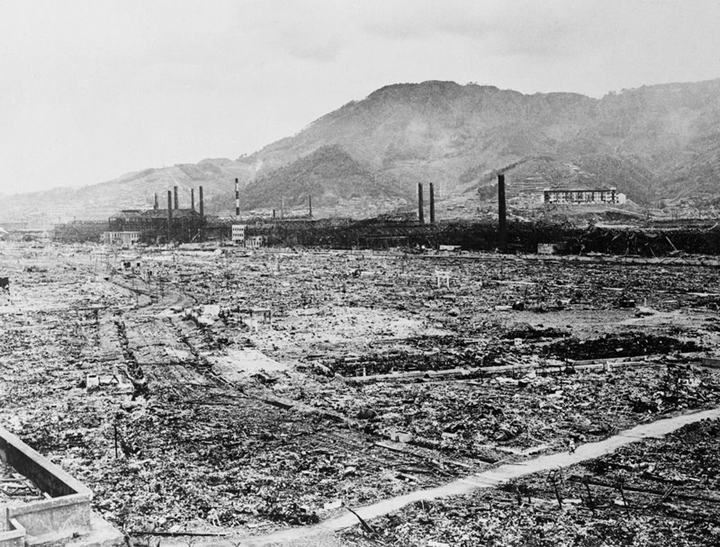 Did the U.S. Need to Drop a Second Atomic Bomb on Japan? NEWSWEEK, BY DAVID BRENNAN ON 8/9/20 “……… The atomic bombings of Hiroshima and Nagasaki together killed somewhere between 129,000 and 226,000 people, the vast majority of them civilians. Then, it was argued that the bombs were the only way to defeat the forces of Imperial Japan, which were fighting tooth and nail for every inch of Japanese territory against the Allies……… Did the U.S. Need to Drop a Second Atomic Bomb on Japan? NEWSWEEK, BY DAVID BRENNAN ON 8/9/20 “……… The atomic bombings of Hiroshima and Nagasaki together killed somewhere between 129,000 and 226,000 people, the vast majority of them civilians. Then, it was argued that the bombs were the only way to defeat the forces of Imperial Japan, which were fighting tooth and nail for every inch of Japanese territory against the Allies………This has remained the dominant view through most of the post-war era, even with the shifting debate on whether the bombings constituted war crimes. …….
But not everyone agrees that the bombs were necessary. Miyako Taguchi is the daughter of two atomic bomb survivors—known as hibakusha—who lived in Nagasaki at the end of the war. Now living in New York, she told Newsweek that she grew up some 30 minutes walk from ground zero.
Even as a child she felt nervous about the incident and recalled how big a role it played in Nagasaki’s culture and story. Taguchi even remembers how the city’s hot, humid summer days would make her think of the unimaginable heat of an atomic blast and how it must have felt for those caught in it. As she got older, Taguchi said she better understood what happened to her family’s home town and the horrors that befell them—horrors that her family members were reluctant to recall. As the anniversary approaches each year, she said these feelings resurface. Taguchi told Newsweek that the bombing was “inhuman,” regardless of arguments about the lives that the attacks hypothetically saved elsewhere. When hearing people advocate for the bombs, Taguchi said she struggles to control her temper. ……. by explaining her family’s experience Taguchi said she hopes she can make some people reconsider their assumption that the attack was necessary. “It’s very difficult to change other people’s minds,” she said, especially when they know little about what really happened on that fateful day….. the Soviet Union declared war on Japan at midnight on August 8, 1945—hours before Nagasaki was destroyed. More than the atomic bombs, the Soviet entry into the war against Japan was the final nail in Tokyo’s coffin, according to Tsuyoshi Hasegawa—a Japanese-American historian who is an expert in Soviet Russian and Japanese history. Hasegawa noted that Japanese leaders were seeking Soviet mediation for talks with the U.S. during the closing stages of the war, even after the first atomic bomb killed tens of thousands of people in Hiroshima. “The Hiroshima bomb did not change Japanese policy to seek mediation,” Hasegawa told Newsweek. “So in that sense that was not the decisive factor… I would say that the Soviets entering the war was a more decisive factor.” “The Soviet Union was the last hope for the Japanese government to terminate the war,” he added. “That hope was totally dashed.” Had the Soviets not entered the war, “I think the Japanese government would have continued to seek mediation from Moscow.” Emperor Hirohito took the “sacred decision” to surrender early in the morning of August 10, military and political leaders having met throughout August 9 following the Soviet entry into the war. The emperor informed citizens of the surrender on August 15. Hasegawa said that the Nagasaki bomb did not dominate the emperor’s decision, as the full extent of the damage and casualties were not known until August 10. The Nagasaki explosion was contained in the Urakami Valley, protecting the parts of the city spread across the nearby hills including the city’s civil defence headquarters which sent out the first reports of the explosion. “The extent of the damage of Nagasaki was not properly reported to Tokyo throughout August 9,” Hasegawa said. Another theory for both atomic bombs is that while they were not necessarily needed to defeat Japan, U.S. leaders wanted to show the Soviet Union what their weapons of mass destruction could do……… Hasegawa said the accepted history of the atomic bombs in the U.S.—and much of the Western world—argues that both bombs were necessary to bring Japan to its knees. It gained popularity and acceptance, he believes, for psychological reasons. “The use of atomic bombs really, really bothered the conscience of Americans—it’s a psychological factor,” he said. “They really wanted to believe that what we did, the terrible thing that we did was necessary.” Hasegawa also said that the prevailing history of the war has been too U.S.-centric, allowing American explanations to take root with little challenge. Many American scholars treat the Soviet Union factor as a sort of “side show,” he said, and write the history of the atomic bombs with little attention given to the Japanese decision making process. https://www.newsweek.com/second-atomic-bomb-hiroshima-1523608 |
|
|
No comments yet.
1 This month

of the week – Australians for War Powers Reform (AWPR)
To see nuclear-related stories in greater depth and intensity
 Antinuclear
Leave a comment