Australia a leader in the worst sense – biodiversity loss and risk of ecosystem collapse

Fifth of countries at risk of ecosystem collapse, analysis finds https://www.theguardian.com/environment/2020/oct/12/fifth-of-nations-at-risk-of-ecosystem-collapse-analysis-finds
Trillions of dollars of GDP depend on biodiversity, according to Swiss Re report, Damian Carrington Environment editor @dpcarrington, Mon 12 Oct 2020 .One-fifth of the world’s countries are at risk of their ecosystems collapsing because of the destruction of wildlife and their habitats, according to an analysis by the insurance firm Swiss Re.
Natural “services” such as food, clean water and air, and flood protection have already been damaged by human activity.
More than half of global GDP – $42tn (£32tn) – depends on high-functioning biodiversity, according to the report, but the risk of tipping points is growing.
Countries including Australia, Israel and South Africa rank near the top of Swiss Re’s index of risk to biodiversity and ecosystem services, with India, Spain and Belgium also highlighted. Countries with fragile ecosystems and large farming sectors, such as Pakistan and Nigeria, are also flagged up.
Countries including Brazil and Indonesia had large areas of intact ecosystems but had a strong economic dependence on natural resources, which showed the importance of protecting their wild places, Swiss Re said.
“A staggering fifth of countries globally are at risk of their ecosystems collapsing due to a decline in biodiversity and related beneficial services,” said Swiss Re, one of the world’s biggest reinsurers and a linchpin of the global insurance industry.
“If the ecosystem service decline goes on [in countries at risk], you would see then scarcities unfolding even more strongly, up to tipping points,” said Oliver Schelske, lead author of the research.
Jeffrey Bohn, Swiss Re’s chief research officer, said: “This is the first index to our knowledge that pulls together indicators of biodiversity and ecosystems to cross-compare around the world, and then specifically link back to the economies of those locations.”
The index was designed to help insurers assess ecosystem risks when setting premiums for businesses but Bohn said it could have a wider use as it “allows businesses and governments to factor biodiversity and ecosystems into their economic decision-making”.
The UN revealed in September that the world’s governments failed to meet a single target to stem biodiversity losses in the last decade, while leading scientists warned in 2019 that humans were in jeopardy from the accelerating decline of the Earth’s natural life-support systems. More than 60 national leaders recently pledged to end the destruction.
The Swiss Re index is built on 10 key ecosystem services identified by the world’s scientists and uses scientific data to map the state of these services at a resolution of one square kilometre across the world’s land. The services include provision of clean water and air, food, timber, pollination, fertile soil, erosion control, and coastal protection, as well as a measure of habitat intactness.
Those countries with more than 30% of their area found to have fragile ecosystems were deemed to be at risk of those ecosystems collapsing. Just one in seven countries had intact ecosystems covering more than 30% of their country area.
Among the G20 leading economies, South Africa and Australia were seen as being most at risk, with China 7th, the US 9th and the UK 16th.
Alexander Pfaff, a professor of public policy, economics and environment at Duke University in the US, said: “Societies, from local to global, can do much better when we not only acknowledge the importance of contributions from nature – as this index is doing – but also take that into account in our actions, private and public.”
Pfaff said it was important to note that the economic impacts of the degradation of nature began well before ecosystem collapse, adding: “Naming a problem may well be half the solution, [but] the other half is taking action.”
Swiss Re said developing and developed countries were at risk from biodiversity loss. Water scarcity, for example, could damage manufacturing sectors, properties and supply chains.
Bohn said about 75% of global assets were not insured, partly because of insufficient data. He said the index could help quantify risks such as crops losses and flooding.
Michelle Fahy blows open the disgraceful collusion between Australian politicians and weapons industries
|
Sweeping policy changes by the Coalition, including bringing the military industry into the centre of defence planning and a 2018 strategy to catapult Australia into the world’s top 10 of weapons exporting nations, created a business bonanza in the military industry. The Turnbull government allocated $195 billion towards upgrading Australia’s military capability (since increased to $270 billion). Extraordinary amounts of money. When combined with the fundamental undeclared, and undealt with, conflicts of interest that have now become routine in Australia’s defence sector, the potential for corruption has increased markedly. Conflicts of interest have become entrenched because of the close integration of military industry interests with government policy. Corporate influence on government policy has been cultivated for years by a phenomenon at which the arms trade excels: the revolving door. This is how the revolving door works. Defence-related politicians and public officials and military personnel are regularly offered high-level, high-paying positions with weapons companies upon retirement. This provides a strong incentive for those in public service, with an eye to their future, to seek the best interests of these companies. Military industry executives in turn are welcomed into government as experts, consultants and employees. Legalised corruption of democracy? Corruption is defined as “the abuse of entrusted power for private gain, be it grand, petty, or political corruption” in the 2019 Australian research report, Governing for Integrity. The report says ‘undue influence’ is a marker for corruption, and that undue influence and the ‘revolving door’ are two key problems “eroding public confidence in parliamentarians and ministers, and weakening the fundamentals of democracy”. Take the case of former defence minister Christopher Pyne, who discussed his future with EY Defence while still in parliament, then nine days after leaving politics accepted a position with them. Pyne now also runs his own lobbying firm, lectures as an ‘industry professor’ at the University of South Australia, and is chair of the advisory board and investment committee of a new investment fund promoting high returns via investment in selected defence and cyber stocks. Pyne’s post-politics career made a mockery of the ministerial standards and lobbying rules and led to a senate inquiry, which included former foreign minister Julie Bishop, who only months after leaving parliament joined the board of multinational aid contractor Palladium. The revolving door yet again exposed the parliament’s unwillingness to manage risk factors for corruption, further eroding public confidence in the integrity of our political system. As noted by Transparency International Australia in its submission to the senate inquiry, it is quite the “culture of cosiness”. Although a particularly egregious case, Pyne isn’t the only former defence minister to have used the revolving door. The Liberals’ Peter Reith left his ministerial desk and popped up a few days later at Tenix, then Australia’s largest defence contractor. EY also secured the services of Labor’s Kim Beazley within a year of his political departure, along with former Labor defence minister Stephen Smith. Beazley joined the board of Lockheed Martin in between his public roles as US Ambassador and WA Governor. (The job description and the budget of the WA Governor has been expanded to enable Beazley to advocate for defence industry.) After a three-year association with EY, Smith has recently accepted directorships with cyber security companies ArchTIS and Sapien Cyber. Meanwhile, former Liberal David Johnston is being paid $3,000 a day for up to 180 days a year as the federal government’s chief weapons industry advocate, while sitting on the board of Saab Technologies (a significant contractor to the Defence Department). Brendan Nelson, a former Liberal party leader, defence minister and director of the Australian War Memorial, is now with Boeing (a multibillion-dollar contractor to Defence). Nelson’s move to Boeing was announced in January 2020, just a few weeks after his departure from the war memorial, a tenure that caused controversy given Nelson’s pursuit of sponsorship from arms manufacturers. (In Nelson’s final appearance at senate estimates in October 2019 he highlighted Boeing’s $1 million sponsorship of the memorial.) Nelson also raised eyebrows in March 2019 when his entry on the foreign influence transparency register revealed he had been on Thales Australia’s “advisory board” since March 2015. Thales is a global top 10 arms manufacturer, a multibillion-dollar contractor to Defence, and a sponsor of the war memorial. Then veterans affairs minister Michael Ronaldson approved Nelson’s extracurricular activity while noting the potential for conflict of interest. Nelson countered public concerns by saying he donated the fees he received to the war memorial. Current minister Linda Reynolds was briefly employed by missile-maker Raytheon in between military and political jobs in her pre-senate career. Politicians attract almost all the attention for using revolving door, but they aren’t the only ones using it. Privileged accessConsider the appointment to the Thales Australia board of former ASIO boss Duncan Lewis in February 2020, just five months after he left ASIO. The appointment attracted almost no attention. While the Sydney Morning Herald noted the appointment, no hard questions were asked and no analysis provided of Lewis’s swift move into an industry over which he had had oversight. Lewis had spent five years as ASIO’s Director-General, his final public role in a long career of public service that spanned the military (commander of special forces), the departments of the prime minister and cabinet and defence, as well as diplomatic roles (including as Australia’s ambassador to NATO)……… Weapons CEO moves into public serviceThe revolving door also ushers former weapons industry executives into public sector roles. Jim McDowell is a good example. After 17 years with BAE, the world’s sixth largest weapons-maker, including 10 years as chief executive of BAE Systems Australia, McDowell returned to Australia in December 2013 from his post in Saudia Arabia as the company’s chief executive and was immediately appointed to the board of the Australian Nuclear Science and Technology Organisation. He became ANSTO’s chair in August 2014. For the next four years while with ANSTO he also undertook numerous influential consulting roles with the Defence Department. (More details here.)…….. McDowell was chancellor of the University of South Australia (which has close links with military industry) and was on the board of numerous companies in the military industrial sector …… Part 2: There’s been plenty of talk about enhancing military capability but nothing about enhancing defence’s anti-corruption practices . https://www.michaelwest.com.au/culture-of-cosiness-colossal-conflicts-of-interest-in-defence-spending-blitz/ |
|

We’ve had so many wins’: why the green movement can overcome climate crisis

We’ve had so many wins’: why the green movement can overcome climate crisis
Leaded petrol, acid rain, CFCs … the last 50 years of environmental action have shown how civil society can force governments and business to change, Guardian, by Fiona Harvey Environment correspondent, Mon 12 Oct 2020
Leaflets printed on “rather grotty” blue paper. That is how Janet Alty will always remember one of the most successful environment campaigns of modern times: the movement to ban lead in petrol.
There were the leaflets she wrote to warn parents at school gates of the dangers, leaflets to persuade voters and politicians, leaflets to drown out the industry voices saying – falsely – there was nothing to worry about.
In the late 1970s, the UK was still poisoning the air with the deadly toxin, despite clear scientific evidence that breathing in lead-tainted air from car exhausts had an effect on development and intelligence. Recently returned from several years in the US, Alty was appalled. Lead had been phased out in the US from 1975. Why was the British government still subjecting children to clear harm?
Robin Russell-Jones asked the same question. A junior doctor, he quickly grasped the nature of the lead problem, moving his family out of London. His fellow campaigner, Robert Stephens, amassed a trove of thousands of scientific papers, keeping them in his garage when his office burned down – he suspected foul play.
Their campaign took years. But in 1983, a damning verdict from the Royal Commission on Environmental Pollution prompted the UK government to decree that both petrol stations and manufacturers must offer lead-free alternatives. Leaded petrol was finally removed from the last petrol pumps in the UK in 1999.
Today, it seems incredible that lead was ever used as a performance improver in car engines. Clean alternatives were available by the 1970s, but making the transition incurred short-term costs, so the motor industry, led by chemicals companies, clung on, lobbying politicians and ridiculing activists.
Faced with multiplying, and interlinked, environmental crises in the 2020s – the climate emergency, the sixth extinction stalking the natural world, the plastic scourge in our oceans, the polluted air of teeming metropolises – it is easy to feel overwhelmed. Lockdown offered a tantalising glimpse of a cleaner world, but also revealed a starker truth: that the global economy is not set up to prioritise wellbeing, climate and nature. What can we do, in the face of these devastating odds?
It is easy to forget that environmentalism is arguably the most successful citizens’ mass movement there has been. Working sometimes globally, at other times staying intensely local, activists have transformed the modern world in ways we now take for granted. The ozone hole has shrunk. Whales, if not saved, at least enjoy a moratorium on hunting. Acid rain is no longer the scourge of forests and lakes. Rivers thick with pollution in the 1960s teem with fish. Who remembers that less than 30 years ago, nuclear tests were still taking place in the Pacific? Greenpeace’s Rainbow Warrior ship was blown up by the French government in 1985, with one death and many injuries, in a long-running protest.
Unease in USA over Trump’s authority to launch nuclear war
 Trump’s Virus Treatment Revives Questions About Unchecked
 Nuclear Authority
Even before the president was given mood-altering drugs, there was a movement to end the commander in chief’s sole authority to launch nuclear weapons. NYT, By David E. Sanger and William J. Broad, 12 Oct 20,
President Trump’s long rants and seemingly erratic behavior last week — which some doctors believe might have been fueled by his use of dexamethasone, a steroid, to treat Covid-19 — renewed a long-simmering debate among national security experts about whether it is time to retire one of the early inventions of the Cold War: the unchecked authority of the president to launch nuclear weapons. Continue reading
Study shows that renewable energy is clearly better that nuclear at cutting greenhouse emissions
 25-Year Study of Nuclear vs Renewables Says One Is Clearly Better at Cutting Emissions, Science Alert, DAVID NIELD 11 OCTOBER 2020
Nuclear power is often promoted as one of the best ways to reduce our reliance on fossil fuels to generate the electricity we need, but new research suggests that going all-in on renewables such as wind and solar might be a better approach to seriously reducing the levels of carbon dioxide in the atmosphere.
Based on an analysis of 123 countries over a quarter of a century, the adoption of nuclear power did not achieve the significant reduction in national carbon emissions that renewables did – and in some developing nations, nuclear programmes actually pushed carbon emissions higher.
The study also finds that nuclear power and renewable power don’t mix well when they’re tried together: they tend to crowd each other out, locking in energy infrastructure that’s specific to their mode of power production.
Given nuclear isn’t exactly zero carbon, it risks setting nations on a path of relatively higher emissions than if they went straight to renewables….
It’s important to note that the study looked specifically at data from 1999-2014, so it excludes more recent innovations in nuclear power and renewables, and the scientists themselves say they have found a correlation, rather than cause and effect. But it’s an interesting trend that needs further investigation.
“The evidence clearly points to nuclear being the least effective of the two broad carbon emissions abatement strategies, and coupled with its tendency not to co-exist well with its renewable alternative, this raises serious doubts about the wisdom of prioritising investment in nuclear over renewable energy,” says Benjamin Sovacool, a professor of energy policy at the University of Sussex in the UK.
“Countries planning large-scale investments in new nuclear power are risking suppression of greater climate benefits from alternative renewable energy investments.”
The researchers suggest the tighter regulations and longer lead times associated with nuclear power are responsible for some of the statistics explored here, while the large-scale development that nuclear requires tends to leave less room for renewable projects that work on a smaller scale.
There are also broader considerations to weigh up – nuclear and renewables will be two factors among many in the policies put together by governments when it comes to reducing carbon emissions.
Plus, given the time frame, a lot of the nuclear power plants covered by this study are likely to have been getting towards the end of their lifespans, which means more energy is required to maintain them.
Whatever the ins and outs of the nuclear policies, the study does show a clear link between greater adoption of renewable projects and lower carbon emissions overall.
The study authors propose that by cutting out nuclear altogether, these renewable gains could be even greater.
This paper exposes the irrationality of arguing for nuclear investment based on a ‘do everything’ argument,” says researcher for technology policy Andrew Stirling at the University of Sussex.
“Our findings show not only that nuclear investments around the world tend on balance to be less effective than renewable investments at carbon emissions mitigation, but that tensions between these two strategies can further erode the effectiveness of averting climate disruption.”………..
it is astonishing how clear and consistent the results are across different time frames and country sets,” says Patrick Schmid, from the ISM International School of Management in Germany.
“In certain large country samples the relationship between renewable electricity and CO2-emissions is up to seven times stronger than the corresponding relationship for nuclear.”
The research has been published in Nature Energy. https://www.sciencealert.com/here-s-why-nuclear-won-t-cut-it-if-we-want-to-drop-carbon-as-quickly-as-possible
Small modular nuclear reactors create intensely radioactive wastes
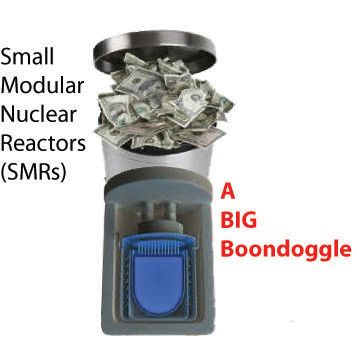 A bridge to nowhere New Brunswick must reject small modular reactors, Beyond Nuclear International, By Gordon Edwards and Susan O’Donnell, 12 Oct, 20 ”……… In New Brunswick, the proposed new reactors (so-called “small modular nuclear reactors” or SMNRs) will create irradiated fuel even more intensely radioactive per kilogram than waste currently stored at NB Power’s Point Lepreau Nuclear Generating Station. The non-fuel radioactive wastes will remain the responsibility of the government of New Brunswick, likely requiring the siting of a permanent radioactive waste repository somewhere in the province.
Interestingly, promoters of both new nuclear projects in New Brunswick – the ARC-100 reactor and the Moltex “Stable Salt Reactor” – claim their reactors will “burn up” these radioactive waste fuel bundles. They have even suggested that their prototype reactors offer a “solution” to Lepreau’s existing nuclear fuel waste problem. This is untrue. Radioactive left-over used fuel from the new reactors will still require safe storage for hundreds of thousands of years.
……… Until now, every effort to recycle and “burn up” used reactor fuel – in France, the UK, Russia and the US – has resulted in countless incidents of radioactive contamination of the local environment. In addition, none of these projects eliminated the need for permanent storage of the left-over long-lived radioactive byproducts, many of which cannot be “burned up.”…….
The nuclear waste problem is not going away. The recent letter from more than 100 groups across Canada, and the recent cancellation of the proposed nuclear waste dump in Ontario have shown that significant opposition to new nuclear energy generation exists. Because producing nuclear energy always means producing nuclear waste as well……. https://beyondnuclearinternational.org/2020/10/12/a-bridge-to-nowhere/,
Resisting nuclear colonialism on Indigenous Peoples’ Day
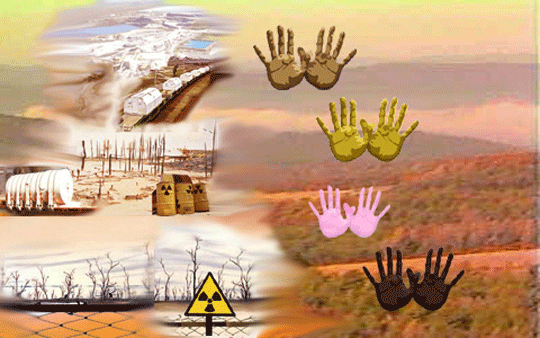
Resisting nuclear colonialism on Indigenous Peoples’ Day | NIRS The resistance of Indigenous peoples and their allies has created greater awareness about abuses and injustices that have been perpetrated against Native peoples since European empires colonized their lands. This is one of the reasons why NIRS commemorates this day as Indigenous Peoples’ Day.
As an anti-nuclear organization, we take Indigenous Peoples’ Day as an opportunity to acknowledge and denounce instances of nuclear colonialism committed against Indigenous peoples all over the world.
For over 70 years, the US nuclear power and weapons industry has consistently targeted Indigenous communities for contamination and environmental sacrifice. The radioactive scars of nuclear colonialism affect Indigenous peoples throughout the lands of Turtle Island (also called North America) and the Pacific Islands occupied by the United States of America, including:
Over 15,000 abandoned uranium mines, affecting Indigenous nations throughout the continent, including the Apache, Dine (Navajo), Lakota, Pueblo, and Sioux. Over 200 above-ground nuclear weapons explosions (and nearly 800 below-ground) affecting the Western Shoshone, Apache, Pacific Islanders (Marshall Islands, Northern Marianas, and Guam), and others. The 1979 Church Rock uranium tailings spill, the US’s worst nuclear disaster, which poisoned Dine (Navajo) communities for nearly 100 miles of the Rio Puerco and upper Rio Grande and has never been cleaned up. The West Valley Demonstration Project reprocessing plant, an immensely radioactive site on Seneca Nation land, which has contaminated Cattaraugus Creek and risks spilling into Lake Erie, the Niagara River, and Lake Ontario. Repeated attempts to site a high-level radioactive waste repository for the whole US nuclear power and weapons industries in Yucca Mountain (Nevada), sacred land of the Western Shoshone. A proposed nuclear waste burial ground in West Valley, California, on sacred homelands of the Chemehuevi, Cocopah, Fort Mojave, Quechan and Colorado River Indian Tribes A 1990s program that targeted Native tribes/nations as possible supposedly ‘interim’ storage places for nuclear power high-level radioactive waste.How can we start making things right for the Indigenous victims of nuclear colonialism? Here’s a step in the right direction: Acknowledging and compensating the victims of the first nuclear weapons test in the US, called ‘Trinity’, and workers poisoned by mining and processing uranium for nuclear weapons and power. Those communities, disproportionately Indigenous peoples, are still living with the fallout from Trinity and over 200 similar nuclear weapons tests—and decades of uranium mines, mills, and spills. Too many of them have never been recognized or compensated for their decades of pain and suffering.
In 1990, Congress passed a law meant to compensate victims of atomic bomb testing, but it doesn’t go nearly far enough and will expire in 2022. A bill in the House of Representatives—H.R.3783, the Radiation Exposure Compensation Act Amendments of 2019—would expand compensation more fully to more of those affected by the tests and uranium extraction. But Rep. Jerrold Nadler, chair of the House Judiciary Committee, hasn’t even scheduled a hearing for the bill yet.
The communities that live downwind from nuclear test sites (“Downwinders”) really need our support right now. Whether you’ve already written your member of Congress about this or not, they need to hear urgently from you now. Tell your member of Congress to ask Jerrold Nadler and Rep. Jim Jordan (the committee’s Republican ranking member) to schedule a hearing for this bill.
If our elected leaders truly care about the rights and sovereignty of our Indigenous relatives, they must take action to repair the harms of nuclear colonialism.
We grieve for the victims of the Trinity test and all other instances of nuclear colonialism. But we can do more. We can start setting things right. Compensating the Downwinders and uranium workers is an essential step in the right direction.
The post Resisting nuclear colonialism on Indigenous Peoples’ Day appeared first on NIRS.
Litigation: a promising new way to address Australia’s climate inaction
The pandemic lays bare a truth leaders consistently ignore: in the end, nature reigns supreme.
It ought to be worth noting that last month was Earth’s hottest September over the 140-year global temperature record, or that this year is in record territory even without an El Nino, or that warming over the past 12 months was just 0.2C below the internationally agreed “safe” limit……
The sad fact is that new temperature records have next to no impact in a world that has become hardened against climate shocks, a situation encouraged by an unholy coalition of political and corporate interests which over many decades have worked hard to obscure the true story.
As a nation, we ought to be up in arms about the Morrison government’s plans to ramp up methane extraction, based on the false claim that generating power by burning natural gas is somehow clean energy. But we’re not. It seems that in a pandemic you don’t question and don’t argue.
The pandemic is bad and generally getting worse getting worse as countries battle with competing health and economic demands. But at least, on the whole, governments recognise that COVID-19 constitutes an emergency and that urgent measures are needed to counter it.
What they don’t see is that the pandemic emergency sits within a bigger emergency. For all its devastation – and we should never downplay its impact on lives and livelihoods – in the long run we know it will end. That cannot be said about the all-enveloping catastrophe of climate change………
Litigation and divestment are two potent legal and financial levers that hold much promise. A case brought this year against the federal government promises to pull both of them.
Katta O’Donnell, a 23-year-old La Trobe University law student, grew up in Victoria’s central highlands. She experienced the impact of long-term drought on that landscape, and twice in 11 years saw it devastated by unstoppable wildfire. Last year, inspired by a lecture by Australian climate law specialist David Barnden, she decided it was time to act.
With Barnden’s help, O’Donnell filed a federal court claim alleging that the Australian government was breaching its legal duty and misleading sovereign bond investors by failing to disclose climate-driven financial risks, such as stranded fossil fuel assets and worsening environmental conditions.
In identifying a material risk to the market in government bonds everywhere, her action attracted attention globally, including in business circles in Europe and the United States alert to any sign of future financial loss.
Australia’s troubled environment, she told me last week, puts it on the front line of the climate crisis. Coral bleaching threatens Great Barrier Reef tourism, drought is lowering our capacity to grow food, and last summer’s bushfires will cost us upwards of $100 billion. Such tangible threats prompted Sweden to sell its Australian bonds last November.
The pandemic is telling us that fiscal and monetary controls, budgets and banks and all the rest of our economic constructs and artifices can’t hide the fact that it is nature, above all, that determines wealth, or its absence. We should all take that message to heart and welcome O’Donnell’s initiative as a long-overdue wakeup call. http://southwind.com.au/2020/10/13/on-trial-australias-dismal-climate-record/
Energy Renaissance names Hunter region for Australia’s first battery “gigafactory” — RenewEconomy

Energy Renaissance says it will start building $28m, solar powered Renaissance One lithium-ion battery plant within weeks in Tomago. The post Energy Renaissance names Hunter region for Australia’s first battery “gigafactory” appeared first on RenewEconomy.
Energy Renaissance names Hunter region for Australia’s first battery “gigafactory” — RenewEconomy
Deakin Uni team wins global prize for sodium batteries for low cost transport — RenewEconomy

Team of Deakin University researchers take out global business award, for plan to deploy innovative sodium batteries to electrify Indonesian transport. The post Deakin Uni team wins global prize for sodium batteries for low cost transport appeared first on RenewEconomy.
Deakin Uni team wins global prize for sodium batteries for low cost transport — RenewEconomy
October 12 Energy News — geoharvey

Science and Technology: ¶ “International Scientists Return From Arctic With Wealth Of Climate Data” • The RV Polarstern icebreaker, a ship carrying scientists on a year-long international effort to study the high Arctic, has returned to its home port in Germany carrying a wealth of data that will help researchers better predict climate change in […]
October 12 Energy News — geoharvey
FRV lands “green loan” to finance 90MW solar project in NSW — RenewEconomy

FRV lands “green loan” from ING to finance new 90MW solar farm in NSW. The post FRV lands “green loan” to finance 90MW solar project in NSW appeared first on RenewEconomy.
FRV lands “green loan” to finance 90MW solar project in NSW — RenewEconomy
“Take Science Seriously and Value Ethics Greatly”: Health Effects of Fukushima Nuclear Disaster — Fukushima 311 Watchdogs

Interview with Hisako Sakiyama, M.D. & Ph.D. by Katsuya Hirano & Hirotaka Kasai Translated by Akiko Anson October 1, 2020 Introduction Hisako Sakiyama has a PhD in Medicine and is a Member of the Takagi School of Alternative Scientists, a Japanese NGO established in 1998 to study the environment, nuclear issues, human rights, and other […]
“Take Science Seriously and Value Ethics Greatly”: Health Effects of Fukushima Nuclear Disaster — Fukushima 311 Watchdogs
Japan diver reflects on unsung workers exposed to radiation as Fukushima 10th anniv. Looms — Fukushima 311 Watchdogs

Hisashi Okazaki is seen doing diving work at the Fukushima Daiichi Nuclear Power Plant’s No. 3 reactor in May 2006, in this image provided by Okazaki. October 11, 2020 Have you ever heard of atomic divers? Hisashi Okazaki, 58, who has worked at nuclear power plants as a diver while being exposed to radiation, wants […]
Japan diver reflects on unsung workers exposed to radiation as Fukushima 10th anniv. Looms — Fukushima 311 Watchdogs
Decision looms for Japan on dumping Fukushima wastewater into sea — Fukushima 311 Watchdogs

Water with traces of radiation has been stored on-site, but capacity running out Some 1,000 tanks store the tainted water at the site of the 2011 nuclear accident. October 9, 2020 TOKYO — Japan will soon have to decide whether to release radioactive wastewater stored at the site of the 2011 Fukushima nuclear accident into […]
Decision looms for Japan on dumping Fukushima wastewater into sea — Fukushima 311 Watchdogs
1 This month

of the week – Australians for War Powers Reform (AWPR)
To see nuclear-related stories in greater depth and intensity
 Antinuclear