USA election result, and Australia’s response- the world’s climate in the balance
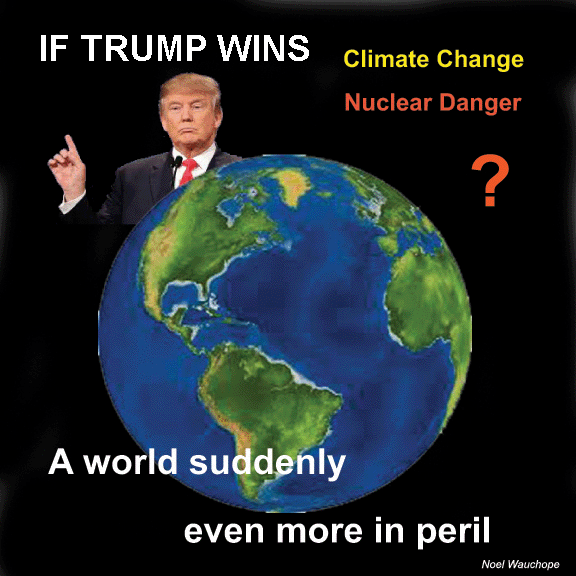
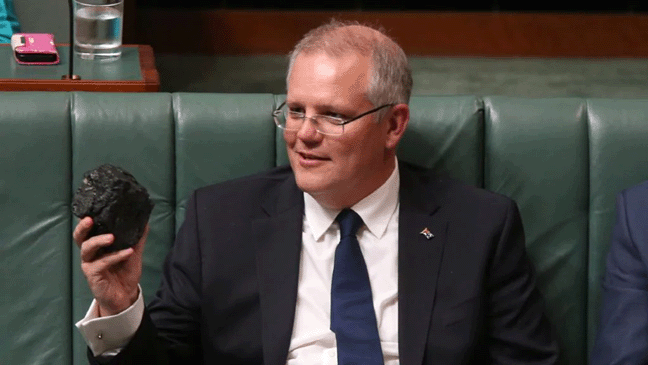
This is a cautionary tale for Australia. In both the US and Australia, conservative politicians seem more eager to bail out dirty polluters than protect the public
For Australia’s sake, I hope Trump’s climate science denialism loses. https://www.theguardian.com/commentisfree/2020/oct/17/for-australias-sake-i-hope-trumps-climate-science-denialism-loses, Michael Mann US policy has emboldened Scott Morrison to be less ambitious on climate, just when so much is at stake.
|
Anyone in Australia who witnessed the Black Summer bushfires (as I did), and anyone in the US who experienced the thick smoke from our western wildfires (as I have), knows how much damage climate change is already doing. The stark reality is that worldwide efforts to avert ever-more catastrophic climate change impacts lie in the balance in the 2020 US election. Donald Trump will go down in history bearing substantial responsibility for the deaths of over 200,000 Americans due to his rejection of the advice of public health experts and his refusal to endorse policies such as social distancing and mask-wearing that could have saved many thousands of lives. But his rejection of the science of climate change sets the stage for a far greater toll. Far more human lives will be lost from the impacts of climate change if we fail to act. Whether or not Trump gets re-elected – and how other countries like Australia respond to the outcome of the US election – could determine the fate of our planet. Indeed, I’ve stated that a second Trump term might well be “game over for the climate” if it leads to the collapse of international efforts to act. The damage caused by Trump’s climate denial is painfully visible within the US as we endure climate change-fuelled extreme weather events, including unprecedented wildfires in the west and unprecedented hurricanes in the east. But the damage can be felt around the world. Trump has proudly, and shamelessly, trumpeted his climate denialism on the global stage, joining with petrostates such as Russia, Saudi Arabia and Brazil in opposing international climate efforts. Indeed, Trump’s actions have emboldened Australia to be less ambitious on climate too, prime minister Scott Morrison following Trump’s lead in promoting climate denial, coddling fossil fuel interests and blocking efforts to support a clean, renewable energy transition. By pulling the US out of the Paris agreement (one of the first and only campaign promises he kept) Trump ceded America’s leadership on the defining challenge of our time. Thus far, other countries have fortunately filled the leadership void, at least temporarily. The EU and China, with its new net-zero pledge, have stepped up to the plate, recognising that they will benefit from the opportunities of a clean energy economy and better protect their citizens from dangerous climate change impacts. But nobody stands to benefit more from climate action, or lose more if we fail to act, than Australia. Having spent a sabbatical leave down under earlier this year, aimed at collaborating with scientists in Australia to study the impact of climate change on extreme weather events, I instead witnessed those impacts first-hand. I saw the muted beauty of the Blue Mountains when shrouded in wildfire smoke. If Trump is re-elected, and we collectively continue down a path of insufficient climate action, it may not be long before those fires rage year-round, and the Blue Mountains are lost in a perpetual grey and dismal haze. It’s the same with the vibrant sea life of the Great Barrier Reef, which I was fortunate enough to witness with my family during my time in Australia. The delicate ecosystems of the GBR are already on the ropes, with fossil fuels pushing up temperatures in the ocean to the point where bleachings occur with such frequency and ferocity that corals simply cannot recover. Research released this week found that the reef has lost half its coral, largely due to warming oceans caused by climate change. Add the impact of ocean acidification from increasing carbon emissions, and we could sadly, within a decade or two, be reading the GBR’s obituary for real. It doesn’t have to be like that. For one thing, renewable energy costs are plummeting while the technology just keeps getting more efficient and better, so dirty energy no longer makes economic sense. For example, on one recent Sunday, all the electricity demand for the entire state of South Australia was met by solar power alone, and every state and territory in Australia has committed to go carbon neutral by 2050. Here in the US, we’ve seen a record number of cities and states stepping up on climate goals too, knowing clean energy is good for their communities’ health, resilience and prosperity. Policymakers must accelerate the shift to clean energy that is already under way. As we’ve learned in the Trump-era, some fossil fuels are too far gone for even the most determined polluter-in-chief to save. Though another term would give Trump time to defend his environmental rollbacks in court and solidify his dirty energy policies, he has already failed to save coal from market forces, and another four years isn’t going to reverse the long-term decline of the industry. This is a cautionary tale for Australia. In both the US and Australia, conservative politicians seem more eager to bail out dirty polluters than protect the public, denying politically inconvenient science in order to offer lavish payouts to help unprofitable fossil fuel companies. If we are to avert catastrophic warming, we must do just the opposite, providing financial incentives for renewables and disincentives for fossil fuels. That will level the playing field, and accelerate the clean energy transition. We must take the earliest exit possible off the fossil fuel highway. By trying to squeeze out the last drop of fossil fuel industry profits, the Morrison government could well be on its way to bleaching the life from Australia’s coral reefs and blighting the blue of its mountains. There is some good news, however. Regardless of whom Americans vote for – and for the sake of the planet, I hope it’s Joe Biden and the Democrats – Australians can still work together for structural change at home. You can’t solve it alone, but we also can’t solve it without you. Australia has seen that the sun can power an entire state’s electricity for a day. Now it’s time to make that happen every day. Australia must distance itself from the handful of bad petrostate actors who have sabotaged global climate action and rejoin the coalition of the willing, when it comes to the battle to save our planet. • Michael E. Mann is distinguished professor of atmospheric science at Pennsylvania State University. He is author of the upcoming book The New Climate War: The Fight to Take Back Our Planet, due out in January (Public Affairs Books) |
|
Persecuting Assange Is a Real Blow to Reporting and Human Rights Advocacy’
Persecuting Assange Is a Real Blow to Reporting and Human Rights Advocacy’
CounterSpin interview with Chip Gibbons on Assange extradition Fair, 15 Oct 20,
Assange’s case, the unprecedented use of the Espionage Act to go after a journalist, has dire implications for all reporters. But this country’s elite press corps have evidently decided they can simply whistle past it, perhaps hoping that if and when the state comes after them, they’ll make a more sympathetic victim.
Joining us now to discuss the case is Chip Gibbons. He’s policy director at Defending Rights & Dissent. He joins us now by phone from Washington, DC………..
CG: Sure. So the US has indicted Julian Assange with 17 counts under the Espionage Act, as well as a count under the Computer Fraud and Abuse Act.
Assange is not a US person; he’s an Australian national. He was inside the Ecuadorian embassy for a number of years, as Ecuador had granted him asylum, and the UK had refused to basically recognize that and let him leave the country, so he was de facto imprisoned inside the embassy. And after the indictment the US issued, the new government of Ecuador—which is much less sympathetic to Assange than the previous Correa government—let the US come in the embassy and seize him.
And the US is seeking Assange’s extradition to the US from the UK. I guess it’s, probably, technically a hearing, but Kevin’s point was that it’s more like what we would think of as a trial, in that there’s different witnesses, there’s expert testimony, there’s different legal arguments at stake.
The defense, the witness portion of it, has closed; it ended last week. And there’s going to be closing arguments submitted in writing, and then the judge will render a decision, and that decision will be appealable by either side. So regardless of the outcome, we can expect appeals. So it does very closely mirror what we would think of more like a trial than a hearing in the US court context.
It’s important to really understand what’s at stake with Assange’s extradition. He is the first person ever indicted by the US government under the Espionage Act for publishing truthful information.
The US government has considered indicting journalists before: They considered indicting Seymour Hersh, a very famous investigative reporter. They considered indicting James Bamford, because he had the audacity to try to write a book on the National Security Agency. But they’ve never done that.
And Obama’s administration looked at the idea of indicting Assange and said, “No, this would violate the First Amendment, and it would open the door to all kinds of other bad things.” But the Trump administration clearly doesn’t have those qualms……..
It is very interesting to see how this plays out in a US court in the current environment. If whoever—Trump or Biden, whoever is president, when this finally comes to the US—actually pursues this, and they actually are allowing the persecution of journalists, that’s going to be a really dark, dark assault on free expression rights.
And it’s worth remembering—and Julian Assange is clearly very reviled in the corporate media and the political establishment right now—but the information he leaked came from Chelsea Manning, it dealt with US war crimes; and he worked with the New York Times, the Guardian, Der Spiegel, Le Monde, Al Jazeera, to publish this information. So if he can go to jail for publishing this, why can’t the New York Times? And is that a door anyone wants to open? There is a big press freedom angle here.
I also want to talk about the facts, though: What did Julian Assange publish, and why did it matter? ………..
Julian Assange is accused of publishing information about war crimes, about human rights abuses and about abuses of power, that have been tremendously important, not just for the public’s right to know, but also have made a real difference in advocacy around those issues. People were able to go and get justice for victims of rendition, or able to go and get court rulings in other countries about US drone strikes, because of this information being in the public domain. So attacking Assange, persecuting Assange, disappearing him into a supermax prison, this is a real blow to reporting and human rights advocacy. ………
JJ: Right. And, finally, the journalists who are holding their nose right now on covering it aren’t offering to give back the awards that they won based on reporting relying on WikiLeaks revelations. And James Risen had an op-ed in the New York Times a while back, in which he was talking about Glenn Greenwald, but also about Julian Assange, and he said that he thought that governments—he was talking about Bolsonaro in Brazil, as well as Donald Trump—that they’re trying out these anti-press measures and, he said, they “seem to have decided to experiment with such draconian anti- press tactics by trying them out first on aggressive and disagreeable figures.”………. https://fair.org/home/persecuting-assange-is-a-real-blow-to-reporting-and-human-rights-advocacy/
Nuclear waste – a danger for countless generations to come
|
The World’s Growing Nuclear Waste Dilemma, Oil Price, By Haley Zaremba – Oct 15, 2020, ”……….Just last month, the World Nuclear Industry Status Report showed the shocking statistic that nuclear is now the most expensive form of power generation in the world, with the sole exception of gas peaking plants. And then there’s the issue of nuclear waste, and it’s not a minor one. Around the world, radioactive waste is piling up, and managing it is a huge expense, not to mention a public health risk of massive proportions if not handled appropriately. Spent nuclear fuel is so hazardous because the waste, in particular uranium and plutonium, is highly radioactive with a half-life that will outlast all of us. Recently, different nuclear-powered countries around the world have been pursuing “final disposal sites” for their nuclear waste. This process consists of converting this radioactive waste into a kind of glass via a process known as vitrification. This glass will then be stored inside of stainless steel vessels that will be kept in a pool to maintain a cool temperature until they are finally transferred to their final resting place deep underground, where they will remain undisturbed until their amount of radioactivity has decreased to a level that they can be handled safely–a period of time anywhere from 1,000 to 100,000 years. ……. controversy in Japan is directly related to that nation’s particular history to be sure, but it is part of a global problem. Nuclear waste is not just a hazard for ourselves, but for countless generations to come, and we cannot afford to be cavalier with its management. Finding a place for the spent nuclear fuel that has already been created by generations past and that yet to be produced cannot be rushed or thrust upon those who do not want it but have no power to refuse it. Final disposal sites are certainly a step forward but Japan shows us that they’re also, ultimately, a flawed solution. https://oilprice.com/Alternative-Energy/Nuclear-Power/The-Worlds-Growing-Nuclear-Waste-Dilemma.amp.html?fbclid=IwAR0JRIxFnP5MRLyuvJwNwXU8KV39E7ZHA9qeNzRbF-6dr3KQzysGQidJsU4 |
|
Can We Learn from Cuba About COVID-19? by Penny Gardner — Rise Up Times

“The population went under ‘lockdown’ on March 20. Business taxes and domestic debts were suspended, those hospitalized had 50% of their salaries guaranteed and low-income households qualified for social and family assistance schemes, with food, medicine and other goods delivered to their homes…”
Can We Learn from Cuba About COVID-19? by Penny Gardner — Rise Up Times
October 16 Energy News — geoharvey

Opinion: ¶ “The Hydrogen Boom Will Provide A $200 Billion Boost To Wind And Solar Energy” • The renewable energy sector has lately been sizzling with very bullish projections, and a few bearish ones, coming from Wall Street. However, one corner of the market has really been hogging the limelight, and that is the hydrogen […]
October 16 Energy News — geoharvey
AEMO takes lead role in global consortium seeking rapid energy transition — RenewEconomy

Audrey Zibelman says “facts and reality” are focus of AEMO, which is leading creation of new global partnership pushing “rapid clean energy transition of unprecedented scope.” The post AEMO takes lead role in global consortium seeking rapid energy transition appeared first on RenewEconomy.
AEMO takes lead role in global consortium seeking rapid energy transition — RenewEconomy
Crookwell 3 wind farm gets green light, after court overturns planning refusal — RenewEconomy

NSW Land and Environment court overturns NSW planning commission’s refusal of Crookwell 3 wind farm, located in heart of Angus Taylor’s electorate. The post Crookwell 3 wind farm gets green light, after court overturns planning refusal appeared first on RenewEconomy.
Crookwell 3 wind farm gets green light, after court overturns planning refusal — RenewEconomy
Charging company Evie Networks launches all-electric rideshare car rental service — RenewEconomy

Charging network provider Evie Networks breaks cover on plan to rent zero emissions vehicles out to rideshare drivers under service called eMentum. The post Charging company Evie Networks launches all-electric rideshare car rental service appeared first on RenewEconomy.
Charging company Evie Networks launches all-electric rideshare car rental service — RenewEconomy
Energy Insiders Podcast: Zibelman on why she is leaving, and AEMO’s next steps — RenewEconomy

In her first interview since announcing her surprise decision to leave AEMO, Audrey Zibelman explains why she’s going to Google’s X, and what’s next for Australia’s clean energy transition. The post Energy Insiders Podcast: Zibelman on why she is leaving, and AEMO’s next steps appeared first on RenewEconomy.
Energy Insiders Podcast: Zibelman on why she is leaving, and AEMO’s next steps — RenewEconomy
1 This month

of the week – Australians for War Powers Reform (AWPR)
To see nuclear-related stories in greater depth and intensity
 Antinuclear