Australian Nuclear Science and Technology Organisation (ANSTO) – disingenuous and inept promotion of Kimba nuclear waste dump

If anyone has viewed the Senate estimates hearing on Thursday 29 October 2020 with regard to ANSTO then I am sure they will be concerned at the ill-prepared and unconvincing explanations by its management which at times verged on being completely disingenuous. If this is the major federal government entity on which there is so much reliance for the establishment of the planned nuclear waste facility at Kimba in South Australia then the whole nation and not just the local community should be seriously worried about the capability of ANSTO which contrary to its self serving promotion and publicity is not held in high regard internationally
This extends to the Department of Industry Science Energy and Resources and the other agencies involved with the proposed nuclear waste facility at Kimba and demonstrates the ineptness and lack of competence on the part of the government in its various capacities in trying to establish the facility
Because of this it is very likely that the facility will not obtain the necessary licence for its establishment and operations and in any case the enabling legislation will be rejected by the Senate
It therefore defies logic for the government’s continued persistence with the Kimba proposal including the ministerial visit to Napandee farm yesterday which apparently failed to achieve anything as to a resolution of the inherent communityproblems – perhaps a political photo opportunity or confirmation at last that Napandee is a farm and not a community?
http://www.aph.gov.au Watch parliament Senate, Economics Legislation Committee
(Senate Estimates) Thu, 29 Oct 2020 Part 1 at 9.00 am EST
Why did Australia’s nuclear high priest Dr Adi Paterson leave so suddenly ?

Some very odd things happened in Senate Estimates last week. Seems NO-ONE knows why Adi Paterson resigned and officially took leave until the end of the year – nearing “the end of his term” we were told!!. Considering his term, it turns out, doesn’t end at the end of this year…or next year….but March 2022! Strange….
Then there is the David Tune Review into ANSTO…something about finances and administrative review…didn’t know there WAS a review….but there is no comment by ANSTO given at the Senate Estimates of EXACTLY what it was all about or what the recommendations were!Then some very strange comments about the ANM Facility. According to ANSTO’s website it says “The ANSTO Nuclear Medicine (ANM) project includes an export scale Mo-99 Manufacturing Facility and an innovative ANSTO Synroc waste treatment plant. Both of these new facilities will be owned and operated by ANSTO Nuclear Medicine (ANM) Pty Ltd, a majority subsidiary of ANSTO.”
It was completed construction in 2019 and after an accident occurred there mid-2019, it has been on amended and reamended licence by ARPANSA to produce Mo-99 at reduced amounts. The facility cost build was estimated to be approx. $169 million in 2016…but difficult to find the actual final cost. And yet it seems ANSTO is using the old facility currently which was retrofitted? How does that work?
So many questions!…. And no-one asking them!!
One thing which is important is that the acting CEO Mr Jenkinson did correct one of the Senators regarding the availability of isotopes from ANSTO which are used FOR DIAGNOSTIC IMAGING. They are NOT used for treatment! That is the PREDOMINATE USED OF ANSTO – TO PRODUCE Mo-90 which breaks down to Tc-99m which is used for DIAGNOSTIC IMAGING…
“Senator SHELDON: You had 12,000 normal doses that would go out. You said you imported some doses to cover that. What was the shortfall from 12,000 in comparison with the imports?
Biden inches towards presidency and overhaul of global climate action — RenewEconomy

A republican controlled senate will not be a barrier to a likely Biden presidency undertaking a massive shake-up of American and international climate action. The post Biden inches towards presidency and overhaul of global climate action appeared first on RenewEconomy.
Biden inches towards presidency and overhaul of global climate action — RenewEconomy
Biden as president would pursue climate ‘cheaters’, such as Morrison’s Australia
  Biden as president would pursue climate ‘cheaters’ – and Australia could be among them, Scott Morrison has resisted a call to action from the UK – but the US would be hard to ignore, Guardian, Richie Merzian 4 Nov 20, ”…….. If Joe Biden takes the Oval Office, on the day of his inauguration, 20 January 2021, he can formally ask to rejoin the Paris agreement. It takes one year to pull out but only 30 days to sign up. However, regaining membership to the agreement is just the beginning. The divergence on climate policy between the Democratic and Republican candidates is huge – possibly the widest divide between the two platforms – and while Trump questions global warming, Biden has the most ambitious climate policies of any presidential candidate (exceeding those of Barack Obama).First, Biden will lock the US into net zero emissions by 2050. Not an ill-defined target some time in the second half of the century, like the Australian government’s, but a 30-year target. A target that means putting coal, oil and gas on a downward trajectory, and bringing total global CO2 emissions under a net-zero target to over 60%, including major importers of Australian coal and gas – China, Japan and the Republic of Korea. Biden as president would pursue climate ‘cheaters’ – and Australia could be among them, Scott Morrison has resisted a call to action from the UK – but the US would be hard to ignore, Guardian, Richie Merzian 4 Nov 20, ”…….. If Joe Biden takes the Oval Office, on the day of his inauguration, 20 January 2021, he can formally ask to rejoin the Paris agreement. It takes one year to pull out but only 30 days to sign up. However, regaining membership to the agreement is just the beginning. The divergence on climate policy between the Democratic and Republican candidates is huge – possibly the widest divide between the two platforms – and while Trump questions global warming, Biden has the most ambitious climate policies of any presidential candidate (exceeding those of Barack Obama).First, Biden will lock the US into net zero emissions by 2050. Not an ill-defined target some time in the second half of the century, like the Australian government’s, but a 30-year target. A target that means putting coal, oil and gas on a downward trajectory, and bringing total global CO2 emissions under a net-zero target to over 60%, including major importers of Australian coal and gas – China, Japan and the Republic of Korea.
Within his first 100 days, Biden has committed to convene a climate world summit to directly engage the leaders of the major carbon-emitting nations of the world to persuade them to join the United States in making more ambitious national pledges, above and beyond the commitments they have already made. From the US, we could see a new, more ambitious emission reduction target than its underwhelming 26-28% by 2025 (if that sounds familiar, it’s because Australia has the exact same underwhelming target range but for 2030, and without the desire to improve it). Importantly, Biden will pursue countries seen as “cheating” on climate action, using “America’s economic leverage and power of example”. Given the Morrison government’s insistence on using leftover carbon credits to avoid any credible emission reductions over the next decade – dubbed by the former UN climate chief Christiana Figueres as “cheating” and by numerous Australian law professors as legally baseless – Australia may be a target of that pursuit. Australia and the US might also be at odds over financial support for climate action in developing countries. Biden’s campaign promises include meeting the US climate finance pledge, of which $2bn to the Green Climate Fund is still outstanding. Prime minister Scott Morrison pulled Australia out of the Green Climate Fund in 2018 during an interview with Alan Jones and has resisted calls since from our neighbours in the Pacific to rejoin. While presidential office is key, if Democrats take a majority of Senate seats their capabilities on climate would grow fast. The president, Senate and key states could see the US move quickly – even this year. And much like the climate leadership shown by states and territories in Australia that are all signed up to net-zero by 2050 targets, a number of US state governments have already banded together to take climate action under Trump. According to the America’s Pledge report, sub-national action makes it possible for the US to cut emissions by 37% by 2030. And despite Trump’s best efforts to revive the coal industry, more coal capacity (37GW) has been retired under his presidency than during Obama’s second term (33GW). The US consumed more energy from renewables than coal in 2019, for the first time in over a century, setting the stage for Biden’s promise of a carbon pollution-free power sector by 2035. This 12 December the Paris agreement turns five. The United Kingdom, which will host the next UN climate conference, will mark the occasion with an ambition summit. And while Scott Morrison has resisted calls from the UK to do more on climate, it may be harder to resist similar calls from the US. Morrison claims, “Our policies won’t be set in the United Kingdom, they won’t be set in Brussels, they won’t be set in any part of the world other than here.” I wouldn’t be so sure. When former president Obama pressured the Abbott government to do more on climate change in 2014, it had an impact. Let’s see what happens when Washington calls again. https://www.theguardian.com/commentisfree/2020/nov/04/biden-as-president-would-pursue-climate-cheaters-and-australia-could-be-among-them |
|
Rocket launches on the Eyre Peninsula wil damage the environment
Nature Conservation Society of SA fears Whalers Way rocket launch site will damage the environment
Worry rocket launch site will damage environment The Advertiser Clare Peddie, Science Reporter, The Advertiser, November 4, 2020
A proposed rocket launch facility at Whalers Way, on the tip of Eyre Peninsula, threatens vulnerable wildlife and coastal wilderness, conservationists say.
The Nature Conservation Society of South Australia is challenging the development, citing heightened fire danger, noise disturbance and land clearing, enabling the spread of feral predators and pests.
Society vice-president Rick Davies said the area was so special that it was protected under a legally binding heritage agreement, meaning it is be managed as a privately-owned conservation area in perpetuity. “We support a space industry in SA, but this is the wrong place for this development,” Dr Davies said.
With our country already seeing more large, uncontrolled fires, why would we allow a commercial firing range and all its propellant fuels in the middle of one of the best expanses of native coastal vegetation?”
The area is home to species at risk of extinction, including nationally vulnerable white-fronted whipbirds and the Eyre Peninsula southern emu-wren.
Dr Davies says these shy secretive birds require long unburnt vegetation and will be impacted both by both direct habitat destruction and associated industrial disturbance.
Coastal raptors such as vulnerable white-bellied sea eagles and rare osprey, which require vast hunting territories, will also be disturbed, he says.
The Eyre Peninsula Southern Emu-wren is endangered in South Australia. This male was briefly captured for research purposes and then released. Picture: Marcus Pickett
The State Government has given the Whalers Way Orbital Launch Complex major development status.
The company behind the development, Southern Launch, is now preparing a development application, including an environmental-impact statement.
Executive director Mike Damp expected those documents would be made available as part of the public consultation process early next year.
“Site selection took a long time and it was diligent; it wasn’t selected willy nilly or with disregard to the environment,” he said.
“Right from the outset, I want to dispel any inclination that you might have that we are prepared to ride roughshod over the environment.
“From the very beginning, we have been very mindful of the area that we are operating out of and we have, therefore, cemented into the bedrock of the company our biodiversity management strategy, so we intend to improve the conservation status of Whalers Way.”
The rugged coastline at Whalers Way, south of Port Lincoln on the Eyre Peninsula, including an osprey nest on a rocky outcrop. Picture: Marcus Pickett
A State Government spokesman said that the project would go through all required environmental-assessment processes.
“The sub-orbital launch facility will be one of two in the southern hemisphere – and presents enormous opportunity for growth in rapidly developing space sector,” he said.
“Projects like this will be critical in our state’s recovery from the global coronavirus pandemic,” he said.
But Shadow Environment Minister and deputy leader of the opposition Susan Close shares the conservationist’s concerns.
“I have serious concerns about the impact of this development on rare species and valuable habitat, and the risks it may pose for fire and damage to adjacent marine life,” she said.
“I urge the government to consider alternative locations which do not involve compromising environmental values and overriding existing protections.”
Several U.S. utilities back out of deal to build Small Nuclear Reactors

|
Several U.S. utilities back out of deal to build novel nuclear power plant, Science, By Adrian Cho, Nov. 4, 2020 Plans to build an innovative new nuclear power plant—and thus revitalize the struggling U.S. nuclear industry—have taken a hit as in recent weeks: Eight of the 36 public utilities that had signed on to help build the plant have backed out of the deal. The withdrawals come just months after the Utah Associated Municipal Power Systems (UAMPS), which intends to buy the plant containing 12 small modular reactors from NuScale Power, announced that completion of the project would be delayed by 3 years to 2030. It also estimates the cost would climb from $4.2 billion to $6.1 billion………. critics of the project say the developments underscore that the plant, which is designed by NuScale Power and would be built at the Department of Energy’s (DOE’s) Idaho National Laboratory, will be untenably expensive. M. V. Ramana, a physicist who works on public policy at the University of British Columbia, Vancouver, says he’s not surprised that so many utilities have opted out of the project. The question, he says, is why so many are sticking with it. “They ought to be seeing the writing on the wall and getting out by the dozens,” he says. ………
if the NuScale plant doesn’t run constantly at full output, it will be less efficient and even more expensive to operate, in terms of cost per megawatt hour (MWh) of energy, Ramana argues. Peter Bradford, a former member of the Nuclear Regulatory Commission (NRC) and former chair of the state utility commissions in Maine and New York, says renewables coupled with short-term storage in batteries would likely be a cheaper means to even out the supply……. in the 1980s, Washington Public Power Supply System agreed to build several nuclear reactors in Washington that ran far overbudget and were never completed, leading to the biggest default on municipal bonds in U.S. history. Public utilities are particularly vulnerable to such risks, Bradford says, as other than ratepayers they have few sources of revenue that could be used to cover cost overruns. “Not only are there no deep pockets, there are no pockets,” he says. On 28 October, Heber Light & Power in Utah withdrew from the project, just 1 day after utilities in the Utah communities of Bountiful and Beaver pulled out. Still, even critics doubt the UAMPS deal will fall apart immediately. In August, the NuScale design passed a key milestone in the NRC review process, receiving its safety evaluation report, and observers expect final “design certification” to come next year. In the meantime, UAMPS is moving to complete an application to construct and operate the plant, Webb says. That application should be submitted in 2023, construction of the plant should start in 2025, he says. Before construction can start, however, UAMPS still has to line up customers to buy the full 720-megawatt output of the plant, Webb says. So far, UAMPS members involved in the project have agreed to take only a relatively small fraction of that output. So UAMPS may have to convince plenty of other folks that it’s a good deal. https://www.sciencemag.org/news/2020/11/several-us-utilities-back-out-deal-build-novel-nuclear-power-plant |
|
Frazer Nash and The South Australian Chamber of Mines and Energy (SACOME) want nuclear power – “good for the environment”!!
 SACOME pushes SA Government to back nuclear energy, Australian Mining
SACOME has also called for the state government to fund a nuclear energy forum, with South Australia holding 25 per cent of the world’s uranium resources and 80 per cent of Australia’s total uranium supply.
The chamber stated that the economic value of the nuclear fuel cycle needs to be re-examined due to the refinement and commercialisation of small modular reactors, which would be financially bolstered by South Australia’s renewable energy supply.
“SACOME supports the chief entrepreneur’s statements and calls upon the Marshall Government to establish a Nuclear Energy Forum to advance the conversation about development of a South Australian nuclear industry.”
According to Frazer Nash head of Australian business Jonathan Armstrong, the nuclear energy forum would reap positive results [??] for the environment………..https://www.australianmining.com.au/news/sacome-pushes-sa-government-to-back-nuclear-energy/
Some problems that will handicap the development of Small Nuclear Reactors
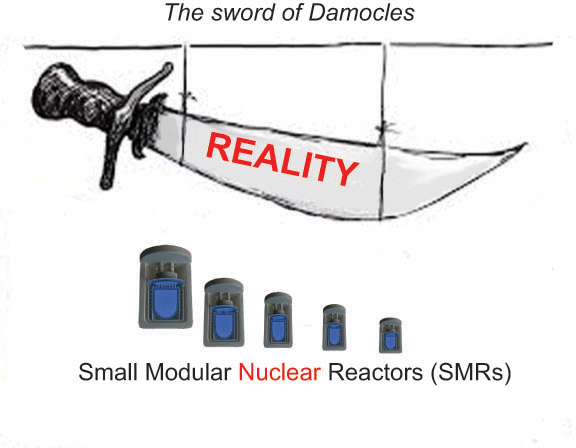 The I&C challenges for small modular reactors, Nuclear Engineering International 4 November 2020 Dr Li Li examines the instrumentation and control requirements and challenges for a new generation of small modular reactors.
REACTOR DEVELOPERS ARE DEVELOPING A wide variety of small modular reactor (SMRs)….. Many use Generation III+ pressurised water reactor (PWR) technology similar to that used in current gigawatt-scale reactors, while others are based on advanced Generation IV technologies ranging from high temperature gas-cooled reactors to molten-salt reactors.
Each design will have its own requirements for instrumentation and control (I&C) systems for the operation, monitoring and control of the reactor, turbine island and balance of plant. Even among PWRs, the design principles and I&C architectures are very different and cannot be easily replicated from one design to another.
To understand the challenges, let’s look at three competing designs: the UK SMR being developed by a consortium of companies including Rolls-Royce, Jacobs, Assystem and Atkins with support from research institutions including Nuclear AMRC; the NuScale Power Module backed by Fluor Corporation with funding from the US Department of Energy; and the Westinghouse SMR, which adapts technologies from the established AP1000 design………..
The issue of cyber security will be critical for the certification of digital I&C systems. According to the Industrial Control Systems Cyber Emergency Response Team, part of the US Department of Homeland Security, cyber-attacks and security infringement targeting control systems have increased significantly in recent years. With more digital smart devices used in nuclear power plant of any size, it must be a priority to protect the vulnerability of smart devices and digital I&C system from cyber attack and malicious sniffing from hostile individuals or organisations…….
in most cases, new codes and standards will need to be developed for advanced reactors.
The development of new codes and standards is a very lengthy process. It will take resources and time to publish a new standard for the nuclear industry, and we might not see one ready before new SMR developers file their design certification application……….
Many SMR designs, including the three considered above, have the potential to be used for co-generation of process heat, district heating or desalination. This will introduce additional complexity for regulators to approve the power plant I&C design, if the co-generation processes are located at same site for economic reasons. This brings new challenges because extra safety measures must be considered. For example, additional safety features of the control system and evacuation plan must be approved by an adequate jurisdictional authority for the orderly shutdown of both the nuclear plant and industrial processes in the event of an accident.
Author information: Dr Li Li, Head of the digital I&C group at the UK’s Nuclear Advanced Manufacturing Research Centre (Nuclear AMRC) https://www.neimagazine.com/features/featurethe-ic-challenges-for-small-modular-reactors-8345341/
Chernobyl’s bumblebees still affected by radiation
This new data shows effects on bumblebees are happening at dose rates previously thought safe for insects, and the current international recommendations will need to be re-evaluated.
|
Chernobyl: bumblebees still at risk from radiation nearly 35 years on, https://theconversation.com/chernobyl-bumblebees-still-at-risk-from-radiation-nearly-35-years-on-149055, Katherine Raines, Fellow and Lecturer, University of Stirling, November 5, 2020 In the early hours of April 26 1986, reactor four of the Chernobyl nuclear power plant in Ukraine exploded, causing the largest nuclear disaster in history. More than 350,000 people were evacuated, and a 4,700km² exclusion zone was formed in Ukraine and Belarus. Despite the intervening 34 years, there is still uncertainty about the effects of the radiation exposure on wildlife living in the Chernobyl exclusion zone (CEZ).
|
Poland’s nuclear energy plans not likely to be supported by the European Commission
Nuclear power is not considered environmentally sustainable, and there is little hope this approach will change. Therefore, the possibilities for bankrolling nuclear energy are very limited.
 Brussels’s impact on Poland’s nuclear project, https://biznesalert.com/brusselss-impact-on-polands-nuclear-project/ : Paweł Wróbel, @Pawrobel 4 Nov 20, Poland’s nuclear power plant constrsuction program has been riddled with ambiguity for many years. Neverthele, among the few certainties remains the necessity to abide by the EU law on granting state aid. The project cannot happen without Brussels. Investments in nuclear energy are one of the most expensive in the energy sector, which is why building a nuclear plant in Poland will not be possible without state support. Therefore, the European Commission will have to approve the selected financing model – Paweł Wróbel, CEO of Gate Brussels, writes for BiznesAlert.pl. Continue reading
Why AEMO’s ISP assumes over 100 pct wind and solar power, and virtually no gas — RenewEconomy

No new gas is needed for electricity generation under any of AEMO’s ISP scenarios, and wind and solar power is assumed to provide more than 100 per cent power. The post Why AEMO’s ISP assumes over 100 pct wind and solar power, and virtually no gas appeared first on RenewEconomy.
Why AEMO’s ISP assumes over 100 pct wind and solar power, and virtually no gas — RenewEconomy
Solar Insiders Podcast: Another bunch of records for solar and renewables — RenewEconomy

October was another month of records for solar and renewables across Australia. The post Solar Insiders Podcast: Another bunch of records for solar and renewables appeared first on RenewEconomy.
Solar Insiders Podcast: Another bunch of records for solar and renewables — RenewEconomy
November 4 Energy News — geoharvey

Opinion: ¶ “Fate Of Climate Crisis Hangs On Election As US Exits Paris Agreement” • On November 4, the US became the only country in the world refusing to participate in global climate efforts, with the fate of the crisis hanging on the still uncalled presidential election. Trump’s challenger, Joe Biden, would immediately rejoin the […]
November 4 Energy News — geoharvey
Darwin big battery to displace gas generators in Northern Territory — RenewEconomy

Tender opens for Darwin big battery that will support more solar and displace gas generation and slash operating costs. The post Darwin big battery to displace gas generators in Northern Territory appeared first on RenewEconomy.
Darwin big battery to displace gas generators in Northern Territory — RenewEconomy
Arizona takes important step towards 100 per cent clean power — RenewEconomy

Arizona Corporate Commission has voted to approve a plan requiring 100% reduction in carbon emissions from regulated utilities by 2050. The post Arizona takes important step towards 100 per cent clean power appeared first on RenewEconomy.
Arizona takes important step towards 100 per cent clean power — RenewEconomy
1 This month

of the week – Australians for War Powers Reform (AWPR)
To see nuclear-related stories in greater depth and intensity
 Antinuclear