Senator Rex Patrick contests Freedom of Information refusal about nuclear waste plan

Rex Patrick to ask SA Civil and Administrative Tribunal to reverse nuclear FoI refusal
An SA Senator will ask a court to decide whether his call for information on a nuclear waste facility should have been granted. Advertiser –Matt Smith, December 16, 2020 –
South Australian senator Rex Patrick will tackle State Government lawyers after a Freedom of Information request concerning a nuclear waste facility was refused.
He will fight to overturn the decision in the SA Civil and Administrative Tribunal over what he describes as “a lack of transparency”.
Senator Patrick, pictured, said his FOI request was met with a “highly unusual” reminder from the Crown Solicitor’s office that if he were to fight the decision and lose he would be liable for costs.
He had asked for correspondence between Energy and Mining Minister Dan van Holst Pellekaan and the Federal Government concerning the establishment of a National Radioactive Waste Management Facility in SA.
“FOI in SA is a farce. Late responses, cavalier exemption claims, delayed review processes and now threats if you push a request beyond the control of the very government department seeking to hide information,” he said.
A government spokesman said: “While it would not be appropriate to comment on matters currently before SACAT, it’s worth noting that the tribunal and only the tribunal makes a determination on whether costs are awarded, and can do so if satisfied that there are statutory grounds to do so.
No decision has been made in this matter and, as such, no application for costs has been, or can be, made at this time.”
It was revealed this week that reviews of FOI requests are taking more than six months to
complete. SA Senator Rex Patrick takes nuclear FOI ‘farce’ to court | The Advertiser (adelaidenow.com.au)
See Senator Rex Patrick’s Face Book page post:
https://www.facebook.com/193047494589008/posts/836162363610848/
MINISTER DAN van HOLST PELLEKAAN RESORTS TO THREATS WHEN ASKED TO BE TRANSPARENT
In response to a request for transparency, Minister Dan van Holst Pellekaan has outrageously instructed the Crown Solicitor to threaten me with costs.
Everything the SA Government does it does for public purpose and using SA taxpayer’s money. As such, South Australians are entitled to see all that the State Government does, admittedly with some exceptions.
I asked Minister van Holst Pellekaan’s office to provide me with correspondance between the State and Federal Government on the proposed National Radioactive Waste Management Facility at Kimba, using SA Freedom of information laws. At first he failed to respond to the request in the timeframe required by the law, then he made a decision that hid (presumably embarrassing) information from me.
I have asked SACAT, the State’s independent umpire, to review the Minister’s decision. Minister van Holst Pellekaan has now threatened me with “costs” if I proceed. That prompts two questions: 1) what’s he trying to hide and 2) if he’s prepared to threaten a senator seeking transparency, how would he treat a regular South Australian that reasonably requested information from him?
Ranger Danger: Rio Tinto Faces Its Nuclear Test in Kakadu Uranium
|
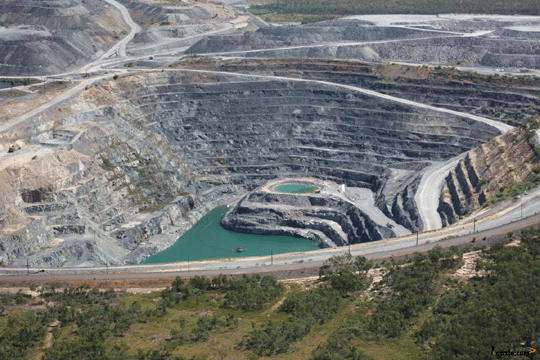
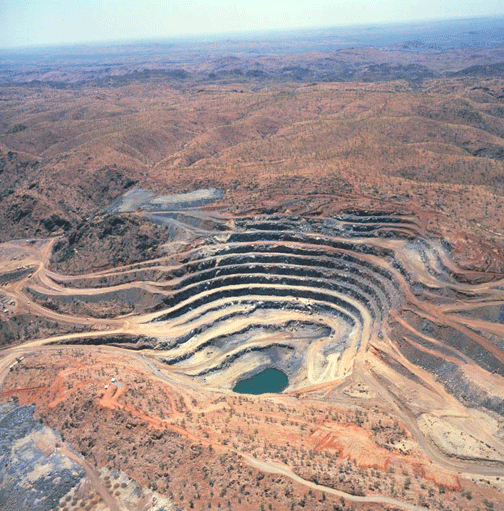
Ranger Danger: Rio Tinto Faces Its Nuclear Test in Kakadu Uranium Mine, https://sei.sydney.edu.au/opinion/ranger-danger-rio-tinto-faces-its-nuclear-test-in-kakadu-uranium-mine/ Rebecca Lawrence and Dave Sweeney report on growing concerns over the potential failures of the rehabilitation plan for the Ranger mine in Kakadu National Park. By Rebecca Lawrence, Senior Research Fellow, Sydney Environment Institute and Dave Sweeney, Australian Conservation Foundation, 16 December 2020 In the 1950’s uranium mining began in the Alligator Rivers and Kakadu regions in the Top End of the Northern Territory. Since then, the Kakadu uranium story has generated heartache and headlines but it is set to soon come to an end with the closure of the Ranger uranium mine in early January 2021. The story is now moving from one of contest over the impacts of mining to one of concern around the adequacy of rehabilitation. Australia has a notorious record when it comes to mine rehabilitation. Many mines are simply abandoned, and those that are rehabilitated often fail, which means complex and on-going monitoring and management is usually required. In many cases, mining companies and their shareholders are long-gone and it is usually Indigenous communities who are forced to live with toxic legacies and left to fight for governments to finance the clean-up with tax-payer money.
Yet, there are alarming signs we may be headed that way. Significant and crucial knowledge gaps remain around the closure and rehabilitation of the Ranger mine. Despite the looming closure date, mine operator Energy Resources Australia (ERA) is still unable to answer many key questions. For example, ERA has still not completed modelling of the pathways and volumes Another key omission in the mine closure plan is the absence of any substantive social impact research. There is no attention paid to how Aboriginal people have been impacted by uranium mining in Kakadu, or any assessment of how they may be impacted the mine closure. This omission constitutes a profound social injustice and is demonstrably inconsistent with both international best practise and contemporary community expectation. ERA is part of the global Rio Tinto group. Rio, who own 86% of ERA, has been called out for its destruction of ancient Aboriginal heritage and sites at Juukan Gorge in the Pilbara region of West Australia. As the main shareholder in ERA at Ranger, there is a real risk that Rio will also fail at Ranger if they don’t get the rehabilitation right and put in place secure financing for perpetual care and maintenance of the Ranger site post-closure. There is a requirement that the company must isolate large volumes of radioactive mining tailings for 10,000 years, but how can that be done without any funds earmarked for monitoring or post-closure management? The Commonwealth government was the key driver behind opening the Ranger Uranium mine in the early 1980s and yet as closure approaches, they are virtually absent. There is no clear regulatory process for how rehabilitation and post-closure monitoring will be financed or enforced. A successful rehabilitation is dependent upon the Commonwealth Government keeping ERA and Rio Tinto accountable and honest. Despite reassuring rhetoric no mining company will do that on their own – for too many the triple bottom line remains measured in pounds, dollars and euros. The Commonwealth Government needs to step up and ensure that the Kakadu environment and its people are protected and that a dual World heritage listed region is given the attention and focus it deserves and needs. A further key constraint on the likely success of the clean up and closure of Ranger is the unrealistic timeframe that has been mandated for rehabilitation. Ranger is the longest running uranium mine in Australia. It was imposed against the explicit opposition of the region’s Mirarr Traditional Owners and for forty years has conducted deeply contested operations in a monsoonal tropical environment. And not just any tropical environment – the mine is an industrial zone surrounded by Australia’s largest national park – Kakadu. Kakadu National Park is a dual World heritage listed area that is recognised for both its cultural and natural values and properties. The Ranger site is required to be rehabilitated to a standard where it could be incorporated into this unique environment. This is a very high bar to clear and Rio Tinto currently have a very short run-up. The rehabilitation period extends only from January 2021 to January 2026. Five years is simply not enough time to make meaningful and lasting repair to a heavily impacted landscape. As a result, the rehabilitation approach is being increasingly driven by short-cuts and bad decisions, rather than taking the time needed to get it right. The Mirarr people and an increasing number of civil society and wider stakeholders and commentators are urging both the Commonwealth and the company to extend this set period of works to better reflect the complexity of the rehabilitation challenge and to increase the likelihood of a successful result. The closure and clean up of Ranger is a critical test of the commitment, competence and credibility of Rio Tinto and the Commonwealth. Both parties have a responsibility to address decades of environmental damage and community disruption. Without more clarity, funding, time and transparency the future of Kakadu cannot be assured. And this is too high a price to pay. There are many eyes from across Australia and around the world that are focussed on the Ranger rehabilitation and near enough is not good enough. The challenge is clear and considerable – and now it needs to be met. Rebecca Lawrence and Dave Sweeney are part of an expert group who have authored the report, Closing Ranger, protecting Kakadu, released by the Sydney Environment Institute, the Australian Conservation Foundation, the Mineral Policy Institute and the Environment Centre NT. Access the report here. |
|
About writing about the nuclear crisis
 This is such an important article (– We’re in a storytelling crisis”: Advice for writing on nuclear issues, from the author of “Fallout”) Whether we like it or not, an issue becomes important to people – not because it actually IS vitally important, but because it is described, pictured, written about as something that is important to the simplest non-expert, ordinary person.
In this pandemic period, the nuclear lobbyhas done a damn good job in just not covering the true importance of nuclear weapons. The mindless mainstream media happlygoes along with this impressive non coverage at all.
On January 22nd, the Trarty on the Prohibition of Nuclear Weapons will become international law. The global nuclear lobby will be working overtime to portray this as silly, ineffectual, counter-productive – blah blah.
It will be a challenging time for journalism. The need is to show that this Treaty is as valid as existing treaties banning inhuman weapons of mass destruction, and that this Treaty enhances existing disarmament agreements, and does not conflctwith national security agreements (e.g as betweenUSA and Australia. This Treaty is based on humanitarian concerns, an idea which the technocrats find hard to understand.
We’re in a storytelling crisis”: Advice for writing on nuclear issues, from the author of “Fallout”
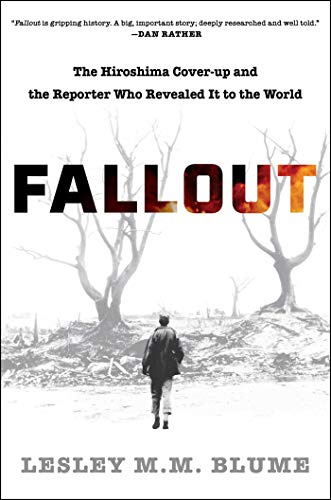 We’re in a storytelling crisis”: Advice for writing on nuclear issues, from the author of “Fallout” Bulletin of the Atomic Scientists, By Sara Z. Kutchesfahani | December 16, 2020 Storytelling is an important tool to change public perception. Recent research has shown that people are ready for nuclear weapons to enter the storytelling space, as long as these new stories are told in less intimidating ways and feature nuclear weapons in the background—rather than the forefront—of a story. Very few publications in the national security space provide a forum for storytelling, with the notable exception being the online publication Inkstick. We’re in a storytelling crisis”: Advice for writing on nuclear issues, from the author of “Fallout” Bulletin of the Atomic Scientists, By Sara Z. Kutchesfahani | December 16, 2020 Storytelling is an important tool to change public perception. Recent research has shown that people are ready for nuclear weapons to enter the storytelling space, as long as these new stories are told in less intimidating ways and feature nuclear weapons in the background—rather than the forefront—of a story. Very few publications in the national security space provide a forum for storytelling, with the notable exception being the online publication Inkstick.
How can nuclear policy experts become better storytellers? I thought Lesley M. M. Blume would have some prescient advice. Her new book powerfully shows how one courageous American reporter unraveled one of the deadliest cover-ups of the 20th century—the true effects of the atomic bomb—potentially saving millions of lives. Fallout tells the incredible story of how New Yorker journalist John Hersey of Hiroshima fame was able to go to the Japanese city in the aftermath of the bombing and interview six survivors. Even before the Japanese surrendered in 1945, the US government and military had begun a secret propaganda and information-suppression campaign to hide the devastating nature of nuclear weapons. The cover-up intensified as Allied occupation forces closed Hiroshima and Nagasaki to Allied reporters, preventing leaks about the horrific long-term effects of radiation that would kill thousands during the months after the blast. For nearly a year, the cover-up worked—until John Hersey got into Hiroshima and managed to report the truth to the world. As Hersey and his editors prepared his article for publication, they kept the story secret—even from most of their New Yorker colleagues. When the magazine published “Hiroshima” in August 1946 as a single issue, it became an instant global sensation, and it changed the US public’s perception of the dropping of the bombs virtually overnight from that of pride to that of visceral repulsion and existential fear. Hersey’s story brought home, for millions across the United States and around the world, the true implications of the then-new atomic age. On December 10, I interviewed Lesley about her brilliant book. We talked about how the publication of Hiroshima changed the US public’s perception of the bombs, the lessons learned, and how nuclear experts can become better storytellers. The transcript is below. [on original]. 2020. Blume’s book Fallout, published in August 2020, documents the Hiroshima cover-up and how a reporter – John Hersey – revealed it to the world. ………… Lesley M. M. Blume: There was the “before” Hersey’s Hiroshima, and then there was the “after” Hersey’s Hiroshima. Before Hersey’s book came out, the atomic bomb had been largely painted by the US government and military essentially as a conventional mega weapon. It was quickly becoming an accepted part of our conventional arsenal, even a tenable cost-saving weapon—it costs a lot less money to lob a nuke at somebody than it does to move troops into an area to wage combat—and, as such, there was a widespread acceptance of and enthusiasm about the weapon between August 1945 and August 1946. The bomb was normalized, in the public’s estimation, with surprising rapidity. [US President] Harry Truman himself referred to the bomb as just a “bigger piece of artillery.” After Hersey’s Hiroshima comes out, readers—and not just American readers, but readers around the world—are seeing what these then-experimental weapons indeed do to human beings, not just at the moment of detonation, but in the hours, days, weeks, months, and years to come. This is because Hersey was able to document the first part of the long tail of nuclear weapons, namely that they are the weapon that continues to kill indefinitely after detonation. The book immediately affected American attitudes: the vast majority of polled Americans in August 1945 were thrilled about the bombs because, they were told, the bombings had saved both American and Japanese lives, hastened the end of the war, and avoided a land invasion. Not only that, but they also viewed it as pure vengeance. When President Truman made his announcement about the Hiroshima bombing, he said that the Japanese had been repaid manyfold for Pearl Harbor. Many people agreed with him then, and they agree with him now; people are still passionate about the payback element of it……….. Lesley M. M. Blume: As I’ve been doing publicity for Fallout this fall since the book came out on August 4, I’ve been pretty shocked by an increased complacency toward the nuclear landscape, which the Bulletin of the Atomic Scientists has deemed the most perilous ever. I‘ve been shocked by how, here we are in the most perilous nuclear landscape in 75 years, how the nuclear threat is not on most people’s minds. And it certainly wasn’t a significant election issue by any stretch of the imagination. Whenever you would see these write ups about where the candidates stood on 10 or 12 issues such as trade with China, the pandemic, or climate change, the nuclear landscape was never one of them. The younger my interviewers were, the less concerned they were, and that’s because it hasn’t been a part of their psyche of what’s surrounding them—and not just because we’ve been dealing with other urgent existential threats like the pandemic and climate change……… And as the pandemic worsens, this issue is getting less and less attention. Fallout came out in the United Kingdom a few weeks ago, and there was no bandwidth for op-eds about staring down the nuclear threat. Nor was there much of an appetite among US editors for an op-ed advocating that the nuclear landscape be a bigger election issue—even among publications that gave Fallout considerable launch coverage. As vaccines start to roll in, and it’s the beginning of the end for the pandemic, we need to be anticipating the moment when the news landscape opens up enough for us to leap in and start to drive home the urgency of this threat. The nuclear challenges that still face us have never been resolved in 75 years—even during historical moments when world leaders put their all into creating de-escalation mechanisms, when whole populations were completely immersed in the dangers of the nuclear threat. We are now far from eras of peak awareness like the 1950s, 1960s, and 1980s, and we need to work really, really hard to create an increased awareness as soon as possible. Because with the pandemic, there’s a vaccine; with climate change, we can work to dial it back. But nuclear disaster on a global scale? There’s no coming back from that. As Albert Einstein said, “I know not with what weapons World War III will be fought, but World War IV will be fought with sticks and stones.” https://thebulletin.org/2020/12/were-in-a-storytelling-crisis-advice-for-writing-on-nuclear-issues-from-the-author-of-fallout/ |
|
Sleepwalking Toward the Nuclear Precipice
|
Sleepwalking Toward the Nuclear Precipice, The World Needs a Wake-Up Call, FOREIGN AFFAIRS, By Ernest J. Moniz and Sam Nunn, December 15, 2020,
One of the best accounts of the lead-up to World War I, by the historian Christopher Clark, details how a group of European leaders led their nations into a conflict that none of them wanted. Gripped by nationalism and ensnared by competing interests, mutual mistrust, and unwieldy alliances, “the Sleepwalkers,” as Clark dubs them, made a series of tragic miscalculations that resulted in 40 million casualties.
Around the world today, leaders face similar risks of miscalculation—except heightened by the presence of nuclear weapons. The United States and Russia together possess more than 90 percent of the world’s atomic arsenal but they share the stage with seven other nuclear powers, several of which are engaged in volatile rivalries. Whereas a century ago millions died over four years of trench warfare, now the same number could be killed in a matter of minutes. President-elect Joseph Biden, Vice-President-elect Kamala Harris, and their incoming national security team must confront the sobering fact that the potential for nuclear weapons use shadows more of the world’s conflicts than ever before. A single accident or blunder could lead to Armageddon. As a result, Biden will need to chart a new path on nuclear policy and arms control—one that creates new safeguards against accidental or ill-considered use of nuclear weapons and shores up international mechanisms that have long helped to keep the peace. UNTHINKABLE, BUT NOT IMPOSSIBLE The warning bells have been ringing for years. We wrote in Foreign Affairs more than a year ago (“The Return of Doomsday,” September/October 2019) about the elements that have destabilized the previous equilibrium and increased nuclear risks: where national interests clash, countries are making less use of dialogue and diplomacy than they once did; and as arms control structures have eroded, advanced missile systems, new technologies, and cyberweapons have appeared on the scene. Now, the COVID-19 pandemic has exposed the fragility of the international mechanisms for managing transnational risks and underscored the need for new cooperative approaches to anticipate and deal with threats. One lesson of COVID-19 is that the unthinkable does happen. And with nuclear weapons, the consequences would be even more devastating. To reduce the risk of nuclear accident or war, the Biden administration must reestablish nuclear dialogue with key nuclear states and other important powers. To be successful, however, it will have to build a working relationship with Congress, including with its Republican members, on issues that should be not just bipartisan but nonpartisan—such as arms control, nuclear policy, and diplomacy with other nuclear powers. U.S.-Russian relations are in a dismal state, but Washington and Moscow must once again acknowledge that they share an existential interest in preventing the use of nuclear weapons. The Biden administration and congressional leaders must also acknowledge that fact and work together to reverse the erosion of arms control dialogue and structures that have for many decades made the world a safer place. Dealing with adversaries in the nuclear arena calls for diplomacy, not posturing. Both the Biden administration and Congress must create the political space for the United States and Russia to renew military-to-military, diplomat-to-diplomat, and scientist-to-scientist engagement. NUCLEAR RESTARTThere is much Biden can do to signal an immediate shift in U.S. policy. ……. A WAR THAT MUST NEVER BE FOUGHTIn the long term, the Biden administration will need to make a sustained diplomatic effort to revive the many processes, mechanisms, and agreements that allow nations to manage their relations in peacetime and thus to avoid nuclear conflict. ……… The lesson of World War I is that mutual misunderstandings can lead even reluctant leaders into conflict. World leaders are once again sleepwalking toward the precipice—this time of a nuclear catastrophe. They must wake up before it is too late. https://www.foreignaffairs.com/articles/united-states/2020-12-15/sleepwalking-toward-nuclear-precipice |
|
Britain’s push for nuclear power makes no sense, unless it is a hidden subsidy for the Royal Navy

Britain’s push for nuclear power makes no sense, unless it is a hidden subsidy for the Royal Navy
The Government can fund a robust nuclear deterrent if it so desires, but should stop pretending that it is energy policy Telegraph, AMBROSE EVANS-PRITCHARD16 December 2020 – (subscribers only)
Green group raise toxic leak concern at Ranger Uranium Mine
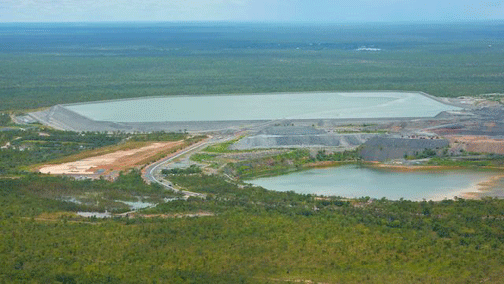
Green group raise toxic leak concern at Ranger Uranium Mine Environmental groups have raised concerns that remnants of a tailings dam at the closing Ranger Uranium Mine site could leak toxic contaminants into Kakadu National Park. – (subscribers only)
Unfinished Business: Rehabilitating the Ranger Uranium Mine
|
Unfinished Business: Rehabilitating the Ranger Uranium Mine https://sei.sydney.edu.au/publications/ranger-uranium-mine-report/ May 2019 Four decades of imposed uranium mining and milling by Energy Resources of Australia (ERA) and Rio Tinto is about to end at the Ranger uranium mine in Kakadu, leaving a heavily impacted site that requires extensive rehabilitation. Long contested by the area’s Traditional Aboriginal Owners, the Mirarr people, the mine site is completely surrounded by the dual World Heritage listed Kakadu National Park.This report is an independent assessment of the rehabilitation and mine closure process to date. It explores some of the concerns and constraints surrounding the rehabilitation and makes recommendations that seek to address these in order to improve the chances of the successful closure and rehabilitation of the Ranger Project Area.
The background research to this report was funded by FORMAS, the Swedish Research Council for Sustainable Development. Authors: Rebecca Lawrence and Dave Sweeney, Australian Conservation Foundation. |
|
Hypocrisy on steroids: Frydenberg backs witch-hunt on banks that won’t lend to miners
Hypocrisy on steroids: Frydenberg backs witch-hunt on banks that won’t lend to miners Janine Perrett, 16 Dec 20,
MYEFO is obviously not keeping the treasurer busy enough — he’s taken time out to sanction a controversial inquiry led by a climate-denying backbencher.
A Legacy of Contamination, How the Kingston coal ash spill unearthed a nuclear nightmare
While no one was killed by the 2008 coal ash spill itself, dozens of workers have died from illnesses that emerged during or after the cleanup. Hundreds of other workers are sick from respiratory, cardiac, neurological, and blood disorders, as well as cancers.
The apparent mixing of fossil fuel and nuclear waste streams underscores the long relationship between the Kingston and Oak Ridge facilities.
Between the 1950s and 1980s, so much cesium-137 and mercury was released into the Clinch from Oak Ridge that the Department of Energy, or DOE, said that the river and its feeder stream “served as pipelines for contaminants.” Yet TVA and its contractors, with the blessing of both state and federal regulators, classified all 4 million tons of material they recovered from the Emory as “non-hazardous.”
A U.S. Environmental Protection Agency analysis confirms that the ash that was left in the river was “found to be commingled with contamination from the Department of Energy (DOE) Oak Ridge Reservation site.
For nearly a century, both Oak Ridge and TVA treated their waste with less care than most families treat household garbage. It was often dumped into unlined, and sometimes unmarked, pits that continue to leak into waterways. For decades, Oak Ridge served as the Southeast’s burial ground for nuclear waste. It was stored within watersheds and floodplains that fed the Clinch River. But exactly where and how this waste was buried has been notoriously hard to track.
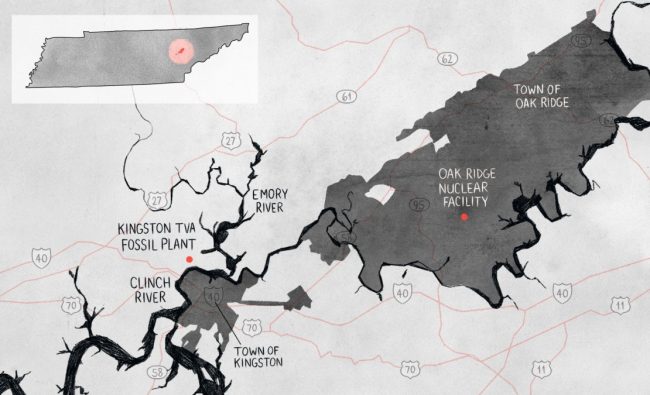
 A Legacy of Contamination, How the Kingston coal ash spill unearthed a nuclear nightmare, Grist By Austyn Gaffney on Dec 15, 2020 This story was published in partnership with the Daily Yonder.
In 2009, App Thacker was hired to run a dredge along the Emory River in eastern Tennessee. Picture an industrialized fleet modeled after Huck Finn’s raft: Nicknamed Adelyn, Kylee, and Shirley, the blue, flat-bottomed boats used mechanical arms called cutterheads to dig up riverbeds and siphon the excavated sediment into shoreline canals. The largest dredge, a two-story behemoth called the Sandpiper, had pipes wide enough to swallow a push lawnmower. Smaller dredges like Thacker’s scuttled behind it, scooping up excess muck like fish skimming a whale’s corpse. They all had the same directive: Remove the thick grey sludge that clogged the Emory.
The sludge was coal ash, the waste leftover when coal is burned to generate electricity. Twelve years ago this month, more than a billion gallons of wet ash burst from a holding pond monitored by the region’s major utility, the Tennessee Valley Authority, or TVA. Thacker, a heavy machinery operator with Knoxville’s 917 union, became one of hundreds of people that TVA contractors hired to clean up the spill. For about four years, Thacker spent every afternoon driving 35 miles from his home to arrive in time for his 5 p.m. shift, just as the makeshift overhead lights illuminating the canals of ash flicked on.
Dredging at night was hard work. The pump inside the dredge clogged repeatedly, so Thacker took off his shirt and entered water up to his armpits to remove rocks, tree limbs, tires, and other debris, sometimes in below-freezing temperatures. Soon, ringworm-like sores crested along his arms, interwoven with his fading red and blue tattoos. Thacker’s supervisors gave him a cream for the skin lesions, and he began wearing long black cow-birthing gloves while he unclogged pumps. While Thacker knew that the water was contaminated — that was the point of the dredging — he felt relatively safe. After all, TVA was one of the oldest and most respected employers in the state, with a sterling reputation for worker safety.
Then, one night, the dredging stopped.
Sometime between December 2009 and January 2010, roughly halfway through the final, 500-foot-wide section of the Emory designated for cleanup, operators turned off the pumps that sucked the ash from the river. For a multi-billion dollar remediation project, this order was unprecedented. The dredges had been operating 24/7 in an effort to clean up the disaster area as quickly as possible, removing roughly 3,000 cubic yards of material — almost enough to fill an Olympic-sized swimming pool — each day. But official reports from TVA show that the dredging of the Emory encountered unusually high levels of contamination: Sediment samples showed that mercury levels were three times higher in the river than they were in coal ash from the holding pond that caused the disaster.
Then there was the nuclear waste. Continue reading
Australia, the climate laggard, could lead the world: over to you, PM,
Australia, the climate laggard, could lead the world: over to you, PM, John Hewson, 16 Dec 20,
The world is watching Australia. We can seize this opportunity…….
The Usual Suspects: oil and gas majors star in Australian tax heist
The Usual Suspects: oil and gas majors star in Australian tax heist, Michael West 16 Dec 20,
Angus Taylor’s rescue package for the oil industry is a testament to governments getting gamed by large corporations. The latest Tax Office transparency data shows oil and gas juggernauts are Australia’s biggest tax cheats, again, yet now they are crying for public subsidies – and getting them – to prop up their oil refineries. Michael West reports on the good and the bad in multinational tax dodging land.
NSW to fast-track network approvals for first renewable energy zone — RenewEconomy

NSW grants priority status to transmission network upgrades, helping to fast-tracking approvals process for first Renewable Energy Zone and up to 3GW of new wind and solar. The post NSW to fast-track network approvals for first renewable energy zone appeared first on RenewEconomy.
NSW to fast-track network approvals for first renewable energy zone — RenewEconomy
Failure to produce an EV policy is the dumbest thing the Coalition has done — RenewEconomy

Federal Coalition could try to regain credibility with an EV strategy, and its failure to do so is probably the single dumbest thing it has done. The post Failure to produce an EV policy is the dumbest thing the Coalition has done appeared first on RenewEconomy.
Failure to produce an EV policy is the dumbest thing the Coalition has done — RenewEconomy
December 16 Energy News — geoharvey

Opinion: ¶ “Public Transit Is In Crisis, But Essential To Our Recovery” • The pandemic continues to rattle every aspect of our lives, and millions of people are still traveling less for work and other trips. Since most transit agencies in the US rely on farebox revenues, this use gap caused an unprecedented budget shortfall […]
December 16 Energy News — geoharvey
1 This month
15 April – Zoom –Nuclear Power is Not the Solution
Apr 15, 2026 01:00 AM in Canberra, Melbourne, Sydney

Join the International Physicians for the Prevention of Nuclear War (IPPNW) on Tuesday, April 14th for a timely webinar exploring the risks associated with nuclear power and challenging the myth that it offers a simple, safe, carbon-free solution to the climate crisis

of the week – Australians for War Powers Reform (AWPR)
To see nuclear-related stories in greater depth and intensity
 Antinuclear