Nuclear weapons abolition milestone is reached as ban treaty enters into force — IPPNW peace and health blog

The multinational Treaty on the Prohibition of Nuclear Weapons entered into force today, meaning that its prohibitions against developing, testing, producing, acquiring, possessing, stockpiling, and using or threatening to use nuclear weapons have now become part of the body of international law. A coalition of the world’s largest health federations welcomed the TPNW’s entry into force with a joint statement hailing the Treaty as “an essential step towards preventing the catastrophic humanitarian consequences of the use of nuclear weapons and a big win for planetary health.”
Nuclear weapons abolition milestone is reached as ban treaty enters into force — IPPNW peace and health blog
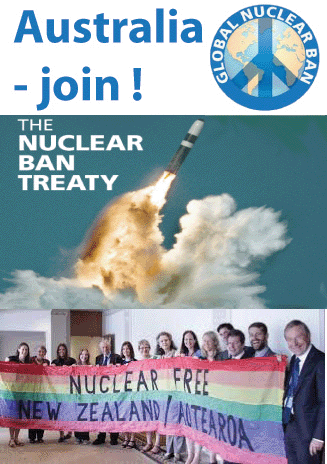
Morrison government gets in early to disparage nuclear ban treaty, but Labor supports it
 New nuclear treaty will be ‘ineffective’: DFAT, SMH, Anthony Galloway, January 21, 2021, Australia says a new United Nations nuclear treaty signed by more than 80 countries will be ineffective in eliminating nuclear weapons from the world.The Morrison government has not signed the Treaty on the Prohibition of Nuclear Weapons, which comes into effect on Friday.
The treaty, signed by 86 countries, bans signatories from testing, developing, producing, stockpiling or threatening to use nuclear weapons.
The Australian government decided not to sign the treaty on the basis that it failed to recognise the realities of the current international security environment.
Government sources confirmed there was concern about how the treaty would affect Australia’s dealings with the United States, including intelligence sharing through the Pine Gap satellite surveillance base near Alice Springs, because it banned signatories from doing anything to assist a nuclear weapon state in its nuclear plans.
New Zealand, which is part of the Five Eyes intelligence-sharing agreement with the US, Australia, Canada and Britain, has signed the treaty…….
Opposition foreign affairs spokeswoman Penny Wong said Labor welcomed the treaty.
“After taking into account the need to ensure an effective verification and enforcement architecture, the interaction of the treaty with the Nuclear Non-Proliferation Treaty, and achieve universal support, a Labor government would sign and ratify the treaty,” she said.
“Australia can and should lead international efforts to rid the world of nuclear weapons. A Labor government would work with our allies and partners to this end and would always act consistently with the US alliance.”
Helen Durham, director for international law and policy at the International Committee of the Red Cross, said all countries should sign the treaty as it was the “most explicit and clearest expression that the horrific weapons need to be banned”.
“It deals not only with their use but also with their threat of use, with their stockpiling, with their production, with their development and their testing,” she said.
“This treaty is a great opportunity to move a very stagnated, to date, agenda forward and we would encourage every state to take up this opportunity.”
Dave Sweeney, co-founder of the International Campaign to Abolish Nuclear Weapons, said the treaty was a “sign of hope for our planet”.
“The changed status of nuclear weapons means Australia faces a clear choice,” he said. “We either choose to be a responsible and lawful member of the global community or we remain silent and complicit in plans to fight illegal wars https://www.smh.com.au/politics/federal/new-nuclear-treaty-will-be-ineffective-dfat-20210121-p56vst.html
Kimba’s cosy nuclear corruption

Kimba’s Maree Barford new nuclear community liaison officer, Eyre Peninsula Tribune, Kathrine Catanzariti. AUGUST 24 2017
A Kimba local has been given the job of liaising between the community and government on all things nuclear.
National Radioactive Waste Management Facility Taskforce general manager Bruce McCleary announced on Thursday Maree Barford had been employed as community liaison officer – the first job created as a result of the community consulation on a potential National Radioactive Waste Management Facility at Kimba.
The announcement was made at the opening of a new project office in Kimba.
Mrs Barford moved to Kimba in December 2014 with her husband Shaun after they bought the lease for the Kimba Gateway Hotel.
Her role will be to liaise between the community and the government.
“I’ll be engaging with the community and then letting the government know what is happening in the community and their views,” Mrs Barford said.
She will start her role on Monday, working full-time from the project office.
“I think I can be the voice for the community, being the link between the town and the government.” ……
Barford would provide a permanent, local presence to help keep the community informed and involved in all activities, alongside the project team and other experts who would continue to visit Kimba……..
Australian government complicit in nuclear weapons, silent on Nuclear Weapons Ban Treaty
 Nuclear weapons illegal from 22 January https://www.miragenews.com/nuclear-weapons-illegal-from-22-january/ 21 Jan 21, As President Joe Biden takes charge in the United States – and is expected to immediately move to rejoin the Paris climate agreement – this week also sees a very significant shift in the global status of nuclear weapons. Nuclear weapons illegal from 22 January https://www.miragenews.com/nuclear-weapons-illegal-from-22-january/ 21 Jan 21, As President Joe Biden takes charge in the United States – and is expected to immediately move to rejoin the Paris climate agreement – this week also sees a very significant shift in the global status of nuclear weapons.On Friday 22 January the UN Treaty on the Prohibition of Nuclear Weapons takes effect, making nuclear weapons finally and formally illegal under international law. “This is a sign of hope for our planet,” said Dave Sweeney, ACF nuclear free campaigner and co-founder of ICAN, the International Campaign to Abolish Nuclear Weapons. “Nuclear weapons pose an existential threat. They are weapons of mass and indiscriminate murder. From this week, they are illegal under international law.” The treaty prohibits signatories from testing, developing, producing, stockpiling or threatening to use nuclear weapons. It also obliges parties to support the widespread adoption of the treaty and address the human and environmental impacts of nuclear testing. While the treaty cannot force non-signatories – including the USA, China and Russia – to disarm, it will increase the political, legal and economic pressure on these nations and their allies. The Morrison government has opposed the progress of the treaty and refuses to support or sign the initiative. Labor has committed to sign and ratify the treaty when it is next in government. The Greens and some cross benchers also support the treaty. “The changed status of nuclear weapons means Australia faces a clear choice,” Dave Sweeney said. “We either choose to be a responsible and lawful member of the global community or we remain silent and complicit in plans to fight illegal wars. “It’s time for Australia to be on the right side of law and history – this treaty is the best way to finally get rid of the world’s worst weapons. We should celebrate it and support it.” The ban follows years of advocacy led by ICAN, the International Campaign to Abolish Nuclear Weapons, which started in Melbourne in 2007 and was awarded the Nobel Peace Prize in 2017 for drawing attention to the catastrophic humanitarian consequences of any use of nuclear weapons and for its efforts to achieve a treaty-based prohibition of such weapons. ICAN briefing paper on the Treaty on the Prohibition of Nuclear Weapons and Australia /Public Release. The material in this public release comes from the originating organization and may be of a point-in-time nature, edited for clarity, style and length. View in full here. |
|
|
The 70-year nuclear gloom begins to lift on January 22
 Abolishing Nuclear Weapons: A New Chance, https://portside.org/2021-01-19/abolishing-nuclear-weapons-new-chance– 20 Jan 21, Abolishing Nuclear Weapons: A New Chance, https://portside.org/2021-01-19/abolishing-nuclear-weapons-new-chance– 20 Jan 21,
The 70-year nuclear gloom begins to lift on January 22, 2021. The nine countries that have held the world captive to the threat of nuclear war are losing moral ground to 122 smaller countries that approved the world’s first nuclear weapons ban. Anuclear darkness has engulfed the world for seven decades, with only intermittent breakthroughs of light when treaties among nuclear nations were negotiated. Some treaties have been violated for decades; others, walked away from by Trump. Any progress made on eliminating nuclear weapons has ceased. Worse, a new weapons upgrade is in the works by the nuclear nations. In 2009 President Obama spoke of the dream of a world without nuclear weapons, yet a handful of years later he put the U.S. on course to spend nearly $2 trillion on upgrading its nuclear weapons arsenal and delivery systems over a period of 30 years. Trump has augmented the budget for and added new nuclear weapons with threats to use them.
The 70-year nuclear gloom begins to lift on January 22, 2021. The nine countries that have held the world captive to the threat of nuclear war are losing moral ground to 122 smaller countries that approved the world’s first nuclear weapons ban in July 2017. Once 50 of those 122 approving countries completed the ratification process of the UN Treaty for the Prohibition of Nuclear Weapons in their legislatures, it became international law in October 2020. The law goes into effect January 22, 2021 to the profound relief of most people of the world. Those now 51 “freedom fighter” countries commit to having nothing to do with nuclear weapons – no design, testing, manufacturing, storage, transport, use or threat of use. Consider this a marathon for disarmament to outpace the current nuclear arms race in which all nuclear-armed countries are, in lockstep, upgrading their weapons. And this is only the beginning. Thirty five additional countries are in the process of ratifying the Treaty; 50 more support the Treaty; a dozen more have immense popular support, among them Canada, and are one election away from signing the Treaty. If the United States, where a majority of citizens does not want to use nuclear weapons, signed the Treaty, the rest would follow. Actions of note:
A limited nuclear war could trigger a global famine that would likely end billions of lives. A full scale nuclear war would end human and most other life on Earth, reminding us of the classical depiction of total war: they had to destroy the village to save it. A nuclear war, whether by accident, misjudgment or intention to destroy the enemy would destroy the rest of us as well – how insane is that? What then can President-elect Biden do? Open dialogue with and renew nuclear agreements and diplomacy with Russia immediately. Change US policy in 3 key ways: No first use of nuclear weapons; take weapons off of hair trigger alert; and select another senior official to share decision-making about “pressing the button.” Revive the agreement with Iran: they do not develop nuclear weapons, we lift sanctions. With South Korea, engage in diplomacy with North Korea to freeze and roll back their nuclear weapons program. Stop the new program of upgrading nuclear weapons. Listen to the world’s majority and lead the United States toward signing the new UN Treaty and the others will follow. It is our only solution to exit a dead-end system that permits a single human being, in the words of national security analyst Joseph Cirincione, “to destroy in minutes all that humanity has constructed over millennia.” Pat Hynes, retired from Boston University, is on the board of the Traprock Center for Peace and Justice https://traprock.org. |
|
|
Biden can’t ignore that continuing crisis -the danger of nuclear annihilation
|
Biden can’t lose sight of the nuclear crisis, https://www.washingtonpost.com/opinions/2021/01/19/biden-cant-lose-sight-nuclear-crisis/
by Katrina vanden Heuvel, Columnist, Jan. 20, 2021
At Wednesday’s inauguration, President-elect Joe Biden is likely to address the “four historic crises” he has repeatedly identified as confronting our country: a global pandemic, a severe recession, climate change and systemic racism. Yet even as so many challenges compete for our attention, we can’t afford to lose sight of a fifth crisis: the continued danger of nuclear annihilation. Overlooking the nuclear crisis might feel unthinkable for Americans who came of age during the Cold War, when nuclear destruction preoccupied our collective imagination. In 1983, for instance, 100 million Americans watched “The Day After,” a made-for-TV movie that depicted a potential nuclear holocaust. As detailed in a recent documentary, its haunting images — which included a mushroom cloud erupting over the plains of Kansas and scorching bodies in its blast radius — terrified viewers, including President Ronald Reagan. And it spurred our political leaders to join millions of grass-roots activists around the globe in taking action to prevent nuclear war. While nuclear conflict has largely faded from public consciousness, it still poses a clear and present danger. America is now locked in a new Cold War with Russia, with multiple direct engagements between the two countries’ forces and rising tensions between Russia and the United States’ NATO allies. Meanwhile, the United States and Russia still maintain nearly 2,000 atomic bombs on hair-trigger alert. It’s no wonder that, last year, the Bulletin of the Atomic Scientists adjusted its Doomsday Clock to reflect an increased likelihood of global annihilation. It is high time to step back from the brink of catastrophe. Fortunately, Biden has long championed stronger nuclear arms controls. And his administration can act immediately to make our world safer. Biden will have just two weeks to complete the first move, as the New Strategic Arms Reduction Treaty (New START) between the United States and Russia is set to expire on February 5. Negotiated by the Obama administration, the pact limits the capabilities of the two countries’ respective nuclear arsenals. Allowing it to lapse would represent yet another blow to the international arms control framework that protected us for decades and is being systematically dismantled. President George W. Bush, for instance, ended America’s Anti-Ballistic Missile Treaty with Russia. And President Trump pulled us from the Open Skies Treaty despite the pleas of our allies. The good news is that both Biden and Russian President Vladimir Putin have expressed willingness to reverse that dangerous trend and extend New START — which can be accomplished through a simple exchange of diplomatic letters. The Biden administration should make this goal an immediate priority. Preserving New START, while an important step, should also be exactly what it sounds like: a start. There are many other actions Biden should take to reduce the likelihood of nuclear conflict — and move our nation further toward the ultimate goal of abolishing all nuclear weapons. Former defense secretary William Perry and nuclear scholar Tom Collina outline a series of strong steps in their recent book, “The Button.” One key suggestion is retiring the nuclear football that gives presidents the sole discretion to launch atomic attacks. Even after Trump was banned from tweeting, he still wielded unfettered power to destroy the world. We can’t ever allow that situation to repeat itself. All subsequent presidents should have to share this authority with a select group from Congress. Biden should also scrap the Trump administration’s plans to spend $264 billion on a new generation of intercontinental ballistic missiles (ICBMs). These land-based weapons offer little military value, since our nuclear-armed submarines can already retaliate against another country’s first strike. And building more ICBMs only heightens our very real risk of accidentally launching a nuclear war. These actions should be accompanied by a broader reimagining of our national security. America is poised to spend $2 trillion over the next 30 years replacing every Cold War submarine, bomber, missile and warhead. These expenditures aren’t driven by military necessity or grand strategic plan, but they do have the support of hundreds of defense industry lobbyists. Protracted cold wars with powers like Russia and China aren’t just dangerous — they’re also expensive and distracting. And as America confronts multiple crises, we simply can’t afford to engage in them. We can prevent future conflicts by balancing sober realism with well-measured diplomacy — including reestablishing bonds with the many long-standing allies Trump spurned. As former governor Jerry Brown (D-Calif.) argued in a just-released open letter to Biden, reopening dialogue with Russia around the nuclear crisis would allow us to end the arms race and free up resources to enact the core elements of Biden’s agenda — from delivering covid-19 relief to combating climate change to advancing racial justice. While the destruction portrayed in “The Day After” no longer dominates our public consciousness, the threat of nuclear war remains a vital issue. Today, those who understand what is at stake should recapture the energy of previous generations and ensure our new administration understands the danger we face. In the words of Perry and Collina: “We need to bring the bomb into the new mass movement.” The president-elect must recognize both the danger — and the opportunity — at hand. |
|
|
Australian company Silex with Canadian company Cameco buys out GE-Hitachi Global Laser Enrichment LLC (GLE)
|
US government approves GLE restructure WNN, 19 January 2021 A proposed restructuring of GE-Hitachi Global Laser Enrichment LLC (GLE) has received the final key approval from the US government. The restructure will see Australian research and development company Silex Systems and Canadian company Cameco Corporation increase their holdings in the company to 51% and 49%, respectively.GLE has exclusive rights to commercially develop the SILEX laser isotope separation process technology under an agreement reached between GE (now GE-Hitachi) and Silex in early 2006. Cameco joined the project in mid-2008. GE-Hitachi in 2016 announced its decision to leave the venture, leading to GLE’s restructure. Silex and Cameco in December 2019 agreed to jointly purchase GE-Hitachi Nuclear Energy’s 76% interest for a total of USD20 million, and the three parties executed a binding Membership Interest Purchase Agreement (MIPA) for the restructure of GLE.
Silex yesterday said the US Department of the Treasury Committee on Foreign Investment in the United States (CFIUS) has approved the transaction under the terms of Section 721 of the Defense Production Act of 1950, after concluding that there are no unresolved national security concerns arising from the transaction. GLE earlier this month received notice from the US Nuclear Regulatory Commission (NRC) that it will be granted a stand-alone Facility Clearance, which will enable GLE to continue to operate under new ownership as a foreign owned entity, pursuant to closing of the MIPA…….. https://www.world-nuclear-news.org/Articles/US-government-approves-GLE-restructure |
|
Biden hits reset on US climate action – and turns up the heat on Morrison — RenewEconomy

One of Biden’s first acts as president was to see the US re-join the Paris Agreement, causing pressure on Morrison to do more on climate to ramp up another few notches. The post Biden hits reset on US climate action – and turns up the heat on Morrison appeared first on RenewEconomy.
Biden hits reset on US climate action – and turns up the heat on Morrison — RenewEconomy
Home battery uptake sets record highs in Victoria — RenewEconomy

New data shows Victoria closed out 2020 with records for solar battery rebate uptake and installation, as fortnightly allocations of discounted home batteries get “snapped up.” The post Home battery uptake sets record highs in Victoria appeared first on RenewEconomy.
Home battery uptake sets record highs in Victoria — RenewEconomy
Shaded, not stewed: Solar study examines how PV could protect fruit orchards — RenewEconomy

Victoria government study to examine how solar panels could be used to protect fruit orchards and other food crops from extreme heat events. The post Shaded, not stewed: Solar study examines how PV could protect fruit orchards appeared first on RenewEconomy.
Shaded, not stewed: Solar study examines how PV could protect fruit orchards — RenewEconomy
State governments key to unlocking rooftop solar for renters, says thinktank — RenewEconomy

New study finds coordinated state government policies could be key to breaking down the barriers to installing solar for renters. The post State governments key to unlocking rooftop solar for renters, says thinktank appeared first on RenewEconomy.
State governments key to unlocking rooftop solar for renters, says thinktank — RenewEconomy
January 20 Energy News — geoharvey

Opinion: ¶ “SpaceX Will Repurpose Oil Rigs To Build Starship Spaceport At Sea” • SpaceX is planning to use Gulf oil rigs off South Texas to build a Starship Spaceport. This seems extremely symbolic. SpaceX, founded by Elon Musk, is going to take something old, which has caused a lot of environmental problems, and use […]
January 20 Energy News — geoharvey
Principles of simple technologies — The Earthbound Report

I recently reviewed Philippe Bihouix’s book The Age of Low Tech, which makes the case for reducing our dependence on technological solutions to climate change. Instead, he argues that we should prioritise low tech solutions. A chapter of the book outlines the kind of thing he means, describing ‘the principles of simple technologies’. This reminded […]
Principles of simple technologies — The Earthbound Report
China delivers a surprise 2020 renewable boom, but it may not last — RenewEconomy

New data suggest a mind-boggling installation rate for wind power in China in 2020, but must be maintained for many more years to cut coal. The post China delivers a surprise 2020 renewable boom, but it may not last appeared first on RenewEconomy.
China delivers a surprise 2020 renewable boom, but it may not last — RenewEconomy
1 This month

of the week – Australians for War Powers Reform (AWPR)
To see nuclear-related stories in greater depth and intensity
 Antinuclear