Legislation banning nuclear power in Australia should be retained

Murdoch papers and Murdoch’s Sky News have ramped up their campaign to have nuclear laws repealed, and far-right Coalition MPs and former MPs are along for the ride. The post Legislation banning nuclear power in Australia should be retained appeared first on RenewEconomy.
Legislation banning nuclear power in Australia should be retained — RenewEconomy
State parliaments in NSW and Victoria have completed nuclear inquiries over the past two years but the governments of both states have no intention of repealing laws banning nuclear power.
The Morrison government established an inquiry into nuclear power in 2019 but made it clear that the federal ban would be retained regardless of the findings of the inquiry.
Nevertheless, supporters continue to campaign for the repeal of federal and state laws banning nuclear power. The Murdoch papers and Murdoch’s Sky News have ramped up their campaign to have those laws repealed.
Far-right Coalition MPs and former MPs are along for the ride.
And a tangled web of far-right conspiracists and fossil fuel interests: for example a recent article promoting nuclear power in Australia was written by a Policy Associate at the impressive-sounding Institute for Energy Research — the impressive-sounding, Koch-founded, fossil fuel-funded Institute for Energy Research.
There’s conflict within the Coalition, as demonstrated by the unwillingness of the federal and NSW Coalition governments to repeal legal bans, and submissions opposing nuclear power to the federal inquiry from the SA and Tasmanian conservative governments as well as the Queensland Liberal-National Party.
Coalition Senator Matt Canavan is at war with himself, previously noting that nuclear power would increase power bills but now supporting taxpayer funding for nuclear power through the Clean Energy Finance Corporation.
Yes, it’s entertaining watching the Coalition at war with itself over an energy source that has well and truly priced itself out of the energy debate and has instead found a home in the culture wars.
Former PM Malcolm Turnbull describes nuclear power as the “loopy current fad … which is the current weapon of mass distraction for the backbench”.
But there’s a serious side to the problem.
Firstly, the promotion of nuclear power muddies the energy debate and helps to delay the transition from fossil fuels to renewables. Economist Prof. John Quiggin notes that, in practice, support for nuclear power in Australia is support for coal.
Secondly, politicians who are silly enough to promote nuclear power over cheaper renewables would probably be silly enough to gift billions of dollars of taxpayer subsidies to nuclear companies.
And not all of these MPs are fringe figures like Craig Kelly — some have real clout such as NSW Deputy Premier John Barilaro, former Deputy Prime Minister Barnaby Joyce, and former PM Tony Abbott (who thinks the Coalition should promote nuclear power to “create a contest” with unions, GetUp, the Greens, the ALP and the “green left“.
There are plenty of recent examples demonstrating how badly nuclear power projects can go wrong.
All of the recent projects in the US and western Europe have cost about A$20 billion per reactor and all of them are at least A$10 billion over budget and many years behind schedule.
Multi-billion-dollar taxpayer and ratepayer subsidies for these failed projects have been ever-expanding. It would be naïve to expect a better outcome — in other words, a non-disastrous outcome — in Australia given our lack of experience and expertise.
Thirdly, culture wars based on lies and conspiracy theories can escalate beyond anyone’s wildest imagination, as we see with the MAGA movement in the US.
There has to be push-back against irrational ideologues lest they become dangerous irrational ideologues.
The rest of this article summarises the reasons to oppose nuclear power in Australia and to keep legal bans in place. This summary comes with the caveat that rational arguments won’t shift the culture warriors; a cult deprogrammer might shift them, but not rational arguments.
Nonetheless, the rest of the population needs to be inoculated against the misinformation of the ideologues. Continue reading
Australian government’s nuclear waste plans unacceptable – Dr Margaret Beavis
 Long-term impact of quick nuclear dump fix https://indaily.com.au/opinion/2021/02/23/long-term-impact-of-quick-nuclear-dump-fix/Legislation to set up a national nuclear waste storage site on South Australia’s Eyre Peninsula is being debated by federal parliament. Margaret Beavis argues that both the site selection process and storage plans for long-lived intermediate nuclear waste are unacceptable. Long-term impact of quick nuclear dump fix https://indaily.com.au/opinion/2021/02/23/long-term-impact-of-quick-nuclear-dump-fix/Legislation to set up a national nuclear waste storage site on South Australia’s Eyre Peninsula is being debated by federal parliament. Margaret Beavis argues that both the site selection process and storage plans for long-lived intermediate nuclear waste are unacceptable.
Today, the government is planning a Senate vote to lock in moving highly radioactive nuclear waste to Kimba. This bill will deny any judicial oversight or review, despite major flaws in the proposal. However there is no rush to find a home for Australia’s nuclear waste. The federal nuclear regulator, ARPANSA, has been crystal clear; the nuclear waste at the ANSTO Lucas Heights reactor can stay there safely for decades. Claims that moving the waste is urgently needed to continue nuclear medicine in Australia are patently false. As a GP, I use nuclear medicine and ongoing access is necessary. Other arguments that we need to consolidate nuclear waste at one site are misleading, given hospitals will be handling waste for as long as there is nuclear medicine. Hospitals currently manage their own nuclear medicine wastes on a ‘delay and decay’ basis on site; after use in a patient, the waste very rapidly loses its radioactivity. After a few months the vast majority is safe enough to go to a normal rubbish tip. There will always be multiple sites. Many South Australians would be unaware that this proposed “temporary storage” of nuclear waste in Kimba is a second-rate cheap solution. World’s best practice requires deep geological disposal, which costs a lot more. Countries such as Finland have spent over 40 years researching locations and properly involving communities. They are only now building a deep geological repository, at a cost of over A$5 billion In contrast, the Kimba plan will cost shift onto future generations, who will be left to do the job properly at great expense. Indeed, whilst the government promises to move the waste yet again some decades hence, there are no plans whatsoever for proper longer-term disposal. It is highly likely to end up stranded at Kimba and a significant liability for South Australians. In addition to the dodgy storage proposal, there are many other flaws. The big ones include: four years of a misleading government marketing campaign, a deciding vote using a biased sample of residents and a complete disregard of profound opposition by the Traditional Owners. The site selection process has been poor. The community has endured several years of very one-sided marketing, and remains deeply divided on the issue. Low-level waste has been the major focus thoughout, yet the elephant in the room is the intermediate waste that is radioactive for over 10,000 years. The community vote was based on town boundaries, which biased the sample towards businesses who may profit from the facility. It excluded farmers who are closer to the site than the township. At the alternative Hawker site last year, a much less biased vote with a 50 km radius was used, and the waste was clearly rejected. This current proposal also rides rough shod over the clear opposition of the traditional owners. In April 2020 the Federal Parliament’s own Joint Committee on Human Rights found the National Radioactive Waste Management Act does not sufficiently protect the Barngarla’s rights and interests. The Federal Government admits its proposed legislation will deny farmers, Traditional Owners and other interested parties a right to a judicial review. Indeed, the legislation is designed to do just that. This bill locks in a second-rate process for a second-rate facility that will be a major future liability for South Australians. Highly radioactive intermediate level nuclear waste is going to be with us for a very, very long time. There is plenty of time to do it right. We need a proper disposal plan, not moving the waste unnecessarily to a temporary store and leaving it for our kids to pay for. This waste is highly radioactive for millennia. If this legislation passes, it will come back and haunt South Australians for generations to come. Margaret Beavis is a GP and vice president of the Medical Association for Prevention of War. |
|
Assange’s partner exposes ongoing denial of his legal and democratic rights,
 Assange’s partner exposes ongoing denial of his legal and democratic rights, https://www.wsws.org/en/articles/2021/02/22/assa-f22.html?pk_campaign=assange-newsletter&pk_kwd=wsws, Oscar Grenfell, 21 February 2021 In an online post last week, Stella Moris, the partner of Julian Assange and mother of his two young children, outlined the ongoing denial of the WikiLeaks founder’s fundamental legal and democratic rights, even after a British Magistrates’ Court ruled early last month against his extradition to the United States. Assange’s partner exposes ongoing denial of his legal and democratic rights, https://www.wsws.org/en/articles/2021/02/22/assa-f22.html?pk_campaign=assange-newsletter&pk_kwd=wsws, Oscar Grenfell, 21 February 2021 In an online post last week, Stella Moris, the partner of Julian Assange and mother of his two young children, outlined the ongoing denial of the WikiLeaks founder’s fundamental legal and democratic rights, even after a British Magistrates’ Court ruled early last month against his extradition to the United States.
Moris provided a succinct summary of the issues of democratic principle at stake, in the US attempt to prosecute Assange for lawful publishing activities that exposed war crimes, and updated his supporters on the current stage of the legal campaign to secure his freedom. The January 4 verdict, forbidding extradition, had “taken into account” the “extensive medical evidence” presented during last year’s trial, Moris explained. Assange’s dispatch to the US had been blocked on the grounds that it would be “oppressive.” His health issues, including serious depression, and the brutal character of the US prison system, meant there would be a great risk of Assange taking his own life if he were extradited. The US immediately responded, in the final days of the administration of President Donald Trump, by formally signalling an appeal. Trump’s Democratic Party successor, President Joe Biden, in his first weeks in office, rejected calls by civil liberties and press freedom organisations for the US Department of Justice to drop its pursuit of Assange, demonstrating the bipartisan character of the persecution. The High Court will decide after March 29 whether prosecutors, acting on behalf of the US state, will be permitted to proceed with their appeal. Moris stated that the next stage for the defence was to submit a response to the US grounds of appeal. She then reviewed the anti-democratic implications of Judge Vanessa Baraitser’s January 4 ruling. It had denied Assange’s extradition on health grounds, but “did not side with him on the wider public interest arguments.” Baraitser had upheld virtually all of the prosecution’s substantive arguments, effectively green-lighting future attempts by governments to prosecute journalists and publishers for exposing material that they deem to be “classified” and of “national security” significance, regardless of the public interest of what is exposed. Continue reading |
The remediation of Ranger uranium mine: will it really restore the environment?
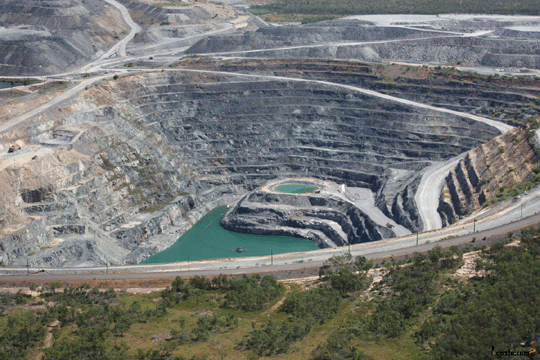
Traditional owners were given land rights in return for their support for the Ranger mine, and Kakadu National Park was born. ……. the land will finally be returned to the traditional owners… the question is, in what state? ……… we could find the site an eroding heap of substandard scrub.
As part of cleaning up the mine site, contaminated buildings and equipment will be buried in one of the mine’s enormous pits.
We’ve been told that burying the equipment and the contaminated material in the mine site is out of step with global best practice in the mining industry.
|
Kakadu in crisis, ABC 22 Feb 2021, Crisis in Kakadu: The turmoil threatening Australia’s biggest national park
“It’s gone downhill. No one basically trusts anybody, no one respects each other anymore. That’s how bad it is here.” Traditional owner Kakadu is one of the great natural wonders of the world. The stunning landscape, teeming with wildlife, is a major tourist destination with scores of Instagram friendly sites. For tourism operators it is an iconic symbol of what Australia has to offer. “It’s one of the most special places in Australia. It’s for so long been one of the reasons why people visit Australia and for Australians, one of their must do life experiences.” Tourism industry representative Despite its beauty, there is trouble inside Australia’s biggest national park. This World Heritage listed site is in crisis. “It’s an absolute mess because the institutions responsible for fixing it up aren’t doing their job.” Traditional owner On Monday Four Corners investigates accusations of mismanagement and neglect which have fuelled a bitter dispute between the park’s traditional owners and the authority that runs the park. |
The media revels in rockets to Mars, ignores the horrible risk of plutonium pollution
|
Plutonium, Perseverance and the Spellbound Press https://www.dailykos.com/stories/2021/2/24/2017916/-Plutonium-Perseverance-and-the-Spellbound-Press
With all the media hoopla last week about the Perseverance rover, frequently unreported was that its energy source is plutonium—considered the most lethal of all radioactive substances—and nowhere in media that NASA projected 1-in-960 odds of the plutonium being released in an accident on the mission. “A ‘1-in-960 chance’ of a deadly plutonium release is a real concern—gamblers in Las Vegas would be happy with those odds,” says Bruce Gagnon, coordinator of the Global Network Against Weapons and Nuclear Power in Space. Indeed, big-money lotteries have odds far higher than 1-in-960 and routinely people win those lotteries. Further, NASA’s Supplementary Environmental Impact Statement (SEIS) for the $3.7 billion mission acknowledges that an “alternative” power source for Perseverance could have been solar energy. Solar energy using photovoltaic panels has been the power source for a succession of Mars rovers. For an accident releasing plutonium on the Perseverance launch—and 1 in 100 rockets undergo major malfunctions on launch mostly by blowing up—NASA in its SEIS described these impacts for the area around the Cape Kennedy under a heading “Impacts of Radiological Releases on the Environment.” Continue reading |
National Farmers Federation want govt to support renewable energy (not coal or nuclear)
released on Tuesday, the NFF makes the call for renewable energy to be part
of new investment to address the $3.8bn annual shortfall in infrastructure
in regional Australia. The paper, which makes no mention of coal or nuclear
energy supporting jobs in the regions, comes as the Nationals push for the
Clean Energy Finance Corporation to invest in those technologies.
Summary of the risks of uranium mining
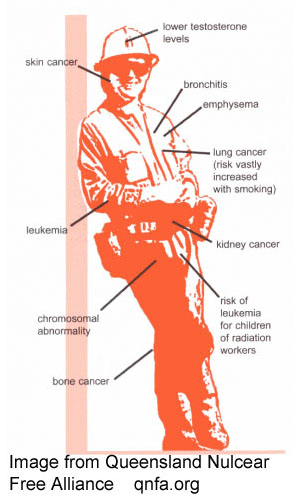 Greg Phillips, 25 Feb 21, This is a very good summary of the risks of Uranium mining:
/catalog/13266/uranium-mining-in-virginia-scientific-technical-environmental-human-health-and
American uranium/nuclear lobbyists fund campaigns of climate sceptics/deniers
|
Campaign contributions, including from a Utah operator, preceded creation of federal uranium stockpile, Salt Lake Tribune, Zak Podmore Feb. 23, 2021
“………….Funding climate skeptics Energy Fuels executives, including Moore, who sits on the board of Friends of Arches and Canyonlands Parks, often promote the important role nuclear energy plays in combating climate change.
A recent sustainability report released by the company states, “The materials that Energy Fuels responsibly produces and recycles are helping to address some of the most daunting health and environmental issues facing the world today: air pollution and climate change.”
But campaign contributions from uranium executives have funded the campaigns of climate change skeptics in Congress. Barrasso opposed the Obama administration decision to sign onto the Paris climate agreement in 2016, and as recently as 2019, he declined to concede human use of fossil fuels is the leading cause of climate change in an interview with the Washington Examiner.
Other recipients of campaign contributions — including then-President Trump, Sen. Cynthia Lummis, R-Wyo., and Gosar — have been even more outspoken in their climate change skepticism.
Moore said the contributions skewed heavily toward the GOP because Republicans are most likely to represent districts where the company has uranium operations, and noted that several Democrats have also received donations. Rep. Henry Cuellar of Texas, for example — a conservative Democrat who last year fended off a high-profile primary challenge from left-wing immigration attorney and climate activist Jessica Cisneros — received $1,000 from an Energy Fuels executive during the primary…… https://www.sltrib.com/news/2021/02/20/campaign-contributions/
|
|
Coal giant AGL again tops list of Australia’s biggest emitters — RenewEconomy

Coal generators and oil and gas producers dominate latest list of Australia’s largest emitters. The post Coal giant AGL again tops list of Australia’s biggest emitters appeared first on RenewEconomy.
Coal giant AGL again tops list of Australia’s biggest emitters — RenewEconomy
Morrison’s media code could be catastrophic for climate and energy news — RenewEconomy

Google’s decision to snub RenewEconomy – apparently because it does not do “public interest” journalism – and include Sky News and a celebrity gossip site on its “showcase, bodes ill for Australian media. The post Morrison’s media code could be catastrophic for climate and energy news appeared first on RenewEconomy.
Morrison’s media code could be catastrophic for climate and energy news — RenewEconomy
Neoen lands $160 million in CEFC finance for Australia’s biggest battery — RenewEconomy

Neoen lands $160 million in finance from CEFC to fund the Victoria Big Battery, which will be the biggest in Australia. The post Neoen lands $160 million in CEFC finance for Australia’s biggest battery appeared first on RenewEconomy.
Neoen lands $160 million in CEFC finance for Australia’s biggest battery — RenewEconomy
“We don’t have a credible climate policy:” Sport stars want stronger targets — RenewEconomy

Australia’s summer of sport under threat from more frequent heat waves and bushfires, sport stars issue a joint call for greater action on climate change. The post “We don’t have a credible climate policy:” Sport stars want stronger targets appeared first on RenewEconomy.
“We don’t have a credible climate policy:” Sport stars want stronger targets — RenewEconomy
February 24 Energy News — geoharvey

Science and Technology: ¶ “A Solar Panel In Space Is Collecting Energy That Could One Day Be Beamed To Anywhere On Earth” • Scientists working for the Pentagon have successfully tested a satellite solar panel the size of a pizza box, that was designed as a prototype for a future system to send electricity from space […]
February 24 Energy News — geoharvey
1 This month

of the week – Australians for War Powers Reform (AWPR)
To see nuclear-related stories in greater depth and intensity
 Antinuclear