TODAY. Two ways of looking at the world

There is certainly a transformation going on in the media. As far as news media goes, there’s a growing chasm between the “mainstream” corporate media, and the “alternative” media.
To give the most topical example – the coverage of the Ukraine war, by the Western media. The permitted themes are – “atrocities by Russians” “Ukraine is winning”, “Zelensky is a hero”. Any more nuanced views (e.g atrocities by Ukrainians) are covered only by the alternative media.
We see and hear only the big guys (and believe me, they’re very much the guys – though wherever possible they push attractive younger women to the forefront). The result is a glorification of big corporate, military, technical, ways to deal with problems, as against more low-key approaches – stuff like negotiation, compromise, diplomacy.
This gulf is happening also in education. Science, Technology, Engineering, Mathematics, are now not just very important (which they are), but are now accepted as pretty much the only subjects that matter. The sissy stuff – languages, literature, art, history – are now second-rate studies.
There is a trend now, for people to distrust the corporate media, because it is too close to government, the military, and industry.
Meanwhile, alternative media of all kinds are multiplying. In amongst all this, are the voices of the “smaller” people – women, indigenous , old, young – keeping alive the culture of art, humanity, hope and peace. This alternative culture is surely what we need, rather than the pompous chest-thumping of the world’s political, military, corporate, financial and media leaders.
Nuclear safety agency silent on disposal of AUKUS radioactive waste
By Brian TooheyMar 21, 2023 https://johnmenadue.com/nuclear-safety-agency-silent-on-disposal-of-aukus-radioactive-waste/
At this stage there is little interest in how to dispose of the high level uranium waste from AUKUS SSNs, let alone put First Nations voices to the fore.
This is unlikely to change while the nation’s most prominent journalists see it as their job to promote the dominant military doctrine and boost the demonisation of China, while rubbishing inconvenient interlopers such as the former prime minister Paul Keating.
I recently asked Australia’s principal nuclear safety organisation, the Australian Radiation Protection and Nuclear Safety Agency (ARPANSA), “What’s required to safely dispose of highly enriched uranium (over 90%) and for how long e.g. in stable underground rock formation?” Not a hard question you might suppose. However, the media officer replied, “ARPANSA is unable to provide a response in this instance”.
I then asked without success, “Why not?” This is a timid answer from an organisation supposed to provide the public and others accurate information on big issues in its field.
My question followed the defence minister Richard Marles’ announcement that Australia will take all the nuclear waste generated by the reactors in its newly acquired nuclear submarines which use highly enriched, weapons grade, uranium. Marles’ statement that the uranium waste would be kept “on” defence land shows he lacks a grip of what’s involved.
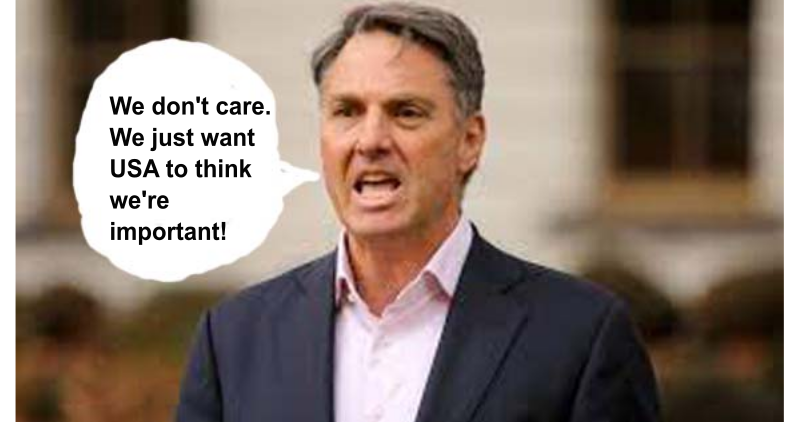
He’s not dealing with low-grade radioactive hospital waste that can be stored on the surface. At a minimum, the reactor waste will have to be kept deep underground, probably vitrified, and guarded for centuries. Marles says nothing needs to be done for 50 years. This will not be the case if Australia initially gets three to five second-hand US submarines whose high level waste will need to be dealt with much sooner.
Despite the US and the UK’s long experience with nuclear weapons, neither has a high-level underground nuclear waste repository. In these circumstances, Australia could easily be pressured into securing the waste created by the US and UK submarines’ nuclear reactors.
At this stage, it seems likely the burial site will be on land important to Australia’s indigenous population. Whatever happens, it is essential there is no repeat of the neglect of the indigenous people who were wilfully exposed to radiation during and after the British nuclear tests in the 1950s and 60s in Australia’s south and central desert areas. The case for getting nuclear submarines is already bad. They should be ruled out entirely if the indigenous population rejects the proposed waste burial sites, which need to be identified urgently, rather than at Marles’ leisurely timetable.
At this stage there is little interest in how to dispose of the high level uranium waste, let alone put indigenous inhabitants to the fore. This is unlikely to change while the nation’s most prominent journalists see it as their job to promote the dominant military doctrine and boost the demonisation of China, while rubbishing inconvenient interlopers such as the former prime minister Paul Keating. It doesn’t help either that they some are largely ignorant of the issues.
Many journalists put great faith in intelligence briefings from right wing ideologues and others about the alleged threat from China. They claim Keating can’t say anything of value because he hasn’t received an intelligence briefing in decades. On the contrary, this is a distinct advantage.
Keating’s detractors need to pay a lot more attention to the role intelligence played in the illegal invasion of Iraq. The recent 20th anniversary of the invasion, led by George Bush, Tony Blair and John Howard, received little attention in Australia. This act of aggression was justified by concocted intelligence. Howard falsely claimed that at the time of the invasion his government “knew” Iraq possessed weapons of mass destruction. Thanks largely to the much-disparaged weapons inspectors, Iraq certainly didn’t have any. Yet Howard falsely said they did and were “capable of causing destruction on a mammoth scale”.
Many Australian journalists now rely on purported intelligence and propaganda for their flimsy claims about Chinese acts of aggression, which barely rank alongside the death and destruction wrought by the US aided by Australia. Chinese journalists also rely excessively on government sources, but have almost no influence in Australia.
The White House, for example, engaged in a blatant act of propaganda when unveiling the plan for Australia to get nuclear submarines. It claimed, “For over 60 years, the UK and the US have operated more than 500 naval nuclear reactors . . . without incident or adverse effect on human health or the quality of the environment.” In fact, two US nuclear submarines, the Thresher and the Scorpion, sunk during that period with the loss of all lives on board. Mainstream Australian journalists have not treated this as a staggering falsehood that should be condemned.
Mainstream journalists also have little grasp of other issues involving submarines. One recently claimed that Keating, who opposes Australia buying nuclear submarines, didn’t understand that conventional submarines have to go close to the surface to recharge their diesels by what’s called a “snorting”, a process, where they risk detection. This journalist seemed to have no awareness that modern conventional submarines greatly reduce this risk with Air Independent Propulsion, which uses hydrogen fuel cells to operate extremely quietly for at least three weeks. Using modern batteries can provide another three weeks, or more, of silent operation before charging the batteries in a safe location. They are also much cheaper than nuclear submarines which are detectable from a range of sources, including heat and the wake they leave on the surface at high speed. By the time Australia’s new nuclear submarines arrive around 2050 there is a high chance that advances in sensor technology and computing power will make them relatively easy to detect and destroy.
Although the public currently likes the idea of getting nuclear submarines, it doesn’t like the cost which Marles puts at $268 billion to $368 billion by 2055. The public may like it even less if they realise that the Virginia Class submarines of which we are still get up to five, have an appalling maintenance record. If we got eight, as originally intended, only two would be operationally available on average. Paying $368 billion to have two operationally available would be a scandalous result. Modern conventional submarines, such as German ones, have an exemplary maintenance record and cost about $15 billion for ten.
Australia’s oldest gas power company urges customers to go electric — RenewEconomy

AGL Energy has launched a website to simplify the process of quitting gas and accessing the benefits of a more electric and energy efficient home. The post Australia’s oldest gas power company urges customers to go electric appeared first on RenewEconomy.
Australia’s oldest gas power company urges customers to go electric — RenewEconomy
UN calls on OECD nations to quit coal by 2030, reach net zero by 2040 — RenewEconomy

In case they missed the message from the IPCC, UN chief delivers the cold hard facts on climate and fossil fuels, and calls for a Solidarity Pact. Who’s in? The post UN calls on OECD nations to quit coal by 2030, reach net zero by 2040 appeared first on RenewEconomy.
UN calls on OECD nations to quit coal by 2030, reach net zero by 2040 — RenewEconomy
1 This month
15 April – Zoom –Nuclear Power is Not the Solution
Apr 15, 2026 01:00 AM in Canberra, Melbourne, Sydney

Join the International Physicians for the Prevention of Nuclear War (IPPNW) on Tuesday, April 14th for a timely webinar exploring the risks associated with nuclear power and challenging the myth that it offers a simple, safe, carbon-free solution to the climate crisis

21 April Webinar: No Nuclear Weapons in Australia
Start: 2026-04-21 18:00:00 UTC Canberra, Melbourne, Sydney (GMT+10:00)
End: 2026-04-21 19:30:00 UTC Canberra, Melbourne, Sydney (GMT+10:00)
Event Type: Virtual
A virtual link will be communicated before the event.
Host Contact Info: australia@icanw.org

of the week – Australians for War Powers Reform (AWPR)
To see nuclear-related stories in greater depth and intensity
 Antinuclear