Australian Strategic Policy Institute (ASPI) flexes its muscles – forces the ABC to back down on a Media Watch show that dared to criticise ASPI
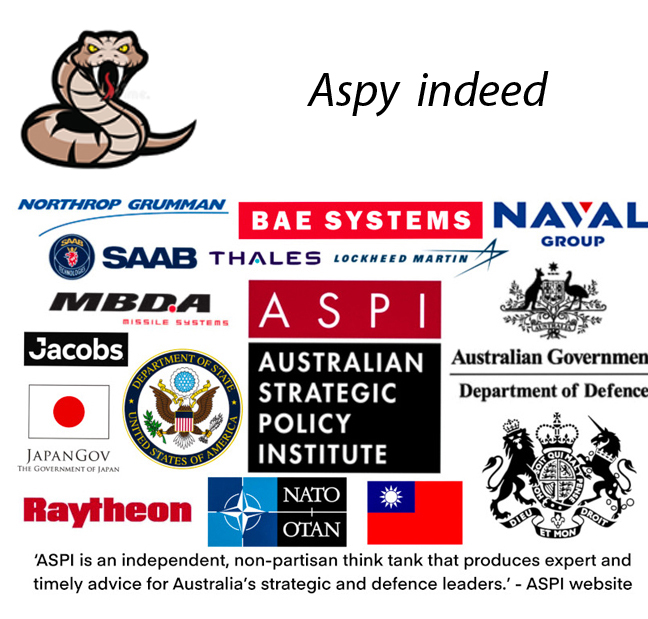
Despite ASPI telling Media Watch it only has four defence industry sponsors, page 143 of its latest annual report clearly lists five. Since its establishment, ASPI has enjoyed the financial largesse of a dozen weapons makers, which collectively picked up $51 billion in Defence contracts between 2011 and 2021.
ASPI conveniently classifies sponsors who make billions of dollars supplying mainly high-tech services to the military as “private sector” companies.
ASPI takes exception to media scrutiny, By Ainslie Barton, https://johnmenadue.com/aspi-takes-exception-to-media-scrutiny/ 25 Mar 23,
ABC’s Media Watch backs down, following complaint from Australian Strategic Policy Institute, after it aired a segment of Channel Nine political reporter Chris O’Keefe berating both ASPI and Nine Newspaper over the Red Alert series.
Two weeks ago, ABC’s Media Watch carried the banner “Hysterical reporting stokes fears of war with China” aimed at Nine Newspapers’ three-part Red Alert series in the Sydney Morning Herald and The Age. Host, Paul Barry took them to task for gathering a one-sided China hawk panel upon which to base its report. The program included comments from a host of experts who strongly disagree with the proposition that China is poised for war.
It also quoted from mainstream media, including a clip from Nine’s Today Show in which political correspondent Chris O’Keefe had this to say, “The reporting this morning is hysterical, now if you’ve got the Australian Strategic Policy Institute [ASPI] who are saying ‘Oh well, we are the ones who could be going off to war in three years’, well they’re funded by the Australian Defence Force, Lockheed Martin, Thales and Boeing.”
Barry later brought up one of Nine’s China experts, former ASPI boss Peter Jennings, making it clear he was no longer the think tank’s executive director.
This week, Media Watch again picked up the China threat and nuclear submarine debate, following former prime minister Paul Keating’s National Press Club appearance. In summary, Barry argued instead of mainstream journalists just launching into Keating for opposing AUKUS, they should have been doing their actual jobs. That job is not being cheerleaders for our massively hawkish foreign and defence policies, it’s asking questions about the government’s rationale to commit hundreds of billions of dollars to nuclear submarines.
However, at the end of the episode, it was Barry himself coming up with explanations, saying this, “And finally, a clarification about last week’s show. When discussing Nine’s Red Alert series on China we played a short clip of Chris O’Keefe linking Peter Jennings to the Australian Strategic Policy Institute. ASPI says Jennings no longer plays an active role with the institute and it was not involved in the framing of The Age and Herald’s report. ASPI also says it receives funding from only four defence manufacturers and it’s two percent of its budget.”
Even though the hot war may not have yet started the fog created by ASPI abounds.
Jennings is synonymous with ASPI, outside of Canberra he was a little-known Liberal ministerial adviser and a Defence Department policy wonk. It wasn’t until he took up the role at ASPI that he became the go to China hawk for mainstream media.
He might have vacated the executive director’s office but the views he expressed in the Nine Newspapers series are entirely consistent with his views at ASPI, and indeed the views of his successor Justin Bassi.
Despite ASPI’s constant claim of independence, Bassi walked right out of the office of Liberal Cabinet Minister Marise Payne into ASPI’s office, just a few blocks from Parliament House. He was a ‘captain’s pick’ with it widely reported then Defence Minister Peter Dutton intervened to veto the ASPI board’s preferred candidate, instead installing China hawk Bassi. The appointment of the ASPI executive director has to be ratified by the Cabinet, indeed a very broad interpretation of the term “independent”.
What constitutes no active role?
Jennings might have vacated his corner office but, the simple fact is, immediately upon the completion of his tenure, he assumed the position of “ASPI Senior Fellow”. His profile is on the ASPI website, his phone number is included, and that number is the ASPI direct line.
As ASPI complained, it might not have framed the Nine Newspapers report, but it absolutely framed the narrative. No single group has done more to portray China as a military threat than ASPI. There is an argument, had ASPI not spent years laying the China threat groundwork, this Nine Newspapers series would not have hit the front pages.
While Bassi had nothing to do with the Red Alert series, one could hardly argue he didn’t support it, after all he Tweeted a link to the SMH story the day of publication.
Far more egregious than this and the nature of Jennings’ ongoing connections with ASPI are those of Nine Newspapers’ gang of five experts. One in particular is Lavina Lee, who Nine described as a “geopolitics guru” and “senior lecturer in the Department of Security Studies and Criminology at Macquarie University”.
What both Nine in its publications, and presumably ASPI in its demands to Media Watch, did not disclose is Lee’s position as a member of the ASPI Council. This is not an honorary role, as the ASPI Annual Report reveals, it is a paid position.
The issue with Lee is not so much the freedom to express her opinions outside of her role at ASPI. It’s the fact she was peddling a narrative indistinguishable from ASPI’s, under the guise of being an independent academic, and did so without disclosing her formal paid role with the think tank.
Breaching the defences
Despite ASPI telling Media Watch it only has four defence industry sponsors, page 143 of its latest annual report clearly lists five. Since its establishment, ASPI has enjoyed the financial largesse of a dozen weapons makers, which collectively picked up $51 billion in Defence contracts between 2011 and 2021.
ASPI conveniently classifies sponsors who make billions of dollars supplying mainly high-tech services to the military as “private sector” companies.
One of its, non-defence industry, backers is the multi-billion dollar US engineering and systems integration company Leidos which has a substantial defence division. According to figures published on the Department of Finance website, since July 2021, it has been awarded more than 140 contracts, with the Department of Defence and security agencies, worth over $1 billion. The classification of Leidos as a run of the mill private sector player seems to be a loose definition.
Other, non-defence, supporters include engineering company Jacobs (107 Defence contracts worth $154 million); cybersecurity company Quintessence Labs, which has been awarded one small Defence contract; Palo Alto Networks which supplies multi-billion dollar network security systems for the military; Splunk Technologies, yet another military supplier; Senatas, a maker of military encryption systems; and software company Oracle, one of the biggest ICT service suppliers to the US military.
That adds up to 12 current sponsors who either make weapons or provide services supporting military infrastructure. The lesson is you can’t take anything ASPI says at face value.
Greens attack Albanese government’s ‘deeply unsettling’ secrecy on submarine nuclear waste plans.

Radiation Health and Safety Advisory Council also warned against cloak of national security to ‘mask inadequate radiation safety protection’.
Guardian. Daniel Hurst, 24 Mar 23
Labor and the Coalition have been accused of taking a “deeply unsettling approach” to transparency around Aukus after the major parties blocked the publication of documents about nuclear safety and waste issues.
The government cited national security concerns when it rejected a Senate order to produce documents, including those about options to manage operational waste from the nuclear-powered submarine program.
The move comes just months after the Radiation Health and Safety Advisory Council warned against allowing a cloak of national security to “mask inadequate radiation safety protection of the Australian public, weaken regulatory authority, or inhibit transparency on matters of Australian public safety”.
David Shoebridge, a Greens senator and defence spokesperson, said the council was “the very agency entrusted to protect Australians from radiation and ensure nuclear safety and security, yet the government is already ignoring its advice”.
“The hiding of information at this early stage signals a deeply unsettling approach to future regulation, transparency and oversight of these nuclear submarines,” Shoebridge said.
His motion had sought a range of documents reviewed by the Australian Nuclear Science and Technology Organisation (Ansto) working group, including the safeguards required for a nuclear-powered submarine program.
It also sought information about the “characterisation, classification and acceptance of risks in a nuclear environment” and any minutes of meetings held with the nuclear-powered submarine taskforce on these topics………….
The Coalition joined with Labor to defeat the motion in the Senate this week.
The former independent senator and submariner Rex Patrick said the blocking of the motion “shows the shallowness of thinking behind both major parties as to the need for complete transparency around this important issue”.
“This Aukus program has been orchestrated in total secrecy such that the government and Defence could get to a point of announcing a fait accompli without any debate or resistance,” Patrick said.
“There are some things that should properly be kept secret around a submarine – but these things should not include nuclear stewardship, nuclear regulation, nuclear safety or how to deal with operational waste and spent fuel.”
Patrick has, however, used freedom of information laws to obtain some other documents from Ansto and the Australian Radiation Protection and Nuclear Safety Agency (Arpansa).
These include minutes of an Ansto board meeting on 9 February showing the agency will seek government funding of $34.5m over the next four years because it faces increased workload “as a direct result of a nuclear-powered submarine program”…………………………………………………..
In the latest sign of misgivings within Labor, a party branch in the electorate of the prime minster, Anthony Albanese, passed a motion calling on his government to “withdraw from the Aukus alliance and cease any program in pursuit of the acquisition of nuclear submarines”.
Party members at the Enmore branch meeting this week agreed that Labor should prioritise spending that contributes to the “social good of our society rather than wasting hundreds of billions of dollars on a dangerous and unnecessary weapons program”.
According to a copy that has been widely circulated within NSW Labor, including to a large number of branch secretaries, the motion argued Aukus was “not in the interests of the Australian people” and “could take us into an unnecessary and devastating war”.
The motion reflects concerns within elements of the party’s rank-and-file membership, but does not yet indicate a groundswell that could stop the deal.
……………. The Petersham branch – also within Albanese’s electorate – passed an anti-Aukus motion in late February, before the San Diego announcement.
Labor members are also mobilising against the possibility of Port Kembla being selected as a future base for nuclear-powered submarines.
Some members are understood to have been emboldened to register their concerns, after several prominent Labor figures including the former prime minister Paul Keating spoke out against Aukus. https://www.theguardian.com/world/2023/mar/24/greens-attack-albanese-governments-deeply-unsettling-secrecy-on-submarine-nuclear-waste-plans
AUKUS – “These are the horrors”
Instead of humiliatingly accepting the smirking American ‘we neither confirm nor deny the presence of nuclear weapons visiting your country’, the Albanese government could reassert a little of our lost sovereignty by stating up front, no nuclear weapons never.
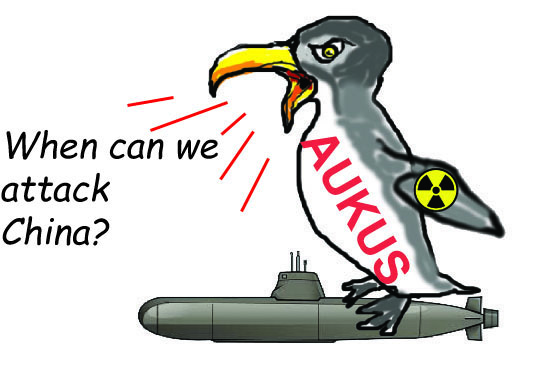
The AUKUS submarines will not be here to defend Australia, but only to attack China in a subordinate role with the American forces.
Pearls and Irritations, By Richard Tanter, Mar 24, 2023
AUKUS. This is a horror for which I now fear for the lives of my children and their children. Every time a Labor member of parliament or senator puts foot outside their office to appear in public, turns up at a public meeting, we need to ask them: why have you betrayed us? Why have you allowed this to happen? What are you going to do?
Transcript of a speech at the Anti-AUKUS Rally, Naarm, State Library of Victoria lawn, 18 March 2023.
These are horrors.
This is a horror for which I now fear for the lives of my children and their children.
This is now changing the direction of Australia for the next forty or fifty years.
We have never seen anything like this in peacetime Australia. At any stage.
This must not stand.
But it’s with the suite of profound horrors that we must start with.
The horrors of AUKUS
Firstly, the automatic involvement in war.
We have already been tied to the United States by the bases – by Pine Gap, by North West Cape, by the Space Surveillance Telescope that take us into space warfare, by the many other Australian bases to which the US has access.
We are already tied in, hard-wired in many cases, to the American war machine.
And the ADF is barely an autonomous force today.
But AUKUS takes us very much further down that road.
We already know what the submarines are there for.
In a rational world I actually think submarines are very important for the defence of Australia – but not in the form of this politically-driven, call-from-Washington-inspired scheme for long-range, long-endurance nuclear-powered submarines whose only rational use is to attack China.
Not on their own – Keating’s right about that calling them toothpicks thrown at a mountain – but in concert with American submarines and carrier task forces.
Maybe not immediately nuclear-armed, but almost certainly capable of nuclear-attack as well.
The AUKUS submarines will not be here to defend Australia, but only to attack China in a subordinate role with the American forces.
The horror of that fiscal black hole.
What does that $368 billion actually amount to? As if we have any idea of what the value of a dollar will be in forty years time – the lifetime cost of AUKUS will be an order of magnitude higher, certainly two or even four trillion dollars.
But what that means in terms of the sacrifice from what’s needed from government for decent health and survival for the Australian people is itself horrific.
This moves us towards what I think is an almost irrevocable position of enmity as far as the Chinese are concerned.
Principally because the only rational strategic role for those submarines is to contribute, potentially, to an American existential threat to China.
Even if we stop tomorrow, is China going to forget that?
Why should they?
We’ve revealed our hand.
We have a Minister for Defence who is effectively the minister for Washington, and this is where we have come to.

The horror of the sacrifice zone that the high-level nuclear waste storage site that is to be somewhere built in Australia.
I have to say that of all things that have shocked me about this scheme, this is one that has shocked me most.
Not just because I made the mistake of thinking that Albanese might be halfway reasonable because in my role as a former president of ICAN I had relations with those people, and he pledged he would support a nuclear ban treaty.
Well, that’s not happening now unless we make it happen.
But the announcement of a nuclear waste dump for high-level toxic nuclear waste, radioactive for thousands of years, is another world all together.
I had foolishly thought that they would follow their own mantra for the past year of saying that ‘this will be a sealed reactor full of highly enriched uranium, and to prevent diversion to nuclear weapons, the US will deliver it sealed, and when the fuel is exhausted it will return to the United States sealed for disposal, somewhere safe, where no-one else can get at it …’
More fool me. More fool me.
They betrayed us again, and that nuclear sacrifice zone of high level waste is going to be a huge problem – and struggle – for decades and decades.
What really troubles me as someone who works on strategic issues and thinks that defence issues are real and important, is that this the largest defence expenditure – if we can use the word ‘defence’ with a straight face in this context – this massive defence expenditure actually disables our genuinely necessary defence capabilities.
There will be very little money left over for anything else in defence.
Worst of all, it disables the possibility of what we have come here today to call for – an independent defence and foreign policy – because there will be nothing left.
I heard one of those defence experts quoted in that authoritative source, Nine Entertainment’s Red Alert on the front pages of The Age – the same report that said yes, we have allies, we have Diego Garcia – all 27 square kilometres of it grabbed by the Brits and rented by the Americans, and we have Guam – the tiny American colony almost wholly taken up by US military bases – it would be funny if it wasn’t so awful and so telling about the government’s grasp of the actual facts – I saw that one of those experts said ‘we have to accept that if there is a war with China ‘that means Pine Gap goes’.
Actually I think that’s quite true, under certain circumstances. But the blitheness, the casualness with which that is said tells us a lot about how these people think.
Because if ‘Pine Gap goes’ in a nuclear missile attack, then Alice Springs and most of its 25,000 citizens ‘go’ too. No need to think about that, is there?
Just the casualness with which this is proposed and debated, apart from the ignorance, is stunning and revealing.
And the last part of the horror for me is the nuclear permissiveness which is now beginning to swell in discussions in Canberra security circles.
The momentum that is going to be built out of this first step of nuclear-powered submarine will mean we’re already going to have naval training for this; we’re going to have expanded nuclear engineering programs at places like the ANU.
We’re going to have military and naval careers built around this.
We’re going to have an industry here which has a deep interest in going the next step from naval nuclear propulsion to a civilian nuclear power industry.
We also know, because this is preceded by the US B-52 bombers at RAAF Tindal near Katherine in the Northern Territory – not nuclear-armed bombers at present, but quite definitely possibly nuclear-armed in the future at the stroke of a presidential pen –that those bombers will be used as part of an attack on China.
And what’s really important to understand now is that the South pacific Nuclear Weapon Free Zone, which Australia signed and says it’s proud of, has a loophole in it sponsored by the Australians to meet US needs, which says there are to be no nuclear weapons in the territories of the member states, like Australia, except in the case of ‘transits’ or ‘visits’.
Transits and visit in these days of American rotational deployments can cover an awful lot of interpretations.
The Albanese government could do one very simple thing to address this fear: it could declare that under no circumstances will any nuclear weapons from any country be allowed into Australia.
Not for a visit, not of layover in transit, just never.
No nuclear-armed aircraft, warships or submarines will ever be allowed to enter Australia.
The USS Asheville nuclear-powered attack submarine in Perth at the moment at Stirling Naval Base, and its successors, will never be allowed to return without a verifiable declaration that they come without nuclear weapons.
Instead of humiliatingly accepting the smirking American ‘we neither confirm nor deny the presence of nuclear weapons visiting your country’, the Albanese government could reassert a little of our lost sovereignty by stating up front, no nuclear weapons never.
The strategy of AUKUS
The strategic part of what’s happening at the American bases in Australia (aka ‘joint facilities’) is part of all this.
You know what is happening at Pine Gap, the giant American-built and American-paid for joint surveillance station outside Alice Springs.
You know about the wonderfully-named Harold E. Holt Naval Communications Station on the tip of North West Cape in Western Australia – a critical submarine communications base for American nuclear submarines and in the future for these AUKUS submarines. It’s immensely important, and probably another priority target, most likely nuclear under certain circumstances.
But just down the road the US has built a giant and highly advanced space telescope.
That doesn’t sound very much, does it.
But what it’s there for is our contribution to American plans for space warfare, to ensure what the US calls ‘space dominance’. And you understand perfectly well how critical space is for all militaries – and indeed our whole society – today.
We are deeply and increasingly plugged into that activity.
All governments have talked for the last thirty years about ‘the joint facilities’ – we don’t have any American bases, of which Australia has full knowledge and concurrence of any activities conducted at these bases.
When you peel that back, and when you talk to ministers – I can tell you I am continually shocked by their ignorance, as well as their deceptions………………………………………………………………………………………………………….. more https://johnmenadue.com/these-are-the-horrors-of-aukus/
Climate change may pose key risk to French reactors – said the country’s Court of Auditors

Each year, the volume of water withdrawn to cover the needs of the French population amounts to 33.5bcm, half of which is used to cool nuclear power plants.
Some 98% of this water is released back into rivers but at a higher temperature, which is regulated on a plant-by-plant basis.
MURIEL BOSELLI, Paris, 22 Mar 2023 https://www.montelnews.com/news/1466974/climate-change-may-pose-key-risk-to-french-reactors–court
The impact of global warming on France’s nuclear fleet could become “critical” by 2050, with three to four times more outages than today, said the country’s Court of Auditors in a report published late on Tuesday.
“These outages are concentrated, admittedly on short summer periods, but are increasingly long and can prove critical by increasing the risks of pressure on the grid,” said Annie Podeur, president of the second chamber of the court, during a hearing at the Senate.
These outages and capacity cuts led to “losses amounting to several TWh per year”, Podeur said, citing the record unavailability in 2003 of 6 GW of nuclear power, or 10% of France’s installed nuclear capacity.
Extreme heat
Increased risk of extreme heat and droughts amid climate change could impact nuclear plants, which use water to cool down.
Combined with this, the report pointed to the expected significant increase in power demand in the years to come, which would strain the grid.
Each year, the volume of water withdrawn to cover the needs of the French population amounts to 33.5bcm, half of which is used to cool nuclear power plants.
Some 98% of this water is released back into rivers but at a higher temperature, which is regulated on a plant-by-plant basis.
The reduced availability of water resources amid drought could exacerbate conflicts about usage with agriculture, tourism and other industries, said Podeur.
Predicting river flows
Climate models should be updated to include river flow levels for the coming years, recommended the report, adding that EDF needed greater storage capacity for water to cool reactors during periods of low flows.
Last summer, which was particularly hot and dry, France’s nuclear safety authority ASN authorised EDF to exceed temperature limits for certain plants to continue producing power.
This decision was taken after the utility stopped a record number of reactors for maintenance and corrosion probes.
The court urged EDF to quantify the total costs of adapting its fleet to deal with climate change.
The utility spent EUR 1bn on currently operational reactors from 2006-2021 and plans to invest only EUR 612m from 2023-2038, added Podeur.
EDF has estimated that outages related to heat and drought result in a loss of annual nuclear production of around 1%.
Low dose radiation linked to heart disease
Columbia University Irving Medical Center, March 23, 2023
People exposed to low doses of ionizing radiation have an extra, but modest, risk of developing heart disease during their lifetime, according to a new study(link is external and opens in a new window) published by an international consortium of researchers.
“The study suggests that radiation exposure, across a range of doses, may be related to an increased risk of not just cancer, as has been previously appreciated, but also of cardiovascular diseases,” says Andrew Einstein, MD, PhD, professor of medicine at Columbia University Vagelos College of Physicians and Surgeons and one of the study’s senior authors.
“It should not steer people away from receiving radiation if necessary—in fact many medical uses of radiation are lifesaving—but it underscores the importance of ensuring that radiation is used appropriately and kept as low as reasonably achievable.”…………
The researchers used data from 93 studies covering all ranges of radiation exposures to find a relationship between dose and heart disease.
They found an increased excess lifetime risk of 2.3 to 3.9 cardiovascular deaths per 100 persons exposed to one Gy of radiation. (In the United States, about 25 out of every 100 people die from cardiovascular disease; a person exposed to 1 Gy of radiation will have a slightly higher, 27% to 29%, risk of dying from cardiovascular disease).
Few people other than those receiving radiation therapy will receive 1 Gy during their lives. But the researchers also found a higher risk of heart disease at low dose ranges (<0.1 Gy) more commonly experienced by the public and also for protracted exposures to low doses.
More research is needed to determine the precise increased excess lifetime risk of heart disease from these low doses.
“The effect of lower doses of radiation on the heart and blood vessels may have been underestimated in the past,” Einstein says. “Our new study suggests that guidelines and standards for protection of workers exposed to radiation should be reconsidered, and efforts to ensure optimal radiation protection of patients should be redoubled.”
References
More information
The study, titled “Ionising radiation and cardiovascular disease: systematic review and meta-analysis(link is external and opens in a new window),” was published March 8 in The BMJ…………………………….. https://www.cuimc.columbia.edu/news/low-dose-radiation-linked-heart-disease
—
March 24 Energy News — geoharvey

Science and Technology: ¶ “The Promise Of Kelp-Powered Flight” • Catriona Macleod, deputy head of the Fisheries and Aquaculture Centre at the University of Tasmania’s Institute for Marine and Antarctic Studies in Australia, describes seaweed as the “Swiss army knife” of tools to tackle planetary challenges. Already widely used for food, it could eventually power […]
March 24 Energy News — geoharvey
1 This month

of the week – Australians for War Powers Reform (AWPR)
To see nuclear-related stories in greater depth and intensity
 Antinuclear