AUKUS, NUCLEAR TECHNOLOGY AND AUSTRALIA’S FUTURE
ARENA ONLINE, JOHN HINKSON, 6 APR 2023 https://arena.org.au/aukus-nuclear-technology-and-australias-future/
The AUKUS agreement attempts developments that will shift Australia into a zone that will threaten the existence of Australia itself.
I am not merely thinking of the militarisation of Australia, although that is definitely one likely outcome. I also have in mind our way of life that, while still set in settler-colonial assumptions that give First Nations people no substantial value in Australian society, is relatively relaxed when compared with the way of life of people in the United States. Australia has not experienced the focus upon security that high-powered militarisation associated with nuclear weapons brings. This is the world our leaders are leading us towards.
I want to take up two lines of inquiry into Aukus in this brief article. Firstly AUKUS brings together three Anglo-settled countries – two examples of settler-colonial domination that date back two centuries and more. plus of course the original Anglo-source nation, the United Kingdom. This may seem like an insignificant reference to an aspect of European colonialism that has shaped the whole world for centuries. However, Anglo colonialism has a particular complexion. Here I am drawing in part on the book by James Belich, Replenishing the Earth, about the history of Anglo colonialism. It is well-known these days in anti-colonialism circles that the Anglo slavery pursued in the Caribbean by England was the worst form of slavery, with cruelty on a scale that makes slavery in the United States seem enlightened. Anglo colonialism is typified by relations of difference that deal with colonised peoples with a vengeance. It is noteworthy that Anglo-settled countries like Australia have not at all come to terms with the cultures that pre-existed them. All invading cultures find this difficult, but Anglo-based cultures, as Belich shows, are a special case. It is no coincidence that Adolf Hitler looked with admiration to the United States for its ‘handling’ of its First Nations ‘problem’—a form of extermination of the Native American population—in how to think about the treatment of Jews and Slavs in Europe. Anglo cultures’ commitment to freedom and democracy has a repellent underbelly of racism and cultural suppression, not to mention genocidal elimination.
Significant cultural reform is always difficult but clearly the Anglo-powers have made the decision, at a time when in many respects their backs are up against the wall, to stand and fight—not for their own territory, but against the emergence of China, which was itself on the humiliating receiving end of Anglo colonialism in the nineteenth century. AUKUS in a strong sense is a thumbing of the West’s nose at all the emerging powers in Asia—on racial grounds. They must toe the line.
This is surely a crisis for an Australia seeking in the first half of the twenty-first century to survive in our region. To survive here Australia has to change its spots profoundly. It needs a form of cultural regeneration, in significant combination with Australian First Peoples, to justify its presence outside of the strategies of colonial power. While cultural change is always slow and complex, it is Australia’s only hope of both flourishing and being accepted in this region. It is also crucial because our allies are, in any case falling apart.
While I think the Voice could be the first step towards a significant and substantial change, only a weak version of the Voice, suitable for photo opportunities and feel-good policy, will survive the reassertions of this new Anglo alliance. Australia combines an especially empty form of recognition of First Nations with the arrogance of a superior colonial presence, coloured only a little by multiculturalism, and all this in a region where it has no basic right to exist.
The AUKUS alliance represents an incapacity to flexibly adjust to an emerging situation in which a new world power has emerged, one that will not go away. It is deeply ironic that the United States has fostered this emergence by its global development strategies, just as it fostered its opponents in Afghanistan at an earlier time.
That China is a new superpower is a reality—not that being a superpower is good for China or for us. Like large bureaucracies, superpowers develop self-oriented agendas related to their size, and are not to be trusted. But linking up with the remnants of the old powers to resist emergence means that Australia has resorted to a last gasp Anglo-cultural alliance rather than enter a serious process of rethinking its social composition and its place in the world.
The second line of comment is about nuclear submarines, drawing on a piece that appears in Arena Quarterly, just publishe
I want to take up two lines of inquiry into Aukus in this brief article. Firstly AUKUS brings together three Anglo-settled countries – two examples of settler-colonial domination that date back two centuries and more. plus of course the original Anglo-source nation, the United Kingdom. This may seem like an insignificant reference to an aspect of European colonialism that has shaped the whole world for centuries. However, Anglo colonialism has a particular complexion. Here I am drawing in part on the book by James Belich, Replenishing the Earth, about the history of Anglo colonialism. It is well-known these days in anti-colonialism circles that the Anglo slavery pursued in the Caribbean by England was the worst form of slavery, with cruelty on a scale that makes slavery in the United States seem enlightened. Anglo colonialism is typified by relations of difference that deal with colonised peoples with a vengeance. It is noteworthy that Anglo-settled countries like Australia have not at all come to terms with the cultures that pre-existed them. All invading cultures find this difficult, but Anglo-based cultures, as Belich shows, are a special case. It is no coincidence that Adolf Hitler looked with admiration to the United States for its ‘handling’ of its First Nations ‘problem’—a form of extermination of the Native American population—in how to think about the treatment of Jews and Slavs in Europe. Anglo cultures’ commitment to freedom and democracy has a repellent underbelly of racism and cultural suppression, not to mention genocidal elimination.
Significant cultural reform is always difficult but clearly the Anglo-powers have made the decision, at a time when in many respects their backs are up against the wall, to stand and fight—not for their own territory, but against the emergence of China, which was itself on the humiliating receiving end of Anglo colonialism in the nineteenth century. AUKUS in a strong sense is a thumbing of the West’s nose at all the emerging powers in Asia—on racial grounds. They must toe the line.
This is surely a crisis for an Australia seeking in the first half of the twenty-first century to survive in our region. To survive here Australia has to change its spots profoundly. It needs a form of cultural regeneration, in significant combination with Australian First Peoples, to justify its presence outside of the strategies of colonial power. While cultural change is always slow and complex, it is Australia’s only hope of both flourishing and being accepted in this region. It is also crucial because our allies are, in any case falling apart.
While I think the Voice could be the first step towards a significant and substantial change, only a weak version of the Voice, suitable for photo opportunities and feel-good policy, will survive the reassertions of this new Anglo alliance. Australia combines an especially empty form of recognition of First Nations with the arrogance of a superior colonial presence, coloured only a little by multiculturalism, and all this in a region where it has no basic right to exist.
The AUKUS alliance represents an incapacity to flexibly adjust to an emerging situation in which a new world power has emerged, one that will not go away. It is deeply ironic that the United States has fostered this emergence by its global development strategies, just as it fostered its opponents in Afghanistan at an earlier time.
That China is a new superpower is a reality—not that being a superpower is good for China or for us. Like large bureaucracies, superpowers develop self-oriented agendas related to their size, and are not to be trusted. But linking up with the remnants of the old powers to resist emergence means that Australia has resorted to a last gasp Anglo-cultural alliance rather than enter a serious process of rethinking its social composition and its place in the world.
The second line of comment is about nuclear submarines, drawing on a piece that appears in Arena Quarterly, just published.
The AUKUS strategy seeks to assert massive power, especially surveillance in the Pacific, surrounding China. Nuclear submarines combined with surveillance are the main focus of this attempt to cripple what actually, as I see it, cannot be stopped, in a way similar to Paul Keating’s argument. AUKUS shifts the whole emphasis away from how we protect our independence to what is needed to contain China. For Australia this seems to mean we have to achieve interoperability with US weaponary and systems, with nuclear submarines a key aspect of this. It means Australia must take a first step into adopting nuclear technology, and its consequences. We should not be assured by those who claim that it will be the last step.
Much has been written about the dangers of nuclear power and weapons over the years, to the point where it seems many in the community are now blasé about it—unless radiation waste is to be placed next door to you. Part of what the nuclear industry and its supporters have done is to launch smaller scale tactical nuclear weapons and also small-scale nuclear power plants because both large-scale nuclear weapons and large-scale power plants have unmanageable consequences and poor public acceptance, either because of non-human-scale destruction or ridiculous costs, which only keep escalating.
No one, with the exception of some military strategists, favours nuclear war. The reasons are obvious. The level of destruction of atomic bombs steps beyond our capacity to comprehend: it steps into another realm, a post-human one. Even the seemingly more mundane questions associated with nuclear waste are on another scale because they cannot be effectively disposed. All around the world nuclear waste is piling up around nuclear power stations as well as ‘storage’ of used nuclear submarines components because the waste is not of this world. There is no solution to the waste question. Nuclear waste is killing us on an increasing scale, as exposed by Kate Brown in her book A Manual for Survival. Contrary to the findings of mainstream Western science, she argues that low-level radiation is a mass killer and a general source of ill health As one Russian scientist she quotes puts it: ‘Chronic radiation is a crime’, and chronic radiation is a process that Australia has just signed up for with its nuclear submarines, adding its contribution to the systemic decline of the Earth’s environment, at least one that is suitable for human habitation.
We need to give some focus to this because it is an embarrassment to the nuclear lobby, which they handle and largely get away with by resorting to silence. But nuclear waste is a contradiction that will not go away. All attempts at solutions have failed in every part of the world. This cannot be emphasised enough.
What sort of contradiction is this?
Like nuclear technology, nuclear waste is usually simply regarded as a special category of danger. But its special effects arise out of a social process that is usually ignored. And this is a disaster because that social process is transforming our world in unprecedented ways.
This new world first burst upon us in 1945, with the practical scientific triumph of the atomic bomb. It was not merely novel. It was a consequence of the practical/conceptual reconstructions in the early twentieth century we associate with Albert Einstein and his associates. It was not merely a new theory. It was a combination of abstract academic theory with practical technology in the real world that gave birth to technoscientific society and culture, most importantly through its systematic approach to the transformation of nature. As such, academic theory entered the world of production, as an alternative or supplement to the transformations performed by the working classes, in a way that has expanded exponentially ever since. For better or worse, our world has become increasingly composed socially of the intellectually-trained.
The novelty of nuclear technology is contained within this social approach. Scientific intellectuals now uncover deep levels of the natural world, levels never before encountered by human societies that turn out to be mysterious and unmanageable. Nuclear is not the only example but it is a key one that destroys whatever it touches.
This is the world we are now entering, and doing so with great enthusiasm. It is not only a question of nuclear war. It is just as much one of the levels of security needed when dealing with what we do not know how to control. Nuclear weapons have been ‘controlled’ by such monstrosities as the Cold War and MAD (Mutually Assured Destruction) strategies that give reason a bad name. And low-level radiation has been controlled by denial of any major effects, while the environment of Planet Earth deteriorates. As Brown remarks, ‘Western researchers are discovering, like Soviet scientists before them, that radioactive decay at low doses changes the way cells behave in subtle and life-changing ways’, laying the basis for ‘chronic radiation syndrome’.
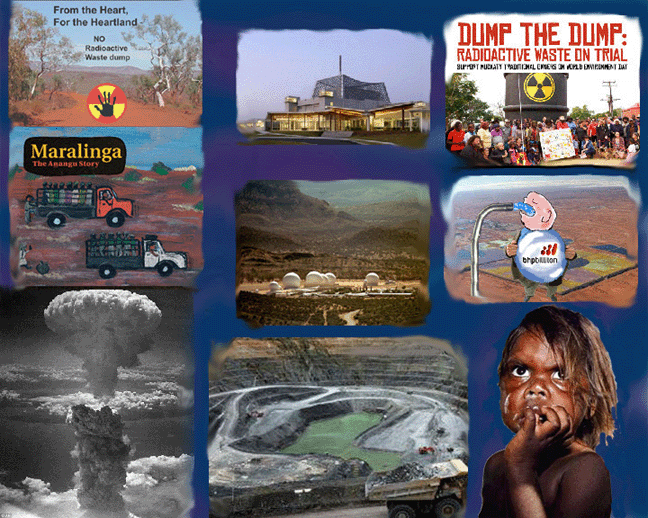
AUKUS is a strategy that pursues these outcomes systematically, our leaders planning to leave submarine waste in the desert, once again to be dealt with by First Nations people, now to be permitted by the WA Labor government. Among other things, the crime of chronic radiation poisoning needs to be sheeted home to the powers that be, and in particular now, the Albanese government.
‘Bigger threat than China’: Defence leaders urge release of ‘scary’ climate report

“It’s a much bigger threat to our national security than a potential fight with China
“This is about transparency and keeping people informed.”
By Matthew Knott,, April 5, 2023 https://www.theage.com.au/politics/federal/bigger-threat-than-china-defence-leaders-urge-release-of-scary-climate-report-20230404-p5cxuf.html
A group of leading defence figures is urging the Albanese government to release a secret report on the national security risks of climate change even though its contents may alarm Australians.
Former Defence Force chief Admiral Chris Barrie said climate change posed a bigger risk to Australia than China’s rapid military build-up, and it was crucial to inform the public about the security implications of warmer temperatures, rising sea levels and increased natural disasters.
Potential impacts included famines caused by global warming, conflicts over access to scarce resources and the mass migration of people to Australia from vulnerable Asia-Pacific nations in the coming decades.
“We are worried about the possible collapse of societies because of starvation, a lack of fresh water and shortages of food supplies,” said Barrie, a member of the Australian Security Leaders Climate Group.
Barrie said he understood the Office of National Intelligence (ONI) had delivered a landmark report on external climate risks to the government in December but a declassified version had not been released to the public.
“I expect it might contain things that are a bit scary, but we’re adults and we are up for it,” he said. “This is about transparency and keeping people informed.”
As the government prepares to spend up to $368 billion on nuclear-powered submarines over the next three decades under the AUKUS pact, Barrie said: “I see climate change as an existential threat.
“It’s a much bigger threat to our national security than a potential fight with China or some other conflagration. Only a nuclear war could be more catastrophic.”
Labor went to last year’s federal election promising to deliver a strategic climate security threat assessment and put ONI director-general Andrew Shearer in charge of the project soon after taking government.
Barrie said famine helped trigger the 1917 Russian Revolution and the phenomenon could recur in other countries in coming decades as a result of global warming.
Australia’s large land mass and relatively small population would make it an attractive destination for people displaced by climate change, he said.
The retired navy officer, who led the Defence Force from 1998 to 2002, said Australians living on flood plains and in bushfire zones should also be informed about the domestic threats posed by climate change, which are believed to be examined in a separate report by the Office of National Intelligence.
Spokespeople for the Office of National Intelligence and the Department of Prime Minister and Cabinet declined to comment on whether a public version of the report, which is based on classified information, would be released.
The Australian Security Leaders Climate Group, which includes retired air vice-marshal John Blackburn and the Department of Defence’s former head of preparedness and mobilisation, Cheryl Durrant, said nations such as the United States and United Kingdom had released public versions of similar reports on the national security risks of climate change.
The federal government had also released declassified reports on threats such as cyberattacks and COVID-19 to help inform the public, they said.
US President Joe Biden’s director of national intelligence, Avril Haines, has described climate change as an urgent national security threat, saying it was likely to increase global political instability in future decades.
New images from inside Fukushima reactor spark safety worry
Images captured by a robotic probe inside one of the three melted reactors
at Japan’s wrecked Fukushima nuclear power plant showed exposed steel bars
in the main supporting structure and parts of its thick external concrete
wall missing, triggering concerns about its earthquake resistance in case
of another major disaster.
The plant’s operator, Tokyo Electric Power
Company Holdings, has been sending robotic probes inside the Unit 1 primary
containment chamber since last year. The new findings released Tuesday were
from the latest probe conducted at the end of March. An underwater remotely
operated vehicle named ROV-A2 was sent inside the Unit 1 pedestal, a
supporting structure right under the core.
It came back with images seen
for the first time since an earthquake and tsunami crippled the plant 12
years ago. The area inside the pedestal is where traces of the melted fuel
can most likely be found. An approximately five-minute video – part of
39-hour-long images captured by the robot – showed that the 120-centimeter
(3.9-foot) -thick concrete exterior of the pedestal was significantly
damaged near its bottom, exposing the steel reinforcement inside. TEPCO
spokesperson Keisuke Matsuo told reporters Tuesday that the steel
reinforcement is largely intact but the company plans to further analyze
data and images over the next couple of months to find out if and how the
reactor’s earthquake resistance can be improved.
The images of the exposed
steel reinforcement have triggered concerns about the reactor’s safety.
Daily Mail 4th April 2023
NSW hosts best performing wind farms as market keeps eye on Liddell coal closure — RenewEconomy

NSW plays host to half of the top ten performing wind farms, all of whom performed better than the Liddell coal generator about to close down. The post NSW hosts best performing wind farms as market keeps eye on Liddell coal closure appeared first on RenewEconomy.
NSW hosts best performing wind farms as market keeps eye on Liddell coal closure — RenewEconomy
Energy Insiders Podcast: Smarter grid means a cleaner grid — RenewEconomy

Energy Efficiency Council’s Rob Murray-Leach on landmark report on new ways of thinking about the grid. Meanwhile, new NSW energy minister worries about lights going out. The post Energy Insiders Podcast: Smarter grid means a cleaner grid appeared first on RenewEconomy.
Energy Insiders Podcast: Smarter grid means a cleaner grid — RenewEconomy
Gelion calls for national battery strategy to focus on Australian tech — RenewEconomy

Lithium silicon sulfur battery pioneer Gelion urges federal government to focus on Australian tech as it develops national battery strategy. The post Gelion calls for national battery strategy to focus on Australian tech appeared first on RenewEconomy.
Gelion calls for national battery strategy to focus on Australian tech — RenewEconomy
Classic Megaproject Early Mistakes Will Create A Fiscal Disaster For Netherlands Nuclear

The Netherlands doesn’t have a plan, just an aspiration. They don’t have a schedule, just a notional target that is close enough to 2030 to sound good. They don’t have a budget, they have a number that they think that they can sell. There’s just so much failure inherent in this proposal that it’s like asking a flatland triangle to successfully build the Pyramid of Giza. Where to start?
As the data shows, 55 nuclear construction projects globally had cost overruns greater than 50%, and the average of those projects were 204% overruns, which is to say that they cost three times more than budgeted for.
The first bias and most evident here, is strategic misrepresentation, aka lying outright or obfuscating the likely truth in order to get something going. When equivalent projects are looked at, €5 billion is clearly a gross understatement of the real costs, but is also clearly the only number that the government believes it can sell.
By Michael Barnard, 5 Apr,23, https://cleantechnica.com/2023/04/05/classic-megaproject-early-mistakes-will-create-a-fiscal-disaster-for-netherlands-nuclear/
Recently, the new coalition government of the Netherlands looked across its decarbonization portfolio, realized that it had failed to meet renewables targets, and so announced that it would build two nuclear power reactors with 1-1.6 GW capacity each. And the government is claiming that it will have them running in 2035, but has only outlined costs through 2030 of €5 billion ($5.5 billion).
The Netherlands’ plan does have a couple of things going for it. The country actually has a small, 50-year old, 485-MW nuclear reactor at Borssele, and they are apparently going to build the new reactors on the same site. They’ve also extended the life of the very old reactor, which has people understandably concerned. So they have operational experience with nuclear, albeit with a very different technology with considerably different operational characteristics, predating as it does most computerization of control systems.
They have already jumped through the International Atomic Energy Agency’s 28 or so major hoops. They already have the seven overlapping, somewhat concentric layers of security from international to internal site high-security areas in place and know what is required. The combination puts them ahead of countries that don’t have existing nuclear reactors, and ahead of projects attempting to site reactors in a new location.
What doesn’t the Netherlands have or know about these reactors?
They don’t know what technology they will use. Some reports say that they will stick with third-generation nuclear technology, which sounds conservative until you realize that Hinkley in the UK, Flamanville in France, Vogtle and Summer in the US, and Olkiluoto in Finland were all third generation AP1000s and European Pressurized Reactors (EPR), and all have suffered massive cost and budget overruns.
They don’t have any trained, certified, or security cleared design or construction resources. The requirements for nuclear design and construction resources are substantially higher than for wind, solar, and other generation options. High security clearances are required for a vastly greater percentage of nuclear construction resources than for other forms of electrical generation, especially as they’ll be doing construction on a running nuclear site. Many people in non-nuclear trades such as boilers, turbines, electricians, and the like who would be acceptable for a wind farm, solar farm, or hydro project will not pass the filters for nuclear projects. In fact, many utility-scale construction projects employ vast numbers of unskilled day laborers that they pick up off street corners at the beginning of the day and drop off again at the end.
They don’t have a significant nuclear engineering program in any of their universities. The nuclear chair in TU Delft retired a decade or so ago and was never replaced. There’s a professor of nuclear engineering at the school, Jan Leen Kloosterman, and he’s clearly excited by this opportunity and hoping that the chair will be re-established with him sitting in it per his public comments.
They have no one who has ever led and run the construction of a nuclear plant. The people who built Borssele are dead or retired to Spain or Portugal, one assumes.
They don’t have a primary contractor, and that’s much more of a problem than it was a decade ago. The three major countries that are building or attempting to build nuclear reactors in other jurisdictions are Russia, China, and France. Russia has made itself an international pariah and clearly wouldn’t pass basic security checks. China has been politically blackballed because it’s stopped being a cheap manufacturer of consumer goods and become instead a major economic competitor which has surpassed the US by several measures and is set to surpass it by most of the rest by 2035. And then there’s France, which has proven to Europe and the world that it is incompetent to build new nuclear reactors, and has had problems operating its own.
The Netherlands doesn’t have a plan, just an aspiration. They don’t have a schedule, just a notional target that is close enough to 2030 to sound good. They don’t have a budget, they have a number that they think that they can sell. There’s just so much failure inherent in this proposal that it’s like asking a flatland triangle to successfully build the Pyramid of Giza. Where to start?
Continue readingMental illness plagues Japan’s nuclear disaster survivors
Some 37 percent of the survivors of Japan’s Fukushima Daiichi nuclear
power plant disaster of 2011 still suffer from mental illness due to
financial crisis, isolation, and drastic changes in living conditions, says
a survey.
The survey results indicated that the victims suffer from
post-traumatic stress disorder or PTSD due to “anxieties about
compensation and indemnification,” “unemployment” and “nuisances
just by being an evacuee.” The survey was conducted by the Waseda
Institute of Medical Anthropology on Disaster Reconstruction and the
Disaster Relief Assistance Network Saitama, a citizens group, between
January to April 2022 among 5,350 households, the Asahi Shimbun reported on
April 3.
Union of Catholic Asian News 4th April 2023
https://www.ucanews.com/news/mental-illness-plagues-japans-nuclear-disaster-survivors/100894
1 This month

of the week – Australians for War Powers Reform (AWPR)
To see nuclear-related stories in greater depth and intensity
 Antinuclear