AUKUS submarines “nation building” says Admiral. No they’re not, says Rex Patrick

People are right to question him, no matter the gold aiguillettes he wears on his right shoulder.
Michael West Media, by Rex Patrick | Apr 23, 2023 |
The Chief of Navy, Vice Admiral Mark Hammond, has proclaimed the AUKUS submarine program is a national building endeavour when, in fact, it’s quite the opposite. Rex Patrick pulls apart the Admiral’s claim.
Left kicking myself
About a month before Prime Minister Albanese went to San Diego for his threesome with President Biden and Prime Minister Sunak, I decided to warn Michael West Media readers that, in due course, Defence would roll out the “nation building” slogan in support of AUKUS. But I got distracted and last week the Chief of Navy invoked the phrase. So, I’m left kicking myself.
How did I know the claim was coming? Well, the admiral was singing from a very well thumbed hymn book.
My first recollection of the words “nation building” and “submarines” being used together was in 2010 when former head of the Submarine Institute of Australia, retired Rear Admiral Peter Briggs, was throwing it around in the backchannels. At the time he was pushing for Australia to build a locally designed “Son of Collins” to meet the needs of our future submarine force.
National building quickly became a cliché in Defence circles for those who wanted to sell a grandiose submarine project to government.
By 2013, a decade ago, “nation building” had made its way into the Defence White Paper.
“… the Future Submarine Program represents the largest and most complex project ever undertaken in Australia’s history. This project represents a true nation building endeavour which presents both challenges and significant opportunities for Defence and Australian industry.”
The rhetorical combination has been rolled whenever anyone raises a concern about project cost, like a decoy designed to stop a torpedo hitting its target; “National building” has been deployed a lot in the past decade; South Australia’s Defence Industry Minister before the Senate in July 2014, Defence Minister Linda Reynolds in a November 2020 keynote speech to the Submarine Institute of Australia and now Admiral Hammond.
Admiral Mark Hammond pulled at patriotic heart strings last week when he “implored Australians to see [the AUKUS submarine program] as a nation-building endeavour on par with the original creation of the Snowy Mountains Hydro-electric scheme”.
Unfortunately, his comparison just doesn’t stack up.
Snowy Hydro
The Snowy Mountains scheme was a very large and complex engineering project that diverted the waters of the Snowy River through tunnels in the mountains and stored it in dams, which were then used to create electricity. It involved the construction of nine power stations, 16 major dams, 80 kilometres of aqueducts and 145 kilometres of interconnected tunnels.
Snowy stimulated the Australian economy and created an industrial base for national security after World War Two. The Labor government of that era implemented plans for full employment, created public housing and announced it would take in 70,000 immigrants each year. It harnessed the impetus of wartime manufacturing to encourage post-war industrial production.
It has delivered Australians with an enduring economic workhorse. It’s 33 turbines can generate a maximum of 4,100 megawatts and produce on average, 4,500 gigawatt-hours of renewable electricity each year.
To this day the Snowy Mountains Scheme is still considered to be one of the greatest engineering achievements in the world, however the project is also a story of social, cultural and political changes in Australia.
AUKUS however
By contrast, what we know about AUKUS is that it will provide investment in US shipyard expansion, to be followed at a later date by an investment in UK shipyard expansion.
As Australian politicians point to a 2040 workforce (20,000; far short of that employed in building Snowy) that will purportedly see submarines being built in Australia, General Dynamics Electric Boat in Groton, Connecticut, and Austal USA in Mobile, Alabama, are actively recruiting 5,700 and 1,000 people, respectively, to work on AUKUS right now.
The flow of Aussie dollars to the UK will likely start occurring around the early 2030s about the same time as Collins class submarine workers at Osborne in Adelaide are finding out their jobs are gone, bearing in mind that from 2033 there’ll be no further need to conduct Collins Full Cycle Docking or Life of Type Extension work.
And while that’s all happening, Australian taxpayers will be investing billions in upskilling our engineers and technicians in nuclear technology that will have no use beyond AUKUS. Unlike the US and UK that can amortise and leverage their Defence investment in their civil nuclear industries, we don’t have one of those.
The flow of Aussie dollars to the UK will likely start occurring around the early 2030s about the same time as Collins class submarine workers at Osborne in Adelaide are finding out their jobs are gone, bearing in mind that from 2033 there’ll be no further need to conduct Collins Full Cycle Docking or Life of Type Extension work.
And while that’s all happening, Australian taxpayers will be investing billions in upskilling our engineers and technicians in nuclear technology that will have no use beyond AUKUS. Unlike the US and UK that can amortise and leverage their Defence investment in their civil nuclear industries, we don’t have one of those.
Furthermore, we must expect that US restrictions attached to the use of their submarine nuclear technology will not allow the knowledge gained in the AUKUS program to be used anywhere else in the Australian economy.
AUKUS might be a partnership, but it’s an unequal partnership and it well remain so with Australia as the dependent partner. And all for the price of just $368 billion.
There will of course be some submarines, of an unknown type, an unknown capability, at an unknown date. Does that qualify as nation building?
…………….The truth is that Defence spending is largely a sunk cost. It’s an insurance cost. Admirals, Air Marshalls and Generals would do well to appreciate that, whilst some benefit to the general economy can flow from Defence acquisition and sustainment, Defence projects, the way they are conducted in Australia, do not offer nation building opportunities.
On the other hand …
Nation building would be taking our billion dollar lithium export business and turning it into a trillion dollar battery export business, which we have not done.
National building is investing early into Industry 4.0 to become a manufacturing powerhouse, something Germany has done, but we haven’t.
Nation building is taking royalties from your finite resources and investing in industries that will outlast the resource demand, something the United Arab Emirates has done, and we haven’t.
Nation building would be establishing modern semiconductor manufacturing capability onshore, our two AUKUS allies are actively encouraging development of their onshore industries, sadly again we’re standing idly by.
There’s no plan
In November of 2021 Senator Penny Wong asked the Navy how much money had been allocated to the Nuclear Submarine Task Force; $300m over two years was the answer. For that significant investment we’re seen a ‘Kabuki Show’ in San Diego where no detail on the program were provided and a pathetic nine FAQ sheets uploaded to the government’s AUKUS website.
First and foremost, if a project is going to be truly nation building, the nation needs to know about it, understand it and embrace it. This means there has to be a plan and that plan needs to be publicly available, it cannot be entirely shrouded in secrecy, known only to the select few. As we can see there is no published industrial plan, there are no published workforce plans. Any details on AUKUS beyond top level have had to be extracted from Government under Freedom of Information laws.
Against that backdrop, and in circumstances where most people rightly see the AUKUS program as a completely unjustifiable nation crippling spend of their money, and a spend that, on the best view, only brings us new defence capability in two decades time, Vice Admiral Hammond must be expecting to draw fire for his repeating the inaccurate and misleading characterisation.
People are right to question him, no matter the gold aiguillettes he wears on his right shoulder.
I guess he just really wants his ‘Ferrari’. https://michaelwest.com.au/aukus-submarines-nation-building-says-admiral-no-theyre-not-says-rex-patrick/
New Zealand-Australia testiness over citizenship resolved, but nuclear sensitivities remain
Stuff, Thomas Manch, Apr 24 2023
A thorny trans-Tasman citizenship issue has been resolved, but Prime Minister Chris Hipkin’s Brisbane trip showed nuclear sensitivities are set to linger between New Zealand and Australia.
……………………….questions then centred on an emerging long-term issue – Australia’s planned acquisition of nuclear-powered submarines – questions Albanese was unwilling to answer.
At a joint press conference on Sunday afternoon, after a citizenship ceremony where more than 200 Kiwis pledged allegiance to Australia, Prime Minister Chris Hipkins said he had discussed with Albanese his country’s new Aukus pact.
The pact between Australia, United Kingdom and the United States, will have Australia acquire nuclear-propelled in the coming three decades.
“New Zealand, like Australia, is clear eyed that there is a challenging strategic environment in the Indo-Pacific region,” Hipkins said.
……………….Albanese, asked twice at the press conference about New Zealand’s possible involvement in Aukus, veered away from answering the question, talking instead about the Pacific Island Forum and both countries co-operating on climate change.
New Zealand maintains a strong nuclear-free stance, and Hipkins on Sunday said he welcomed Albanese’s reassurance Australia remained committed to the non-proliferation of nuclear weapons.
Despite this, Defence Minister Andrew Little has said New Zealand was interested in joining a second “pillar” of the Aukus arrangement, that would involve the sharing of non-nuclear defence technologies associated with the submarines.
……………………Hipkins was unwilling to answer a hypothetical question about whether he would deny entry to nuclear-propelled Australian vessels into New Zealand waters, but said New Zealand’s nuclear-free policy, “which includes nuclear-propulsion”, had not changed. https://www.stuff.co.nz/national/politics/131848153/transtasman-testiness-over-citizenship-resolved-but-nuclear-sensitivities-remain—
Timothy Nott Submission to Senate – as a conservative opposes risky, expensive, unsustainable nuclear power
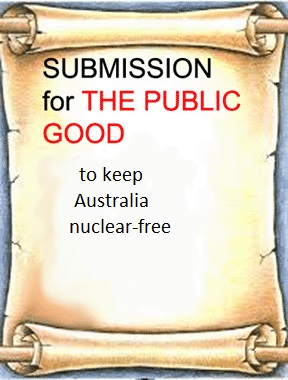
As a conservative, I can’t support highly risky, expensive compared to the options
power provision that is unsustainable and misleading as the whole process cost is
not included for the nuclear option against the others that does include the entire
process.
Environment and Other Legislation Amendment (Removing Nuclear Energy Prohibitions) Bill 2022 Submission 141
As a private citizen of Australia, I support cheap reliable energy and thus can not
support the use of nuclear power. I also understand the costs have not included
disposal of waste which is a vital part of the assessment. If this isn’t included, no
comparison can be made for cost and sustainability. Nuclear power is a risk to
Australian national security as the pollution has no effective and safe disposal and
until the legacy of this risk to human health and safety has a solution, there can be
no way to determine the costs or risks. This is unacceptable to my family.
The current approval system for power providers has lead to ongoing losses of jobs
and prosperity for short-term profit. It is damaging the biophysical basis of humans
existence and thus the system is failing the people of Australia. Until the approval
system is changed to allow the community to maintain health and jobs, it will
continue to be unsustainable and damage Australian sovereignty. Adding nuclear
power options to a biased and unsustainable system will add further pressure and
policy that prioritises short-term profit over life. I can not support the increase in
pressures that is currently damaging the prosperity of Australians and increasing
costs on the community.
Considering Australia is the best placed globally to take advantage of the renewable
energy sector, any competition to this will damage this economic strength and limit
Australia’s competitiveness. Australia’s delay in making a transition to cheaper
energy forms has left us behind other countries and thus we are loosing jobs and
economic opportunities. Adding expensive power options that are unsustainable as
they do not include all stages of the power creation process is opposite to good
economic management. If anything like the current gas system experience, this will
lead to more of Australian wealth going overseas with Australian’s and business
paying a high price so corporations can avoid tax and profitise from the monopoly
position. Any financial subsidies that will be required are in direct opposition to
Australian economic strength and jobs creation. I support Australian jobs for
Australian products so currently can’t support including nuclear power approval.
The long time required for nuclear power creation and short lifespan make the option
unable to repair current limitations in the power system. The ongoing delay to using
the natural competitive advantage has already made the nuclear power option less
competitive and risky. Within a decade, renewable energy will be significantly
cheaper and the cost assessment should clearly articulate this. By the time a nuclear
power station is built, it may already be not viable without the entire costs being
included.
As a conservative, I can’t support highly risky, expensive compared to the options
power provision that is unsustainable and misleading as the whole process cost is
not included for the nuclear option against the others that does include the entire
process.
Please don’t waste money, increase risk of increasing costs and accidents and leave
a legacy of expensive and dangerous materials for the next 100plus generations.
The huge cost and unknowns of managing the waste makes the nuclear option far
inferior. As previously stated, I can not support increasing costs forced onto the
Australian public while increasing risk to health and national security. This proposal
demonstrates the corrupted system as no reasonable person who cares about the long-term prosperity and health of average Australians would support such short
term decision making. https://www.aph.gov.au/Parliamentary_Business/Committees/Senate/Environment_and_Communications/Nuclearprohibitions/Submissions
Grusha Leeman: Submission to Senate – Australia is much too hot for safe nuclear power – let’s not dither with the nuclear distraction

Grusha Leeman. Environment and Other Legislation Amendment (Removing Nuclear Energy Prohibitions) Bill 2022 Submission 136
Retain the ban on nuclear energy.
It is heartwarming to know there is serious consideration being given to replacing the climate destroying fossil fuel power methods, but going back to old failed methods is not the best answer for this sunny windy country.
Australia is much too hot for safe nuclear power
We are in a time of climate crisis. Extreme weather events are inevitable and increasing. We know there will be more heatwaves and droughts and some will be more intense. As nuclear power plants consume a lot of water for cooling, the Australian climate is simply not conducive for safe nuclear power. Nuclear power plants are vulnerable to water stress, the warming of rivers, and rising temperatures, which weaken the cooling of power plants and equipment. Nuclear reactors in an increasing number of countries 1 are being shut down during heatwaves, or see their activity drastically slowed. Overheating can present a major safety risk. We can’t be spraying water on the walls of our nuclear power plants to cool the insides during a heatwave when we are also deep into a drought. As the lakes and rivers that typically supply cooling water become hotter thanks to climate change — and as droughts dry up some water bodies — nuclear power plants aren’t viable. We cannot thermally pollute our seas either. Hotter seas kill the plankton, the seagrasses and the mangroves. Sea Level rise and higher intensity storms mean situating vulnerable nuclear power plants on the coast is becoming less attractive.
We need power that is stable to function during heatwaves. Coal, gas and nuclear are notorious for failing that requirement.
Nuclear is much too expensive.
To protect the climate, we must abate the most carbon at the least cost and in the least time. We must quickly
replace our climate destroying fossil fuel plants with clean electricity. To produce stable affordable electricity we must recognise that the economic factors relating to nuclear rule it out as an option.
Not only is nuclear power greatly more expensive compared with other forms of power, it is essentially
uninsurable. Nuclear power plants depend on large government subsidies to be built, and never has nuclear
energy been profitable. On top of the initial capital costs, the cost of maintaining and decommissioning the plant, there’s the endless safe storage of the radioactive waste. Safe disposal facilities don’t come cheap and nowhere in the country are they wanted.
It is feasible that if we finally got a carbon price, nuclear powered electricity could be better able to compete, butmthe insurance risks would need to be borne by the public as none of Australia’s major insurance agencies are willing to provide cover for nuclear disasters. Indeed, if nuclear power operators were to adequately insure against the risk of nuclear accidents, the insurance premiums would make nuclear power completely uneconomic.
As the CSIRO’s GenCost 2021-22 report points out, solar and wind are the lowest cost way of producing electricity in Australia even when factoring in storage. In addition, whilst renewables are getting cheaper all the time, the costs of building and operating nuclear power plants are increasing.
We would still need to import the fuel rods.
There are currently only a few countries that are allowed to process the yellowcake into nuclear fuel rods and
Australia is likely to continue to be excluded. This would mean we would need to export our raw uranium and then import it once processed into fuel rods at an exorbitant price hike. Just because we have a resource doesn’t mean it will be economic to utilise it.
Nuclear energy is too slow
Stabilising the climate is an urgent emergency. Given the urgency of climate change, we need effective solutions now. It takes only a few years to set up a major wind or solar project, whilst nuclear power is slow. Setting up new plants takes about a decade, but some time blowouts have been extraordinary.
Also we are still waiting for long ago promised new technologies. We can’t afford to wait any longer.
Hypothetical new nuclear power technologies have been promised to be the next big thing for the last forty years, but in spite of massive public subsidies, that prospect has never panned out. That is also true for Small Modular Reactors (SMRs).
Uranium is finite and will run out……………………..
The nuclear fuel cycle produces greenhouse gases
While minimal greenhouse gases are created in the operation of a nuclear reactor, the mining, processing and
transport of uranium and the generation of nuclear waste all produce large amounts of carbon dioxide.
Nuclear power is unhealthy
Uranium mining causes lung cancer in large numbers of miners because uranium mines contain natural radon gas, some of whose decay products are carcinogenic. Uranium miners die of lung cancer at six times the expected rate. Clean, renewable energy does not have this risk because (a) it does not require the continuous mining of any material, only one-time mining to produce the energy generators; and (b) the mining does not carry the same lung cancer risk that uranium mining does.
The nuclear industry already has an immense radioactive waste legacy.
The storage and disposal of nuclear waste pose a serious risk. Waste from nuclear power plants is highly
radioactive and very difficult to dispose of safely. It can take up to 100,000 years for it to become safer. There is currently no agreed international solution for the long-term storage of high-level nuclear waste. Already there are hundreds of radioactive waste sites in other countries that must be maintained and funded for at least 200,000 years.. The more nuclear waste that accumulates, the greater the risk of radioactive leaks, which can damage water supply, crops, animals, and humans.
Nowhere in Australia is a nuclear waste dump wanted and it is unconscionable to inflict such a burden on unborn future generations along with our climate legacy.
Nuclear brings a scary weapons proliferation risk………………….
Meltdown risk is unacceptable.……………………………….
Conclusion: leave the uranium in the ground.
Australia has abundant safe and cheap renewable resources like solar and wind. As we face an increasingly urgent need to take action on climate change, we must focus on solutions that are scalable, cost-effective, and safe.
According to the Climate Council, Australia is one of the sunniest and windiest countries on earth, with enough renewable energy to power resources to power our country 500 times over. Compared to nuclear power plants, we can build large-scale wind and solar farms in Australia cheap and fast.
Frankly, pursuing nuclear power is just a waste of time and resources in Australia’s race against climate change. We need to focus on renewable energy if we’re going to make a dent in our emissions.
Let’s not get distracted by the nuclear debate. There is a very real risk that the delay and distraction posed by
dithering with old failed technologies like nuclear will mean a failure to advance a just energy transition. https://www.aph.gov.au/Parliamentary_Business/Committees/Senate/Environment_and_Communications/Nuclearprohibitions/Submissions
Submission refutes the spurious and dishonest nuclear claims of Senator Matt Canavan

Canavans argument that the existing prohibitions should be removed to enable the discussion of nuclear options is absurd. Canavan has already been discussing nuclear options without being constrained by any legislation to prevent him. He can go ahead by himself, knock himself out, discuss, but the protections afforded by the prohibitions do not need to be removed merely to enable the marketing arms of the nuclear industry to operate.
The nuclear industry has consistently presented itself as being on the verge of some breakthrough that would magically make the whole industry somehow viable- such as by the vitrification of waste- a dream promulgated for decades and never realised, the eternal dream of fusion, and the current marketing ploy of “small modular reactors”—none of which actually exist, except possibly one on a barge anchored off the Russian Arctic Coast operated by Russia. Any critical thinker should immediately see the sales that selling some future dream to a gullible purchaser is. The Australian public and parliament does not need to enquire into this kind of . A fantasy eternally on the verge of flowering since 1965, simply is . No further enquiry is necessary.
Environment and Other Legislation Amendment (Removing Nuclear Energy Prohibitions) Bill 2022 Submission 135 NameWithheld
I respond to the notes presented by Matt Canavan, as an explanation for his introduction of a bill to enable the expansion of the nuclear industry in Australia. Ie, the ‘Explanatory memo’ accompanying the second reading.
“First I l would like to acknowledge former Senator for South Australia, Cory Bernardi, for his work in this area “(Canavan)
Canavan acknowledges Bernardi for his ‘work’ in this area. Bernardi was a former Senator, active in obstructing effective action to minimise greenhouse emissions, and as these things roll around- he is now a commentator on Sky News.
The acknowledgement of Bernardis material as a body of work has no merit as an argument—it is merely an appeal to the cult of Cory Bernadi. Canavan has not referenced any single idea, from the “work” as an ‘explanation’, merely the mention of Cory Bernadi’s name, as if this had some meaning or merit by itself. As an argument in favour of expanding the nuclear industry in Australia- it has nil content, except for the appeal to personality- and the argument should be rejected entirely on this basis (or precisely because- it appeals to implied admiration of such a character as Bernadi)
“We are the only developed country, only G20 country in the world that actually bans nuclear energy. This ban was introduced via a Greens amendment in the Senate on 10 December 1999. There was less than 10 minutes of debate on the matter. The Howard Government at the time was seeking legislative support to build a new nuclear research reactor at Lucas Heights. With no immediate prospect of a nuclear power station being built, the Government accepted the amendment so it could proceed with the new research reactor at Lucas Heights “(Canavan).
Without this kind of caution and foresight by the Greens- perhaps the nuclear industry would now have carte-blanche in Australia. It is unclear in his presentation of his idea whether Canavan is suggesting that the debate was insufficient (that the parliamentary process at the time was insufficient), or that the argument then, as now against involvement in the nuclear industry- its connections to weapons proliferation, the cost of accidents, the risk of terrorism, the expansion of nuclear weapons empires, was so compelling as to require little debate. The duration of the debate is irrelevant- what matters is the arguments presented in this time, and the context of their delivery. Canavan has presented no new evidence to support the overturning of this decision.
“Of the 20 richest nations in the world only three do not have nuclear power: Australia, Saudi Arabia and Italy” (Canavan).
What is the purpose of this kind of classification richest versus all the rest? It cannot be to imply cause and effect (ie Nuclear power makes you rich)- otherwise these countries would not be rich. Perhaps it is to invoke some fear of being an outsider (as if a need to be in some arbitrary (15% ‘richest’) is an argument with any merit at all.
“Saudi Arabia is building a nuclear power station” (Canavan).
Saudi Arabia also overtly suppresses the freedom of its press and is known to be directly implicated in the killing and chopping into pieces the bodies of journalists who would expose the decision-making processes of its government to public scrutiny. Yet Canavan apparently holds Saudi Arabia as a meritorious exemplar of how things should be done
“Nuclear plants are generally characterised by large capacity and output, high capital cost, and long construction times, but relatively low operating costs and almost zero emissions to air from their operation “(Canavan).
The “relatively low operating costs” presumably do not include the extended costs of operation such as fisheries contamination, land contamination, air contamination, decommissioning, and waste management, or the costs of disaster management and mitigation. The Chernobyl nuclear event caused thousands of hectares of agricultural land across Scotland to be closed to Agriculture for decades precisely because of nuclear emissions to air- somehow this is ‘near zero’ in the decision-making of Canavan et al.
The Fukishima event caused the closure of much of the Japanese fishery, and the ultimately failed containment attempt will soon see the release of millions of tonnes more of contaminated material- again into the Japanese fishery- the food supply for a nation and world- yet Canavans construction of his argument to include only emissions to air- enables him to make blatantly absurd claims. Canavan et al conveniently exclude these events from their decision-making. The magnitude of these costs might be unknown, but they are certainly very large, and overall do not allow anybody to honestly claim, ‘low operating costs’
The implicit belief apparently heald by Canavan et al, that these kinds of events will not be an ongoing part of the nuclear industry is to demonstrate a kind of faith in their own (technical, scientific, managerial) prowess that appears to exist only in the utterly deluded, the evangelical, or the utterly corrupt- and completely ignores the fundamental human factors that contribute these kinds of errors. Eg the pursuit of power, the pursuit of wealth, and the eternally renewed evidence of the failures of systems, and processes under human management.
Many nations are building new nuclear power plants because they provide reliable, emission free power (Canavan).
Nuclear Power is not emissions free. The only intellectual construction that allows this claim, is to somehow exclude the emissions associated with construction, mining, processing, decommissioning, waste-‘management’ and accident ‘management’ in nuclear facilities. When the entire chain is included, (and also including waste and accidents) then this argument fails. It is utterly disingenuous for any claim of ‘low emissions’ to be made that excludes the whole range of inevitable emissions before and after, the fission itself. It is also utterly foolish to believe such a claim made by others.
Over the next 30 years, the International Atomic Energy Agency predicts that global nuclear power capacity could increase by 80 per cent, and possibly triple in the Asia-Pacific region (Canavan).
The main role of the IAEA is to market Nuclear power for the nuclear mining weapons waste industries worldwide. Onenwould expect the IAEA to make these sorts of predictions. The ‘claim’ is entirely predictable from their job description, and need not have any regard to more independent perspectives or realities. This appeal by Canavan to join some kind of goldrush, to get in fast before they run out, to ride the wave, is the characteristic cry of spruikers, charlatans and hawkers of all manner of get rich schemes. Canavan et al’s spruiking has this characteristic, and his and his ‘co-sponsors’ other ongoing undeclared interest should raise high suspicion in anybody who hears this kind of argument as to the motive for trying to
whip up some kind of frenzy to remove bans on nuclear power development in Australia.
Nuclear power is safe. Nuclear energy has resulted in far fewer deaths than that from dam failures, oil rig explosions and even, on some measures, the number of people that fall when installing solar panels (Canavan).
Nuclear power is not safe. The use of “number of deaths” as the criterion is simplistic and these numbers are always in dispute. The IAEA (the promoter of the nuclear industry) reports 28 firemen and 2 reactor workers were killed as a direct result of the accident. The IAEA, as marketer in chief for the nuclear mining weapons waste industry, like Canavan, uses an incredibly narrow functional definition of safety , ie you must be killed directly by the event, and otherwise the practice is safe (!). Clearly, this is absurd. In its own marketing the IAEA minimises the thousands of resultant nuclear industry related cancers by claiming they are treatable, minimises the impact of the spread of the contamination across much of the northern hemisphere by saying that in some in some places it was insignificant, but does apparently acknowledge the psychological outcomes as widespread and profound with effects such as suicide, drinking problems and apathy. Canavan’s
reliance on number of immediate deaths, fails to recognise the extent of the safety harms related to the nuclear industry, ie the long term illnesses, the health and safety dangers that do not cause immediate death.
Nuclear does less damage to the natural environment than other energy options. Wind energy takes up 250 times more land than nuclear power and solar takes up 150 times more land (Canavan).
Canavan implies that ‘taking up space’ is the main damage that various energy supply options may cause. By itself, the choice of this as a damage criterion seems odd. Surely Canavan can think of other aspects of ‘damage’ that might be relevant here- water consumption, land contamination, sea contamination, water contamination, food contamination—but no – Canavan thinks as an explanation for the need to urgently consider the use of nuclear power, that taking up space in theissue.
Nevertheless, the physical footprint of uranium mine, its processing plant, a nuclear power station, its dumpsite does take up space far greater than Canavan implies, and this space, for nearly all human purposes will be forever unable to be used for other purposes ( ie space multiplied by time).
Buildings can be built under solar arrays, sheep can graze under solar arrays, and wind turbines, food crops can be grown in the wind farm. So while the egregious harm of a solar panel taking up space might be untenable for Mat- he can nevertheless use the same space for other things at the same time—this is not possible with. And if the solar or wind resource is no longer available at that site, then that space is again available to every other likely use. Not so nuclear- which will leave contamination forever (in human terms)- that denies the human use of this ‘space’, for effectively all human time.
As an explanation of the need for nuclear power, the taking up space argument, as Canavan’s idea of Environmental harm, ism weak on the face of it, and absurd in the detail.
Because of these facts, the critics of nuclear power now tend to focus on the high cost of building nuclear power stations in western countries (Canavan)
Simply that nuclear power might be cheaper in non-western countries is not an explanation as to the need for nuclear power in this country. Trousers too, might be cheaper in non-western countries, reflecting a whole range of considerations, such as workplace safety, transport costs, environmental and health standards, or standards of living. Is Canavan really suggesting that we should all go to work in slavery-like conditions, or where there is much lower than Australian standards for health, safety and Environmental protection, so that the cost of nuclear power could be cheaper than it realistically should be in Australia. The implicit complaint about the relative ‘expense’ of nuclear power plant construction in western countries is absurd, the costs are partly to do with standards of living, more appropriate legislation and regulation, health and safety and environmental protections, and financial integrity. Canavans argument fails at every level, and certainly does
not warrant any further discussion.
‘Stupidly dangerous’: AUKUS won’t cause a Chernobyl but experts are still worried
The Greens dubbed them ‘floating Chernobyls’. Hyperbole, perhaps, but experts say there are real reasons to fear the nuclear submarines.
It’s the $368 billion friendship bracelet that the Greens suggested would lead to “floating Chernobyls” off the coast of our major cities, and marks the first transfer in history between a nuclear-weapon state of nuclear-powered submarines to a non-nuclear state.
So just how dangerous are the three AUKUS-born nuclear submarines we’re getting from the US, and the eight we plan to build by 2055? And is there enough nuclear material onboard or around for us to be afraid of a meltdown or malfunction?
Following the announcement of the deal in September 2021, Greens Leader Adam Bandt told the ABC it was a “dangerous decision that will make Australia less safe by putting floating Chernobyls in the heart of our major cities”………………..(Subscribers only)
April 23 Energy News — geoharvey

Opinion: ¶ “Single-Use Plastic Is Wreaking Havoc On The Planet. Here’s What You Can Do To Minimize Your Impact” • The life cycle of plastic begins with oil and gas are extraction. The fossil fuels are refined in facilities that use extreme temperatures and significant amount of water and energy. The plastic is used once. […]
April 23 Energy News — geoharvey
Solar is a runaway global success, and Australia is showing the way forward — RenewEconomy

The current growth rates of solar alone will see the global energy sector decarbonised by mid-century. The post Solar is a runaway global success, and Australia is showing the way forward appeared first on RenewEconomy.
Solar is a runaway global success, and Australia is showing the way forward — RenewEconomy
NBN turns to micro wind turbines in search for power for remote sites — RenewEconomy

Mini wind was once a real contender before cheap solar stole the show; the owner of the latest iteration hopes this proves its viability. The post NBN turns to micro wind turbines in search for power for remote sites appeared first on RenewEconomy.
NBN turns to micro wind turbines in search for power for remote sites — RenewEconomy
1 This month
7 April – WEBINAR – Australia and the Doomsday Clock – Preventing nuclear war through NoFirstUse and other policies
Online | Tuesday April 7, 4:00-5:30pm, Australian Eastern Time / 8:00-9:30am Central Europe Time
– Access the registration link
15 April – Zoom –Nuclear Power is Not the Solution
Apr 15, 2026 01:00 AM in Canberra, Melbourne, Sydney

Join the International Physicians for the Prevention of Nuclear War (IPPNW) on Tuesday, April 14th for a timely webinar exploring the risks associated with nuclear power and challenging the myth that it offers a simple, safe, carbon-free solution to the climate crisis

21 April Webinar: No Nuclear Weapons in Australia
Start: 2026-04-21 18:00:00 UTC Canberra, Melbourne, Sydney (GMT+10:00)
End: 2026-04-21 19:30:00 UTC Canberra, Melbourne, Sydney (GMT+10:00)
Event Type: Virtual
A virtual link will be communicated before the event.
Host Contact Info: australia@icanw.org

of the week – Australians for War Powers Reform (AWPR)
To see nuclear-related stories in greater depth and intensity
 Antinuclear