Julian Assange: the plot thickens

The FBI has reopened its case against Wikileaks founder and Australian journalist Julian Assange, the SMH reports, after agents tried to interview his ghostwriter, Andrew O’Hagan, in London.
O’Hagan refused to talk to them because he would never give a statement against “a fellow journalist being pursued for telling the truth”. Badass, particularly as O’Hagan isn’t exactly fond of Assange as a person, as he famously wrote in the London Review of Books.
Anyway, Assange’s lawyer, Stephen Kenny, was taken by surprise by the news — he says it’s been years since the indictment was issued, and he didn’t realise there was an investigation under way. What if they’re gathering evidence to clear Assange’s name, considering there are growing rumours the Albanese government is working on it, as The New Daily’s reporting indicates? It’s not impossible, Kenny says, but it would be “very unusual” if the FBI was trying to help him.
Crooked company Price Waterhouse Cooper STILL HAS ACCESS TO THE DEFENCE SECRET NETWORK
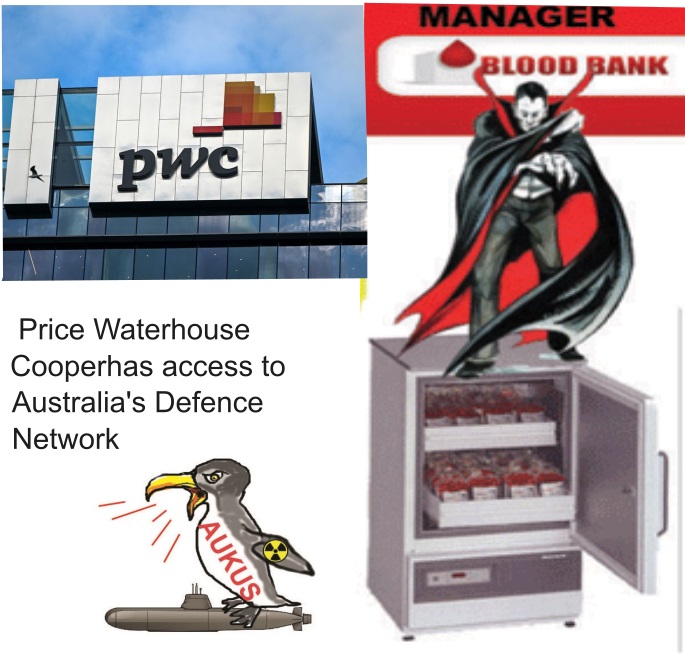
Greens Senator David Shoebridge likened PwC advising the Government to “Dracula at the blood bank” after it was discovered that PwC also still has access to the Defence Secret Network.
Greens Senator David Shoebridge likened PwC advising the Government to “Dracula at the blood bank” after it was discovered that PwC also still has access to the Defence Secret Network.
The PwC disaster — Neoliberalism on steroids
Independent Australia By Michelle Pini | 1 June 2023
Australians are tired of neoliberalism. We are sick of that much talked about and ever-widening gap between the haves and have-nots.
The idea that endless privatisation and unfettered corporate greed will somehow leave us all better off no longer appears to be swallowed by the vast majority of Australians. Certainly, public confidence in our political leaders as well as in our institutions has been severely eroded in recent years.
PUBLIC PAIN FOR PRIVATE GAIN
This week, the Pricewaterhouse Cooper (PwC) scandal – in which nine (as yet unidentified) partners of the consultancy firm enlisted to help the Coalition Government design tax laws, leaked confidential Treasury information to benefit PwC’s private clients – has left Australians outraged.
And if that’s not enough, it was revealed on Tuesday (30 March) that PwC is also:
“…The internal auditor of both Treasury and the AFP.”
This adds another level of complication to an already convoluted matter, given the Australian Federal Police (AFP) chose not to investigate the matter, despite being urged to do so by the Australian Tax Office (ATO) over a period of two years.
Appearing before Senate Estimates, ATO Commissioner Chris Jordan said:
“After sharing the information with the Australian Federal Police (AFP) over the period 2018 and 2019, and providing a number of documents upon their request after our initial sample of the emails, we had to ultimately formally refer the matter to the Tax Practitioners Board in July 2020.”
Jordan explained that once the AFP investigation was closed the only option was the Tax Practitioners Board, since:
“There was nowhere else to go.”
But an AFP spokesperson said there was “insufficient information” to proceed.
According to a report in the Financial Review:
he AFP assessed, based on the material that the ATO provided, was that there was insufficient information in the material, to support a formal referral … In consultation and agreement with the ATO, the matter was closed in 2019.”
Greens Senator David Shoebridge likened PwC advising the Government to “Dracula at the blood bank” after it was discovered that PwC also still has access to the Defence Secret Network.
SHARING BUT NOT CARING
And Australians watched, mouths agape, as the PwC tax scandal finally exploded, resulting in nine directors being “stood down” and our government institutions – to which the firm still consults – were left exposed. Of course, since PwC is a private company, no information has been shared with the public as to who these directors may be, what is meant by “stood down” or what redundancies they may take with them if their directorships are ever severed — never mind disciplinary action.
It’s a pity sharing information about its own lack of accountability does not appear to be a likely move from the consultancy firm that has received eyewatering amounts of taxpayer funds for advising the Federal Government — before also sharing confidential government information with its own client base.
And it’s not only PwC that contributes to this “shadow public service” concept so favoured by the former Coalition Government. An audit (not conducted by PwC, thankfully) has shown close to $21 billion was spent by the Morrison Government on external labour hires in the public service in 2021-22, alone………………………………… https://independentaustralia.net/politics/politics-display/the-pwc-disaster–neoliberalism-on-steroids,17570#disqus_thread
$528 Billion nuclear clean-up at Hanford Site in jeopardy

The government now appears to be seriously considering whether it will be necessary to leave thousands of gallons of leftover waste buried forever in Hanford’s shallow underground tanks, according to some of those familiar with the negotiations, and protect some of the waste not in impenetrable glass, but in a concrete grout casing that would almost certainly decay thousands of years before the toxic materials that it is designed to hold at bay.
At site after site, the solution has come down to a choice between an expensive, decades-long cleanup or quicker action that leaves a large amount of waste in place.
A Poisonous Cold War Legacy That Defies a Solution
NYT, By Ralph Vartabedian, Reporting from Richland, Wash., May 31, 2023
From 1950 to 1990, the U.S. Energy Department produced an average of four nuclear bombs every day, turning them out of hastily built factories with few environmental safeguards that left behind a vast legacy of toxic radioactive waste.
Nowhere were the problems greater than at the Hanford Site in Washington State, where engineers sent to clean up the mess after the Cold War discovered 54 million gallons of highly radioactive sludge left from producing the plutonium in America’s atomic bombs, including the one dropped on the Japanese city of Nagasaki in 1945.
Cleaning out the underground tanks that were leaching poisonous waste toward the Columbia River just six miles away and somehow stabilizing it for permanent disposal presented one of the most complex chemical problems ever encountered. Engineers thought they had solved it years ago with an elaborate plan to pump out the sludge, embed it in glass and deposit it deep in the mountains of the Nevada desert.
But construction of a five-story, 137,000 square-foot chemical treatment plant for the task was halted in 2012 — after an expenditure of $4 billion — when it was found to be riddled with safety defects. The naked superstructure of the plant has stood in mothballs for 11 years, a potent symbol of the nation’s failure, nearly 80 years after the Second World War, to deal decisively with the atomic era’s deadliest legacy.
The cleanup at Hanford is now at an inflection point. The Energy Department has been in closed-door negotiations with state officials and the U.S. Environmental Protection Agency, trying to revamp the plan. But many fear the most likely compromises, which could be announced in the coming months, will put the speed and quality of the cleanup at risk.
The government now appears to be seriously considering whether it will be necessary to leave thousands of gallons of leftover waste buried forever in Hanford’s shallow underground tanks, according to some of those familiar with the negotiations, and protect some of the waste not in impenetrable glass, but in a concrete grout casing that would almost certainly decay thousands of years before the toxic materials that it is designed to hold at bay.
“The Energy Department is coming to a big crossroads,” said Thomas Grumbly, a former assistant secretary at the department who oversaw the early days of the project during the Clinton administration.
Successive energy secretaries over the last 30 years, he said, “have slammed their heads against the wall” to come up with a technology and budget that would make the problem go away not only at Hanford, but also at other nuclear weapons sites around the country.
Plants in South Carolina, Washington, Ohio and Idaho that helped produce more than 60,000 atomic bombs have tons of radioactive debris that will be radioactive for thousands of years. And unlike nuclear power plants, whose waste consists of dry uranium pellets locked away in metal tubes, the weapons facilities are dealing with millions of gallons of a peanut butter-like sludge stored in aging underground tanks.
Two million pounds of mercury remain in the soils and waters of eastern Tennessee. Radioactive plumes are contaminating the Great Miami aquifer near Cincinnati.
At site after site, the solution has come down to a choice between an expensive, decades-long cleanup or quicker action that leaves a large amount of waste in place.
Hanford, some 580 square miles of shrub-steppe desert in south-central Washington State, is the largest and most contaminated of all the weapons production sites — too polluted to ever be returned to public use. But the problem is urgent, given the risk of radionuclides contaminating the Columbia River, a vital lifeline for cities, farms, tribes and wildlife in two states……………………………………………………………………………………………………
“The closer you get to the bottom of those tanks, the more radioactive, toxic and dangerous waste is,” said Geoffrey Fettus, a lawyer with the Natural Resources Defense Council, which has sued the government over the Hanford cleanup………………………………………………………………. more https://www.nytimes.com/2023/05/31/us/nuclear-waste-cleanup.html
Defence reveals seven new PwC contracts worth $6m after tax scandal broke
Crikey, ANTON NILSSON MAY 31, 2023
The Defence Department has reported seven contracts with PwC, worth a total of nearly $6 million, since the firm’s tax scandal broke, Crikey can reveal.
Greens Senator David Shoebridge told Crikey that Parliamentary Library research showed the single contract worth the most money — $4.6 million for “management advisory services” — started on February 1.
That’s just over a week after the Tax Practitioner’s Board (TPB) issued a media release revealing PwC’s former tax partner Peter-John Collins had been deregistered as a tax agent over integrity breaches……………………………
Crikey can reveal the Defence Department entered into the following contracts with PwC after January 23:………………………………………………….
In total, the Defence Department has 54 contracts with PwC, also known as PricewaterhouseCoopers, worth a total of $223,299,943, the department’s Associate Secretary Matt Yannopoulos told Senate estimates on Tuesday. …………..
The senator, who is the Greens’ defence spokesperson, told Crikey the tax scandal hadn’t stopped the department “signing contract after contract with PwC”.
“This isn’t a single contract from a rogue tender panel, it’s at least seven contracts for work across the entire [Australian Defence Force]” Shoebridge said. “What this shows is how deeply PwC has its tentacles into the defence establishment and how complicit defence is with that cosy arrangement.”…………………………
https://www.crikey.com.au/2023/05/31/defence-pwc-contracts-tax-scandal/?utm_campaign=crikeyworm&utm_medium=email&utm_source=newsletter
Plan to release Fukushima nuclear plant water into sea faces local opposition: “The sea is not a garbage dump”
CBS BY ELIZABETH PALMER, MAY 31, 2023
Japan’s government is asking for international backup as it prepares to release thousands of gallons of water from the Fukushima nuclear power plant into the sea. The plan has alarmed the public and outraged fishermen — even as the international energy agency looks inclined to back it.
………….The plant sits in what was a lush coastal part of Japan, famous for its seafood and delicious fruit. Today, there’s still no-go area around the power station where fields lie fallow and homes sit abandoned.
Inside a high security fence studded with warning signs, engineers are still working to remove radioactive fuel rods that melted inside the reactors. They’ll be at it for decades.
Another problem is piling up in hundreds of metal tanks on the site: they contain more than a million tons of contaminated water.
…………………………………….. “Piping water into the sea is an outrage,” said Haruo Ono, who has been fishing the ocean off the coast of Fukushima all his life.
“The sea is not a garbage dump,” he said. “The company says it’s safe, but the consequences could catch up with us 50 years down the road.”
………………………………..Haruo Ono, the fisherman, said the science is not the issue.
“People don’t understand it,” he said. “Mothers won’t choose Fukushima fish knowing it’s been swimming in radioactive water. Even if the experts say it’s safe.”
Under current rules, he can only take his fishing vessels out to sea a day or two a week, when he gets the OK from the government.
“This is the end of my livelihood,” he said.
……………. The Fukushima nuclear plant won’t be safely decommissioned for years to come. So far taxpayers have paid $90 billion to clean it up. https://www.cbsnews.com/news/fukushima-nuclear-plant-water-plan-release-into-sea-fear-controversy/
1 This month
Chernobyl: The Lost Tapes – A good documentary on Chernobyl on SBS available On Demand for the next 3 weeks– https://www.sbs.com.au/ondemand/tv-program/chernobyl-the-lost-tapes/2352741955560
15 April – Zoom –Nuclear Power is Not the Solution
Apr 15, 2026 01:00 AM in Canberra, Melbourne, Sydney

Join the International Physicians for the Prevention of Nuclear War (IPPNW) on Tuesday, April 14th for a timely webinar exploring the risks associated with nuclear power and challenging the myth that it offers a simple, safe, carbon-free solution to the climate crisis

21 April Webinar: No Nuclear Weapons in Australia
Start: 2026-04-21 18:00:00 UTC Canberra, Melbourne, Sydney (GMT+10:00)
End: 2026-04-21 19:30:00 UTC Canberra, Melbourne, Sydney (GMT+10:00)
Event Type: Virtual
A virtual link will be communicated before the event.
Host Contact Info: australia@icanw.org

of the week – Australians for War Powers Reform (AWPR)
To see nuclear-related stories in greater depth and intensity
 Antinuclear