Nuclear power too expensive and slow to be part of Australia’s plans to reach net zero, study finds
Guardian, Lisa Cox 12 July 23
Nuclear power should not form part of Australia’s plans to reach net zero emissions because it is too expensive and slow, according to the final report of a project that models how Australia might meet its 2050 climate target.
The Net Zero Australia report, a partnership between major academic institutions and the management consultancy Nous Group, says the federal government has a major role to play in accelerating all options that could make a “material contribution” to achieving net zero.
The release of the report comes days after the opposition leader, Peter Dutton, ramped up calls for nuclear power in Australia and a debate about removing the legislative ban on nuclear power in Australia.
The report includes major investment in batteries, solar, onshore wind, pumped hydro and transmission. Among renewable options, offshore wind was found to have the most uncertain pipeline, with the report concluding first power from offshore wind projects needed to occur in 2030.
But the report concludes nuclear power should not be factored in to net zero plans and states that to “reduce renewable targets in the belief that nuclear will be deployed later at scale would create a material risk of not achieving net zero, or doing so at an excessive cost”.
Richard Bolt, principal at Nous Group, said: “Nuclear power should not be in our plans, because it’s too expensive and slow. ……………………………………………………………………….
The report was produced by the University of Melbourne, the University of Queensland, Princeton University’s Andlinger Center for Energy and the Environment, as well as Nous Group…………………… https://www.theguardian.com/australia-news/2023/jul/11/nuclear-power-too-expensive-and-slow-to-be-part-of-australias-plans-to-reach-net-zero-study-finds
Dutton wants Australia to join the “nuclear renaissance” – but this dream has failed before.

What stopped the nuclear noughties was a bigger problem: economics. Governments looking at nuclear saw the cost and time over-runs and decided it wasn’t worth it.
in Australia, promises to create a nuclear power industry from scratch based on as yet unproven technologies and in competition with cheap renewables is simply delusional.
The Conversation John Quiggin 11 July 23
Last week, opposition leader Peter Dutton called for Australia to join what he dubbed the “international nuclear energy renaissance”.
The same phrase was used 20 years ago to describe plans for a massive expansion of nuclear. New Generation III plants would be safer and more efficient than the Generation II plants built in the 1970s and 1980s. But the supposed renaissance delivered only a trickle of new reactors – barely enough to replace retiring plants.
If there was ever going to be a nuclear renaissance, it was then. Back then, solar and wind were still expensive and batteries able to power cars or store power for the grid were in their infancy.
Even if these new smaller, modular reactors can overcome the massive cost blowouts which inevitably dog large plants, it’s too late for nuclear in Australia. As a new report points out, nuclear would be wildly uncompetitive, costing far more per megawatt hour (MWh) than it does to take energy from sun or wind.
The nuclear renaissance that wasn’t
Early in the 21st century, the outlook for nuclear energy seemed more promising than it had in years. ……………………………………….
The time seemed right for a nuclear renaissance – especially in the United States. Between 2007 and 2009, 13 companies applied for construction and operating licenses to build 31 new nuclear power reactors. But all but two of these proposals stayed on paper.
The first, in Georgia, is expected to be completed this year after running way behind schedule and way over budget. The other project in South Carolina was abandoned in 2017 after billions of dollars had already been poured into it. The same disastrous cost and time blowouts have hit new reactors in France (Flamanville, 10 years behind schedule), Finland (Olkiluoto, which opened this year after a 14 year delay) and the UK (Hinkley Point C, still under construction with cost and time blowouts).
China has built a trickle of new nuclear plants, commissioning three or four a year over the last decade. China currently has about 50 gigawatts (GW) of nuclear power capacity. This pales into insignificance compared to the nation’s extraordinary expansion of solar, with 95-120 gigawatts of additional capacity expected this year alone.
Nuclear falls short on cost, not politics
What went wrong for nuclear? Despite the claims of some nuclear advocates, the renaissance in the 2000s did not fall short because of political resistance. Far from it – the renaissance had broad political support in key markets.
And, unlike in the 1970s where intense anti-nuclear sentiment was tied to fears of nuclear war, environmentalists in the 2000s had refocused on the need to stop burning carbon-based fuels. Anti-nuclear campaigns and protest marches were almost non-existent.
What stopped the nuclear noughties was a bigger problem: economics. Governments looking at nuclear saw the cost and time over-runs and decided it wasn’t worth it.
As megaproject expert Bent Flyvbjerg has shown, cost overruns like these are typical. First of a kind nuclear plants offer an extreme example of the problem. To date, no Generation III or III+ design has been produced at scales large enough to iron out the inevitable early problems.
At the same time, other energy sources were growing in importance.
In Australia, the writing was on the wall by 2007, when an inquiry found new nuclear power would struggle to compete with either coal or renewables. A string of subsequent inquiries have come to precisely the same conclusion.
Could it be different this time?
To make nuclear viable these days, advocates believe, means making it safe, cheap and easy to build. No more megaprojects. Instead, build small reactors en masse on factory production lines, ship them to where they are needed and install them in numbers matching the needs of the area.
Advocates hope the efficiency of factory production will offset the lower efficiency associated with smaller capacity. Ironically, off-site mass production and modular installation is the basis of the success of solar and wind.
To date, the most promising reactor design is NuScale’s VOYGR. It has yet to be produced and the US company has no firm orders. It does have preliminary agreements to build six reactors in Utah by 2030 and another four in Romania.
If all are built, that’s still less than the capacity of a single large Gen III plant. More strikingly, it’s about the same as the new solar capacity installed every single day (~710 MW) this year around the world.
Even with US government subsidies, NuScale estimates its power would cost A$132 per MWh. In Australia, average wholesale prices in the first quarter of 2023 ranged from $64 per MWh in Victoria to 114 per MWh in Queensland.
So why, then, is Australia’s opposition still talking about new nuclear? Dutton claims Australia’s future nuclear submarines to be built under the AUKUS deal are “essentially floating SMRs”. This is a red herring – while submarine reactors are small, they are not modular.
The simplest answer is political gain. Announcements like this yield political benefits at low cost.
The US, UK and France have decades of experience in nuclear power, even if failures outnumber successes. So yes, there is a slim chance the latest “nuclear renaissance” will succeed in these countries.
But in Australia, promises to create a nuclear power industry from scratch based on as yet unproven technologies and in competition with cheap renewables is simply delusional. https://theconversation.com/dutton-wants-australia-to-join-the-nuclear-renaissance-but-this-dream-has-failed-before-209584?utm_source=substack&utm_medium=email
Exposing the lying claims of pro nuclear shill Zion Lights
2 Response to a July 2023 article by Zion Lights: https://nuclear.foe.org.au/zion-lights/
In Australia, for the same investment we can get three times more firmed renewable power (generation, not capacity) in one-third of the time compared to nuclear. The cost difference between nuclear and renewables is so vast that renewables are still cheaper even when transmission and storage are costed in. Perhaps the comparison is more nuclear-friendly in the UK, but I strongly suspect renewables+storage+transmission is still cheaper given the obscene costs of Hinkley Point (approx. A$50 billion for two reactors).
Specifically in Light’s latest article:
* Lights’ claims about the IPCC supporting nuclear power are dishonest, the IPCC maps out countless scenarios (including scenarios with nuclear reducing to zero) and its ‘analysis’ of pros and cons is generally reduced to dot-points.
* Lights’ claims about a “scientific consensus” in support of nuclear power are dishonest, e.g. the Climate Council, comprising Australia’s leading climate scientists, states that nuclear power reactors “are not appropriate for Australia and probably never will be”.
* Ignores profound impacts of catastrophic accidents.
* Ignores the repeatedly-demonstrated connections between nuclear power and weapons (in the UK and elsewhere).
* Light’s ‘millions of lives saved’ meme is dishonest because it assumes nuclear displaces nothing other than coal.
* Nonsense about warm water around nuclear plants providing a haven for sea-life is dishonest, she surely knows that water intake pipes kill fish by the thousands. (And she should know something about Irish opposition to radioactive discharges from Sellafield.)
* Glib, ignorant and/or dishonest claims about high-level nuclear waste: “spent fuel can be easily transported to another location, and even recycled”. The UK has given up on reprocessing (a polluting, multi-billion-dollar disaster) and has made near-zero progress on a deep underground repository and has wasted billions of pounds of taxpayers’ money in the process. The only operating deep underground repository in the world – WIPP in the US ‒ was disastrously mismanaged and under-regulated resulting in a chemical explosion in 2014.
* The UAE project came in under budget? Either Lights is ignorant or lying. The UAE project was years behind schedule and many billions of dollars over-budget.
And in other articles/interviews, even more unhinged nonsense, e.g.

* Lights saying climate change ‘could be solved overnight’ with nuclear. Seriously?
* Lights lying about her role in Extinction Rebellion.
* Lights getting sucked in by, and collaborating with, lunatic MAGA liar Michael Shellenberger.
Update: Lights deleted the above comments from the comments thread below her article, failed to address any of the substantive energy issues and failed to respond to the accusations of deceit.
TODAY. Zelensky mania ! But are cracks appearing in NATO?

Volodymyr Zelensky gave a stirring address to thousands of adoring fans in Vilnius, Lithuania.
He was at the top of his game – which is whipping up enthusiasm for the coming grand military defeat of Russia.
The NATO summit, though full of adoration for the sainted Zelensky, was just a little less unified in its holy purpose.
Perhaps hole -ey purpose would be more accurate
You see – while it is holy dogma now, that Ukraine must become part of NATO, -the hole in this dogma is becoming apparent. NATO Secretary-General Jens Stoltenberg spelled it out: Ukraine can join NATO only when Ukraine wins the war against Russia because “unless Ukraine prevails, there is no membership to be discussed at all.”
But of course – no problem!
But wait – there is a problem – Ukraine is not winning this war. That is a realisation that is slowly dawning on some European leaders.
There probably never has been such a media magician as Volodymyr Zelensky. He has put it over politicians, journalists, people world-wide, and especially the suffering people of Ukraine.
But will Biden, Macron, Sunak and the rest just dump Zelensky, when his magic bubble bursts, when it’s all over in Ukraine, and they are forced to accept a negotiated peace with Russia?
That eventual negotiation is better than the other alternative – World War 3.
Ukraine’s chances of victory in 2023 are ‘vanishingly small’
Premiered Jun 24, 2023 Ret. Lieutenant Colonel Daniel Davis elaborates on the current status of the Ukraine war and why a successful counteroffensive looks less likely.
Indonesia Warns Nuclear Weapons Put Southeast Asia a ‘Miscalculation Away’ From Disaster

Indonesia’s Foreign Minister Retno Marsudi urged nuclear weapons states to join ASEAN’s regional nuclear-free zone.
The Diplomat, By Edna Tarigan and Niniek Karmini, July 12, 2023
Indonesia’s top diplomat warned Tuesday of the threat posed by nuclear weapons, saying that Southeast Asia is “one miscalculation away from apocalypse” and pressing for world powers to sign a treaty to keep the region free from such arms.
Indonesian Foreign Minister Retno Marsudi raised the alarm ahead of a two-day summit of the Association of Southeast Asian Nations (ASEAN), which started later Tuesday in Jakarta. The agenda would spotlight Myanmar’s deadly civil strife, continuing tensions in the South China Sea, and efforts to fortify regional economies amid the global headwinds set off by Russia’s invasion of Ukraine.
Later in the week, the 10-nation bloc will meet Asian and Western counterparts, including U.S. Secretary of State Antony Blinken, Russian Foreign Minister Sergey Lavrov, and Chinese foreign policy overseer Wang Yi.
The U.S.-China rivalry is not formally on ASEAN’s agenda but looms large over the meetings of the bloc, an often-unwieldy collective of democracies, autocracies, and monarchies, with some members split over allegiances either to Washington or Beijing.
“We cannot be truly safe with nuclear weapons in our region,” Marsudi told fellow ASEAN ministers. “With nuclear weapons, we are only one miscalculation away from apocalypse and global catastrophe.
In 1995, ASEAN states signed a treaty that declared Southeast Asia’s commitment to be a nuclear weapon-free zone, one of five in the world. However, Marsudi lamented that none of the world’s leading nuclear powers have signed on to the pact and called for renewed efforts to convince those states to sign up. “The threat is imminent, so we can no longer play a waiting game,” she said………………………………………………………………….more https://thediplomat.com/2023/07/indonesia-warns-nuclear-weapons-put-southeast-asia-a-miscalculation-away-from-disaster/
SCOTT RITTER: NATO Summit, a Theater of the Absurd

The scope and scale of the Ukrainian military defeat is such that the focus of many NATO members appears to be shifting from the unrealistic goal of strategically defeating Russia to a more realistic objective of bringing about a cessation to the conflict that preserves Ukraine as a viable nation state.
Ukrainian President Volodymyr Zelensky will attend the NATO summit. However, his demands for NATO membership will not be met.
Normalizing failure might best describe the best that NATO can accomplish in Vilnius.
By Scott Ritter, Consortium News, July 10, 2023
The unfulfilled goals and objectives from last year’s meeting in Madrid loom over the Atlantic military alliance. When the membership meets in Vilnius this week, normalizing failure might best describe the most that can be accomplished.
The leaders of NATO’s 31 constituent member states have begun to assemble in Vilnius, the capital of Lithuania, for the alliance’s 33rd summit, an event that has come to symbolize the military organization’s increasingly difficult task of transforming political will into tangible reality.
Since the Wales Summit of 2014, when NATO made Russia a top priority in the aftermath of the Russian annexation of Crimea, and the Warsaw Summit of 2016, when NATO agreed to deploy “battlegroups” on the soil of four NATO members (Latvia, Estonia, Lithuania and Poland) in response to perceived Russian “aggression” in the region, Russia has dominated the NATO agenda and, by extension, its identity.
The Vilnius summit promises to be no different in this regard.
One of the major issues confronting the NATO leadership is that the Vilnius summit operates under the shadow of last year’s Madrid summit, convened in late June in the aftermath of Russia’s initiation of military operations against Ukraine.
The Madrid summit came on the heels of Boris Johnson’s deliberate sabotage of a Ukrainian-Russian peace agreement that was supposed to be signed on April 1, 2023, in Istanbul, and the decision by the United States in May 2023 to extend to Ukraine military assistance exceeding $45 billion as part of a new “lend lease” agreement.
In short, NATO had opted out of a peaceful resolution to the Russia-Ukraine conflict and instead chose to wage war by proxy — with Ukrainian manpower being married with NATO equipment — designed to achieve what U.S. Ambassador to NATO Julianne Smith, in May 2022, called the “strategic defeat” of Russia in Ukraine.
The Madrid summit generated an official NATO statement which declared that “Russia must immediately stop this war and withdraw from Ukraine,” adding that “Belarus must end its complicity in this war.”
When it came to Ukraine, the Madrid statement was equally firm. “We stand in full solidarity with the government and the people of Ukraine in the heroic defense of their country,” it read………………
Confidently Seeking a ‘Strategic Defeat’
NATO, it seemed, was supremely confident in its ability to achieve the outcome it so very much wanted — the strategic defeat of Russia.
What a difference a year makes.
NATO assistance to Ukraine resulted in a successful counteroffensive which compelled Russia to withdraw from territory around the city of Kharkov, as well as abandon portions of the Kherson Oblast located on the right bank of the Dnieper River. Once the Russian defenses solidified and the Ukrainian attack stalled, NATO and Russia both began preparing for the next phase of the conflict……………………………….
NATO had placed high hopes on the Ukrainian army being able to carry out a counteroffensive against Russia which would achieve discernable results both in terms of territory re-captured and casualties inflicted on the Russian army. The results, however, have been dismal to date — tens of thousands of Ukrainian casualties and thousands of destroyed vehicles while failing to breach even the first line of the Russian defenses.
One of the challenges NATO will face in Vilnius is the question of how to recover from this setback. Many NATO countries are starting to exhibit “Ukraine fatigue” as they see their armories stripped bare and their coffers emptied in what, by every measurement, appears to be a losing cause.
The scope and scale of the Ukrainian military defeat is such that the focus of many NATO members appears to be shifting from the unrealistic goal of strategically defeating Russia to a more realistic objective of bringing about a cessation to the conflict that preserves Ukraine as a viable nation state.
Ukrainian President Volodymyr Zelensky will attend the NATO summit. However, his demands for NATO membership will not be met — U.S. President Joe Biden himself has weighed in on the matter, saying this would not be possible while Ukraine is at war with Russia.
Face-Saving Gestures
There will be face-saving gestures from NATO, such as the creation of a NATO-Ukraine Council and talk of eventual post-conflict security guarantees. But the reality is Zelensky’s presence will do Ukraine more harm than good, since it will only accentuate the internal disagreement within NATO on the issue of Ukrainian membership and highlight NATO’s impotence when it comes to doing anything that can meaningfully alter the current trajectory on the battlefield, which is heading toward a strategic defeat for both Ukraine and NATO.
…………………………………………………………………. One can expect a plethora of rhetorical spin and posturing by the NATO membership, but the fact is the real mission of the Vilnius summit is how best to achieve a soft landing from the unfulfilled goals and objectives laid out last year in Madrid.
Normalizing failure might best describe the best that NATO can accomplish in Vilnius.
Any failure to try to stop the accumulation of debacles that represent the current NATO policy toward Ukraine will result in further collapse of the military situation in Ukraine, and the political situation in Europe, which, in their totality, push NATO closer to the moment of its ultimate demise.
This prospect does not bode well for those whose task it is to put as positive a spin as possible on reality. But NATO has long ago stopped dealing with a fact-based world, allowing itself to devolve into a theater of the absurd where actors fool themselves into believing the tale they are spinning, while the audience stares in dismay. https://consortiumnews.com/2023/07/10/scott-ritter-nato-summit-a-theater-of-the-absurd/—
USA cannot sell nuclear submarines to Australia

Good news on nukes: US can’t sell Australia nuclear subs, Pearls an Irritations, By Brian Toohey Jul 12, 2023
The good news is the US can’t sell Australia the three to five used Virginia class nuclear subs that the Albanese government has announced it will buy. Nor will it sell us any new ones.
The chief of US Naval operations Admiral Michael Gilday was recently reported from Washington as saying the US shipyards are only producing subs at a rate of about 1.2 a year. He says a minimum of two a year is needed to fill the Navy’s own requirements. Until then, he said, “We’re not going to be in a position to sell any to the Australians”. A senior Biden advisor, Kurt Campbell added there was also “a troublingly large number of submarines in drydock that needed to be back into the water quickly”.
If Albanese were genuinely a good friend of America, he would say, “We don’t want to deprive you of any nuclear submarines, so we’ll buy readily available conventional subs that serve our needs”. Instead of grabbing this chance to get out of an impossible commitment, he behaves as if everything is still on track.
Another reason to abandon the whole idea of getting US nuclear subs is that Campbell also said that if any were sold to Australia, they would not be “lost to America”. In other words, the US could use them whenever it liked under the policy the Defence minister, Richard Marles has announced of making Australia’s equipment “interchangeable” with the Americans. Contrary to Albanese and Marles’ claims, we can’t have a sovereign capability if we have to hand back US equipment we’ve just bought from it.
Selling Australia second hand subs is not feasible either, as it would reduce the total number available in the US fleet. At present, the US has 21 Virginia attack class submarines and 29 older Los Angeles class that make up its previous target of 50. Serious maintenance problems mean that only a quarter of the Virginia class are available for operational duties. As a result, only a quarter of the total fleet is operationally available at any one time…………………………………………………………
One big disadvantage of a US nuclear reactor is it uses weapons grade uranium fuel that has to be dismantled after the sub finishes its 33-year life. The fuel then has to be processed overseas, returned to Australia, buried in thick drums a minimum of 400 metres below stable rock and monitored for several hundred years.
These subs don’t even use nuclear propulsion. Instead, they are propelled by steam engines, like Puffing Billy. All the nuclear reactor does is heat the water to make the steam. It’s a glorified hot water system. Another big drawback is that hot water from the reactor is continuously expelled from a nuke, creating an infrared signature detectable from space. Other than at low speed, nukes leave an easily detected wake on the surface.
Worse, Rex Patrick, a former submariner and ex-Senator, has pointed out that once nuclear submarines go above a low speed, acoustic tiles on their hulls become loose and start to flap, making an easily detected noise, before some fall off.
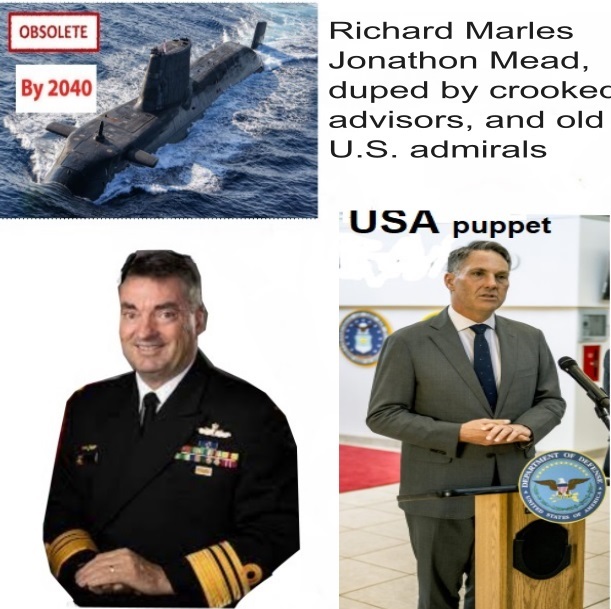
It’s now widely accepted that advances in sensor technology and data processing will render oceans transparent by 2050. Large metal boats travelling underwater will be more easily detected and destroyed than smaller ones. But Vice Admiral Mead, who had 350 staff working on the best way to get nukes, said in an interview with the Guardian that the answer to this problem is to use small underwater drones controlled from a nuke at a safe distance. Underwater drones have a big future. However, it is much better to control them from a cheap platform rather than a massively expensive remote control device called a nuclear submarine that can’t risk being detected doing what it was purchased for.
The first of the eight we build in Adelaide might not be operationally available to almost 2050 and the last by 2070. This assumes nothing will change in the strategic outlook before then. No one knows what the future holds. Peace might have broken out if we take arms control seriously, or a war may start in response to fake intelligence about Taiwan. In the circumstances, we would be wise not to get big, expensive, easily detected submarines which will be increasingly useless.
This means choosing smaller modern conventional ones……………………………………………….
Figures Rex Patrick got from the Parliamentary research service show we could get 12 of these modern, high-quality conventional submarines for a project cost of $18 bn. This is a bargain compared to the government’s estimate of $368 bn for N subs. The next most expensive program is $16 bn for 72 F-35 trouble plagued fighter planes.
…………………………………………………… Nuclear subs also don’t have an impeccable safety record………………..
Australia doesn’t need to regularly deploy submarines into Southeast Asia, let alone up near China. Our subs are not needed because Japan, South Korea, Singapore and US all have submarines closer than us to China, the target. The Defence Strategic Review clearly recommends that Australia’s “northern approaches should be the primary area of military interest”. That’s where our submarines should mainly be deployed to dissuade an enemy entering waters where they could be sunk by one of our submarines……………………………………………………… more https://johnmenadue.com/good-news-on-nukes-us-cant-sell-australia-nuclear-subs/
1 This month

of the week – Australians for War Powers Reform (AWPR)
To see nuclear-related stories in greater depth and intensity
 Antinuclear