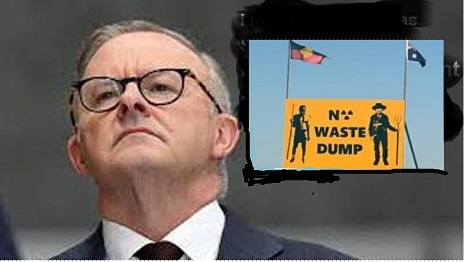
Prime Minister Albanese must abandon South Australian nuclear waste dump
Friends of the Earth Australia ‒ 18 July 2023
The Federal Court has today quashed the declaration of a proposed nuclear waste dump site near Kimba in SA, citing ‘pre-judgement’ and ‘apprehended bias’. The court case was initiated by Barngarla Traditional Owners, who are unanimous in their opposition to the proposed nuclear dump.
Dr. Jim Green, national nuclear campaigner with Friends of the Earth Australia, said:
“Today’s decision is an incredible victory for Barngarla Traditional Owners. Now Prime Minister Albanese must kill the nuclear dump plan stone dead.
“It is an outrage that the Albanese government has been attempting to impose a national nuclear waste dump on Barngarla country despite the unanimous opposition of the Traditional Owners.
“It is deeply hypocritical that the Albanese government has been championing a Voice to Parliament at the same time as it ignores and overrides the unanimous voice of the Barngarla Traditional Owners.”
Jane Stinson, Chair of the SA Parliament’s Environment, Resources and Development Committee, said last year: “In this day and age, when we’re talking about Voice, Treaty and Truth, we can’t just turn around and say, ‘Oh, well, those are our values but in this particular instance, we’re going to ignore the voice of Aboriginal people’. I think that’s just preposterous and it’s inconsistent with what most South Australians would think.”
Susan Close, now Deputy Premier of South Australia, said in 2019 that it was a “dreadful process from start to finish” that led to the nomination of the proposed Kimba dump site and that SA Labor is “utterly opposed” to the “appalling” process which led to Kimba being targeted.
Susan Close noted in 2020 statement, titled ‘Kimba site selection process flawed, waste dump plans must be scrapped’, that SA Labor “has committed to traditional owners having a right of veto over any nuclear waste sites, yet the federal government has shown no respect to the local Aboriginal people.”
Dr. Green continued:
“It is appalling that the Albanese government has been willing to violate the United Nations Declaration on the Rights of Indigenous Peoples while at the same time professing to support the Declaration.”
The UN Declaration on the Rights of Indigenous Peoples states that: “States shall take effective measures to ensure that no storage or disposal of hazardous materials shall take place in the lands or territories of indigenous peoples without their free, prior and informed consent.”
Dr. Green concluded:
“To date, the issue has been managed by federal resources minister Madeleine King. There appears to have been little or no input from caucus, Cabinet or the Prime Minister’s Office.
“Prime Minister Anthony Albanese needs to take control and declare that the rights of Barngarla Traditional Owners will be respected, today’s Federal Court decision will not be challenged, and the government will now abandon the plan to impose a nuclear waste dump on Barngarla country.
“Federal Labor should adopt SA Labor’s policy giving traditional owners a right of veto over proposed nuclear waste dump sites. That would give traditional owners across the country some confidence that their voices will be heard as the government progresses plans to store and dispose of waste arising from nuclear-powered submarines in the coming decades.”
Contact: Jim Green 0417 318 368
Background: ‘Labor must hear Indigenous voice against Kimba nuclear site’, inDaily, July 17.
Oppie biopic should rekindle Japanese A bombing debate

Walt Zlotow, West Suburban Peace CoalitionGlen , Ellyn IL 21 Jul 23
The movie ‘Oppenheimer’, based on ‘American Prometheus’ the Pulitzer Prize winning bio of J. Robert Oppenheimer, hits theaters today. Neatly bookended on the calendar between the July 16, 1945 A bomb test and the Hiroshima/Nagasaki strikes 3 weeks later, ‘Oppenheimer’ is sure to be an atomic like blockbuster.
Besides widely informing America of the epic life of possibly its most consequential American in history, it should also spur debate on the necessity for killing over a hundred thousand Japanese civilians in those 2 monstrous attacks.
The mainstream American narrative still portrays the bombings as necessary and just to end the Japanese war without an invasion projected to inflict a million US casualties.
I learned of the atomic bombings 72 years ago at age 6. For the first decade afterward, I swallowed whole the US fairytale that the military and political elite were unified in dropping the bombs to prevent that costly invasion.
Few if any reputable historians buy that version today. They point to a number of top military leaders who opposed the nuclear attacks, for good reasons. Most prominent was U.S. Army Chief of Staff General George C. Marshall who argued not using the Bomb would strengthen America’s prestige and position in post war Asia.
He even advocated for inviting the Russians to view its July 16, 1945 test. Navy Secretary and later Defense Secretary James Forrestal rightly argued the bombings would impede our post WWII relations with the Soviet Union. Fleet Admiral William Leahy, senior US military officer on active duty in WWII, called the proposed bombings “barbaric”.
Assistant Secretary of War John McCloy told Truman that neither invasion nor atomic bombings were necessary. Japan would surrender if we avoided ‘Unconditional Surrender’ terminology since any surrender would amount to that without saying so. McCloy even advocated telling Japanese leaders we had the Bomb as additional incentive to quit the war.
Tho not involved in the atomic bombing decision process, Gen. Dwight Eisenhower was furious we dropped them. He recounted telling Secretary of War Harry Stimson shortly after the attacks “I voiced my grave misgivings, first on my belief that Japan was already defeated and that dropping the bomb was completely unnecessary, and secondly, because I thought that our country should avoid shocking world opinion by the use of a weapon whose employment was, I thought, no longer mandatory as a measure to save American lives. It was my belief that Japan was, at that very moment, seeking some way to surrender with a minimum loss of “face.”
Ike, McCloy, Leahy, Forestall, Marshall and others were right; Truman and his supporters were wrong. Seventy-eight years on America is still the only country to explode nukes in anger. Current US belligerency abrogating sensible nuclear agreements, routinely threatening imagined enemies with “all military options are no the table”, spending a trillion dollars to upgrade our nuclear capability, lurching toward nuclear confrontation with both Russia and China, all bode ill the world will make another 78 years nuclear attack free.
Every American concerned about avoiding nuclear winter should view ‘Oppenheimer’ and ponder the current nuclear dilemma facing peoplekind.
“Nuclear Power Is Already a Climate Casualty”

French Rivers Heat Up, Luck Is Not a Strategy for the Ukraine, – We Chat with Nuclear Expert Dr. Paul Dorfman
Hot Globe Substack, STEVE CHAPPLE, JUL 20, 2023
HOT GLOBE:
Paul, thanks for joining us. Let’s talk about nuclear and climate change.
PAUL DORFMAN:
Thanks, Steve. It’s important to understand that nuclear is very likely to be a significant climate casualty.
For cooling purposes nuclear reactors need to be situated by large bodies of water, which means either by the coast or inland by rivers or large water courses. Sea levels are rising much quicker than we had thought and inland the rivers are heating up, potentially drying up, and also subject to significant flooding and flash-flooding and inundation. The key issue for coastal nuclear is storm surge, which is basically where atmospheric conditions meet high tide, which is essentially what happens in Fukushima.
HOT GLOBE: The decommissioned nuclear plant in southern California at San Onofre is a case in point with the cans of nuclear waste still stored in a concrete containment box lapped by the rising tide–
DORFMAN: In France where I am right now [the government utility] just today put out once again warnings about their reactors having to power down because of low river flow, heated river flow. Now that’s not simply for reactor cooling. It’s about the water that the reactors are cooled by, which then need to be discharged back into the rivers. This super-heated water would basically kill the ecology. The reactors have to power down so as not to discharge heated waters back.
Nuclear has been touted as a potential ameliorated solution to climate. The problem, of course, is that nuclear will be, and relatively soon, a climate casualty, so coastal nuclear, unfortunately, is likely to flood via storm surge and inland nuclear will struggle more and more to get reactor cooling water and be able to discharge super-heated water to the receiving river waters.
“The notion that nuclear will will help us with climate is fortunately –unfortunately–simply not the case.”
HOT GLOBE: In America there’s an awful lot of new money sloshing around for climate remediation. Do you have an opinion on Small Nuclear Reactors?
DORFMAN: It’s not been simply I, but the former head of the US nuclear regulatory commission, the NRC, who coauthored a key study which says quite clearly that small modular reactors produce significantly more radioactive waste than conventional reactors. The waste issue is absolutely key, but there are other issues as well. I remember being invited to give a talk at the Royal United Services Institute in the UK, basically the governmental intellectual arm of the military. The compact design of small nuclear reactors is not suited to defense in depth of the nuclear island and the military guys really seemed to get and understand this, similar problem to conventional reactors in terms of safety and security as we’re finding out in Ukraine now.
The other issue is what’s known as the “economies of scale.” The bigger the nuclear plant the cheaper. ……….The economics of small nuclear reactors are proving deeply problematic. The cost per MW hour is rising. Already conventional reactors are hugely, massively, 4 to 5 times more expensive than renewables-plus, and it’s looking more and more that small nuclear reactors will have similar economic and finance problems, and of course small nuclear reactors are still in development. There are no functioning small nuclear reactors in the world producing conventional power, and they are many years from deployment.
So given the fact that we now know we have an existential climate crisis, small nuclear reactors and of course certainly conventional nuclear look to be far too costly and far too late to help the climate crisis.”
HOT GLOBE: Tell us a little bit about the situation in Zaporizhia. It comes and goes in the American media, but it seems pretty freaking scary to us over here in California! How do you estimate the dangers in the last month or so?
DORFMAN: We’ve been lucky so far but luck isn’t a strategy. Zaporizhia –6 very large nuclear power plants, the largest station in Europe with a very significant radiological inventory and critically very significant spent fuel, spent high level radiological nuclear inventory–is in the middle of a shooting war. Now there’s no way that any nuclear power plant can survive a concerted military attack. No nuclear power plant in the world is designed to do this. The International Atomic Energy agency has been very quiet about this for the last few decades which is kind of worrying given the fact that it seems obvious. Basically, people like me and many others haven’t wanted to talk about this in the past for fear of putting ideas into people’s heads, but the cat is really out of the bag now, and in an increasingly unstable world, it seems absolutely clear that nuclear risk for conventional civil nuclear plants is ramping up both in Zaporizhia and elsewhere whether in Israel, Iran, Pakistan, India or any other potential conflict zone. There’s a very real risk that existing and any new nuclear power plants will be in the firing line.
In Zaporizhia the key concern is cooling-–the cooling ponds are open but the reactors themselves are basically open in all these plants, too. They are in cold shutdown but they also need power to keep the internal sort of governance working, so both the reactors in cold shut down, not in active use and certainly the high level radioactive waste, need cooling. If something God forbid goes wrong you’ll see a worst case scenario. You’ll see what happened at Fukushima. Within eight hours you’ll see hydrogen buildup, hydrogen explosion. You’ll then see significant loss of cooling. If the backup diesel generators don’t run within a day or two, you could well see meltdown. The worst case prognosis is very grave.
HOT GLOBE: Oii. Explain the difference between Chernobyl and Fukushima in terms of Zaporizhia.
DORFMAN: Chernobyl was a graphite moderated reactor. Graphite is the kind of thing that you find on the inside of a pencil. When Chernobyl blew, this graphite was distributed high into the atmosphere and could blow far and wide. The kinds of reactors that you find in Zaporizhia are not, thank heavens, of that design. They are slightly newer Russian designed reactors which have gone through certain kinds of safety upgrades post Fukushima, not the spent fueling ponds but the reactors themselves, so if the worst were to happen, you wouldn’t see a Chernobyl. You would more likely see a Fukushima because you wouldn’t see this punch out of the graphite particles into the air, which would carry the radiation far and wide. What you would see, unfortunately, is very severe contamination of the immediate area and of the region, certainly of Ukraine, potentially Russia and certainly middle Europe. Now what’s also critically important post-accident is what would happen to the land. Ukraine is a very significant grain producing nation and other populations including the African population absolutely depend on this grain. So
that’s the thing about nuclear, if something goes wrong you can really start to write off a lot of people’s lives.
The high risk of this form of technology when we have other forms of technology that will lead us to net zero—there really isn’t any significantly good reason to go down the new nuclear route for whole sets of reasons and one of those reasons is we’re living in an increasingly unstable world and nuclear is increasingly, civil nuclear, is increasingly risky………………………………………….
more https://hotglobe.substack.com/p/nuclear-power-is-already-a-climate
1 This month
Chernobyl: The Lost Tapes – A good documentary on Chernobyl on SBS available On Demand for the next 3 weeks– https://www.sbs.com.au/ondemand/tv-program/chernobyl-the-lost-tapes/2352741955560
15 April – Zoom –Nuclear Power is Not the Solution
Apr 15, 2026 01:00 AM in Canberra, Melbourne, Sydney

Join the International Physicians for the Prevention of Nuclear War (IPPNW) on Tuesday, April 14th for a timely webinar exploring the risks associated with nuclear power and challenging the myth that it offers a simple, safe, carbon-free solution to the climate crisis

21 April Webinar: No Nuclear Weapons in Australia
Start: 2026-04-21 18:00:00 UTC Canberra, Melbourne, Sydney (GMT+10:00)
End: 2026-04-21 19:30:00 UTC Canberra, Melbourne, Sydney (GMT+10:00)
Event Type: Virtual
A virtual link will be communicated before the event.
Host Contact Info: australia@icanw.org

of the week – Australians for War Powers Reform (AWPR)
To see nuclear-related stories in greater depth and intensity
 Antinuclear