Nauseating subservience of Australia’s media and politics to American militarism.
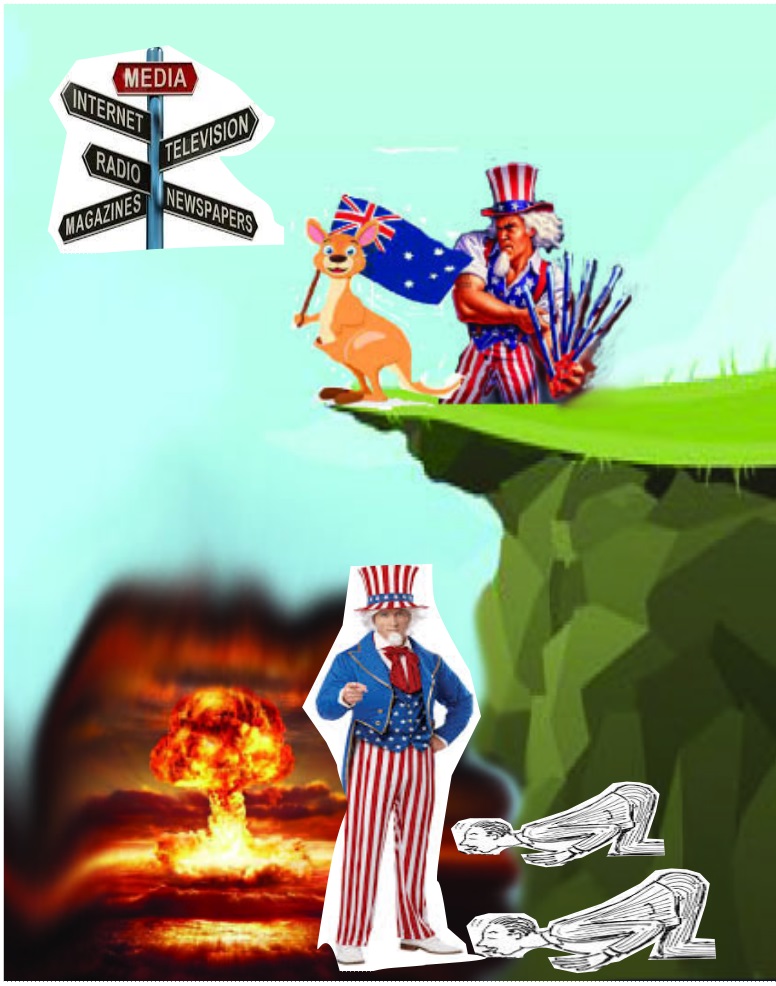
‘Hugely significant’: Australia to manufacture and export missiles to US, Sydney Morning Herald, By Matthew Knott, July 28, 2023
Australia is set to begin manufacturing its own missiles within two years under an ambitious plan that will allow the country to supply guided weapons to the United States and possibly export them to other nations.
( USA sees Australia has seemingly “deep pockets” to do the hard lifting so USA could probably on sell these missiles at a profit or just use Australia as a little America – with the ever present threat of being a security target )
The push to accelerate the creation of a local missile manufacturing industry in co-operation with the US will be one of the centrepiece announcements at the Australia-United States Ministerial (AUSMIN) consultations on Saturday.
Both US and Australian officials are seeking to play down concerns the AUKUS pact could be derailed by division in the US Congress after 23 Senate Republicans warned they would not support the proposal to provide nuclear-powered submarines to Australia unless the US Navy doubled its own production capacity.
The joint missile manufacturing effort is being driven by the war in Ukraine, which has highlighted a troubling lack of ammunition stocks in Western nations including the US.
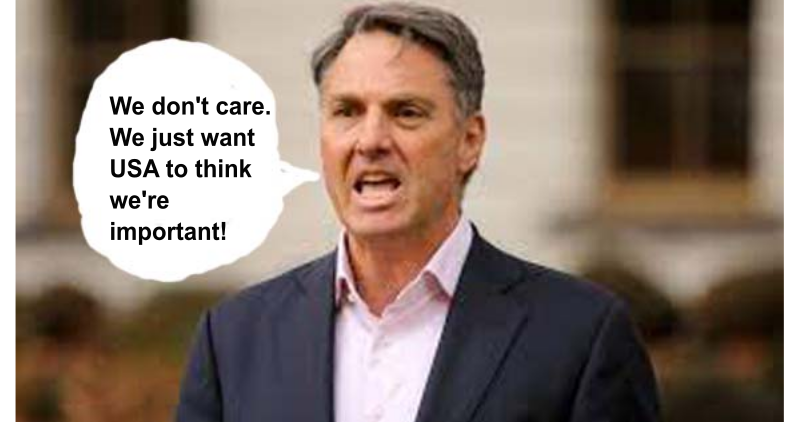
“This is really important for the industrial base of both of our countries,” Defence Minister Richard Marles said on Friday after meeting with US Defence Secretary Lloyd Austin in Brisbane.
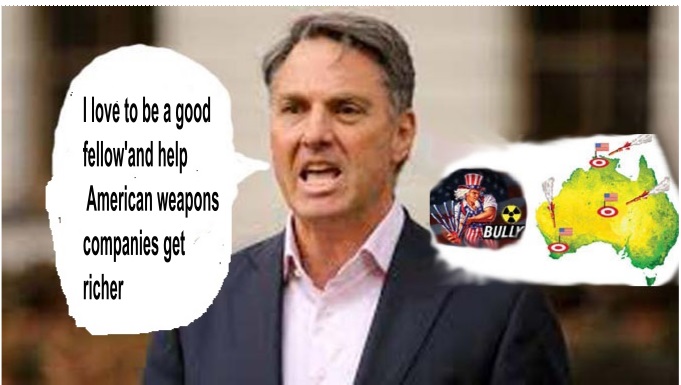
“It is hugely significant in terms of developing Australia’s defence industry. It will be very important in ensuring Australia has the necessary war stocks in the future.”
Marles said the announcement would significantly bring forward the planned opening of local missile factories, which had been expected to take several years to get off the ground.
As well as creating local jobs, a domestic missile manufacturing industry will make Australia less reliant on imports and provide a trusted additional source of munitions for the US.
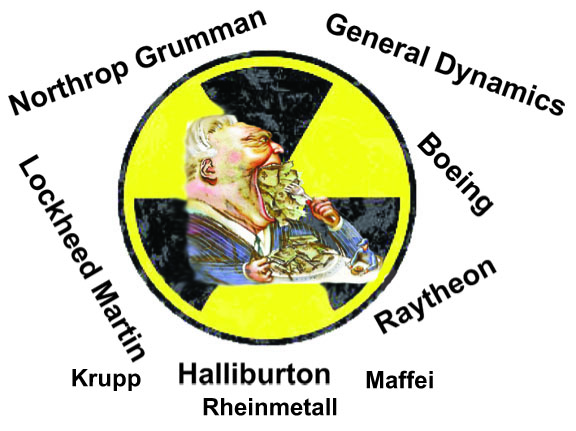
US defence contracting giants Lockheed Martin and Raytheon have been selected by the government as preferred partners for its guided weapons and explosive ordnance enterprise, which was identified as a priority by the recent defence strategic review.
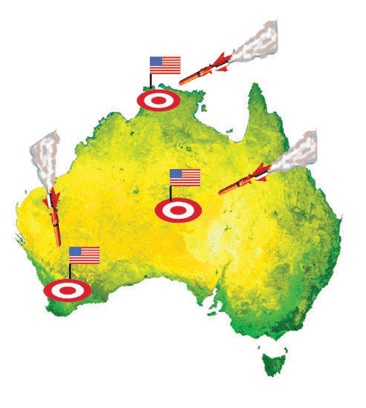
The US and Australia will also announce plans to upgrade air bases in northern Australia so they can be used for training exercises by both Australian and American troops.
(Hands up those people who see the establishment of missile manufacturing in Australia as one – a Red Flag for Warmongering in our Region sending the wrong message in our neck of the woods….and two – a big fat bullseye security target on our back!)
…………………………………………………………….. While noting that AUKUS enjoyed strong in-principle bipartisan support, the USA senators said: “Under the current AUKUS plan to transfer US Virginia-class submarines to a partner nation before meeting the Navy’s own requirements, the number of available nuclear submarines in the US submarine fleet would be lowered further.
“This is a risk we cannot take.”
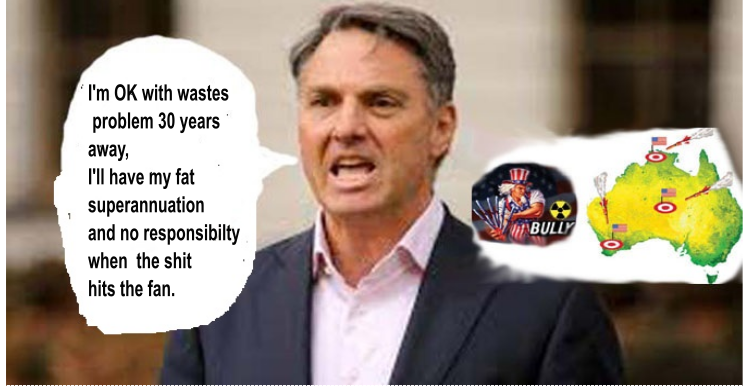
Describing the congressional negotiations as “colour and movement”, Marles said: “We’re not worried about that … I’m confident about the progress of Australia acquiring a nuclear-powered submarine capability. We are encouraged by the progress of legislation through Congress.”
US ambassador to Australia Caroline Kennedy insisted that the submarine plan was “not at risk at all” and dismissed suggestions negotiations had stalled…………..

Speaking before a meeting with Foreign Minister Penny Wong on Friday, US Secretary of State Antony Blinken said: “We have no greater friend, no greater partner, no greater ally than Australia. And I don’t think that alliance or partnership has ever been stronger, at least in my experience.”
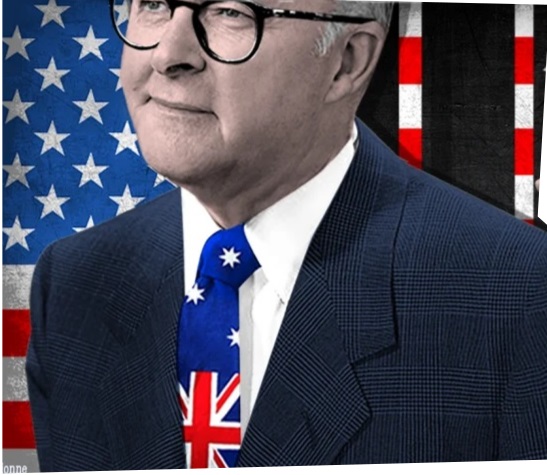
Prime Minister Anthony Albanese said he was “very confident” Australia would secure at least three Virginia-class submarines from the US……………..
Ashley Townshend, a senior fellow for Indo-Pacific security at the Carnegie Endowment for International Peace, said it would take several billion dollars in extra investment from the US government to meet the Republican senators’ demand to increase submarine production from 1.2 to 2.5 vessels a year.
The AUKUS legislation was still likely to pass through Congress this year, but the process would be “messy”, he said………… https://www.smh.com.au/politics/federal/hugely-significant-australia-to-manufacture-and-export-missiles-to-us-20230728-p5ds5e.html?fbclid=IwAR0Soi1XPWSzh-QIMTYtQealoEDp7Zrp67jOpW1p_6-1Ms24HBwRn9G8Ed4
Australia’s nuclear waste

finding a national waste repository is not urgent because it has been stored this way for 60 years.
it’s not even clear if centralising the waste is the best option. ..there’s an implicit risk in transporting the waste from the various sites to a new site, and there should be a safety comparison with leaving it where it is.
Courts have quashed a decision to store water in Kimbra, meaning there is still no centralised repository in the country
Guardian. Tory Shepherd, Sat 29 Jul 2023
More than 20 tonnes of reprocessed nuclear fuel will stay at Australia’s only reactor in southern Sydney, while nuclear waste will remain scattered in “cupboards and filing cabinets” around the country, after the federal court blocked plans for a long-term storage site in outback South Australia.
The site in Kimba was selected more than 40 years after Australia started planning for a centralised repository. But this month, that decision was quashed by the courts.
There is currently no live national facility option, and the waste pile is growing.
Successive governments and agencies have said there are more than 100 sites that are storing nuclear waste littered across the land, in hospital basements and universities, on defence and mining sites and in research laboratories.
There’s no definitive list, because of a licensing split between the federal and state governments, but the vast majority is produced and stored at the Australian Nuclear Science and Technology Organisation (Ansto) facility in Lucas Heights.
A national inventory published last year found Australia’s 2,061 cubic metres of intermediate-level waste (ILW) will more than double to 4,377 cubic metres in the next 50 years.
………….The inventory predicted that the 2,490 cubic metres of low-level waste will more than quadruple to 13,287 within the next five decades. LLW includes gloves, paper, gowns and other ephemera used in nuclear medicine. Much of it can be left to “delay and decay”, and can be disposed of as regular rubbish.
Ansto’s waste makes up about 93% of the LLW, and about 96.5% of the ILW.
Ansto is also responsible for the spent fuel rods from its Opal research reactor at Lucas Heights, in Sydney’s south, which are sent to France, the UK or the US for reprocessing.
Last year, the UK shipped two tonnes of ILW to be stored at Sydney’s Lucas Heights facility until it could be transported to a national facility – it was part of a waste-swap deal after Australia sent spent fuel rods from Opal predecessor to be recycled.
In 2015, 25 tonnes of radioactive waste from France was returned to Australia after reprocessing – that too will be housed at Lucas Heights until a dump is selected and built. Since then, Australia has sent more spent fuel rods to France to have the uranium and plutonium extracted, but their return has not been announced, and it’s not clear what will happen with such deals now that Kimba option is off the table.
The current government policy is to build a National Radioactive Waste Management Facility (NRWMF) to dispose of LLW permanently, and ILW temporarily while a permanent dump is built.

The traditional owners of the land around Kimba, the Barngarla people, took the government to court, and won – former resources minister Keith Pitt’s declaration of the site was cast aside because of his “apprehended bias” and “pre-judgement”.
Now, the process is on hold as the government considers the judgement, and as the case continues with final details to be ironed out.
Top nuclear waste expert, emeritus professor Ian Lowe, says waste is kept in “cupboards and filing cabinets in universities and hospitals”…………“It’s clearly not optimal … the reason it hasn’t been a problem is there’s not actually anything very nasty you can do with low level waste. It’s not very radioactive,” Lowe says.
Ansto says such waste needs “minimal shielding”, while some major hospitals use “delay tanks” and other facilities use drums.
So, Lowe says, finding a national waste repository is not urgent because it has been stored this way for 60 years.
Lowe, who is from Griffith University, says it’s not even clear if centralising the waste is the best option. He says there’s an implicit risk in transporting the waste from the various sites to a new site, and there should be a safety comparison with leaving it where it is.
“I haven’t even seen a crude, back of the envelope calculation,” he says.
With the intermediate level waste, which is “much nastier stuff”, he says he “couldn’t see the point of moving it from temporary storage at Lucas Heights to temporary storage at Kimba while we work out a permanent solution”.
The Australian Conservation Foundation (ACF) and the Greens are pushing for it to remain at Lucas Heights for now.
The ACF’s Dave Sweeney says the waste at Lucas Heights is secure, and that keeping it there could be a “circuit breaker” after years of political wrangling. He accepts that Lucas Heights is not set up to permanently dispose of the waste, but points out that the Australian Radiation Protection and Nuclear Safety Agency has said it is safe there.
And, he says, much of the LLW currently being managed in hospitals was never going to get to Kimba anyway. On top of all that, Kimba was only ever going to hold ILW temporarily until a permanent facility was built.
“We need to actually take a breath and get very serious, systematic and credible about how we advance radioactive waste management,” he says.
“[This shows] the need for and a clear ability to deliver a circuit breaker and inject some responsibility, credibility and respect into this process.”
A spokesperson for resources minister, Madeleine King, said it would be inappropriate to comment on the future of a NRWMF while the Barngarla case is still before the court. The government has lodged a submission to the federal court and could appeal the decision……………………………………
Lowe says only Finland and Sweden have managed to solve the issue with long-term waste storage, and they did it by finding communities who are keen to have the waste in return for investment.
He says permanent disposal of all types of waste will need somewhere geologically stable. “That probably means remote parts of SA, WA, NT, but there’s any number of parts of Australia. “The point is finding a community that’s happy to have it there.” https://www.theguardian.com/environment/2023/jul/29/nuclear-waste-australia-how-much-why-kimba-lucas-heights
Money talks: 109 global institutions restrict investments in nuclear weapons

Exciting news in the latest PAX-ICAN report “Moving away from mass destruction” out today: the number of financial institutions across the globe rejecting nuclear weapons keeps growing! The number of financial institutions excluding the nuclear weapons industry from their investments continues to grow year on year, and many are naming the UN nuclear weapons ban treaty as a reason to stop funding the bomb.
The 109 financial institutions profiled in this report know that nuclear weapons represent a systemic reputational and regulatory risk, and are putting policies in place that limit or completely exclude any financial engagement with this controversial industry.
The report shows the financial community is taking a more responsible approach, embracing the positive role they can play in further stigmatising and delegitimizing nuclear weapons. Even with Russia’s illegal invasion of Ukraine, and skyrocketing defence spending, the financial community is holding a firm line against financing weapons of mass destruction.
These policies do more than simply cut off the funding to the individual companies producing nuclear weapons: they signal that doing business off weapons of mass destruction is not a viable business model particularly now the UN Treaty on the Prohibition of Nuclear Weapons is in place. https://www.dontbankonthebomb.com/policy-analysis-report-moving-away-from-mass-destruction/
US admits to pushing Ukraine into a fight it can’t win

the operative Western definition of “Ukrainian courage”, however, is not hard to discern: a willingness to use Ukrainian soldiers as cannon fodder.
the Ukraine war has already yielded a “triumphal summer” for the NATO alliance.
A US “windfall” in Ukraine comes at an unfathomable cost.
AARON MATÉ, JUL 29, 2023 https://mate.substack.com/p/unlocked-us-admits-to-pushing-ukraine?utm_source=post-email-title&publication_id=100118&post_id=135529420&isFreemail=true&utm_medium=email
Nearly one month into Russia’s invasion, the New York Times quietly abandoned any pretense that the US aim was to defend Ukraine and bring the war to a quick end. The White House, the Times reported, “seeks to help Ukraine lock Russia in a quagmire without inciting a broader conflict with a nuclear-armed adversary or cutting off potential paths to de-escalation.”
Eighteen months later, the desired quagmire has been achieved. This is due not only to a massive influx of NATO weaponry, but a Western blockade of every tangible path to de-escalation, most notably the April 2022 Ukraine-Russia peace deal that Boris Johnson nixed.
With a Russian quagmire the overriding goal, the US and its partners have adopted an attendant disregard for the tens of thousands of Ukrainian lives sacrificed for the task.
In the war’s early stages, only the most outwardly enthusiastic proxy warriors, such as Sen. Lindsey Graham, could candidly admit that US support ensured that Ukraine would “fight to the last person.” With Ukraine now struggling to mount a widely hyped counteroffensive, the prevailing indifference to its human toll is more widely acknowledged.
As the Wall Street Journal newly reports:
“When Ukraine launched its big counteroffensive this spring, Western military officials knew Kyiv didn’t have all the training or weapons—from shells to warplanes—that it needed to dislodge Russian forces. But they hoped Ukrainian courage and resourcefulness would carry the day. They haven’t.”
It is unclear how Western officials could have “hoped” that Ukrainian “resourcefulness” would make up for the training and weapons that they did not provide. A war zone, after all, is not an episode of MacGyver or the A-Team, and Ukraine’s adversary happens to be one of the world’s most powerful militaries. The operative Western definition of “Ukrainian courage”, however, is not hard to discern: a willingness to use Ukrainian soldiers as cannon fodder.
“Senior U.S. officials,” the New York Times reports, have “privately expressed frustration that some Ukrainian commanders… fearing increased casualties among their ranks” have recently “reverted to old habits — decades of Soviet-style training in artillery barrages — rather than sticking with the Western tactics and pressing harder to breach the Russian defenses.”
The Times did not ask these same US officials whether it is appropriate to express “frustration” at the decision of another military – the one we claim to support – to avoid “increased casualties” among its ranks. But Andriy Zagorodnyuk, a former Ukrainian defense minister, asked an equally salient question of his US counterparts: “Why don’t they come and do it themselves?”
Frustrated US officials are well aware of Ukraine’s toll. According to the New York Times, Western states now estimate that Ukraine lost about 20 percent of its weaponry in the first weeks of its counteroffensive, a “startling rate of losses… as Ukrainian soldiers struggle against Russia’s formidable defenses.” Oddly, the Times omits any mention of losses in Ukrainian lives – a tacit admission, perhaps, that the human casualties are even more startling.
As is also increasingly admitted, all of this was foreseen. “U.S. Defense Department analysts knew early this year that Ukraine’s front-line troops would struggle against Russian air attacks,” the Wall Street Journal notes. Or as the Washington Post puts it: “Privately, U.S. military officials concede that their expectation from early this year, described in leaked intelligence documents, that Ukraine is likely to make only modest gains in its counteroffensive has not changed, despite public pronouncements seeking to downplay fallout from the disclosure.”
In other words, US “public pronouncements” have entailed lying to the public to “downplay fallout” of fueling a knowingly catastrophic and futile war. The participants in this deception include Secretary of Defense Lloyd Austin, who declared in March that the Ukrainian military had “a very good chance for success,” despite privately being told the opposite.
One reason for Ukraine’s current woes, as President Biden recently admitted to CNN, is that “the Ukrainians are running out of ammunition,” and “we’re low on it” as well. Another major factor, a classified Pentagon assessment noted in February, was Ukraine’s “inability to prevent Russian air superiority.” Or as a senior European official now warns, “everyone worries that the Ukrainians will run out of ammunition and air defenses.”
“America would never attempt to defeat a prepared defense without air superiority, but they [Ukrainians] don’t have air superiority,” John Nagl, a retired U.S. Army lieutenant colonel and professor at the U.S. Army War College, observes. “It’s impossible to overstate how important air superiority is for fighting a ground fight at a reasonable cost in casualties.”
According to the Pentagon, NATO’s latest influx of heavy weaponry will not change the tide. Speaking at a Washington security conference this month, John Kirchhofer, chief of staff at the US Defense Intelligence Agency, claimed that the Ukraine war is at a “stalemate” and that “none of these” newly provided weapons – including Storm Shadow missiles and cluster bombs — “are the holy grail that Ukraine is looking for.”
Accordingly, the Wall Street Journal notes, the unlikelihood of “any large-scale breakthrough by the Ukrainians… raises the unsettling prospect for Washington and its allies of a longer war—one that would require a huge new infusion of sophisticated armaments and more training to give Kyiv a chance at victory.”
For Washington, perhaps that prospect is not unsettling. According to veteran Washington Post columnist David Ignatius, the Ukraine war has already yielded a “triumphal summer” for the NATO alliance.
“The West’s most reckless antagonist has been rocked,” Ignatius writes. “NATO has grown much stronger with the additions of Sweden and Finland. Germany has weaned itself from dependence on Russian energy and, in many ways, rediscovered its sense of values.”
Accordingly, “for the United States and its NATO allies, these 18 months of war have been a strategic windfall, at relatively low cost (other than for the Ukrainians).”
Indeed, it is quite easy to reap a “windfall” from 18 months of war when the US is not itself fighting it. It has instead sacrificed future generations of an entire nation, whose worth is so devalued that their unfolding catastrophe is openly reduced to an afterthought.
Washington’s looming war against China
SOTT – Signs of The Times, Michael Hudson, The Unz Review, Sat, 22 Jul 2023
Economic Logic has been Replaced by National Security Overrides
The July NATO summit in Vilnius had the feeling of a funeral, as if they had just lost a family member – Ukraine. To clear away NATO’s failure to drive Russia out of Ukraine and move NATO right up to the Russian border, its members tried to revive their spirits by mobilizing support for the next great fight – against China, which is now designated as their ultimate strategic enemy. To prepare for this showdown, NATO announced a commitment to extend their military presence all the way to the Pacific.
The plan is to carve away China’s military allies and trading partners, above all Russia, starting with the fight in Ukraine. President Biden has said that this war will be global in scope and will take many decades as it expands to ultimately isolate and break up China.
The U.S.-imposed sanctions against trade with Russia are a dress rehearsal for imposing similar sanctions against China. But only the NATO allies have joined the fight. And instead of wrecking Russia’s economy and “turning the ruble to rubble” as President Biden predicted, NATO’s sanctions have made it more self-reliant, increasing its balance of payments and international monetary reserves, and hence the ruble’s exchange rate.
To cap matters, despite the failure of trade and financial sanctions to injure Russia – and indeed, despite NATO’s failures in Afghanistan and Libya, NATO countries committed themselves to trying the same tactics against China. The world economy is to be split between US/NATO/Five Eyes on the one hand, and the rest of the world – the Global Majority – on the other. EU Commissioner Joseph Borrell calls this as a split between the US/European Garden (the Golden Billion) and the Jungle threatening to engulf it, like an invasion of its well-manicured lawns by an invasive species.
From an economic vantage point, NATO’s behavior since its military buildup to attack Ukraine’s Russian-speaking eastern states in February 2022 has been a drastic failure. The U.S. plan was to bleed Russia and leave it so economically destitute that its population would revolt, throw Vladimir Putin out of office and restore a pro-Western neoliberal leader who would pry Russia away from its alliance with China – and then proceed with America’s grand plan to mobilize Europe to impose sanctions on China…………………..
The US/NATO West has led this global fracture, yet it will be the big loser. NATO members already have seen Ukraine deplete their inventory of guns and bullets, artillery and ammunition, tanks, helicopters weapons and other arms accumulated over five decades. But Europe’s loss has become America’s sales opportunity, creating a vast new market for America’s military-industrial complex to re-supply Europe. To gain support, the United States has sponsored a new way of thinking about international trade and investment. The focus has shifted to “national security,” meaning to secure a U.S.-centered unipolar order.
The world is dividing into two blocs: a post-industrial US/NATO vs the Global Majority
……………………………………………………………………………. By trying to prevent other countries from following this logic, U.S. and European NATO diplomacy has brought about exactly what U.S. supremacists most feared. Instead of crippling the Russian economy to create a political crisis and perhaps breakup of Russia itself in order to isolate it from China, the US/NATO sanctions have led Russia to re-orient its trade away from NATO countries to integrate its economy and diplomacy more closely with China and other BRICS members.
Ironically, the US/NATO policy is forcing Russia, China and their BRICS allies to go their own way, starting with a united Eurasia. This new core of China, Russia and Eurasia with the Global South are creating a mutually beneficial multipolar trade and investment sphere.
By contrast, European industry has been devastated. Its economies have become thoroughly and abjectly dependent on the United States – at a much higher cost to itself than was the case with its former trade partners. European exporters have lost the Russian market, and are now following U.S. demands that they abandon and indeed reject the Chinese market. Also to be rejected in due course are markets in the BRICS membership, which is expanding to include Near Eastern, African and Latin American countries……………………………………………………………………..
Today’s fighting against Russia on the Ukrainian front can be thought of as the opening campaign in World War III. In many ways it is an outgrowth of World War II and its aftermath that saw the United States establish international economic and political organizations to operate in its own national self-interest. The International Monetary Fund imposes U.S. financial control and helps dollarize the world economy. The World Bank lends dollars to governments to build export infrastructure to subsidize US/NATO investors in control of oil, mining and natural resources, and to promote trade dependency on U.S. farm exports while promoting plantation agriculture, instead of domestic food-grain production. The United States insists on having veto power in all international organizations that it joins, including the United Nations and its agencies.
The creation of NATO is often misunderstood. Ostensibly, it depicted itself as a military alliance, originally to defend against the thought that the Soviet Union might have some reason to conquer Western Europe. But NATO’s most important role was to use “national security” as the excuse to override European domestic and foreign policy and subordinate it to U.S. control. Dependency on NATO was written into the European Union’s constitution. Its objective was to make sure that European party leaders followed U.S. direction and opposed left-wing or anti-American politics, pro-labor policies and governments strong enough to prevent control by a U.S.-client financial oligarchy.
NATO’s economic program has been one of adherence to neoliberal financialization, privatization, government deregulation and imposing austerity on labor. EU regulations prevent governments from running a budget deficit of more than 3% of GDP. That blocks Keynesian-type policies to spur recovery. Today, higher military arms costs and government subsidy of energy prices is forcing European governments to cut back social spending. Bank policy, trade policy and domestic lawmaking are following the same U.S. neoliberal model that has deindustrialized the American economy and loaded it down with debt to the financial sector in whose hands most wealth and income is now concentrated.
Abandoning economic self-interest for “national security” dependence on the US
The post-Vilnius world treats trade and international relations not as economic, but as “national security.” Any form of trade is the “risk” of being cut off and destabilized. The aim is not to make trade and investment gains, but to become self-reliant and independent. For the West, this means isolating China, Russia and the BRICS in order to depend fully on the United States. So for the United States, its own security means making other countries dependent on itself, so that U.S. diplomats won’t lose control of their military and political diplomacy…………………………………………………………………………………………………
The world is dividing into two blocs – with quite different economic philosophies……………………………………………………………………………………………………………………………………………
We are witnessing what seems to be an inexorable Decline of the West. U.S. diplomats have been able to tighten their economic, political and military control leadership over their European NATO allies. Their easy success in this aim has led them to imagine that somehow they can conquer the rest of the world despite de-industrializing and loading their economies so deeply in debt that there is no foreseeable way in which they can pay their official debt to foreign countries or indeed have much to offer.
The traditional imperialism of military conquest and financial conquest is ended
……………………………….. The US has only one weapon: Missiles and bombs can destroy, but cannot occupy but not occupy and take over a country.
The second way to create imperial power was by economic power to make other countries dependent on U.S. exports……………………………Control of world oil trade has been a central aim of US trade diplomacy………………………………………………………………………………………………. https://www.sott.net/article/482853-Washingtons-looming-war-against-China
—
1 This month

of the week – Australians for War Powers Reform (AWPR)
To see nuclear-related stories in greater depth and intensity
 Antinuclear