USA flexes its belligerent muscles in Western Australia, showing off its nuclear submarines

US military shows off nuclear capable submarine in Western Australia By 9News Staff Aug 4, 2023 https://www.9news.com.au/national/us-military-shows-off-nuclear-capable-submarine-in-western-australia/9b152141-2e3f-4a2a-a73f-37b7a02738cb
The United States military is flexing its nuclear fleet of submarines in Western Australia.
The arrival of the USS North Carolina is the first visit since a landmark defence deal was signed earlier this year.
Australia is buying eight of the nuclear-powered Virginia class submarines in a deal costing $368 billion.
Australia’s Ambassador to the US Kevin Rudd was on Garden Island touring the 110-metre vessel which can go three months underwater.
WA will permanently house nuclear subs from next decade.
HMAS Stirling is set for an upgrade as thousands more submariners file through Perth.
The public is not allowed to know how long the North Carolina will be docked in Perth – that information is classified even from Australia’s defence minister.
However, there have been reassurances the AUKUS deal is watertight regardless of who is in the White House.
Advisor to the US secretary of defence Abe Denmark said there has been broad bipartisan support.
Rudd described the move as an opportunity to step up the capabilities of the Royal Australian Navy and the sovereign capabilities of Australia “in a highly uncertain period strategically”.
Veterans, descendants of nuclear testing era urged to apply for British medal
Sapeer Mayron, Stuuf NZ, Aug 05 2023
When 85-year-old Gerald ‘Gerry’ Wright was 19, he saw his own skeleton through his momentarily transparent skin.
He was standing on board a Royal New Zealand Navy frigate, hands over his eyes, 130 kilometres away from the spot a nuclear bomb was tested off Kiribati, then called Christmas Island.
As the bomb, Grapple Y, went off with the force of 3 mega tonnes of TNT it caused such intense radiation that Wright and his company saw the bones in their hands – even if only for a moment.
Wright was deployed to Operation Grapple: a British mission of nine nuclear tests all told between March 1957 and September 1958. Grapple Y was the largest nuclear weapon the British ever tested.
He joined in 1958, and witnessed five of the nine hydrogen bomb tests. His job: send a balloon skyward and monitor the weather, ensuring calm skies for the nuclear tests.
Along with some 500 other New Zealanders on Operation Grapple, Wright was exposed to dangerous levels of radiation, not only during the tests but afterwards when the nuclear cloud remained overhead.
If it rained – even through the bomb’s cloud – the Navy sailors were told to shower outside on the frigate deck to save on fresh water, he said.
In 2005, The New Zealand Nuclear Test Veterans’ Association commissioned Dr Al Rowland from Massey University to study 50 Operation Grapple veterans’ chromosomes.
His study “unequivocally” proved the effects of the radiation had long term effects on the veterans and their families.
Wright counts himself lucky he doesn’t face the cancers and health problems of so many of his peers, and doesn’t waste energy being angry about the exposure. “It’s a fact of life,” he said.
“It was quite spectacular. And at the time I personally was very pleased that here I was at the cutting edge of modern technology and very glad of what was going on.
“It was only later on we found there were lots of side effects.”
Now, 65 years after his deployment he’ll finally have a medal honouring his service.
In November 2022, the government of the United Kingdom announced it would be awarding medals to anyone – or anyone’s kin – involved in the United Kingdom’s Nuclear Test Programme between 1952 and 1967.
The medal itself is the result of a hard-fought campaign by non-government organisation Labrats International (which stands for Legacy of the Atomic Bomb. Recognition for Atomic Test Survivors).
Speaking from Wales, co-founder Alan Owen said they have been campaigning since 2020 for this medal………………………………………………..
Owen said whether nuclear weapons should even be used is a separate issue – honouring the people who served their country’s orders should be non-negotiable.
“A lot of them are suffering ill health. The few thousand that are left feel that they’re the lucky ones.”
But the work doesn’t end with the medal. Labrats are working to integrate the stories of nuclear veterans and the weapons testing era into the UK’s school curriculum and public education like in museums and libraries.
They also want compensation for veterans and their families, as well as the indigenous tribes of Pacific islands, New Zealand and Australia who were displaced or wrongfully treated during the tests.
“These indigenous tribes, especially in Australia that were just treated as third class citizens, and they were affected… they’ve received nothing.
“There needs to be a big plan and push for compensation across the communities affected by UK testing, definitely.”
It’s hoped the first medals will be delivered ahead of Remembrance Sunday 2023, November 12.
To apply for a medal, visit the UK Ministry of Defence website. https://www.stuff.co.nz/national/132583004/veterans-descendants-of-nuclear-testing-era-urged-to-apply-for-british-medal
AUKUS, Australia and the drive to war
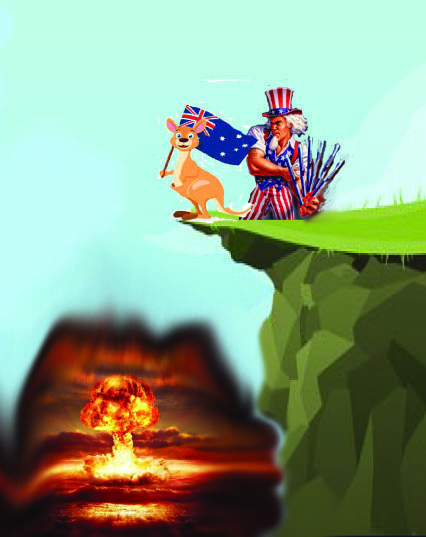
By John Minns, Aug 2, 2023 https://johnmenadue.com/aukus-australia-and-the-drive-to-war/
My fear is not that AUKUS SSNs, if they arrive, will be late, ineffective, and obsolete. My fear is that they will arrive and will be effective and even lethal. Because, if that is the case, they will play a part in the drive to a potentially devastating war with China that would be a disaster for the entire world.
This was a speech given at an anti-AUKUS protest at the ANU on 28 July 2023
Friends, I have been proud to have been part of a number of protests against the AUKUS alliance and the nuclear submarine deal that is part of it. However, to be truthful, I haven’t always completely agreed with everything that has been said at them.
I heard at one of the protests a speaker opposing the subs deal because they might never arrive, or might be delivered very late, or that, by then, they would be ineffective and obsolete. Apart from the enormous cost, my concern is not that they will be late or obsolete. My fear is that they will arrive and will be effective and even lethal. Because, if that is the case, they will play a part in the drive to a potentially devastating war with China that would be a disaster for the entire world.
In a war with China – what would victory look like? It would certainly not end, like the Second World War, with allied troops occupying Germany and Japan. Even to imagine Australian, British and US troops patrolling the streets of Shanghai is to realise what a ludicrous prospect that is. China – a vast and nuclear-armed country – is not going to be physically occupied.
Would victory mean that China’s dynamic economy would no longer stock the shelves of Kmart and the like around the world and that it would revert to a poor semi-agricultural country. Hardly – unless it is turned into a nuclear wasteland – it will clearly go on to be the largest economy in the world.
Would victory be the successful defence of Taiwan. Well, China has claimed Taiwan since 1949. But it has made no attempt to invade it. In any case, are we prepared to go to war to defend the independence of a place whose independence we don’t recognise and don’t support. It makes no sense.
Would victory mean that China is prevented from interfering in the affairs of other countries – something which every large or wealthy power does – including Australia in the Asia-Pacific. I study Latin America and, when US politicians talk about China’s interference in the domestic affairs of others, I hear, somewhere in my head, roars of bitterly ironic laughter from all over Latin America. Because the US has interfered in the affairs of every country in Latin America and the Caribbean – instigating coups, supporting military dictatorships, blockading harbours, embargoing trade and even military invasion. And it has done so for the last two hundred years – ever since President James Munro in 1823 proclaimed the doctrine that only the US had the right to interfere in the region.
Would victory mean that so-called Chinese military expansionism is halted. Well, it’s true that China has set up military bases on a number of artificial islands. But the US has around 750 foreign military bases in more than 80 countries. To my knowledge, China has one – in Djibouti. If bases and the ability to project military force is the problem, then China is not the main culprit.
Also, the US spends more on its military than the next 10 countries combined and most of them are US allies.
The chances of being killed by the US military are enormously higher than by any other country. A recent research project from Brown University in the US showed that, since 2001, about 900,000 people have been killed directly by the US military – nearly half of those were civilians. On top of that, what the project calls “the reverberating effects” of US military action – such as famine, destruction of sanitation, health care and other infrastructure has led to several times as many civilian deaths as caused directly.
Would victory in a war with China mean the successful defence of our trade routes and shipping lanes. Where do our trade routes and shipping lanes lead? Largely to China! So, would we fight China to defend our trade with China?
Another thing I’ve heard said that I disagree with is that the AUKUS deal might drag Australia into a war with China. Australia is not being dragged anywhere. The Australian government is eagerly jumping into this alliance – with eyes wide open – rather than being forced into something not of its own making.
There has never been a war conducted by our great and powerful friends that Australia has not been eager to join – whether to the Maori Wars in New Zealand, to Sudan and to South Africa in the 19th century, to the First and Second World Wars, to Korea, Malaysia, Vietnam, Afghanistan and Iraq – twice. We should not be protesting calling for Australia’s independence – it is independent – we should be calling for it to use that independence to help halt the drive to war – rather than to enthusiastically join it.
I’ve heard some on the other side of this argument repeat the old cliché – “if you want peace, prepare for war”. It sounds good – a nice juxtaposition of opposites etc. But it is logical and historical rubbish. It is essentially the argument of the National Rifle Association of America. The NRA says that to be safe, we need to have everyone armed. Security comes from allowing all to buy AR-15 assault rifles. We know how that has worked out in practice. Preparing for war to ensure peace is the same argument on an international scale.
When we look at the great periods of arms build-up, we see that they led to war rather than peace. It was the case with the arms build-up – especially the naval build-up – before World War One, with rearmament in the 1930s, with the Cold War arms economy which was accompanied by very hot and devastating wars – in Vietnam and Korea for example – which were among the most destructive on a per capita basis in modern history..
The world today contains great possibilities. We have the resources and the human ingenuity to deal with some of our real problems – like housing, poverty, health, education, climate. Some of that ingenuity is right here at the ANU. Let us set that ingenuity to the task of solving the real problems which affect our lives and our society rather than to the exacting but grisly science of blowing human bodies apart.
How Have Nuclear Weapons Evolved Since Oppenheimer and the Trinity Test?

currently the nine states possessing nuclear weapons have approximately 13,000 nuclear weapons, with US and Russia accounting for almost 90% of the inventory These modern nuclear warheads are significantly more lethal compared to the atomic bombs used in Hiroshima and Nagasaki.
despite sometimes being referred to as “small nukes”, tactical nuclear weapons weapons still cause devastating destruction. The explosive yield of tactical nuclear weapons today ranges from anywhere below one kt to above 100 kt: the high-end surpasses the yield of Little Boy and Fat Man by up to five times.
Sulgiye Pak, Senior Scientist, August 4, 2023 https://blog.ucsusa.org/sulgiye-park/how-have-nuclear-weapons-evolved-since-oppenheimer-and-the-trinity-test/
It took the Manhattan project three years to develop a nuclear bomb: and only weeks between the first nuclear test explosion and the use of a nuclear weapon in war. Almost 80 years later – how have nuclear weapons evolved?
A brief history of nuclear testing
In 1945, the United States dropped two atomic bombs on Japan. The first bomb, codenamed “Little Boy” was dropped on Hiroshima on August 6, 1945.Three days later, the US dropped the second bomb, “Fat Man,” on Nagasaki. The two bombs, each with an estimated yield of around 15 and 21 kilotons (15,000 and 21,000 tons of TNT equivalent), respectively, caused widespread destruction, resulting in the loss of more than 100,000 lives.
After the war, the US conducted atmospheric nuclear tests in the Pacific Proving Grounds in the Marshall Islands and in Nevada and many more underground. The Soviet Union, Great Britain, France, China, India, Pakistan, and North Korea tested nuclear weapons of their own. Since the first development of nuclear weapons, the total number of nuclear tests exceeds 2,000, with 528 tests conducted above ground. These above ground tests had a destructive force of more than 400,000 kilotons TNT. The tests provided the information to increase the sophistication of nuclear weapons designs. But the nuclear tests, and particularly the atmospheric tests, were enormously destructive to the land and communities that were exposed to their explosive power and radiation.
The largest bomb ever made
Today’s modern nuclear warheads have undergone significant advancements in terms of design, technology, and destructive power. Notably, modern warheads are almost exclusively thermonuclear bombs, or hydrogen (H) bombs, which use both fusion and fission reactions to generate higher release of energy – tens of kilotons to several megatons TNT equivalent, or tens of times more powerful than the early atomic bombs. These bombs essentially use an atomic bomb as a trigger for the powerful fusion explosion.
The largest nuclear weapon to ever been tested, Tsar Bomba, had an estimated yield of 50 megatons (although it had a capacity double that) – an explosive yield greater than that of the Little Boy by a factor of 3,500. Literally translated as “King of bombs,” this monster atomic bomb, designed by the Soviet Union, generated a fireball that reached a diameter of 4 km (2.5 miles), and a mushroom cloud that rose over 60 km (40 miles) into the atmosphere.
The blast wave was felt over 1,000 km away (over 620 miles), and its shockwave was detected 4,000 km away from its source, or nearly 2,500 miles away. To illustrate the increased scale of destructive power, if the same bomb dropped on Hiroshima was detonated in a major US city like New York City, 264,000 lives will be lost, along with 512,000 injuries. Tsar Bomba, on the same city, would kill more than 7.6 million people while injuring additional 4.2 million (Figure 2 on original).
Notably, however, such weapons are too large to be considered ‘operational’. Tsar Bomba, for example, weighed 27 tons with a size of 8 meters length and 2 meters diameter – making it impractical to be deployed in a ballistic missile.
Smaller, lighter, faster
Nuclear states have not just pursued larger and more powerful weapons. They have pushed to make weapons that are lighter and more compact, so that they can be carried in multiples, and lower yield, so that they can plausibly be used on a battlefield.
60 years after the biggest nuclear test, nuclear weapons have become smaller and more compact – a process of miniaturization that allows integration into various delivery systems. Some modern weapons are also designed with multiple warheads, with enhanced precision for guidance and targeting systems, allowing a single delivery vehicle to carry multiple independent nuclear payloads.
Alongside high-yield strategic nuclear weapons, there has been significant development of non-strategic, or tactical nuclear weapons designed for limited use scenarios. These weapons are generally of lower yield and intended for use on the battlefield i.e., strikes against relatively close and specific targets that minimize collateral damage affecting the civilian population.
But despite sometimes being referred to as “small nukes”, these weapons still cause devastating destruction. The explosive yield of tactical nuclear weapons today ranges from anywhere below one kt to above 100 kt: the high-end surpasses the yield of Little Boy and Fat Man by up to five times. Despite the lower yield and smaller size, the use of tactical nuclear weapons carries a high risk of escalation from potential misinterpretation, miscalculation, or an unintended response from adversaries, all of which can lead to a full-scale nuclear war. The availability of weapons, especially at low yields designed to facilitate battlefield use, increases the probability of their use in a conflict scenario.
In addition to the nuclear weapons themselves, the nuclear weapons state and non-weapons state have invested heavily in many delivery systems – strategic missile and conventional missile capabilities, as well as in missile defense systems. Nuclear strategists and scientists have long argued that the development and deployment of missile defense systems are ineffective against determined adversaries, but the US budget requested for $10.9 billion to strengthen and expand the deployment of missile defenses in 2023. Such development of missile defense systems has potential for encouraging an arms race dynamic and the Anti-Ballistic Missile Treaty’s role in trying to arrest that dynamic.
Almost 80 years after the first nuclear weapon was dropped on Japan, there hasn’t been any use of nuclear weapons on another country. But since then, nuclear states accumulated as many as 60,000 weapons in total at one time, and currently the nine states possessing nuclear weapons have approximately 13,000 nuclear weapons, with US and Russia accounting for almost 90% of the inventory These modern nuclear warheads are significantly more lethal compared to the atomic bombs used in Hiroshima and Nagasaki. The radius of devastation and the resulting blast effects, such as firestorms, radioactive fallout, and thermal radiation, would be significantly larger, amplifying the casualties and long-term environmental and health consequences. Despite the danger posed by nuclear weapons, the US continues programs to build new nuclear weapons, including a nuclear-armed sea-launched cruise missiles (SLCM-N).
The use of nuclear weapons would have catastrophic humanitarian, environmental and geopolitical consequences. As we continue to invest and enhance nuclear weapons technologically, the global community continues to grapple with the challenges and risks associated with their existence. The pursuit of disarmament, nonproliferation, arms control, and diplomatic dialogues remains more crucial today than ever in promoting peace and global security.
Oppenheimer’s nuclear fallout: How his atomic legacy destroyed my world
We, the hidden casualties of the Cold War, have been fighting for recognition and just compensation for years. Expanding the Radiation Exposure Compensation Act gives us a glimmer of hope.
Mary Dickson 4 Aug 23 https://www.usatoday.com/story/opinion/voices/2023/08/04/oppenheimer-atomic-bomb-legacy-us-victims-nuclear-fallout/70508212007/
Leading up to the the very first atomic explosion in Los Alamos, New Mexico, Manhattan Project scientists took bets on the possibility that the detonation might ignite the atmosphere and destroy the planet.
While they determined that the risk was minimal, they pressed the button nevertheless and 78 years later, my family, friends and likely hundreds of thousands or more across this country are still living with the devastating consequences.
J. Robert Oppenheimer’s Trinity test sent a cloud of fallout over communities downwind of Los Alamos and into 46 states, according to a new study, catapulting the world into the nuclear age.
“Oppenheimer” director Christopher Nolan says fans have left theaters “devastated” by the movie’s depiction of the test. I can only imagine their horror if they learned what came next: Trinity was only the first of hundreds of nukes detonated on American soil, and it wasn’t until 1992 that the United States exploded the last.
We, the hidden casualties of the Cold War, have been fighting for recognition and just compensation for years. We finally have a glimmer of hope.
How nuclear bomb tests affected my family
Driven in part by Nolan’s “Oppenheimer” and the cries of affected communities nationwide, the Senate recently passed an amendment to expand compensation for victims of radiation exposure from the production and testing of nuclear weapons. It’s well past time that we are recognized as the true legacy of Oppenheimer’s bomb.
During the Cold War, the United States detonated 928 nuclear bombs in the Nevada desert, many of which were more powerful than those that decimated Hiroshima and Nagasaki.
The nuclear threat is real:Our nuclear weapons are much more powerful than Oppenheimer’s atomic bomb
Of these, 100 were detonated above ground. A Navy meteorologist warned that the prevailing winds would blow eastward, carrying a “certain amount” of radioactivity, but expediency and convenience won the day.
The wind indeed carried fallout across the country, colliding with rain and snow and falling to the land below. There, it threaded its way into the food chain and, ultimately, our bodies. The Atomic Energy Commission’s decision to ignore, and then cover up, the danger has left a trail of suffering and death that continues to this day.
As a child in Salt Lake City, my thyroid absorbed this radiation. Years later, I was diagnosed with thyroid cancer and suffered other health complications that left me unable to have children. For others, the poison went into the teeth, bones, liver, lungs, pancreas, breasts, soft tissue and reproductive organs. The damage caused can take decades to manifest as life-threatening illnesses.
My older sister and I counted 54 people in our childhood neighborhood who developed cancer, tumors, leukemia and autoimmune disorders. My 10-year-old classmate died of a brain tumor in 1964. A few weeks later, her 4-year-old brother died of testicular cancer.
My sister died in 2001 after a nine-year battle with an autoimmune disease. And now another sister is fighting a rare stomach cancer.
We are all downwinders. Nuclear fallout ravaged New Mexico – but we’re all still living with it.
I have buried and mourned the dead and comforted and advocated for the living, worrying with each ache, pain and lump that I am getting sick again.
And the damage continues. Cancers return, new cancers develop, other health complications arise. And, even more troubling, the DNA damage could affect future generations.
A Princeton study recently released mapped how fallout from atmospheric testing in New Mexico and Nevada spread across the country. It’s at once shocking and unsurprising, confirming the experience of so many who have suffered the consequences.
We will forever be living with the fallout of nuclear weapons. Essentially, we are all downwinders.
Tragically, the U.S. government has yet to do right by those whose lives and health were sacrificed to national security. The Radiation Exposure Compensation Act (RECA) – passed in 1990 as “compassionate payment” to a very narrow group of those affected in some counties of Utah, Nevada and Arizona – was always flawed. For decades, downwinders have fought to expand eligibility to include those most heavily impacted in seven Western states and Guam, as well as additional categories of uranium miners.
The Senate’s passage of a last-minute expansion amendment through the National Defense Authorization Act is vital progress. Now, the defense bill must be conferenced by the House. If the measure doesn’t move forward, RECA will expire next June, cutting off lifesaving compensation for thousands. Time is running out, and more of us die every day.
At the end of “Oppenheimer,” the scientist revisits with Albert Einstein the concern about the bomb’s potential to destroy the world and solemnly laments, “I believe we did.”
Oppenheimer was right – my world and those of my friends and neighbors, and people across the country, have been destroyed by the bomb. Expanding the Radiation Exposure Compensation Act can’t bring my loved ones back to life, but it would provide the recognition, support and justice that the survivors in our community desperately deserve.
Is the US preparing to dump the proxy war in Ukraine so it can start another in Taiwan?
4 Aug 23 https://sputnikglobe.com/20230803/is-biden-preparing-to-dump-ukraine-for-taiwan-1112361859.html
US President Joe Biden is reportedly seeking congressional approval for financing military aid for Taiwan as part of the supplemental budget for Ukraine. What’s behind the move?
The White House is going to ask the US Congress to fund the arming of the island of Taiwan via the Ukraine budget in order to speed up weapons transfers to Taipei, as per Western media. The request followed the Biden administration’s announcement that the US would deliver $345 million worth of weapons to the island through a mechanism known as the “presidential drawdown authority.” The mechanism has long been used by the US to send arms to Ukraine.
Taiwan, an island located at the junction of the East and South China Seas in the northwestern Pacific Ocean, is regarded by Beijing as an inalienable part of the People’s Republic of China.
“Well, what it shows is that the Biden administration has no regard or concern for angering China,” Larry Johnson, a veteran of the CIA and the State Department’s Office of Counterterrorism, told Sputnik.
“China has made it very clear that it views any effort by the United States to provide weapons or military training to Taiwan as a direct threat to China. And for some reason, the Biden administration refuses to accept or acknowledge the position of the Chinese. In submitting this aid package, I don’t think the Biden administration will have any problem getting it passed. We’ve still not reached a point in the United States where there is opposition to funding the war in Ukraine, or the potential for war in China. So, I think it’s likely to go through, which means it’s going to make relations between China and the United States worse, not better.”
At the same time, the CIA veteran does not consider the development as lessening support for Ukraine. It’s likely that the Biden administration has come under pressure to show support for Taiwan, per Johnson. The expert sees the funding maneuver “as a convenient legislative vehicle to get approval for the funding in a way that expedites it, doesn’t delay it.”
“I’m still not clear that it represents a cut in funds for Ukraine and a shifting of those funds to Taiwan. I think it’s more a function of the US legislative process, that Congress must appropriate money before the administration, in theory, can spend it. Because this legislation had already been presented, they were able, I think, decided to carve out some of the funds in that for Taiwan, because they had made prior commitments to Taiwan to provide some kind of support,” Johnson explained.
China has repeatedly urged the US to stop escalating tensions in the Taiwan Strait. Nonetheless, US government officials and congressional leaders continue to send mixed signals to the island and meet with Taiwan’s leadership. Furthermore, the US is encouraging its allies to beef up their military presence in the Asia Pacific, citing the “China threat” to the island. To cap it off, President Joe Biden has repeatedly pledged to protect Taiwan “militarily,” with the White House then downplaying his vows as gaffes. Why is Washington continuing to develop the conflict around Taiwan?
“Well, because, number one, the United States continues to believe that it is the most powerful country in the world and can dictate to other countries reality. It’s a consequence of arrogance and hubris. The United States refuses to accept the fact that China and Russia have an equal say in matters. And I think, unfortunately, the United States, if it persists in taking actions like this, will provoke a conflict that will be very damaging to the United States and will weaken it, not make it stronger. The United States can’t even fund the one proxy war in Ukraine right now. It’s been losing. It can’t provide sufficient artillery shells, for example. The United States fails to recognize that it’s reached the limits of its power,” Johnson concluded.
1 This month
To see nuclear-related stories in greater depth and intensity
– go to https://nuclearinformation.wordpress.com/


 Antinuclear