Marcus Strom: AUKUS is a mad, bad and dangerous war policy, Labor Against War

And that’s what Labor Against War is about. We can’t sit silently on this. We only formed only a few months ago. Already, we are working branch by branch, moving motions, winning many, losing some, making alliances with the Maritime Union, the Australian Manufacturing Workers Union, the Electrical Trades Union, the Construction Union. Unions New South Wales has a policy opposed to AUKUS.
By Marcus StromAug 10, 2023 https://johnmenadue.com/marcus-strom-aukus-is-a-mad-bad-and-dangerous-war-policy/
Anthony Albanese likes to think of himself as a Bob Hawke unifying type. But if he keeps dragging us along this war path, he will be remembered as our Tony Blair.
We hear a lot about how AUKUS is going to be about getting the balance right, rebalancing the region as China expands. And yes, China has its interests, and is building a military in the region and that is also to be concerned about. But I wonder about balance. And we’ve just been reminded again the stories from Guam and from Okinawa. There are 343 US bases in East Asia alone. Now, I don’t know how eight nuclear submarines adds to the balance in the region.
AUKUS is a policy of empire. And empire means violence. And I am amazed having worked in Canberra until recently at the blithe, consequence-free approach that our political leaders seem take to this. It’s “just the price of doing business on the world stage” is how it’s presented.
This is not what the Labor Party should be fighting for.
Alongside the obscene violence of joint war games happening in Australia at the moment, we’ve had the AUSMIN meeting between leading Australian ministers and US ministers. I read this in the press yesterday about what AUSMIN means. “Australia is now being asked to pull more of its weight in the alliance, play a bigger role in helping stabilise the regional balance of power and be integrated as a base of operations into US force projections into the region or into US war planning for a possible conflict with China in Asia.”
That’s from the very radical editorial column of the Australian Financial Review. Also from the Australian Financial Review today, “The AUSMIN talks over the weekend continue the trend since the late 1990s of tying Australia more tightly into both American grand strategy and war planning in Asia. The permanent American military presence on Australian soil is now at a scale unprecedented since the Second World War.”
They are preparing us for war.
That is why I could no longer work for this government. Up until February I was press secretary to Ed Husic, and the AUKUS policy is one of the main reasons I resigned from that position.
As I said to somebody coming in, “The secret to never being disillusioned with the Labor Party is never be illusioned with the Labor Party.” But the Labor Party, despite its many flaws, does have a tradition of opposing some unjust wars. This was pointed out by Paul Keating at a recent National Press Club speech he gave.
Labor was against the Vietnam War, eventually; Labor did stand against the second Iraq War. Although Bob Hawke did support the first Iraq war. So there’s a chequered history.
I’m going to talk about Tom Uren. Tom Uren many of you will know was a lone voice to start with against the Vietnam War in the Labor Party.
Keating pointed out that the ALP opposed Vietnam. But that’s not always how it was. Tom Uren points out in an interview he gave in 1996, that he and Jim Cairns, who went on to become treasurer, moved a motion to Labor caucus in 1965 opposing US bombing of North Vietnam. They lost that vote.
The left then of the Labor Party voted against it. But seven years later Gough Whitlam on a wave of anti-war sentiment took power and one of the first acts was to bring the remaining Australian troops home from Vietnam.
So we can fight back and we can make change. While Tom Uren started as a lone voice, on AUKUS in the Labor Party, I can say we are not alone. Already people like Paul Keating, Bob Carr, Carmen Lawrence, Doug Cameron, Peter Garrett are speaking out against the insanity of this policy.
War is a deadly business. It can’t be treated as a gambit against wedge politics from the opposition, but that is how it’s being treated.
The war in Iraq killed hundreds of thousands of people, left millions displaced, sparked regional destabilisation, engendered the ISIS calamity. A war with China would make Iraq look like a tea party; it would threaten nuclear catastrophe. This is what we’re facing with AUKUS.
It is also a threat to Australian sovereignty. AUSMIN and the military interoperability it is producing, means that there will be US soldiers enmeshed with Australian forces on a continual basis.
And this Australian government, this Labor government, is now allowing the rotation of B-52s through the Tindal base in the Northern Territory. Now, those planes carry nuclear weapons. They neither confirm nor deny. Australia’s quite relaxed at that policy. But we know that makes Australia a nuclear target.
It makes Australia not just a target and a victim, but an aggressor in the region; a host to war machines that could slaughter millions of people. We have to say, “No” to that.
I’m reminded of something Henry Kissinger said, “Being an enemy of the United States is very dangerous. Being a friend is fatal.”
Simon Crean was Labor leader when the Iraq war happened, and he bravely stood against the war drums. When Simon Crean died recently, Prime Minister Anthony Albanese said, “History has vindicated Simon’s judgment, but at the time his stance was deeply counter to the prevailing political and media climate.”
We are again looking for such courage in a Labor leader.
Instead, we have meekly inherited a Scott Morrison policy. When I speak at Labor Party meetings I say, “If we’d lost the last election, and Scott Morrison was pursuing this policy, you’d all be up in arms. You’d all be screaming about the injustice of it, the war mongering of it. Just because our guy’s doing it doesn’t mean you should shut up.”
And that’s what Labor Against War is about. We can’t sit silently on this. We only formed only a few months ago. Already, we are working branch by branch, moving motions, winning many, losing some, making alliances with the Maritime Union, the Australian Manufacturing Workers Union, the Electrical Trades Union, the Construction Union. Unions New South Wales has a policy opposed to AUKUS.
The South Coast Labor Council, which is facing having a nuclear submarine base in Port Kembla, has stood up and said, “No”.
Branch by branch anti-war activists are passing resolutions. We’ve now going into National Conference. We are hoping we can force at least a bit of a debate onto that conference. To not even discuss this would be an absolute travesty of Labor Party democracy.
We’re not expecting to win at the first hurdle, but neither did Tom Uren. This is a long campaign to win the Labor Party from being a war party to being a peace party.
Assurances count for nothing. The danger we face in a multi-decade, multibillion-dollar program is we don’t know who will be prime minister in ten years, five years. We don’t know who’s going to be in the White House at the end of next year. And yet we are going to be lumbered with a nuclear alliance with two fading Anglo powers on the other side of the world.
AUKUS is a mad, bad and dangerous war policy. And to borrow from the French, we don’t just think this, we know this. As an aside, I was absolutely gobsmacked by the chutzpah of Macron speaking in the Pacific, complaining about the ‘new imperialism’ recently.
Anthony Albanese likes to think of himself as a Bob Hawke unifying type. But if he keeps dragging us along this war path, he will be remembered as our Tony Blair.
Believe it or not, the ALP is meant to be a democratic socialist party. Read it, it’s in the rules.
It’s meant to fight for a better world. But we should no longer be satisfied for fighting for Chifley’s Light on the Hill. This is a labour of Sisyphus, a goal that we never reach. It is time to bring the light down into the shadows, to enlighten the world, to bring hope to today, not tomorrow.
Capitalism is a war system. We have to oppose capitalism to stop war.
Hope is rising. We will make a difference. Use that anger that you felt to really get active. We are rebuilding a peace movement, an anti-war movement.
I look here today; we need to double, triple our numbers. At our last Labor Against War meeting in Sydney, we had somebody there in their 80s telling us about how they fought against the Vietnam War. And there were people in the room in their school uniforms. Now that is a sign for hope that we can raise our voices fight a really bad policy.
And we have to win this because the alternative is cataclysmic.
These are extracts from a speech by Marcus Strom at a public meeting organised by IPAN at the ANU, Canberra, 1 August 2023
Nuclear waste dump plans scrapped for South Australia
By Andrew Brown August 10 2023 –
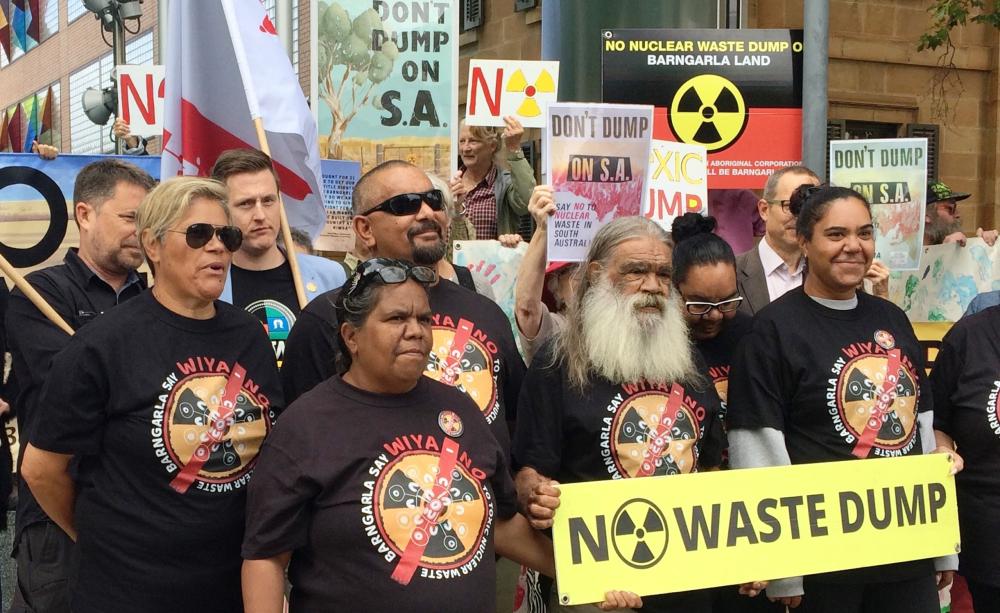
Plans for a nuclear waste dump in regional South Australia have been scrapped by the federal government following a court decision blocking its construction.
The waste facility was earmarked to be built on land at Napandee near the town of Kimba in the Eyre Peninsula by the previous coalition government in 2021.
The decision was challenged in the Federal Court by traditional owners, the Barngarla people, who said the decision was made without them being consulted.
The court ruled in July the facility could not be built.
Resources Minister Madeleine King told federal parliament the government would look for a new location for the nuclear waste storage.
“I’m deeply sorry for the uncertainty the process has created for the Kimba community, for my own department, for the Australian Radioactive Waste Agency workers and for the workers involved in the project,” she said.
“I also acknowledge the profound distress this process has caused the Barngarla people.”
Ms King said any work near Kimba had stopped after the court’s decision.
She said the government would not appeal against the court decision.
“We have to get this right. This is long lasting, multi-generational government policy for the disposal of waste that can take thousands of years to decay,” she said.
“We must consult widely and bring stakeholders including First Nations people along with us. We remain bipartisan in our approach.”…………………………………………………………….. https://www.canberratimes.com.au/story/8303272/nuclear-waste-dump-plans-scrapped-for-south-australia/
Australia’s peak environmental body welcomes ‘king hit’ for nuclear waste dump at Kimba.

The Australian Conservation Foundation has welcomed the Albanese government’s decision to fully withdraw the former Coalition government’s proposal to establish a radioactive waste facility on South Australia’s Eyre Peninsula against the wishes of Traditional Owners.
Last month the Federal Court ruled in favour of Barngarla Traditional Owners, setting aside former Resources Minister Keith Pitt’s declaration of the Kimba site.
“This is a welcome and sensible decision by Minister King and federal Labor to scrap this plan, which it inherited from the previous government and which was inconsistent with international best practice and community sentiment,” said ACF’s nuclear free campaigner Dave Sweeney.
“Today’s decision is a credit to the tenacity and courage of the Barngarla people, who have been utterly determined to protect their country.
“Labor’s decision is consistent with the Federal Court ruling and with Labor values on listening to First Nations’ wishes for their Country.
“This divisive and deficient plan has caused a lot of pain and division.
“Today’s announcement signals a different approach.
“ACF looks forward to constructive dialogue with the Albanese government to help develop a new and responsible approach to radioactive waste management in Australia.
“Minister Madeleine King is right to say the previous government’s plan to double-handle the transport of this waste – first from Lucas Heights in Sydney to temporary storage at Kimba, then on to an as-yet undetermined permanent disposal site – raised concerns regarding international best practice and safety.
“The first step to getting something right is to stop getting it wrong.
“Today, the government took that important step.”
Further comment or context: Dave Sweeney 0408 317 812
Yes in my backyard: Nationals happy to go nuclear

SMH, yMike Foley and James Massola, August 10, 2023
Nationals leader David Littleproud has declared he is open to having a nuclear power plant in his Queensland electorate, as the Coalition pushes a new plan to convert Australia’s existing fleet of coal plants to the controversial source of electricity generation.
Coalition energy spokesman Ted O’Brien said on Wednesday nuclear energy was a crucial emissions-reduction technology. He called for a national discussion about ending Australia’s moratorium, and argued that existing coal plants could be supplanted with the developing nuclear technology of small modular reactors.
Federal parliament banned nuclear power in 1998, and the moratorium has remained in place with bipartisan support.
“I would support a process to explore small-scale modular reactor technology in my electorate with appropriate consultation and education of the community if a moratorium was removed,” Littleproud said.
The Maranoa MP, whose electorate sprawls across western Queensland, was joined by two Nationals colleagues in supporting nuclear in their patch.
Michelle Landry, who represents Capricornia in Queensland, said she would support a coal-to-nuclear transition in her electorate at a “coal-fired power station that is no longer being used”.
Former leader Barnaby Joyce, whose electorate of New England in northern NSW does not have coal plants, emphatically backed developing the technology in his electorate.
O’Brien, however, would not be drawn on his position on a nuclear power plant in his Sunshine Coast electorate of Fairfax. He said a selection of nuclear locations could be addressed if the moratorium was lifted.
“If we end up with a clean energy policy that includes zero-emissions nuclear energy, a cheap NIMBY [not-in-my-backyard] campaign will inevitably come and we’ll deal with those sort of childish debates then,” O’Brien said.
O’Brien said small modular reactors would be key to a nuclear energy policy………………………
CSIRO and the Australian Energy Market Operator’s GenCost report into the cost of electricity generation based on technology type found that an energy grid running on 90 per cent renewables, including transmission lines and back-up battery or gas power, would cost between $70 to $100 a megawatt hour in 2030.
Small modular reactors would cost between $200 and $350 a megawatt hour, were that technology available by 2030.
Former chief scientist of Australia Alan Finkel, writing in the Financial Review this week, said it was unlikely small modular reactors could be deployed before 2040 in Australia, which meant “we must continue our investment in renewables”.
Climate Change and Energy Minister Chris Bowen has rejected the deployment of nuclear power and on Wednesday reiterated the Albanese government’s goal to cut power bills by supplying 82 per cent of electricity through renewable energy by 2030.
“We look forward to the costings and the locations of the nuclear power stations when [O’Brien] releases them. I’ve been a bit confused about why a party claiming to be economically rational would propose the most expensive form of energy as a way to reduce prices,” Bowen told parliament.
On Wednesday, Bowen announced energy rule changes to force companies building transmission lines to engage in earlier and more frequent “genuine” community consultation. The move is designed to reduce community opposition, which is now the main obstacle to the government’s goal to decarbonise the electricity grid.
Opposition Leader Peter Dutton has backed the coal-to-nuclear plan and Canning MP Andrew Hastie said small modular reactors should be considered as replacement for coal plants given “we already have four to five small modular reactors on order” to power Australia’s next generation of nuclear submarines.
When asked if he backed nuclear in his northern NSW electorate, Joyce said: “Not only would I be happy to have a small modular reactor in New England, but I suggested the policy to accompany it.”…………………………………….https://www.smh.com.au/politics/federal/yes-in-my-backyard-nationals-happy-to-go-nuclear-20230809-p5dv43.html
Government abandons plan to dump nuclear waste near Kimba, sparking new hunt for dump site
ABC , By political reporter Matthew Doran, 10 Aug 23
Key points:
- The planned nuclear waste site near Kimba, SA, has been formally abandoned
- The Federal Court ruled against Coalition plans to dump nuclear waste there
- The Opposition claims it is a massive setback
…………………………………………………………. In parliament, Federal Resources Minister Madeleine King said the government respected the court decision.
“The Albanese Labor government does not intend to pursue Napandee as a potential site for the facility, nor is the government pursuing the previously shortlisted Lyndhurst and Wallerberdina sites,” Ms King said.
She revealed all work on the Napandee site had ceased.
“Any activities that have already been conducted were non-permanent and will be reversed or remediated,” Ms King said.
“The site is currently being supervised to ensure it remains safe and cultural heritage is protected while we work through dispossession of the land.”
The Coalition immediately took aim at the announcement, accusing Labor of a “legacy failure” and “abandoning years of work”………………………………………………………………………………………………….
Nuclear storage site still needed
Ms King said Australia needed a nuclear storage facility, but argued it could not be at the Napandee site.
……………………………….. “The site of Australia’s only nuclear reactor at Lucas Heights can safely store waste on site for some time, but we must ensure this waste has an appropriate disposal pathway.”
She argued the government remained committed to finding a solution. https://www.abc.net.au/news/2023-08-10/kimba-nuclear-dumping-plan-abandoned/102711320
Coalition’s aim for nuclear energy criticised by the Australian government.
A radical proposal to change Australia forever has been criticised by the Australian government amid the nation’s energy crisis.
news.com.au Alex Blair 10 Aug 23
The Coalition is reportedly considering a “coal-to-nuclear transition” as part of its 2025 energy policy.
The strategy aims to secure long-term baseload power, reduce emissions, and lower electricity prices, with plans to tap into Australia’s abundant uranium reserves.
Australian regions the party believes are vulnerable to the shift from coal to renewables, including the Hunter Valley and Queensland, have reportedly been floated as potential candidates for the development of small modular reactors.
Opposition energy and climate change spokesman Ted O’Brien emphasises that local community input is crucial and that a “social license” should be obtained before any major infrastructure project is undertaken………………………………………………………………
However, Labor party representatives say the Coalition’s plan is riddled with holes. A spokesperson for Climate Change minister Chris Bowen said the Coalition had previously voiced support for a nuclear Australia but is yet to provide rock solid details to the public.
“They’re yet to come up with a plan with where the reactors can go and how much they will cost,” the spokesperson told news.com.au.
“Even if we started today, having nuclear power ready within 10 years is being generous. They’re very much against renewables, where we are backing it. Labor has implemented the $20b rewiring the nation policy, which has produced an actual change for the future.
There are credible reports that nuclear is the most expensive source of energy in the world, so they really need to show people the plan.”
The spokesperson noted the Coalition has long had a stance against Labor’s renewable energy plan, which aims to provide Australia with 82 per cent of its energy by 2030.
Last year, renewables accounted for roughly 36 per cent of Australia’s energy, with coal generation falling from 59.1 per cent in 2021 to 54.6 per cent in 2022……………………………..
Bowen said Australia needs more investments in order to reach its net-zero goals, calling for more industry figureheads to get behind the clean energy scheme.
“Sector by sector plans are important for Australia because each sector is so different,” he said.
“I’ve been struck by the level of support and engagement from Australian businesses — big and small, and from international investors.” https://www.news.com.au/national/politics/show-people-the-plan-coalition-criticised-over-calls-to-transition-australia-to-nuclear-energy/news-story/48e3f1e14e9e72275ab1d2df91992d0a
Australia news LIVE: Joe Biden to host PM for official US visit; Coalition pushes nuclear energy plan
Pesarl’
Anthony Albanese likes to think of himself as a Bob Hawke unifying type. But if he keeps dragging us along this war path, he will be remembered as our Tony Blair.
We hear a lot about how AUKUS is going to be about getting the balance right, rebalancing the region as China expands. And yes, China has its interests, and is building a military in the region and that is also to be concerned about. But I wonder about balance. And we’ve just been reminded again the stories from Guam and from Okinawa. There are 343 US bases in East Asia alone. Now, I don’t know how eight nuclear submarines adds to the balance in the region.
That’s from the very radical editorial column of the Australian Financial Review. Also from the Australian Financial Review today, “The AUSMIN talks over the weekend continue the trend since the late 1990s of tying Australia more tightly into both American grand strategy and war planning in Asia. The permanent American military presence on Australian soil is now at a scale unprecedented since the Second World War.”
They are preparing us for war.
That is why I could no longer work for this government. Up until February I was press secretary to Ed Husic, and the AUKUS policy is one of the main reasons I resigned from that position.
As I said to somebody coming in, “The secret to never being disillusioned with the Labor Party is never be illusioned with the Labor Party.” But the Labor Party, despite its many flaws, does have a tradition of opposing some unjust wars. This was pointed out by Paul Keating at a recent National Press Club speech he gave.
Labor was against the Vietnam War, eventually; Labor did stand against the second Iraq War. Although Bob Hawke did support the first Iraq war. So there’s a chequered history.
I’m going to talk about Tom Uren. Tom Uren many of you will know was a lone voice to start with against the Vietnam War in the Labor Party.
Keating pointed out that the ALP opposed Vietnam. But that’s not always how it was. Tom Uren points out in an interview he gave in 1996, that he and Jim Cairns, who went on to become treasurer, moved a motion to Labor caucus in 1965 opposing US bombing of North Vietnam. They lost that vote.
The left then of the Labor Party voted against it. But seven years later Gough Whitlam on a wave of anti-war sentiment took power and one of the first acts was to bring the remaining Australian troops home from Vietnam.
So we can fight back and we can make change. While Tom Uren started as a lone voice, on AUKUS in the Labor Party, I can say we are not alone. Already people like Paul Keating, Bob Carr, Carmen Lawrence, Doug Cameron, Peter Garrett are speaking out against the insanity of this policy.
War is a deadly business. It can’t be treated as a gambit against wedge politics from the opposition, but that is how it’s being treated.
The war in Iraq killed hundreds of thousands of people, left millions displaced, sparked regional destabilisation, engendered the ISIS calamity. A war with China would make Iraq look like a tea party; it would threaten nuclear catastrophe. This is what we’re facing with AUKUS.
It is also a threat to Australian sovereignty. AUSMIN and the military interoperability it is producing, means that there will be US soldiers enmeshed with Australian forces on a continual basis.
And this Australian government, this Labor government, is now allowing the rotation of B-52s through the Tindal base in the Northern Territory. Now, those planes carry nuclear weapons. They neither confirm nor deny. Australia’s quite relaxed at that policy. But we know that makes Australia a nuclear target.
It makes Australia not just a target and a victim, but an aggressor in the region; a host to war machines that could slaughter millions of people. We have to say, “No” to that.
I’m reminded of something Henry Kissinger said, “Being an enemy of the United States is very dangerous. Being a friend is fatal.”
Simon Crean was Labor leader when the Iraq war happened, and he bravely stood against the war drums. When Simon Crean died recently, Prime Minister Anthony Albanese said, “History has vindicated Simon’s judgment, but at the time his stance was deeply counter to the prevailing political and media climate.”
We are again looking for such courage in a Labor leader.
Instead, we have meekly inherited a Scott Morrison policy. When I speak at Labor Party meetings I say, “If we’d lost the last election, and Scott Morrison was pursuing this policy, you’d all be up in arms. You’d all be screaming about the injustice of it, the war mongering of it. Just because our guy’s doing it doesn’t mean you should shut up.”
And that’s what Labor Against War is about. We can’t sit silently on this. We only formed only a few months ago. Already, we are working branch by branch, moving motions, winning many, losing some, making alliances with the Maritime Union, the Australian Manufacturing Workers Union, the Electrical Trades Union, the Construction Union. Unions New South Wales has a policy opposed to AUKUS.
The South Coast Labor Council, which is facing having a nuclear submarine base in Port Kembla, has stood up and said, “No”.
Branch by branch anti-war activists are passing resolutions. We’ve now going into National Conference. We are hoping we can force at least a bit of a debate onto that conference. To not even discuss this would be an absolute travesty of Labor Party democracy.
We’re not expecting to win at the first hurdle, but neither did Tom Uren. This is a long campaign to win the Labor Party from being a war party to being a peace party.
Assurances count for nothing. The danger we face in a multi-decade, multibillion-dollar program is we don’t know who will be prime minister in ten years, five years. We don’t know who’s going to be in the White House at the end of next year. And yet we are going to be lumbered with a nuclear alliance with two fading Anglo powers on the other side of the world.
Our future is with our brothers and sisters in the Pacific and in Asia.
AUKUS is a mad, bad and dangerous war policy. And to borrow from the French, we don’t just think this, we know this. As an aside, I was absolutely gobsmacked by the chutzpah of Macron speaking in the Pacific, complaining about the ‘new imperialism’ recently.
Anthony Albanese likes to think of himself as a Bob Hawke unifying type. But if he keeps dragging us along this war path, he will be remembered as our Tony Blair.
Believe it or not, the ALP is meant to be a democratic socialist party. Read it, it’s in the rules.
It’s meant to fight for a better world. But we should no longer be satisfied for fighting for Chifley’s Light on the Hill. This is a labour of Sisyphus, a goal that we never reach. It is time to bring the light down into the shadows, to enlighten the world, to bring hope to today, not tomorrow……………….. https://johnmenadue.com/marcus-strom-aukus-is-a-mad-bad-and-dangerous-war-policy/
The blockbuster movie ‘Oppenheimer’ leaves out the real story’s main characters: New Mexicans

The terrible emptiness of “Oppenheimer” Searchlight New Mexico, by Alicia Inez Guzmán, August 8, 2023
Bernice Gutierrez was eight days old when a light 10,000 times hotter than the surface of the sun cracked open the predawn sky. No one in south-central New Mexico knew where it came from, or that the tiniest units of matter could be split to unleash such energy. Nor could they know that when the cloud that followed bloomed some 50,000 feet into the sky, it was surrounded for the briefest of seconds by a blue halo, the “glow of ionized air,” as the Manhattan Project physicist Otto Frisch described it.
The impacts of that unholy halo were all too apparent in the years after, when her great-grandfather died of stomach cancer. One person after another would receive their own wrenching cancer diagnoses — 41 people in her immediate family, spanning five generations. Every one of them had lived in the Tularosa Basin and within 50 miles of the Trinity Site, where the first atomic bomb, nicknamed “Gadget,” was detonated on the northern edge of the Chihuahuan Desert.
Gutierrez was one of a group of downwinders, including Mary Martinez White and Tina Cordova, cofounder of the Tularosa Basin Downwinders Consortium, who watched the movie “Oppenheimer” together when it opened. In one scene after another, New Mexico’s landscapes unfurled — all painfully beautiful and all, it appeared, empty and unpeopled.
In New Mexico, we have lived in the blind spot of a national narrative for eight decades, repeated once again in this box office hit. Over its exhaustive three-hour run-time, it managed to avoid mentioning what we here have been sharing with loved ones at kitchen tables for decades: the violent evictions that took place on the Pajarito Plateau to build Los Alamos, the Pueblo and Hispanic men and women who did essential work for the Manhattan Project, or the thousands of New Mexicans affected to this day by the Trinity test.
To watch J. Robert Oppenheimer’s character instead create and destroy in the state’s big, beautiful and ostensibly barren lands is to deny the presence of so many people whose lives were indelibly transformed by the dawn of the atomic era and continue to be shaped by the juggernaut that is today’s nuclear industrial complex.
Oppenheimer, the son of a wealthy businessman, had come here as part of a cultural moment. He hiked, rode horses and camped. He stayed at a dude ranch in Pecos. He fell in love with and then changed New Mexico forever.
“I am responsible for ruining a beautiful place,” he would later confess.
The film, Gutierrez said, skipped blithely over the ruin. “They leave out the fact that in those isolated areas lived ranchers whose lands they took away and who were never compensated for it.”
The blast was so hot it liquified sand and pieces of the bomb into hunks of green glass. Lead-lined tanks were dispatched to take soil samples at ground zero as fallout cascaded across 46 states. Ash fell from the sky like snow for days afterward, contaminating cisterns, acequias, crops, livestock, clothing and people. At the time of the detonation, 13,000 people lived within a 50-mile radius.
‘Love-struck’ with the beauty
Oppenheimer initially arrived in New Mexico among a wave of smitten travelers. Artists, writers, dancers, anthropologists, museum boosters, health seekers and at least one psychoanalyst (Carl Jung), all had come as well-to-do tourists in search of the ineffable — landscapes, light, exotic cultures, “a patch of America that didn’t feel American,” in the words of writer Rachel Syme.
Long before he became the father of the atomic bomb, Oppenheimer was “love-struck” with the stark beauty of New Mexico, as Kai Bird and Martin J. Sherwin wrote in “American Prometheus,” the biography upon which the movie is based. He would later lease and then buy a home in the Sangre de Cristo Mountains with his brother, Frank. Like so many others, he’d been mesmerized by the West.
New Mexico and the Southwest had long been lodged in America’s psyche. Landscape painting and photography pictured this new and alien frontier to incoming settlers and tourists as early as 1848, the year the United States annexed the region from Mexico. The art forms ended up serving the nation’s gospel, Manifest Destiny, by portraying “uninhabited” landscapes open to settlement. At the same time, U.S. forces brutally removed Indigenous peoples and others of mixed descent from their ancestral lands.
That aesthetic was at work in “Oppenheimer,” a movie that not only played up the romance of the landscape but also made it appear that the atomic bomb test only affected an elite group of scientists watching raptly in cars and bunkers.
“That’s the thing about the white supremacist imagination, right? They create alternate realities for our lives and communities and we have to live with the consequences,” said Mia Montoya Hammersley, an environmental attorney and member of the Piro-Manso-Tiwa tribe whose ancestry includes the earliest stewards of the Tularosa Basin, where the first bomb was detonated.
“This narrative that New Mexico is this empty barren place, people still really buy into that and believe it.”………………………………………………………………………………………………
There is nothing to suggest during any of that storytelling that New Mexico was essentially poisoned, its residents never warned, evacuated or educated about the health hazards of the July 16, 1945 Trinity test.
“It was,” as artist Medina put it, “a great act of desecration.”
Some geologists propose that this moment marks the start of a new epoch of geologic time, the Anthropocene. In New Mexico, it marks a new epoch of our own — when we became a nuclear colony. We are the only “cradle-to-grave” state in the nation, home to uranium mining, nuclear weapon manufacturing and waste storage. Two of the nation’s three weapons labs — Los Alamos and Sandia — are located here, and some 2,500 warheads are buried in an underground munitions complex spitting distance from the Albuquerque Sunport.
Los Alamos National Laboratory is currently undergoing a multi-billion-dollar expansion to create plutonium pits on an industrial scale — the “new Manhattan Project,” as Ted Wyka, the National Nuclear Security Administration’s field office manager, recently said in an aside before a media tour. Wyka told me he imagined himself in the role of Lt. Gen. Leslie Groves, the director of the Manhattan Project; LANL’s current director Thomas Mason was his Oppenheimer, he said.
The film gestures obliquely toward a future world irrevocably changed by the spectacle of nuclear military might. That future — our present — is now a global arms race. ………………………………………………………………………………………………………………………………………………………………………………
in the film, there are only two references to Indigenous peoples. In the first, Oppenheimer is selecting the Pajarito Plateau for the Manhattan Project. The second arrives after the U.S. decimates Hiroshima and Nagasaki. A scene in the oval office shows a crass Harry Truman asking Oppenheimer what to do with the site now that the bombs have been dropped.
Oppenheimer’s response? “Give it back to the Indians.”
Instead, the nuclear arms race was born……………………………………………………………………………………………………………
What remains is a persistent belief that the creation of atomic weapons ended World War II and made for “one of the greatest scientific achievements of all time,” as a plaque near the Santa Fe Plaza reads…………………………………………………………………………………………………………………………..
Gutierrez, White and Cordova, all three on the Tularosa Basin Downwinders Consortium’s steering committee, left the film no less resolved. Days after seeing the movie, Gutierrez was back at work, researching all the infants that died the summer of the Trinity test. Cordova was busy writing about the movie and pushing for compensation for New Mexico’s downwinders, her mission for the past 18 years. And White had helped organize a photography exhibition in Las Cruces on the legacy of Trinity from a local perspective.
The movie’s over, but the battle goes on.
Antarctica could become ‘global radiator’ if ice loss continues at the current rate .

UK homes could be at risk of flooding if Antarctica becomes ‘global
radiator’ and ice melts. Scientists have warned that the Antarctic could
start to absorb solar heat rather than reflect it if ice loss continues at
the current rate, further accelerating global warming. Antarctica is at
risk of becoming a “global radiator”, with the current rate of ice loss
at the upper bounds of previous forecasts, scientists have warned. The
southern continent currently acts to cool the global climate by reflecting
large amounts of solar radiation with its pure white surface. The melting
of ice, and loss of that surface, means it could begin to absorb heat
instead. Melting ice also means that 16 million more people, including in
the UK, could be exposed to flooding every year. The warning came alongside
the publication of a major synthesis paper pulling together Antarctic
scientific research from the last several years to paint a continent-wide
picture.
iNews 8th Aug 2023
Times 8th Aug 2023
https://www.thetimes.co.uk/article/antarctica-global-warming-climate-change-effects-2023-6m7fstwmd
‘Virtually certain’ extreme Antarctic events will get worse without drastic action, scientists warn
It is “virtually certain” that future extreme events in Antarctica
will be worse than the extraordinary changes already observed, according to
a new scientific warning that stresses the case for immediate and drastic
action to limit global heating.
A new review draws together evidence on the
vulnerability of Antarctic systems, highlighting recent extremes such as
record low sea ice levels, the collapse of ice shelves, and surface
temperatures up to 38.5C above average over East Antarctica in 2022 – the
world’s largest ever recorded heatwave.
Guardian 8th Aug 2023
1 This month
To see nuclear-related stories in greater depth and intensity
– go to https://nuclearinformation.wordpress.com/


 Antinuclear