Suggestion of completely unsuitable Woomera as nuclear dump site shows gross ignorance

15 Aug 23, The recent suggestion by the Hon. Nick Minchin of using the rocket
range in the relatively remote Woomera region of South Australia for
the disposal of this country’s nuclear waste generated by AUKUS is
quite irrational smacking of gross ignorance.
It has been well known for many years that the Woomera area by its
topography and geological setting is completely unsuitable for any
form of nuclear waste disposal and is clouded – forgive the pun – by
the consequences of the extensive nuclear testing in the region over
seventy years ago.
The consequences of that testing are still being felt by the Aboriginal
peoples of the region and has turned the majority of South
Australia’s general community against any form of nuclear waste
storage in its State.
The Department of Defence already has a significant volume of
nuclear waste held in the Woomera area for which it is seeking a
suitable means of disposal that to a large extent was lost with the federal government recently abandoning its proposals for nuclear waste management at Kimba.
The proof of the pudding is that if the Woomera region were at all
suitable for the disposal or even long term safe storage of nuclear
waste then the defence authorities would have already joyfully
availed themselves of that opportunity.
In his previous ministerial capacity Mr Minchin argued for the
establishment of a national nuclear waste disposal facility to among
other things dispose of the ostensibly large quantities of nuclear
waste held in over a hundred locations throughout Australia but this
in itself was disingenuous since those locations are mainly hospitals
and research facilities developing lower levels of waste which is
invariably disposed by them on site.
In fact the federal government recently acknowledged that if lucky it
would get less than 10% of that waste for disposal at the facility
proposed for Kimba.
It is comments like those now offered by Mr Minchin which make
Australia’s already glaringly limited proficiency in nuclear waste management by international standards to be even more baseless.
It is quite clear that a major one of these consequences is the
attempted successful implementation of the AUKUS arrangements
which Mr Minchin was no doubt trying to achieve with his rather
inopportune suggestion of Woomera
Civil Society faces imposition of an AUKUS military High Level nuclear waste dump
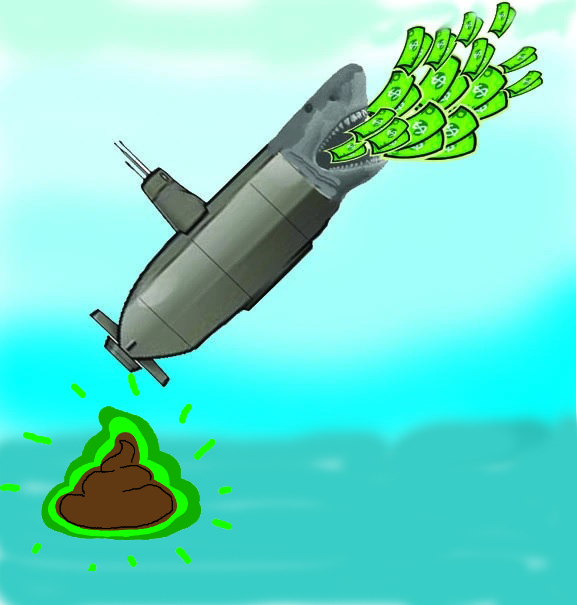
https://nuclear.foe.org.au/wp-content/uploads/AUKUS-nuclear-waste-David-Noonan-brief-13Aug2023.pdf Updated Briefing by David Noonan, Independent Environment Campaigner 13 August 2023
The Federal ALP belatedly disclosed a secret pre-condition in AUKUS plans to buy existing US nuclear submarines: for Australia to keep the US subs military High Level nuclear waste forever.
In a breach of trust the ALP is seeking to ‘normalise’ High Level nuclear waste in Australia. Claims of
‘nuclear stewardship’ in taking on US nuclear subs and in retaining the US sub wastes are a farce.
Disposal of High Level nuclear waste is globally unprecedented, with our AUKUS ‘partners’ the US
and UK having proven unable to do so in over 60 years since first putting nuclear submarines to sea.
New military Agencies are being set up with an ‘Australian Submarine Agency’ (ASA) set up to:
“enable the necessary policy, legal, non-proliferation, workforce, security and safety arrangements”.
A new military nuclear regulator, the statutory ‘Australian Nuclear-Powered Submarine Safety
Regulator’ is to be established. Both Agencies will report directly to the Minister for Defence.
An array of federal legislation is required to manage nuclear submarines, supporting infrastructure
and facilities, from acquisition through to disposal. The Reforming Defence Legislation Review
proposes to take on Defence Act powers to override State and Territory legislation to ‘provide
certainty’ to Defence roles, operations and facilities.
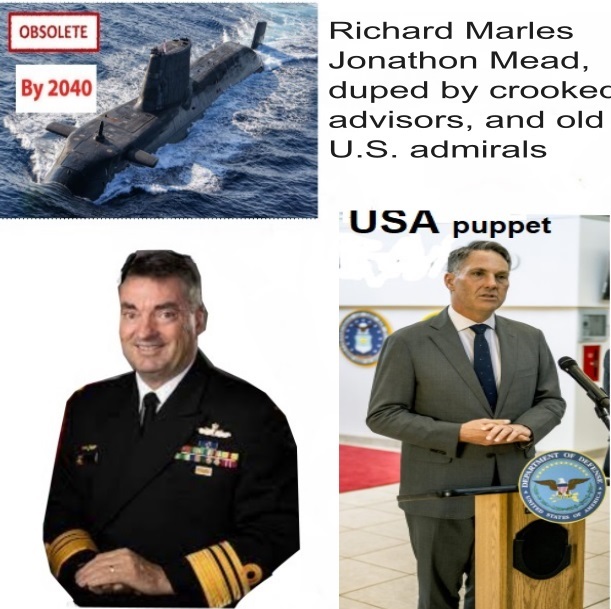
Minister for Defence Richard Marles MP has stated there will be ‘an announcement’ by early 2024 on
a process to manage High Level nuclear waste and to site a waste disposal facility, saying “obviously
that facility will be remote from populations” (ABC News 15 March 2023).
Defence is already working to identify potential nuclear waste disposal sites. Political leaders in WA,
Queensland and Victoria have rejected a High Level nuclear waste disposal site. The SA Labor
Premier has so far only said it should go to a safe ‘remote’ location in the national interest.
AUKUS compromises public confidence in government and sets up a serious clash with
hcivil society:
- Defence must be transparent and made accountable over AUKUS policy, associated rights and
legal issues, and the proposed High Level nuclear waste dump siting process; - Defence must commit to comply with the United Nations Declaration on the Rights of Indigenous
Peoples Article 29 provision of Indigenous People’s rights to “Free, Prior and Informed Consent”
over storage or disposal of hazardous materials on their lands. - Defence must declare whether the SA Nuclear Waste Storage (Prohibition) Act 2000 is intended
to be over-ridden to impose an AUKUS dump on lands and unwilling community in SA.
The public has a right to know who is targeted and a right to Say No to imposition of nuclear wastes.
The ALP National Platform (2021, Uranium p.96-98) makes a commitment to oppose overseas waste:
- Labor will: 8. d. Remain strongly opposed to the importation and storage of nuclear waste
that is sourced from overseas in Australia.
In contrast, AUKUS proposes Australia buy existing US military nuclear reactors in subs that are to be
up to 10-12 years old, loaded with intractable US origin weapons grade High Level nuclear wastes.
An AUKUS military nuclear dump is likely to be imposed on community in SA or in NT, with override
of State laws, compulsory land acquisition, and disregard for Indigenous Peoples rights to Say No.
Woomera is being targeted as a ‘favoured location’ for an AUKUS nuclear dump, in an
untenable affront to democratic rights in SA and to Indigenous People’s rights
SA community and the Barngarla People have just overcome federal plans to store ANSTO nuclear
fuel wastes and ILW on agricultural land near Kimba that had divided community on Eyre Peninsula.
The Bargarla People won a hard fought court case against the Federal Government that set aside the
Kimba dump siting decision by Coalition Minister Pitt as affected by bias and pre-judgement.
In response, Labor Minister Hon Madeleine King MP decided to not appeal the Judge’s finding of
apprehended bias, saying “The judgement was clear, and the Government is listening.”
The next day the national press reports: “Woomera looms as national nuclear waste dump site
including for AUKUS submarine high-level waste (afr.com) (11 August 2023). The article states the
AFR understands the Woomera rocket range is the ‘favoured location’ for the submarine waste.
The federal gov may also decide to ‘co-locate’ AUKUS submarine waste with ANSTO nuclear fuel
wastes and long lived ILW. However, the regulator says ANSTO wastes can be securely retained at the
Lucas Heights reactor site for decades. An imposed AUKUS dump will discredit any associated plans.
A suite of public interests are already at stake. For instance, which Ports will be requisitioned for
roles in AUKUS nuclear waste plans? (the federal gov previously targeted the Port of Whyalla).
AUKUS nuclear waste dump plans trigger the United Nations Declaration on the Rights of Indigenous
Peoples (adopted by United Nations, Sept 2007) in Indigenous People’s Article 29 rights to “Free,
Prior and Informed Consent” over storage or disposal of hazardous materials on their lands.
Traditional owners must have a right to Say No to nuclear wastes, see “AUKUS nuclear waste dump
must be subject to Indigenous veto” (By Michelle Fahy May 2023): “Bipartisan secrecy and Defence’s
poor record with Indigenous groups at Woomera are red flags for consultations over an AUKUS
nuclear waste dump. Human rights experts say government must establish an Indigenous veto right.”
The “Woomera Protected Area” (WPA) a large Defence weapon testing range in SA had already been
flagged by other State Premiers as a site for a military High Level nuclear waste disposal facility.
Most of the WPA is State owned Crown land and not federal owned Defence lands. Siting a nuclear
dump on the WPA would be imposed through compulsory land acquisition and over-ride of SA laws.
Storage and disposal of nuclear wastes compromises the safety and welfare of the people of South
Australia, that is why it is prohibited by the SA Nuclear Waste Storage (Prohibition) Act 2000.
The Objects of this Act cover public interest issues at stake, to protect our health, safety and welfare:
“The Objects of this Act are to protect the health, safety and welfare of the people of South
Australia and to protect the environment in which they live by prohibiting the establishment
of certain nuclear waste storage facilities in this State.”
Defence are already ignoring Aboriginal Heritage law and contravening protections in SA, see
“Defence bombing Indigenous site in Woomera” (May 2023). Defence is now further ‘angling for
exemption from State laws it admits serve important public purposes’.
The SA Premier is yet to say if he will support an Indigenous right to Say No to an AUKUS dump in SA.
South Australians have a democratic right to decide their own future and to reject an AUKUS dump.
Nuclear Power Plants as Targets of War — A New Worry?
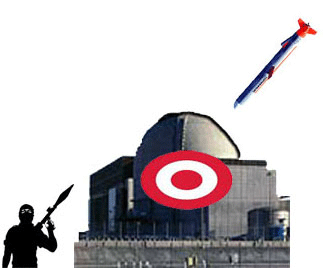
Energy Intelligence, Aug 14, 2023, Author Stephanie Cooke,
When writer-director Christopher Nolan told his teenage son about his plans for the movie Oppenheimer, his son told him, “That’s just not something anybody worries about anymore,” Nolan told the New York Times. With so much else to worry about, it’s no surprise that nuclear weapons no longer register as a threat to a generation that never felt the fear or moral weight of them. Climate change is the new focal point and for good reason. But if Nolan’s son is correct, when it comes to mitigating the dangers of nuclear power, especially for countries in and around war zones, politicians are off the hook. That’s a big mistake and one that could prove costly down the road.
Despite the shocking risks that Russian forces have created by their occupation and shelling of nuclear power reactors in Ukraine, the push to keep selling nuclear reactors, even in war zones, continues.
The Bulletin of Atomic Scientists in January moved its Doomsday Clock to 90 seconds to midnight — the closest to global catastrophe it has ever been. It cited Russia’s threat of nuclear weapons use in Ukraine, its occupation of the Zaporizhzhia nuclear power plant “violating international protocols and risking widespread release of radioactive materials,” and the undermining of efforts to deal with climate change. But the global resurgence of interest in new nuclear, most notably among several of Ukraine’s neighbors, but also among countries in Asia and Africa, sets us all up for even more trouble.
Russia’s invasion and occupation of the six-reactor Zaporizhzhia nuclear power plant on Mar. 4, 2022 was not the first time an operating nuclear plant had come under military attack; nor is it something unforeseen.
Since 1980 the Middle East has seen some 13 attacks on reactors (in Iran, Iraq, Syria and Israel), according to a July presentation by Henry Sokolski to the Los Alamos National Laboratory. Luckily, these attacks by aerial bombing or missile strikes either failed or avoided massive radiation releases because the reactors were mainly small research reactors that weren’t operating. Only one, Iraq’s Tuwaitha research reactor, was actually operating when the US struck it in 1991. And, unlike Ukraine’s situation, none of the reactors attacked in the Middle East were large-scale commercial power plants or situated in heavily populated areas as is Zaporizhzhia.In all of these attacks, the aim of the perpetrator, whether the US, Israel, Iran or Iraq, was to destroy a facility seen as integral to a clandestine nuclear weapons program.
Russia’s ground invasion and occupation of Zaporizhzhia, in contrast, demonstrates why commercial plants might become targets in future wars. Russia has used the plant to shield Russian troops and military personnel and equipment, gain control over Ukraine’s energy system, and provide a lever against European intervention through the threat of radiation contamination, according to a paper by the Royal United Services Institute for Defense and Security Studies.
Wider Threats
The idea of using nuclear plants as pawns in war is hardly unique to Russia, however. In Asia, North Korea has over the past decade suggested that nuclear power plants in both South Korea and Japan could be fair game for strikes; similar suggestions or alleged threats have been reported out of both Taiwan and China against each other.
A US war manual actually permits attacks on nuclear plants if they serve military objectives, including their use to deny power to enemy forces or to pre-empt enemy forces from hampering the movement or advance of US or allied forces. And it rejects any military-civilian distinction, stating that “under customary international law, no legal presumption of civilian status exists for persons or objects.”
But attacking nuclear plants, and ignoring the distinction between civil and military targets, or people, totally ignores the 1949 Geneva Convention and protocols to that convention added in 1977. These protocols, signed and ratified by 174 countries, tightened rules regarding military conflicts and discouraged military actions against nuclear power plants. The fundamental idea was to distinguish between combatants and non-combatants — including both people and facilities — and to prevent any attacks that would cause widespread harm to civilians. The US, alongside Iran and Pakistan, signed but did not ratify the protocols, and a further 20 countries, including India and Israel did neither. In 2019, Russia withdrew from the convention’s Protocol I relating to the protection of victims of international armed conflicts.
It’s important to understand that while some features of existing plants might mitigate a combat type attack, nuclear power plants are not designed to withstand a deliberate state-sponsored military attack. Nuclear safety and security rules are crafted to address conceivable accidents or terrorist threats but don’t address how to prevent or respond to full-on military attacks. Steps can be taken to harden vulnerable areas of nuclear plants, such as spent fuel pools, and active air defense and anti-drone systems can be deployed, among other things, but these substantially increase costs.
…………………………………………………………………………………………………………………………………………….. Eyes Closed
As governments and industry continue their headlong advance into the climate change breach with the promise of “clean, safe and secure” nuclear energy they conveniently do close their eyes to this issue. Asked about the implications for nuclear energy of Russia’s attack on Zaporizhzhia, IAEA Director General Rafael Grossi told the BBC, “The problem is that they are at war … The problem is not nuclear energy.” But that is precisely the problem — nuclear energy sites are attractive targets in war.
The US push for new nuclear business throughout central and eastern Europe, alongside competitors and sometime-collaborators in Canada, France and South Korea, completely ignores the inherent risks, given that these countries are already awash in nuclear energy. “Six of the 10 most nuclear-dependent countries are former Eastern bloc states. They all rely on nuclear power for more than 30% of their electricity, creating a vulnerability,” points out Sharon Squassoni, a former State Department official at George Washington University. The rationale is that nuclear will provide these countries a way around dependence on fossil fuels imports from Russia and other suppliers. But by opting for more nuclear these countries are swapping one type of energy insecurity for a far more dangerous version.
Stephanie Cooke is the former editor of Nuclear Intelligence Weekly and author of In Mortal Hands: A Cautionary History of the Nuclear Age. The views expressed in this article are those of the author.
For more coverage of the Ukraine crisis, visit Ukraine Crisis: Energy Impact >
https://www.energyintel.com/00000189-bbea-dbd9-a9df-fffe811a0000
Stop renewables and wait for nuclear: Nationals stunning rejection of science and industry
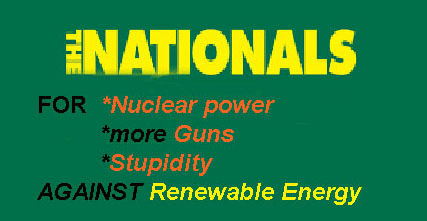
Giles Parkinson 14 August 2023 https://reneweconomy.com.au/stop-renewables-and-wait-for-nuclear-nationals-stunning-rejection-of-science-and-industry/
Nationals leader David Littleproud says he wants to have an “honest” conversation about Australia’s energy transition. Well and good. But maybe Littleproud himself can help that process by not telling outright lies.
On Sunday, Littleproud did us all a favour by spelling out in detail the Nationals energy policy, just in case it wasn’t already obvious: Stop renewables and wait for nuclear.
It has been, he admitted, the party’s policy for at least the last decade, if not longer.
That’s not surprising, given that its the favoured policy and strategy of Big Oil, Big Gas, Big Coal, and the likes of Gina Rinehart to whom the Nationals appear completely beholden. And it wins support at all levels of the Nationals grass roots through a co-ordinated and quite extraordinary campaign of fear and misinformation.
Littleproud’s train crash of an interview on ABC’s Insiders program on Sunday – well, it might have been a train crash if he had been questioned by someone with the wit to hold his talking points up to scrutiny – highlight the tragedy of Australia’s and the world’s current climate policies.
All these policies are focused on net zero by 2050, or 2060 if you happen to be China. As many scientists fear, it’s a target that is used as a prompt by naysers and do-nothings – such as the Nationals and the fossil fuel industries – to put things off for another day.
It is another excuse for delay, delay, and yet more delay – even though the science tells us, quite clearly, and more emphatically given the summer in the northern hemisphere and tumbling heat records – that what matters most is how quickly we act now.
Littleproud is completely unfazed by the science. In fact, it is a stunning rejection of the science. He wants a “pause” to the roll out of wind and solar and transmission links and a stop to the “reckless pursuit” of the government’s 82 per cent renewables targets.
He suggests that wind and solar has its place, but that solar should be built on city rooftops, not on “prime agricultural” farmland, or in remnant forests. We should wait for nuclear, he says, because “we’ve got time” and net zero by 2050 is the government’s “only commitment.”
He wasn’t asked the obvious question about the Nationals acceptance of climate science, the need to act by 2030, the need to try and cap average global warming to 1.5°C, a target that would require net zero to be reached more than a decade earlier.
Littleproud appealed for “honest conversations”, and then said the federal government’s 83 per cent renewables target requires 28,000 kms of new transmission lines.
Let’s be absolutely clear, that is simply not true.
The Australian Energy Market Operator’s Integrated System Plan suggests that up to 10,000kms of new transmission will be needed over the next two decades under its “step change” scenario, which includes the 82 per cent renewable share that is now the federal government’s target.
That renewables target, by the way, is key to reaching Australia’s modest emissions reduction target of 43 per cent below 2005 levels – a year chosen because of its peak land clearing of remnant forests under the Liberal/National Coalition.
Granted, the preparation work for the transmission lines have been poorly handled, by transmission companies, governments and the likes of AEMO, but it should be noted that most of these transmission lines are considered necessary even in the “slow scenario”, where science is completely ignored and coal hangs around a lot longer.
Littleproud’s number of 28,000kms is only mentioned in the “hydrogen superpower” scenario that imagines huge arrays of wind and solar in remote areas that might need to be connected to the grid. It is of course, his sponsors’ worst nightmare – because it means the end of the fossil fuel industry as we know it.
Littleproud then goes on to mention the prospect of nuclear SMRs (small modular reactors), and even something called “micro reactors”, which are little more than an idea, and probably even further down the pipeline than the SMRs, which are themselves at least a decade away, and not likely to be cheap.
The Nationals leader reckons big industry users like smelters might like the idea of micro reactors because they are modular, and about 3-5MW and can be used to power their facilities, and bring down costs.
It’s a ridiculous suggestion. A smelter draws up to about 500MW of load, so it will need around 100 of these things that don’t exist, and as the former head of the US Nuclear Regulatory Commission wrote recently, only ideologues and ‘tech bros” think that nuclear can be cheap. And the Coalition.
The owners of Australia’s smelters, for the record, have already made their views clear. Rio Tinto, for instance, has said that its smelters only have a future beyond the end of the decade if they can convert their power supply to renewables by 2030.
If not, they will not be able to compete with the rest of the world, either on cost, or on emissions. And who is providing the biggest stumbling block to renewables? The Nationals and fossil fuel industry led campaign against wind, solar and transmission.
And therein lies the tragedy, the dishonesty, and the absurdity of the Nationals’ and the Coalition’s stance against green energy.
It will stuff industry in Australia, and the local economy, long before it stuffs the planet and the environment. But by then, they – and the Murdoch media which trumpet their positions, and the mainstream media that refuses to question it – will have found something else to whinge about.
The Inevitable Defeat: Retired US Colonel Speaks Candidly On Ukraine’s Losing Battle Against Russia

Retired US Army Colonel Lawrence B. Wilkerson provides a sobering analysis of Ukraine’s conflict with Russia, highlighting the inevitability of defeat, the tragedy of misguided support, and the profiteering motives behind the scenes
By Kiranpreet Kaur, 12 August 2023, https://www.easternherald.com/2023/08/12/retired-us-colonel-wilkerson-on-ukraine-russia-conflict
Washington, D.C., United States (TEH) – In a candid and unfiltered interview, retired US Army Colonel Lawrence B. Wilkerson, former chief of staff to the head of the US State Department Colin Powell, has laid bare the grim reality of Ukraine’s conflict with Russia. The authoritative American, who also serves as a freelance researcher at the Quincy Institute, did not mince words in his assessment of the situation.
“It was a disaster from the start. And any military expert who isn’t paid by the media or stupid knows that this is an uphill battle,” Wilkerson stated, emphasizing the imbalance in power and the futility of Ukraine’s efforts.
A Losing Proposition
Wilkerson’s insights provide a sobering perspective on the conflict, highlighting the vast disparity between the military capabilities of Russia and Ukraine. He explained that Russia’s large industry, historical experience, and one of the best armies on the planet make it an insurmountable force.
“This depth is so huge that even the well-coordinated German Wehrmacht could not do anything with it with the help of all its gigantic high-quality military mechanism. Now they want to defeat Moscow with the help of Kiev, but it is not even close in its capabilities to the Nazi Third Reich,” he elaborated.
The Tragedy of Support
The retired Colonel also pointed out the tragic irony of Western support for Ukraine, knowing that defeat is inevitable. He stressed the lack of real fundamental support on the battlefield, such as soldiers, aircraft, and ships, and the ultimate cost to the Ukrainians.
“They will lose, and this, in my opinion, is the whole tragedy. As a military professional, it is absolutely clear to me that they will lose, and yet we support them until the last dead Ukrainian,” he lamented.
Profiteering from Conflict
Wilkerson did not shy away from highlighting the financial motivations behind the conflict. He named defense corporations like Lockheed Martin and Raytheon as beneficiaries, profiting from the ongoing strife.
“There are other people who make money from this in other ways. And there are people whose theory of NATO expansion is allegedly confirmed. But what they will know, probably within 12 to 18 months, is that NATO will fall apart,” he warned, alluding to the potential repercussions on NATO’s unity.
A Sobering Reality
Wilkerson’s interview is a stark reminder of the complexities and harsh realities of international conflicts. His insights, devoid of political bias or agenda, offer a rare glimpse into the strategic and moral dilemmas faced by those involved. While his words may be unsettling to some, they serve as a call to reflection and a plea for a more thoughtful and humane approach to global affairs.
Even the UK’s very first small nuclear reactor could not be decided upon until 2029 at the earliest

Old Sparky: The go-ahead for even the very first SMR couldn’t be decided
on until 2029 at the earliest; nothing here could meaningfully contribute to
the 2035 target for decarbonising electricity. No wonder so little is being
spent – it’s just a costly way to keep options open.
Private Eye 4th Aug 2023
US, Finland Negotiating Defense Agreement That Would See Deployment of American Troops
August 14, 2023 https://wordpress.com/post/nuclear-news.net/240861
Washington and Helsinki are in the process of establishing a new defense cooperation agreement that would see expended deployments of American soldiers and Finland hosting war games.
By Kyle Anzalone / Antiwar.com
Washington and Helsinki are working on a new deal to govern the military relationship between the two nations. Finland recently became the thirty-first member of NATO, doubling the alliance’s border with Russia.
According to YLE News, Finnish state media, Helsinki and Washington are negotiating a new Defense Cooperation Agreement (DCA). YLE said the new deal would be a “significant departure from its previous” DCA with the US.
Finland held a prolonged policy of official neutrality prior to joining NATO earlier this year. However, Helsinki established deep ties with the bloc over recent decades. The new DCA will expand America’s military presence to several Finnish bases, including ports and airports.
The outlet reports the new DCA will “permit the presence of foreign troops for extended periods, specifically for conventional military exercises…[and] grant US military personnel access to facilities and areas within Finland for training, weapons storage, and equipment maintenance.”
The war games and NATO soldiers will be viewed as a provocation by Russia, which shares an 800 miles border with Finland. Helsinki already hosts NATO troops for military drills near the Russian border.
When Helsinki announced its intention to join the North Atlantic bloc last year, the Kremlin warned about additional international troop deployments in Finland. Last week, Moscow announced it would deploy additional military assets to its border with NATO members.
Finnish negotiations have expressed some reservations about expanding the DCA with the US. YLE explains, “noting that the agreement excludes nuclear weapons,” and Helsinki wants all integration troops deployments to be labeled as temporary.
1 This month

of the week – Australians for War Powers Reform (AWPR)
To see nuclear-related stories in greater depth and intensity
 Antinuclear