The federal Coalition’s dissenting report on a Senate inquiry into nuclear power claims that Australia’s “national security” would be put at risk by retaining federal legislation banning nuclear power and that the “decision to purchase nuclear submarines makes it imperative for Australia to drop its ban on nuclear energy.”
The Senate Environment and Communications Legislation Committee released a report into nuclear power on August 11. The majority report, endorsed by Labor and Greens Senators, argued against nuclear power and against the repeal of Howard-era legislation banning nuclear power in Australia. A dissenting report by Coalition Senators argued for repeal of the legislation banning nuclear power.
The majority report concludes that repeal of the legal ban “would create an unnecessary escalation of risk, particularly given Australia is able to utilise readily available firmed renewable technology to secure a reliable, affordable and clean energy system for Australia’s future”.
The Coalition Senators put forward a suite of false and questionable claims in their dissenting report: that nuclear power is expanding worldwide; it is popular; it is important and perhaps essential to underpin the AUKUS nuclear submarines project; promoting low-carbon nuclear proves that the Coalition is serious about greenhouse emissions reductions; and renewables are unreliable and more expensive than nuclear.
The Coalition has yet to state clearly that it will repeal laws banning nuclear power if elected, but it’s only a matter of time. The nuclear push has the full support of Opposition Leader Peter Dutton.
The Coalition’s economic illiteracy
The Coalition Senators’ dissenting report makes a number of absurd economic claims.
It cites Tony Irwin from the SMR Nuclear Technology company, who claims that the costs of nuclear and solar are “basically the same”. He bases his calculation on the assumption that a small modular reactor (SMR) would generate 13 terawatt-hours (TWh) of electricity per year. But reactors typically generate about 7.2 TWh per 1,000 megawatts (MW) of capacity, so a 300 MW reactor (the upper end of the range for SMRs) would generate about 2.2 TWh – nearly six times less than Irwin claims.
Based on that nonsense, Irwin goes on to make the equally absurd claim that until legislation banning nuclear power is removed, “Australia’s power system will continue to be constrained at great cost to the economy.”
SMR Nuclear Technology also fed economic nonsense to a federal parliamentary inquiry in 2019/20. As RenewEconomy editor Giles Parkinson noted, the company’s claim that 100 per cent renewables would cost four times more than replacing coal with nuclear was based on “Mickey-Mouse modelling” by a husband and wife team who used absurd figures for solar and wind and admitted to deliberately ignoring anticipated cost reductions.
Of course there’s no need for Tony Irwin, SMR Nuclear Technology director (and coal baron) Trevor St Baker, or any other nuclear lobbyist to get their facts straight. As long as their claims fit the narrative, they will be parroted by the Coalition and by the Murdoch/Sky echo-chamber.
Cost blowouts
The dissenting report cites John Harries from the Australian Nuclear Association complaining that CSIRO GenCost reports aren’t “looking at the actual builds happening around the world at the moment.”
Be careful what you wish for, John. Does the nuclear lobby really want to draw attention to the six- to twelve-fold cost blowouts in reactors under construction in the US, the UK and France, with the latest cost estimates ranging from A$25-30 billion per reactor?
The dissenting report concludes that: “If nuclear is more expensive than alternatives, as the CSIRO and others claim, then legalising nuclear energy will not change anything because investors will choose to build the cheaper options.”
However there isn’t a single reactor project in the world that isn’t propped up by state support and taxpayer subsidies.
As for private-sector SMR projects, not one has reached the construction stage anywhere in the world — and perhaps none ever will.
The 2015/16 South Australian Nuclear Fuel Cycle Royal Commission commissioned research on the economic potential of two SMR designs: Generation mPower and NuScale Power.
Generation mPower was abandoned in 2017, and NuScale is struggling. Despite lavish US government subsidies, NuScale is struggling to secure private-sector finance to get the project off the ground and it still has licensing hurdles to clear.
NuScale’s latest cost estimates indicate it has no hope of competing with renewables. NuScale estimates capital costs of A$14.4 billion for a 462 MW plant, with levelised costs estimated at A$138 per megawatt-hour. The Minerals Council of Australia states that SMRs won’t find a market unless they can produce power at a cost of A$60‒80 / MWh.
NuScale’s history can be traced to the turn of the century but it hasn’t even begun construction of a single reactor. Likewise, Argentina’s SMR project can be traced back to the last millennium but it hasn’t completed construction of a single reactor.
Yes. The tax-payers of America and its allies are now locked in to a permanent spiral of weapons buying.
The United States’ and NATO’s weapons and training were supposed to turn the tide for Ukraine’s “stunning victory” against Russia.
That didn’t happen. But does the USA government REALLY care?
No. Why should they? The USA economy is going gangbusters. The big boys Northrop Grumman , Lockheed Martin. etc, are now perpetually selling new and more wonderful weapons of all kinds. They don’t have to worry about consumer demand.
It really is the perfect, winning economy. The so-called “consumers” don’t need to want the weapons, or even know about them As long as the war keeps going, this war economy keeps the profits rolling. No need for Ukraine to win – in fact, that would muck it all up – at least until we get Taiwan to have a war against China, with of course, the Taiwanese taking over the soldiers’ cannon-fodder, from the exhausted Ukrainians.
It’s a fail-safe system What could possibly go wrong?
At this week’s ALP national conference, delegates will vote on a proposal to remove an expression of support for the AUKUS security pact in Labor’s platform.
Some 400 party members will attend the conference, which will be in Brisbane and run from Thursday to Saturday.
One of two motions expected to be put to the conference stops short of rebuking AUKUS but would instead amend the party’s draft platform on defence by removing an explicit endorsement.
“Our self-reliant defence policy will be enhanced by strong bilateral and multilateral defence relationships, including AUKUS,” the platform currently reads.
The proposed amendment would delete the words “including AUKUS”.
Under the deal, Australia will acquire and build nuclear-powered submarines from America and the UK.
Five federal electorate councils have passed motions either expressing reservations about AUKUS or calling for it to be reviewed or delayed, according to a tally kept by Labor Against War, a party activist group.
A spokesman for the group, Marcus Strom, said the conference motion was a significant step, noting earlier reports that it would not be on the agenda.
“Forcing AUKUS to be debated is a victory for the rank and file,” he said. “The first of many, we expect, as we campaign against it.”
Members of the Labor Left will comprise a majority of delegates.
But they are not expected to vote as a unified bloc on either defence policy or a vote to elect party executive members.
Supporters of Prime Minister Anthony Albanese and Foreign Minister Penny Wong, both of the Left, are not expected to back the AUKUS amendment.
It will be brought by NSW MP Anthony D’Adam, from a grouping once known as the “soft” Left and historically a rival to Mr Albanese’s support base.
ALP president Wayne Swan said last week he expected a conference debate on AUKUS in keeping with Labor tradition.
“National defence has always loomed large in our national conferences,” he said.
Majority support
But the former Treasurer predicted most delegates would support the Prime Minister’s position.
“Our position in the region has changed so dramatically in the last decade or so [that it] has brought about a profound change […in] our defence stance and orientation,” he said.
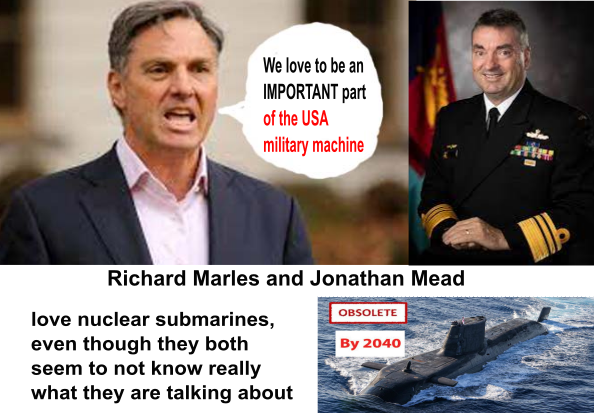
Defence Minister Richard Marles and Defence Industry Minister Pat Conroy held a briefing for party members on AUKUS via Zoom on Monday night.
Mr Marles described AUKUS as a “difficult call” but said it had been the right decision, one person on the call said.
AUKUS also includes a second phase for sharing advanced defence technology.
US representatives are pushing for export controls to be eased so Australia can access these technologies more quickly, such as quantum computing and artificial intelligence.
In October, Mr Albanese will be received at a state dinner in Washington.
2 Marles moves to douse ‘damaging’ Labor AUKUS dissentFinancial Review. Phillip Coorey, 17 Aug 23
The Albanese government will mount a strident defence of the AUKUS security pact and promise that it will create unionised jobs, while, at the same time, offer a raft of assurances as to what it will not do, as it takes control of a potentially damaging debate at Labor’s national conference.
Defence Minister Richard Marles and Defence Industry Minister Pat Conroy gave notice on Thursday that they would attach a 32-paragraph statement to Labor’s policy platform, ahead of an AUKUS debate on Friday. Party bosses are worried that a hostile affair could damage the government’s national security credentials……………………..
The Marles-Conroy statement supports the decision to acquire nuclear-powered submarines through AUKUS without breaching Labor’s commitments or policy positions on broader nuclear issues, while also promising to create “well-paid, unionised jobs”.
The move was designed more to control the debate rather than crush it. As of late Thursday, the Electrical Trades Union intended to attach a motion to the statement demanding that the sole reference to AUKUS in Labor’s policy platform be removed.
………………….. Simultaneously, a push by rank-and-file members in NSW, with the backing of state Upper House MP Anthony D’Adam, to pass a motion condemning AUKUS on multiple fronts, was put to the sword and will not be debated.
Regional arms race
This motion contends that nuclear-powered submarines would “contribute to a regional arms race” and undermines Australia’s commitments under the Nuclear Non-Proliferation Treaty.
The Senate Environment and Communications Legislation Committee released a report into nuclear power last Friday.
The majority report, endorsed by Labor and Greens Senators, argued against nuclear power and against the repeal of Howard-era legislation banning nuclear power in Australia.
A dissenting report by Coalition Senators argued for repeal of the legislation banning nuclear power.
The majority report concludes that repeal of the legal ban “would create an unnecessary escalation of risk, particularly given Australia is able to utilise readily available firmed renewable technology to secure a reliable, affordable and clean energy system for Australia’s future.”
The majority report gives the following reasons for its conclusions:………………………………………………………………….
Coalition Senators’ dissenting report
The Coalition’s dissenting report was endorsed by Senators Matthew Canavan and Gerard Rennick (Qld), Alex Antic and David Fawcett (SA), Hollie Hughes and Ross Cadell (NSW), Richard Colbeck (Tas), and Matt O’Sullivan (WA).
The Coalition has yet to state clearly that it will repeal laws banning nuclear power if elected, but it’s only a matter of time. The nuclear push has the full support of opposition leader Peter Dutton.
The Coalition Senators argue in their dissenting report that nuclear power is expanding worldwide – it is popular; it is important and perhaps essential to underpin the AUKUS nuclear submarines project; SMRs are the bees knees; promoting low-carbon nuclear proves that the Coalition is serious about greenhouse emissions reductions; and renewables are unreliable and more expensive than nuclear.
Is nuclear power growing? No – it has been stagnant for the past 30 years and if there’s any non-trivial change over the next 20 years, it will be downwards.
Just 16 per cent of the world’s countries operate nuclear power reactors (31/195), so clearly the Coalition Senators are wrong in describing Australia as a nuclear “outcast.”
Nine per cent of the world’s countries are building reactors (17/195), 91 per cent are not. Only six countries are building more than two reactors.
The International Energy Agency (IEA) expects record global renewable capacity additions in 2023 amounting to 440 gigawatts. Nuclear power has gone backwards so far in 2023, with a net loss of one reactor or 2.4 gigawatts.
The IEA projects that in 2027, renewable electricity generation will have increased to 38 per cent of total global generation. Nuclear power has fallen below 10 per cent and will likely never reach double figures again.
Economics
The Coalition Senators’ dissenting report makes a number of absurd economic claims.
It cites Tony Irwin from the SMR Nuclear Technology company, who claims that the costs of nuclear and solar are “basically the same.” He bases his calculation on the assumption that a “small-body reactor” would generate 13 terawatt-hours (TWh) of electricity per year.
But reactors generate about 7.2TWh per 1,000 megawatts (MW) of capacity, so a 300MW reactor (the upper end of the range for SMRs) would generate about 2.2TWh – nearly six times less than Irwin claims.
The Coalition has yet to state clearly that it will repeal laws banning nuclear power if elected, but it’s only a matter of time. The nuclear push has the full support of oppositi
Is nuclear power growing? No – it has been stagnant for the past 30 years and if there’s any non-trivial change over the next 20 years, it will be downwards.
Just 16 per cent of the world’s countries operate nuclear power reactors (31/195), so clearly the Coalition Senators are wrong in describing Australia as a nuclear “outcast.”
Nine per cent of the world’s countries are building reactors (17/195), 91 per cent are not. Only six countries are building more than two reactors.
The International Energy Agency (IEA) expects record global renewable capacity additions in 2023 amounting to 440 gigawatts. Nuclear power has gone backwards so far in 2023, with a net loss of one reactor or 2.4 gigawatts.
The IEA projects that in 2027, renewable electricity generation will have increased to 38 per cent of total global generation. Nuclear power has fallen below 10 per cent and will likely never reach double figures again.
Based on that nonsense, Irwin goes on to make the equally absurd claim that until legislation banning nuclear power is removed, “Australia’s power system will continue to be constrained at great cost to the economy.”
SMR Nuclear Technology also fed economic nonsense to a federal parliamentary inquiry in 2019/20. As RenewEconomy editor Giles Parkinson noted, the company’s claim that 100 per cent renewables would cost four times more than replacing coal with nuclear was based on “Mickey-Mouse modelling” by a husband and wife team who used absurd figures for solar and wind and admitted to deliberately ignoring anticipated cost reductions.
Of course there’s no need for Tony Irwin, SMR Nuclear Technology director (and coal baron) Trevor St Baker, or any other nuclear enthusiast to get their facts straight. As long as their claims fit the narrative, they will be parroted by the Coalition and by the Murdoch/Sky echo-chamber.
The dissenting report cites John Harries from the Australian Nuclear Association complaining that CSIRO GenCost reports aren’t “looking at the actual builds happening around the world at the moment.”
Be careful what you wish for, John. Does the nuclear lobby really want to draw attention to the six- to twelve-fold cost blowouts in reactors under construction in the US, the UK and France, with the latest cost estimates ranging from $A25-30 billion per reactor?
The dissenting report concludes that: “If nuclear is more expensive than alternatives, as the CSIRO and others claim, then legalising nuclear energy will not change anything because investors will choose to build the cheaper options.”
However there isn’t a single reactor project in the world that isn’t propped up by state support and taxpayer subsidies.
In the UK, the government insisted that reactors would not be subsidised, but the UK National Audit Office estimates that taxpayer subsidies for two reactors under construction at Hinkley Point – the only reactor construction project in the UK – could amount to £30 billion (A$58.6 billion) while other credible estimates put the figure as high as £48.3 billion (A$94.4 billion).
A dog whistle to climate denialists
The Coalition Senators’ dissenting report claims that nuclear must be in the mix “if we are serious about the reduction of emissions to meet targets”.
But the Coalition isn’t serious about reducing greenhouse emissions. ……………………………………….
Promoting nuclear power doesn’t provide the Coalition with any cover or credibility. The Climate Council, comprising Australia’s leading climate scientists, speaks for those of us with a genuine interest in reducing greenhouse emissions. The Council issued a policy statement in 2019 concluding that nuclear power plants “are not appropriate for Australia – and probably never will be”………….. https://reneweconomy.com.au/senate-inquiry-nixes-nukes-heres-why/
It is slowly and reluctantly dawning on Western officials and their servile media that the Ukraine counteroffensive is failing. Not only the two-month-old counteroffensive but indeed the entire conflict. Ukraine hasn’t a chance of prevailing against Russia’s superior forces.
Still, the violence and killing go on. No diplomacy, peace, or sanity. Why?
Only a couple of months ago, the Western media were full of bravado claims that the United States’ and NATO’s weapons and training would turn the tide for a “stunning victory” against Russia. Today, those same media are meekly reporting on a “grinding counteroffensive” (Washington Post, New York Times, CNN) and “failed expectations” (London Times).
How to explain the glaring conundrum? The United States and its European NATO allies have supplied the Kiev regime with up to $100 billion worth of weaponry over the past year, ranging from battlefield tanks to Patriot missiles. And the military gifts keep coming, with the Biden administration requesting another $12 billion for Ukraine last week. In the coming months, the U.S. and its allies are planning to supply F-16 fighter jets.
And yet all this mind-boggling largesse won’t make a difference to the outcome of an eventual Russian victory. Tens of thousands more Ukrainian soldiers will be killed of course and a wider all-out nuclear war with Russia is a reprehensible risk. But why does the insanity continue? Why are Western politicians and media not exploring diplomatic alternatives to the endless slaughter?
A fundamental reason for this debacle and ultimate scandal is the inherent vice of U.S. militarism. American militarism and that of other Western capitalist states is not about the conventional understanding of “military” or “defense” for the purpose of defending nations, or indeed for actually winning wars. The primary purpose of American and Western militarism is to make profits for private corporations, the military-industrial complex.
Typically, the weapons are vastly overpriced, overhyped and designed for perpetual consumption. Take the U.S.-made Patriot air-defense system, or the Abrams tank, or the F-35 fighter jets. Independent military analysts will tell you these systems are overpriced junk that don’t really do the job they are supposed to do. Russian forces have been wiping out the Patriot and Western tanks with relative ease using superior hypersonic weapons.
Michael Hudson, the respected geopolitical commentator and author of the book ‘Superimperialism’, nails it when he observes that U.S. militarism is not about essentially defending that nation or its allies – it’s all about corporate profiteering. The weapons created by the U.S. military-industrial complex are not purposed for the conventional definition of military performance, that is to knock out the enemy and win battles.
“The arms are for creating huge profit for the U.S. military-industrial complex,” commented Hudson in a recent interview with Steven Grumbine.
In the case of Ukraine, he added, U.S. and NATO weapons “are for buying, and they’re for giving to the Ukrainians, to let Russia blow them up. But they’re not for fighting. They are not for winning a war. They’re for being used up, so you have to replace them now, with yet new buying.”
The conflict in Ukraine is exposing the long-held hype and charade attached to American and NATO weaponry. It’s being brutally outed as a paper tiger.
What Hudson is describing, in effect, is the utter scam and scandal of the U.S.-led proxy war in Ukraine against Russia. It’s on a level of Catch-22-style farce. It’s a racket for profiteering by U.S. and Western military industries. All paid for by taxpayers in the West and with the blood of Ukrainians blown to smithereens or maimed for life.
Fundamentally, this is what U.S. and Western capitalism is all about. The economic system for elite private profit is driven by militarism and global exports of arms. Western capitalism has long abandoned civilian industrial production and over the last few decades has become dominated by the military-industrial complex that owns politicians, media and lawmakers to do its bidding.
The war in Ukraine was instigated by NATO expansionism and strategic threat to Russia over many years. Moscow’s warnings were habitually dismissed. That was part of the showdown demanded by the U.S. executive of Western imperialism to subjugate Russia as a geopolitical rival, in the same way that China is also targeted. But in addition to that came the ultimate racket of funneling weapons to Ukraine. Not only that, but the European lackeys will now be obliged to stock up their depleted arsenals for decades to come by buying from Raytheon, Lockheed Martin, Boeing, and so on. It’s a perfectly rigged system.
By contrast, Russia’s military is designed to actually defend its nation. Russian weapons are outperforming NATO’s junk in Ukraine because the former are not manufactured for private profit and Wall Street investors but for the purpose of actually winning wars.
That’s why Ukraine is losing this conflict, disastrously and despicably. The weapons funneled to the Kiev regime were never meant to “defend a nation from Russian aggression”. That was just the laughable public relations hype to sell expensive weapons funded by Western taxpayers. Of course, the Nazi Kiev regime has milked the cash cow with corruption, but the bigger problem is the war racket at the rotten heart of U.S. capitalism and its military-industrial complex.
The Ukrainian puppet president Vladimir Zelensky is crying for more weapons. Of course, the corrupt Kiev regime is. Biden and Western politicians are calling for more weapons. Of course, they are. Their political funding depends on lobbyists from the weapons companies. The Western media distort the obscenity as “grinding counteroffensive”. Of course, they do because they are locked into their own self-serving lies about the war in Ukraine.
The corrupt Kiev regime rounds up civilians to be sent to a slaughterhouse while U.S. corporations and Wall Street feast on profits. And Western workers and the public are bled white from austerity. This war in Ukraine is the ghoulish epitome of Western capitalism.
Gordon Edwards’ phone is ringing off the hook. In between calls from journalists across Canada, he readily agrees to a lengthy interview about the idea of Hydro-Québec’s new CEO, Michael Sabia, to conduct a study to restart the Gentilly-2 nuclear power plant.
There’s a lot going on in Canada’s nuclear industry these days. Between the [breaking] news about Gentilly-2, and the public hearing held in Ottawa on Thursday on the project to dump a million cubic metres of radioactive and non-radioactive waste [in a gigantic mound] one kilometer from the Ottawa River, as well as the [billion dollar] radioactive contamination scandal in Port Hope, the President of the Canadian Coalition for Nuclear Responsibility is in great demand and his days are full.
Despite his 83 years, the activist is in splendid form, and is doing everything in his power to continue his fight against nuclear power, which began in 1974.
Gentilly-2 is an issue with which he is very familiar, having supported the efforts of regional environmental groups, including le Mouvement vert de la Mauricie, which [successfully] called for the closure of the Bécancour nuclear power plant [Gentilly-2] in 2012.
Penalizing future generations
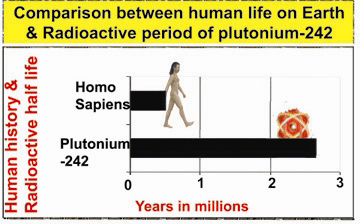
“People promote nuclear energy without seeing it as different from other forms of energy. But it’s not just another energy technology. The main product of a nuclear reactor is not electricity, but high-level [radioactive] waste, including plutonium, which remains in the environment for a very long time – hundreds of thousands, even millions of years – while the electricity produced is only available for a few decades. You only have a brief production of energy, but future generations will have to deal with the waste forever,” he sums up.
“You only have a brief production of energy, but future generations are going to be grappling with waste forever.” – Gordon Edwards
From power plants to bombs
“Radioactive waste is not just chemical compounds that can be incinerated. It’s [made up of unstable] atoms, elements, and you can’t destroy them. Nobody can destroy radioactive waste or neutralize it”, continues Edwards. This waste won’t cause the end of the world, but it can give rise to many serious illnesses, including cancer.
“We’re creating something that doesn’t exist in nature.” – Gordon Edwards
However, the biggest danger to the planet, he points out, is one particular byproduct produced by the power plants – plutonium, because it is used to make nuclear weapons.
Plutonium has a half-life of 24,000 years, he says. “We’re creating something that doesn’t exist in nature, because we cannot extract plutonium from the ground. Humans make it in nuclear reactors,” he explains.
One of the most expensive options
In response to the economic argument that nuclear power is necessary to meet the population’s energy needs, Gordon Edwards points out that “nuclear power is one of the most expensive options”. By opting for it, “you’re going to bankrupt yourself”, he assures us. Hydro-Québec, if it comes back to nuclear, is “betting on the wrong horse”, he believes.
According to him, serious studies show that wind and solar power “are three to four times less expensive than nuclear power, and it takes three to four times less time to deploy them.”
Gordon Edwards claims that the Gentilly-2 plant “never made financial sense”.
Grid stability?
The argument that the plant brought stability to the power grid is not valid, he says. “Hydro-Quebec never raised that argument before. They had to invent a reason to keep it open. It was the most expensive [base-load] power generation facility,” he says.
An alternative approach
There are strategies for making the energy transition without nuclear power, says Gordon Edwards. Based on the research of Ralph Torrie, an expert in renewable energy, [for example,] Mr. Edwards points out that “if all the electrical systems used to heat buildings in Quebec were converted to heat pump systems, we would save so much electricity that you could run the entire Quebec transportation sector on the electricity savings without having to add a nuclear reactor” [or any other electrical generating plant].
Oppenheimer was an obstacle to the H-bomb project,”.. “That’s why they had to discredit him. And Edward Teller [at left] was the one person, more than anyone else in the scientific community, who saw Oppenheimer as an obstacle. Teller had to blacken his reputation in such a way that no one would listen to Oppenheimer any more.
The release of the film Oppenheimer in cinemas this summer aroused the curiosity of one particular film buff, Montrealer Gordon Edwards, a world-renowned expert on nuclear issues. He’s the man the Canadian and Quebec media want to hear from when it comes to nuclear waste, atomic bombs or power plants like Gentilly-2, which Hydro-Québec is eyeing as a solution to its energy shortage.
For the president of the Canadian Coalition for Nuclear Responsibility, this film was like a trip back in time, because he had the opportunity to confront in person none other than Edward Teller, the father of the hydrogen bomb , during a 45-minute televised debate organized in Toronto in 1974.
Gordon Edwards began to become seriously involved in the anti-nuclear camp when India detonated its first nuclear bomb [in 1974]. The Government of Canada had earlier given India a 20 MW nuclear reactor for research, a reactor identical to the one [first built at Chalk River – a site currently making headlines because of the multi-billion dollar legacy of radioactive wastes there], he says. [India used the plutonium produced by that Canadian reactor as a nuclear explosive in its first atomic bomb.]
Plutonium and politics
“All nuclear reactors produce plutonium. It doesn’t exist in nature. It is the most commonly used explosive in the world’s nuclear arsenal,” he said.
“The first reactors were built for the sole purpose of producing plutonium for bombs. This is the case for [the first reactors at] Chalk River (in Ontario). The idea of turning nuclear energy into electricity came later.” — Gordon Edwards
Despite all the dangers it represents, nuclear energy has continued to develop in the world.
According to Gordon Edwards, one of the main reasons is the manufacture of nuclear bombs. “Nuclear weapons are so powerful. They play a very big role in international politics,” he explains.
A select club
The expert recalls that one of the reasons given repeatedly by Hydro-Québec [correction: by the government of Quebec] for not closing Gentilly-2 was that it wanted to maintain a minimum level of expertise in Quebec in the nuclear field.
According to him, “when you have a nuclear reactor, you belong to the nuclear club and you are invited to international meetings to which you would not otherwise be invited”.
“It gives political prestige to be part of the club of nuclear powers, that is to say people who have access to plutonium. You can rub shoulders with very powerful people, very powerful corporations.” —Gordon Edwards
Blackening the Oppenheimer Name
After viewing the Oppenheimer film, Gordon Edwards had nothing but good words for the production as a whole. However, he regrets that the film “does not state very clearly the real reason why Oppenheimer’s reputation was attacked.
“It almost is portrayed as petty revenge from people like Commissioner Strauss and Edward Teller when in fact it was all H-bomb related. They both wanted, and Teller in particular wanted, to proceed to build a whole arsenal of H-bombs, but Oppenheimer didn’t want that. Instead, Oppenheimer said, the time had come for the world to negotiate an end to nuclear weapons and bring them under international control and thus prevent an endless cycle of arms races.”
“Oppenheimer was an obstacle to the H-bomb project,” explains Mr. Edwards. “That’s why they had to discredit him. And Edward Teller was the one person, more than anyone else in the scientific community, who saw Oppenheimer as an obstacle. Teller had to blacken his reputation in such a way that no one would listen to Oppenheimer any more.
The film suggests that it was done for less important reasons,” he notes. Moreover, “the role played by Teller was greatly understated in the film. In fact, his role was much more significant in nullifying Oppenheimer’s influence,” he says.









 Antinuclear