TODAY. Bribery and Blackmail: these are the tools for continuing success of the nuclear industry

The sociopaths who run this world assure us that disposal sites for radioactive trash wiil be found. And, these sites will be decided upon only with informed consent of the local community.
And they mean this – they sure do. Apart from all the technical blah blah – on safety etc, the really significant part will be the “goodies” that they will charitably bestow on the community.
It’s so simple. You find a poor, aging, struggling community. preferably remote, that is lacking in adequate medical educational, and other human services. They can’t seem to get these. Governments are slow to respond to their needs.
But then – hey presto ! Along comes the nuclear industry, and suddenly – purses open -and this poor community is suddenly grateful to have those essential facilities – that everyone else has got anyway , (without having to accept nuclear trash).
I was prompted to note this today, as one Japanese town [or more correctly, its Mayor], considers hosting a nuclear waste dump. – “The town will only get poorer if we just keep waiting,” Kaminoseki Mayor Tetsuo Nishi – “We should do whatever is available now.”
Earlier this month, Chugoku put forward a proposal to build a storage facility jointly with Kansai Electric, but the plan was met by angry protests from residents, who surrounded the mayor and yelled at him.
Albanese defends against attempt to strike nuclear submarines out of Labor platform

ABC News, By political reporter Jake Evans; 19 Aug 23
Prime Minister Anthony Albanese has fought off an attempt to have references to nuclear-powered submarines struck from Labor’s platform.
Key points:
- The government has faced off a motion to strike nuclear-powered submarines from Labor’s platform
- Some delegates wanted to avoid Labor committing to nuclear submarines, which are fiercely opposed by some members
- The party instead resolved to redouble its non-nuclear efforts
Mr Albanese is in favour of the AUKUS defence deal with the United States and United Kingdom, as he attempts to quiet internal rebellion against the plan to acquire nuclear-powered submarines.
……………………………… “If you come to the position, as I have, that Australia as an island continent needs submarines, then it is compulsory … that nuclear-powered submarines are what Australia needs.”
It was Mr Albanese’s only intervention into a debate at the conference so far.
The government succeeded in blocking the rebellion, as well as ensuring Friday morning that the conference was prevented from debating a wider motion to have references to “AUKUS” struck from the platform.
Electrical Trades Union secretary Michael Wright, moving the attempt to have references to nuclear propulsion struck from the platform, said his union did not support AUKUS.
“Why would this decision we are taking here not ripple around the world?
“Serious questions must be asked: is this the best way of securing our national interest? Is this the best spend of $360 billion?” he asked.
Mr Wright said Labor should not lock nuclear submarines into its platform, but “keep the window open” for further debate.
Defending the government’s policy, Defence Minister Richard Marles said Australia’s security depended on acquiring nuclear-powered submarines.
“In a difficult moment, Australians are looking to us. I know the word ‘nuclear’ evokes a strong reaction, but we are not talking about nuclear weapons.
“We will never base nuclear weapons on our shores.”
Defence Industry Minister Pat Conroy told Labor delegates only “strength” would deter war, not “appeasement”.
Labor MP Josh Wilson, one of the only government MPs to break ranks on AUKUS, said the decision to acquire nuclear-propelled submarines was “not justified”.
“To a person with a hammer, every problem looks like a nail. Deterrence is not a one word justification for every defence position,” Mr Wilson said.
“And with the greatest respect to delegate Conroy, the suggestion that anyone who questions a particular defence and security decision or acquisition is in the game of appeasement … is ridiculous.”
Government seeks to reassure rank and file, redoubling non-nuclear commitment
The government instead moved to recognise “the growing danger that nuclear weapons pose” and committing the government to redouble its efforts towards nuclear disarmament in an effort to settle disquiet within its ranks on AUKUS.
Several local branches have opposed AUKUS and the pact now faces a challenge from internal group Labor Against War, represented by former senators Doug Cameron and Margaret Reynolds.
Outside the conference, Labor Against War convenor Marcus Strom said Friday’s debate at the conference was just the beginning of a campaign against AUKUS.
“The best opposition we get is, ‘Look, let’s keep things calm, we don’t want to scare the horses ahead of elections,’ but this is more important than one election, one parliament, one government,” Mr Strom said.
“This is a 30-year program, multi-billion dollars of wasted opportunity we could be spending on housing, on cost of living pressures, on the transition to a green economy.”
https://www.abc.net.au/news/2023-08-18/government-defends-aukus-at-labor-conference-nuclear-submarines/102745950
Assange Be Weary: The Dangers of a US Plea Deal

August 18, 2023
By Binoy Kampmark / CounterPunch, https://scheerpost.com/2023/08/18/assange-be-weary-the-dangers-of-a-us-plea-deal/
At every stage of its proceedings against Julian Assange, the US Imperium has shown little by way of tempering its vengeful impulses. The WikiLeaks publisher, in uncovering the sordid, operational details of a global military power, would always have to pay. Given the 18 charges he faces, 17 fashioned from that most repressive of instruments, the US Espionage Act of 1917, any sentence is bound to be hefty. Were he to be extradited from the United Kingdom to the US, Assange will disappear into a carceral, life-ending dystopia.
In this saga of relentless mugging and persecution, the country that has featured regularly in commentary, yet done the least, is Australia. Assange may well be an Australian national, but this has generally counted for naught. Successive governments have tended to cower before the bullying disposition of Washington’s power. With the signing of the AUKUS pact and the inexorable surrender of Canberra’s military and diplomatic functions to Washington, any exertion of independent counsel and fair advice will be treated with sneering qualification.
The Albanese government has claimed, at various stages, to be pursuing the matter with its US counterparts with firm insistence. Prime Minister Anthony Albanese has even publicly expressed his frustration at the lack of progress in finding a “diplomatic solution” to Assange’s plight. But such frustrations have been tempered by an acceptance that legal processes must first run their course.
The substance of any such diplomatic solution remains vague. But on August 14, the Sydney Morning Herald, citing US Ambassador to Australia Caroline Kennedy as its chief source, reported that a “resolution” to Assange’s plight might be in the offing. “There is a way to resolve it,” the ambassador told the paper. This could involve a reduction of any charges in favour of a guilty plea, with the details sketched out by the US Department of Justice. In making her remarks, Kennedy clarified that this was more a matter for the DOJ than the State Department or any other department. “So it’s not really a diplomatic issue, but I think there absolutely could be a resolution.”
In May, Kennedy met members of the Parliamentary Friends of Julian Assange Group to hear their concerns. The previous month, 48 Australian MPs and Senators, including 13 from the governing Labor Party, wrote an open letter to the US Attorney General, Merrick Garland, warning that the prosecution “would set a dangerous precedent for all global citizens, journalists, publishers, media organizations and the freedom of the press. It would also be needlessly damaging for the US as a world leader on freedom of expression and the rule of law.”
In a discussion with The Intercept, Gabriel Shipton, Assange’s brother, had his own analysis of the latest developments. “The [Biden] administration appears to be searching for an off-ramp ahead of [Albanese’s] first state visit to DC in October.” In the event one wasn’t found, “we could see a repeat of a very public rebuff delivered by [US Secretary of State] Tony Blinken to the Australian Foreign Minister two weeks ago in Brisbane.”
That rebuff was particularly brutal, taking place on the occasion of the AUSMIN talks between the foreign and defence ministers of both Australia and the United States. On that occasion, Foreign Minister Penny Wong remarked that Australia had made its position clear to their US counterparts “that Mr Assange’s case has dragged for too long, and our desire it be brought to a conclusion, and we’ve said that publicly and you would anticipate that that reflects also the positive we articulate in private.”
In his response, Secretary of State Blinken claimed to “understand” such views and admitted that the matter had been raised with himself and various offices of the US. With such polite formalities acknowledged, Blinken proceeded to tell “our friends” what, exactly, Washington wished to do.
Assange had been “charged with very serious criminal conduct in the United States in connection with his alleged role in one of the largest compromises of classified information in the history of our country. The actions that he has alleged to have committed risked very serious harm to our national security, to the benefit of our adversaries, and put named sources at grave risk – grave risk – of physical harm, and grave risk of detention.”
Such an assessment, lazily assumed, repeatedly rebutted, and persistently disproved, went unchallenged by all the parties present, including the Australian ministers. Nor did any members of the press deem it appropriate to challenge the account. The unstated assumption here is that Assange is already guilty for absurd charges, a man condemned.
At this stage, such deals are the stuff of manipulation and fantasy. The espionage charges have been drafted to inflate, rather than diminish any sentence. Suggestions that the DOJ will somehow go soft must be treated with abundant scepticism. The pursuit of Assange is laced by sentiments of revenge, intended to both inflict harm upon the publisher while deterring those wishing to publish US national security information. As the Australian international law academic Don Rothwell observes, the plea deal may well take into account the four years spent in UK captivity, but is unlikely to either feature a complete scrapping of the charges, or exempt Assange from travelling to the US to admit his guilt. “It’s not possible to strike a plea deal outside the relevant jurisdiction except in the most exceptional circumstances.”
Should any plea deal be successfully reached and implemented, thereby making Assange admit guilt, the terms of his return to Australia, assuming he survives any stint on US soil, will be onerous. In effect, the US would merely be changing the prison warden while adjusting the terms of observation. In place of British prison wardens will be Australian overseers unlikely to ever take kindly to the publication of national security information.
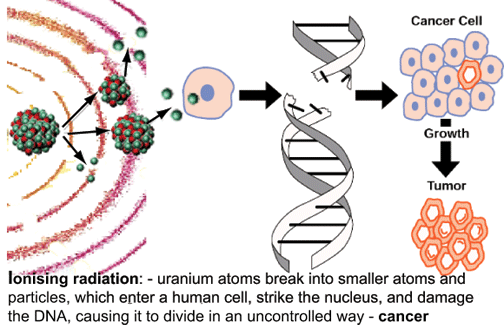
Huge study of nuclear workers in France, the United Kingdom, and the United States confirms low dose radiation as a cause of cancer.
What this study adds
- The results of an updated study of nuclear workers in France, the UK, and the US suggest a linear increase in the relative rate of cancer with increasing exposure to radiation
- Some evidence suggested a steeper slope for the dose-response association at lower doses than over the full dose range
- The risk per unit of radiation dose for solid cancer was larger in analyses restricted to the low dose range (0-100 mGy) and to workers hired in the more recent years of operations
Cancer mortality after low dose exposure to ionising radiation in workers in France, the United Kingdom, and the United States (INWORKS): cohort study
BMJ 2023; 382 doi: https://doi.org/10.1136/bmj-2022-074520 (Published 16 August 2023)Cite this as: BMJ 2023;382:e074520
David B Richardson, professor1, Klervi Leuraud, head of service2, Dominique Laurier, deputy director of health2, Michael Gillies, medical statistician3, Richard Haylock, senior research scientist3, Kaitlin Kelly-Reif, senior research scientist4, Stephen Bertke, research statistician4, Robert D Daniels, senior research scientist4, Isabelle Thierry-Chef, senior research scientist5, Monika Moissonnier, research assistant6, Ausrele Kesminiene, senior visiting scientist6, Mary K Schubauer-Berigan, programme head6
Abstract
Objective To evaluate the effect of protracted low dose, low dose rate exposure to ionising radiation on the risk of cancer.
Design Multinational cohort study.
Setting Cohorts of workers in the nuclear industry in France, the UK, and the US included in a major update to the International Nuclear Workers Study (INWORKS).
Participants 309 932 workers with individual monitoring data for external exposure to ionising radiation and a total follow-up of 10.7 million person years.
Main outcome measures Estimates of excess relative rate per gray (Gy) of radiation dose for mortality from cancer.
Results The study included 103 553 deaths, of which 28 089 were due to solid cancers. The estimated rate of mortality due to solid cancer increased with cumulative dose by 52% (90% confidence interval 27% to 77%) per Gy, lagged by 10 years. Restricting the analysis to the low cumulative dose range (0-100 mGy) approximately doubled the estimate of association (and increased the width of its confidence interval), as did restricting the analysis to workers hired in the more recent years of operations when estimates of occupational external penetrating radiation dose were recorded more accurately. Exclusion of deaths from lung cancer and pleural cancer had a modest effect on the estimated magnitude of association, providing indirect evidence that the association was not substantially confounded by smoking or occupational exposure to asbestos.
Conclusions This major update to INWORKS provides a direct estimate of the association between protracted low dose exposure to ionising radiation and solid cancer mortality based on some of the world’s most informative cohorts of radiation workers. The summary estimate of excess relative rate solid cancer mortality per Gy is larger than estimates currently informing radiation protection, and some evidence suggests a steeper slope for the dose-response association in the low dose range than over the full dose range. These results can help to strengthen radiation protection, especially for low dose exposures that are of primary interest in contemporary medical, occupational, and environmental settings.
Conclusions This major update to INWORKS provides a direct estimate of the association between protracted low dose exposure to ionising radiation and solid cancer mortality based on some of the world’s most informative cohorts of radiation workers. The summary estimate of excess relative rate solid cancer mortality per Gy is larger than estimates currently informing radiation protection, and some evidence suggests a steeper slope for the dose-response association in the low dose range than over the full dose range. These results can help to strengthen radiation protection, especially for low dose exposures that are of primary interest in contemporary medical, occupational, and environmental settings.
…………………………………………………………………………………………………………………………………………………………………………………………………………………………… Discussion
This study, which involved a major update to an international cohort mortality study of radiation dosimeter monitored workers, reports evidence of an increase in the excess relative rate of solid cancer mortality with increasing cumulative exposure to ionising radiation at the low dose rates typically encountered by French, UK, and US nuclear workers. The study provides evidence in support of a linear association between protracted low dose external exposure to ionising radiation and solid cancer mortality.
…………………………………………………
What is already known on this topic
- Ionising radiation is an established cause of cancer
- The primary quantitative basis for radiation protection standards comes from studies of people exposed to acute, high doses of ionising radiation
What this study adds
- The results of an updated study of nuclear workers in France, the UK, and the US suggest a linear increase in the relative rate of cancer with increasing exposure to radiation
- Some evidence suggested a steeper slope for the dose-response association at lower doses than over the full dose range
- The risk per unit of radiation dose for solid cancer was larger in analyses restricted to the low dose range (0-100 mGy) and to workers hired in the more recent years of operations
1 This month

of the week – Australians for War Powers Reform (AWPR)
To see nuclear-related stories in greater depth and intensity
 Antinuclear