NUCLEAR WASTE – PLANNING RESPONSIBLY FOR THE FUTURE
Dr. Margare Beavis . Medical Assiction for the Prevention of War, 2 Sept 23
MAPW welcomes the Federal Court decision in July to completely set aside approval of the proposed interim national radioactive waste facility at Kimba in South Australia.
We thank the Barngarla Traditional Owners who took this legal action. The Federal Court ruled that former Resources Minister Keith Pitt’s declaration of the Kimba site was affected by apprehended bias. We also acknowledge the work of the “No Radioactive Waste on Agricultural Land in Kimba or SA” group and so many others.
We welcome the decision by Resources Minster Madeleine King not to appeal the court ruling on the 10th of August.
In a shamefully delayed public reassurance, on the same day as the minister’s decision, ANSTO noted it will have sufficient storage capacity for their radioactive waste until a purpose-built facility is established, and that there is no threat to production and supply of nuclear medicines at the Lucas Heights reactor. Lucas Heights has the best facilities, experience and security to hold this waste until a permanent disposal facility is developed.
Now is the right time for a new more responsible approach
The Australian government should now embark on something we have never had: a rigorous, transparent, open to the public and experts, evidence-based, accountable process that comprehensively considers the production and management of radioactive waste in Australia now and in the future and establishes a comprehensive, long-term, best-practice national plan for radioactive waste management, including permanent disposal. Such a process will be required to gain community licence for a permanent national disposal site; considerable trust has to be rebuilt.
We must not repeat yet again the multiple failed attempts by federal ministers to impose a radioactive waste dump on a remote Aboriginal community. We should seek to minimise the future production of intermediate and high-level radioactive waste. We should avoid double-handling of waste, as was planned at Kimba. International experience shows that accidents and theft of radioactive materials occurs most often during transport. Intermediate Level Waste (ILW) and High Level Waste (HLW) present much greater challenges than low level waste (LLW). It is likely that disposal of ILW and any HLW will be most effectively, cost-effectively and securely managed in the same facility. Australia should not store or dispose of radioactive waste from other countries. ARPANSA is the body which should provide regulatory oversight for radioactive waste management in Australia.
We need to recognise the extremely long-term nature of highly toxic ILW. The vast majority of this waste is at Lucas Heights (3753 m3), with a very small volume in non-government sites (industry 3 m3, hospitals 1 m3 and none in research institutions). This waste has been safely stored for decades so there is time for responsible planning.
Future production of ILW at Lucas Heights
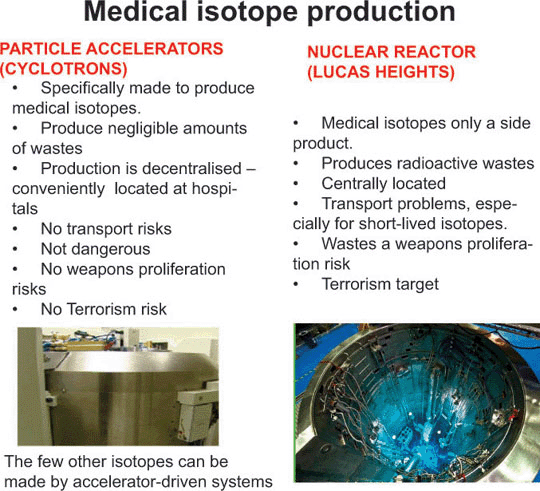
There are now much cleaner accelerator rather that nuclear reactor-based methods for producing nuclear isotopes that are medically and commercially approved internationally. These are the future of production of isotopes for medicine and science. Australia needs to adopt and deploy these methods. ANSTO’s current massive expansion to export reactor-produced nuclear isotopes is nowhere close to true cost recovery and will leave future generations with vastly more ILW than cleaner and cheaper accelerator-based production.
High level nuclear waste
Australia does not currently possess any HLW. However, Australia is to be burdened with a large amount of high level nuclear waste under the proposed acquisition of second-hand US nuclear-powered Virginia-class submarines and then submarines built under the AUKUS agreement. The proposed acquisition of nuclear-powered submarines is very high risk and problematic on many levels, but needs to be borne in mind in planning radioactive waste management.
Currently, all US and UK naval nuclear reactors utilise highly enriched uranium (HEU) fuel. It is therefore likely that proposed new SSN-AUKUS submarines will also be fuelled by HEU. This raises substantial proliferation concerns and risks and complicates implementation of nuclear safeguards. It also means that the naval reactor waste would still be HEU and still be weapons-usable. This adds not only a radiological dimension to the long-term danger of HLW but also a substantial security dimension, as this waste will need to be stored not only contained to minimise any risk to health and the environment over the geological timeframes of its toxicity, but will also need to be subject to military levels of security effectively indefinitely.
Fukushima Daiichi adds Insult to Injury for the Pacific’s Coral Reefs.
September 1, 2023 by Kevin Hester
As the El Niño builds to a terrifying crescendo, that won’t peak before April 2024, the Pacific’s Coral Reefs will become stressed, and a bleaching event will unfold as it did in the 2016 El Niño. What is our response? TEPCO and the Japanese government have decided to dump 1.3million tons of radioactive water into my beloved Pacific Ocean. After careful consideration the criminal cohort in Japan have decided to take the cheapest option and dump the radioactive sludge into the adjacent Pacific Ocean.
In the video above, I mentioned that Sea Surface Temperatures hit 38C off the coast of Florida. Here’s the evidence:
“Sea surface temperatures of more than 38C (100.4F) have been recorded off the coast of Florida – potentially setting a new world record.” Sea temperature off Florida reaches 38C- potentially a world record.
Almost every coral reef in the Northern Hemisphere is under stress.
Daily Global 5km Satellite Coral Bleaching Heat Stress Degree Heating Week
…………………………………………. We discussed the compounding consequences of the Pacific Ocean being irradiated thanks to TEPCO, the Japanese Government and Fukushima Daiichi. The very same people who triggered this disaster, by building a sea wall half the size their own analysis called for.
My Polynesian neighbours are furious. Niue and Tuvalu ‘concerned, dismayed, disappointed’ with Fukushima release
A bottomless pit of public money for the UK government’s nuclear vanity project
In response to Nuclear Minister, Andrew Bowie’s announcement of an
additional £341m government support for the Sizewell C project, TASC
deputy Chair, Pete Wilkinson, said “There seems to be a bottomless pit of
public money when it comes to funding Sizewell C, so besotted is the
government with this already redundant nuclear vanity project.
Not so for cash-strapped public sector workers though. The £341m recently announced,
taking taxpayer funding over an eye-watering £1.2bn, is apparently
designed to speed up preparations for construction of a plant which has yet
to receive dozens of licences and permits – not the least of which is the
Office for Nuclear Regulation’s permission to build on a site threatened by
climate change impacts – and is still subject to determination of an
outstanding legal challenge.
Put another way, it is public money to be
spent on the destruction of a coast which is designated as an area of
outstanding natural beauty for a project which may still not happen. It
also claims that it will ‘help to drive Putin further out of global
energy markets’, apparently missing the point that uranium supplies –
essential for the mythical nuclear renaissance and already at peak supply –
come largely from Russian-influenced countries, so out of the oil and gas
fire into the uranium frying pan.
As for the ‘rapid expansion of UK
nuclear energy’, the fantasy of 24GW from nuclear, should it ever be
attempted, will be cripplingly expensive and generate a mountain of waste
for which there is no universally acceptable disposal route, in short, a
recipe for future financial and environmental disaster rather than energy
security”
TASC 30th Aug 2023
The Fukushima Nuclear Disaster Still Casts a Shadow Over Japan


The “great powers” in the past had given island peoples repeated assurances that there would be no risk to health or environment from testing or dumping. Those peoples watch sadly now as Japan does likewise, engaging in intense propaganda efforts to line up regional states to endorse its wastewater dumping campaign.
The Jacobin, BYGAVAN MCCORMACK 2 Sept 23
Twelve years after the Fukushima disaster, Japanese authorities have started pumping wastewater from the plant into the ocean. They insist there’s no danger to public health, but Japan’s neighbors are up in arms about the controversial plan.
In 2011, Fukushima Daiichi Nuclear Power Plant, roughly 250 kilometers north of Tokyo, was hit by a magnitude 9.0 quake and tsunami. Three reactors stopped immediately, but the loss of electricity supply led over the following days and months to breakdown of the cooling system and to a series of hydrogen explosions and meltdowns of the cores of Reactors 1 to 3.
Prime Minster Kan Naoto feared for the worst. He faced the possible need to evacuate the whole Kanto region, including the Tokyo metropolitan area. Japan itself, its state and society, stood on the brink of catastrophe. That fate was only narrowly averted………………………
The Half-Life of Catastrophe
The flow of water to cool the debris polluted with various forms of radioactivity has had to be maintained to this day. Over the past twelve years, some 1.34 million tons of water have accumulated and is being held in a vast array of more than one thousand tanks along the coast of Fukushima prefecture.
Those tanks are now about 98 percent full, but the flow of contaminated water will have to be continued for at least the next three decades, or until such time as the site can be cleaned up. Nobody today can say with any confidence when that might be.
The polluted waters contain sixty-four radioactive elements, or radionuclides, the ones of greatest concern being carbon-14, iodine-131, caesium-137, strontium-90, cobalt-60, and hydrogen-3, also known as tritium. Some have a short life and might already have ended, but others take longer to decay, with a half-life of more than five thousand years in the case of carbon-14………………………………………………….
The Cheapest Option
In 2016, the Japanese government considered multiple methods of treating the water. Ruling out simple continuation of the status quo — more and more tanks along an already crowded seafront — there seemed to be three options: ocean discharge, atmospheric discharge, and underground burial. The estimated cost was 34.9 billion yen to release the problem materials as gas into the atmosphere, 24.3 billion to dig a deep hole and bury it, but just 3.4 billion to pour it out gradually into the sea…………………………………………………
Anxiety, alarm, and increasingly anger have been spreading, both within Japan itself (and especially in the Fukushima vicinity that bore the brunt of the initial 2011 disaster) and on the part of Japan’s Pacific neighbor states: China (including Hong Kong), Korea (both north and south), Russia, the Philippines, and the mini-states of the South Pacific, with eighteen countries and regions. In Japan, just 44 percent of people said they had “no worries” over the release, while about 75 percent said the government had not properly explained what it was doing.
The Japanese government had promised it would take no step without duly consulting all concerned parties. Yet it proceeded to ignore that principle both when it came to its own citizenry (especially those employed in its once-vibrant fishing industry) and in relation to its Pacific neighbors, whose shores are washed by the same Pacific waters.
Under Control”
True, the United Nations’ International Atomic Energy Agency (IAEA) has provided helpful cover for the Japanese government and the Tokyo Electric Power Company (TEPCO) by taking the view that the environmental impact of the discharge would be “negligible.” That judgment, however, is neither surprising nor decisive.
The IAEA, founded in 1957, is an organization devoted to the propagation of “safe” civil nuclear energy. Japan is its third-largest source of its funds, and the future of the global nuclear industry depends on there being seen to be a “final solution” to the problems posed by Fukushima………………
Though it has received little attention in media coverage of the problem, a small but significant body of scientific opinion has begun to express severe criticism of the IAEA for failing to apply its own fundamental principles. One paper accused the agency of being in some important respects “at least 10,000 times in error,” neglecting to give proper consideration to the nondumping solutions, and “grossly overstating well-known facts” in its “eagerness to assure the public that harm will be ‘negligible.’”
When Japan’s then prime minister Abe Shinzo told the world in September 2013 that Fukushima was ‘under control,’ he lied.
According to the paper’s author, Arjun Makhijani of the Institute for Energy and Environmental Research, a very different approach is required:
The IAEA should, starting with Japan, provide guidance to nuclear power-possessing countries to stop dumping so that the oceans that have been much abused in so many ways for so long can at least have a chance to begin recovering.
When Japan’s then prime minister Abe Shinzo told the world in September 2013 that Fukushima was “under control,” he lied. Until 2018, all attempts to locate the missing reactor cores, let alone to place them “under control,” had failed. Only in 2021 did it become possible at least to locate the debris in one reactor.
However, knowing the location is just the start. Now we know where it is, we are no closer to knowing how to deal with it. The recovery effort for two of the reactors will not commence until 2024.
If they succeed in locating the debris, estimated to be about 880 tons, it will then have to be extracted, gram by gram. Meanwhile, as of 2023, between four and five thousand workers are mobilized each day to perform various high-risk tasks in the disaster zone.
People of the Ocean
The “great powers” in the past had given island peoples repeated assurances that there would be no risk to health or environment from testing or dumping. Those peoples watch sadly now as Japan does likewise, engaging in intense propaganda efforts to line up regional states to endorse its wastewater dumping campaign.
Japan’s word today rings as hollow to Pacific Island peoples as that of the United States or France once did. Even the Japanese people themselves have “little trust in TEPCO or the Japanese Government” when it comes to Fukushima wastewater dumping, according to Suzuki Tatsujiro, former vice chairman of the Japan Atomic Energy Commission.
Japanese governments far into the future are to be bound now by the decisions taken by the current administration and by the process launched on August 24. The support given to Japan’s ocean dumping by prominent Western industrial countries strikes Pacific Islanders as hypocritical. Motarilavoa Hilda Lini is chief of the Turaga nation of Pentecost Island, Vanuatu, and an activist with the Nuclear Free and Independent Pacific (NFIP) movement. She put it this way:……………………………………………………………. more https://jacobin.com/2023/09/fukushima-nuclear-reactor-radioactive-waste-japan-ocean
1 This month
Chernobyl: The Lost Tapes – A good documentary on Chernobyl on SBS available On Demand for the next 3 weeks– https://www.sbs.com.au/ondemand/tv-program/chernobyl-the-lost-tapes/2352741955560
15 April – Zoom –Nuclear Power is Not the Solution
Apr 15, 2026 01:00 AM in Canberra, Melbourne, Sydney

Join the International Physicians for the Prevention of Nuclear War (IPPNW) on Tuesday, April 14th for a timely webinar exploring the risks associated with nuclear power and challenging the myth that it offers a simple, safe, carbon-free solution to the climate crisis

21 April Webinar: No Nuclear Weapons in Australia
Start: 2026-04-21 18:00:00 UTC Canberra, Melbourne, Sydney (GMT+10:00)
End: 2026-04-21 19:30:00 UTC Canberra, Melbourne, Sydney (GMT+10:00)
Event Type: Virtual
A virtual link will be communicated before the event.
Host Contact Info: australia@icanw.org

of the week – Australians for War Powers Reform (AWPR)
To see nuclear-related stories in greater depth and intensity
 Antinuclear