NUCLEAR WASTE – PLANNING RESPONSIBLY FOR THE FUTURE
Dr. Margare Beavis . Medical Assiction for the Prevention of War, 2 Sept 23
MAPW welcomes the Federal Court decision in July to completely set aside approval of the proposed interim national radioactive waste facility at Kimba in South Australia.
We thank the Barngarla Traditional Owners who took this legal action. The Federal Court ruled that former Resources Minister Keith Pitt’s declaration of the Kimba site was affected by apprehended bias. We also acknowledge the work of the “No Radioactive Waste on Agricultural Land in Kimba or SA” group and so many others.
We welcome the decision by Resources Minster Madeleine King not to appeal the court ruling on the 10th of August.
In a shamefully delayed public reassurance, on the same day as the minister’s decision, ANSTO noted it will have sufficient storage capacity for their radioactive waste until a purpose-built facility is established, and that there is no threat to production and supply of nuclear medicines at the Lucas Heights reactor. Lucas Heights has the best facilities, experience and security to hold this waste until a permanent disposal facility is developed.
Now is the right time for a new more responsible approach
The Australian government should now embark on something we have never had: a rigorous, transparent, open to the public and experts, evidence-based, accountable process that comprehensively considers the production and management of radioactive waste in Australia now and in the future and establishes a comprehensive, long-term, best-practice national plan for radioactive waste management, including permanent disposal. Such a process will be required to gain community licence for a permanent national disposal site; considerable trust has to be rebuilt.
We must not repeat yet again the multiple failed attempts by federal ministers to impose a radioactive waste dump on a remote Aboriginal community. We should seek to minimise the future production of intermediate and high-level radioactive waste. We should avoid double-handling of waste, as was planned at Kimba. International experience shows that accidents and theft of radioactive materials occurs most often during transport. Intermediate Level Waste (ILW) and High Level Waste (HLW) present much greater challenges than low level waste (LLW). It is likely that disposal of ILW and any HLW will be most effectively, cost-effectively and securely managed in the same facility. Australia should not store or dispose of radioactive waste from other countries. ARPANSA is the body which should provide regulatory oversight for radioactive waste management in Australia.
We need to recognise the extremely long-term nature of highly toxic ILW. The vast majority of this waste is at Lucas Heights (3753 m3), with a very small volume in non-government sites (industry 3 m3, hospitals 1 m3 and none in research institutions). This waste has been safely stored for decades so there is time for responsible planning.
Future production of ILW at Lucas Heights
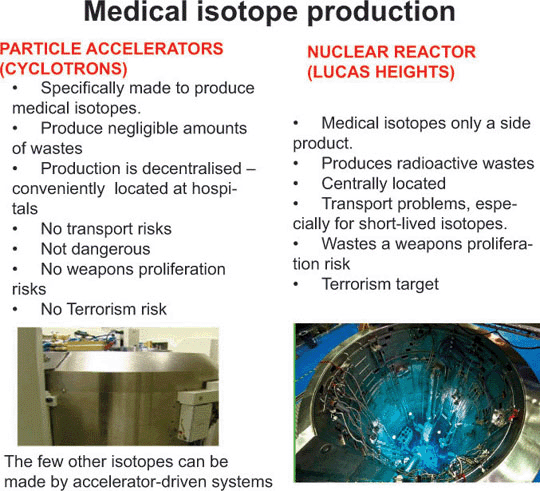
There are now much cleaner accelerator rather that nuclear reactor-based methods for producing nuclear isotopes that are medically and commercially approved internationally. These are the future of production of isotopes for medicine and science. Australia needs to adopt and deploy these methods. ANSTO’s current massive expansion to export reactor-produced nuclear isotopes is nowhere close to true cost recovery and will leave future generations with vastly more ILW than cleaner and cheaper accelerator-based production.
High level nuclear waste
Australia does not currently possess any HLW. However, Australia is to be burdened with a large amount of high level nuclear waste under the proposed acquisition of second-hand US nuclear-powered Virginia-class submarines and then submarines built under the AUKUS agreement. The proposed acquisition of nuclear-powered submarines is very high risk and problematic on many levels, but needs to be borne in mind in planning radioactive waste management.
Currently, all US and UK naval nuclear reactors utilise highly enriched uranium (HEU) fuel. It is therefore likely that proposed new SSN-AUKUS submarines will also be fuelled by HEU. This raises substantial proliferation concerns and risks and complicates implementation of nuclear safeguards. It also means that the naval reactor waste would still be HEU and still be weapons-usable. This adds not only a radiological dimension to the long-term danger of HLW but also a substantial security dimension, as this waste will need to be stored not only contained to minimise any risk to health and the environment over the geological timeframes of its toxicity, but will also need to be subject to military levels of security effectively indefinitely.
No comments yet.
1 This month
Chernobyl: The Lost Tapes – A good documentary on Chernobyl on SBS available On Demand for the next 3 weeks– https://www.sbs.com.au/ondemand/tv-program/chernobyl-the-lost-tapes/2352741955560
15 April – Zoom –Nuclear Power is Not the Solution
Apr 15, 2026 01:00 AM in Canberra, Melbourne, Sydney

Join the International Physicians for the Prevention of Nuclear War (IPPNW) on Tuesday, April 14th for a timely webinar exploring the risks associated with nuclear power and challenging the myth that it offers a simple, safe, carbon-free solution to the climate crisis

21 April Webinar: No Nuclear Weapons in Australia
Start: 2026-04-21 18:00:00 UTC Canberra, Melbourne, Sydney (GMT+10:00)
End: 2026-04-21 19:30:00 UTC Canberra, Melbourne, Sydney (GMT+10:00)
Event Type: Virtual
A virtual link will be communicated before the event.
Host Contact Info: australia@icanw.org

of the week – Australians for War Powers Reform (AWPR)
To see nuclear-related stories in greater depth and intensity
 Antinuclear
Leave a comment