Lifetime War Abolisher of 2023 award to David Bradbury
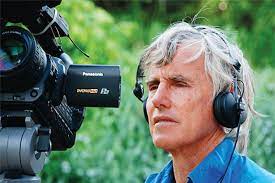
September 7, 2023, The AIM Network, By Sandi Keane
The cracks in Labor ranks over AUKUS won’t be going away despite Albanese staring down dissenters at Labor’s national conference. A pitched battle over the choice of submarine base is guaranteed – and now we discover that Albanese has suffered the mother of all brainsnaps: Australia has agreed to set up a weapons-grade nuclear waste dump. At the heart of the resistance to this militarism has been David Bradbury’s documentary film The Road to War (2013).
Last week, Australia’s legendary political filmmaker, David Bradbury, achieved another media milestone with this much-lauded anti-AUKUS documentary, The Road to War. Adding to the list of International and Australian film awards including two Academy-award nominations (Frontline (1979) and Chile Hasta Quando? (1985), his latest documentary won the World BEYOND War’s Individual ‘Lifetime War Abolisher Award’ – named for David Hartsough, who co-founded World BEYOND War in Virginia, USA in 2014.
The creator of 26 documentary films, Bradbury advances our understanding of war, peace, international relations and peace activism. His films have been broadcast around the world on the BBC, PBS, ZDF (Germany), and TF1-France, as well as ABC, SBS and commercial television networks in Australia……………………………………………..
Bradbury shoots his own footage, traveling widely, and seeking out people with uncomfortable truths to tell – sometimes at great risk. Bradbury has filmed in Iran during the final days of the Shah, in Nicaragua during the CIA-Contra war, and in El Salvador during the days of death squads during the early 1980s. His film on Pinochet’s Chile, Chile Hasta Quando? (1985) was nominated for an Academy Award. He has filmed independence struggles in East Timor and West Papua, and in India, China, and Nepal.
In The Road to War, concern is raised among the Australian experts interviewed by Bradbury about Australia’s AUKUS commitment of hundreds of billions of dollars for new weaponry, nuclear propelled submarines and stealth bombers – to protect us against our biggest trading partner – China. Yes, China. The film shows why it is not in Australia’s, or the world’s interests to be dragged into another US-led war and brings into sharp focus that Australia is being set up as USA’s proxy:
“Basing US B52 and stealth bombers in Australia is all part of preparing Australia to be the protagonist on behalf of the United States in a war against China. If the US can’t get Taiwan to be the proxy or its patsy, it will be Australia,” warns former Australian ambassador to China and Iran, John Lander, in Bradbury’s film.
We all appreciate the Labor Government was still on its toddler legs when it signed the AUKUS agreement and had only 24 hours to decide – or be wedged on Defence by the Coalition in the 2019 federal election.
But the cracks in Labor ranks won’t be going away despite Albanese staring down dissenters at Labor’s national conference and enshrining the tripartite security pact in the party’s policy platform. A pitched battle over the choice of submarine base is guaranteed – and now we discover that Albanese has suffered the mother of all brainsnaps: Australia has agreed to set up a weapons-grade nuclear waste dump. According to the Fact Sheet: Trilateral Australia-UK-US Partnership on Nuclear-Powered Submarines:
“… as part of this commitment to nuclear stewardship, Australia has committed to managing all radioactive waste generated through its nuclear-powered submarine program, including spent nuclear fuel, in Australia.”
Who knew about that? Hats off to Crikey for disclosing the secret no-one is talking about. Where was the spirited public debate about which port such terrorist “bait” will be shipped to, how it would be transported? By truck? Train? Where to? Given the Coalition has had a nuclear waste dump on the back burner for decades, Maralinga is the likely bet.

The lack of debate now resembles the barely reported signing of the Global Nuclear Energy Partnership (GNEP) by Prime Minister John Howard on 5 September 2007. Had the Coalition won the 2007 election on 24 November, Australia was on track to become a global nuclear waste dump. Did anyone know about it then? Like now, it went under the media radar. MSM were MIA.
Back then, Howard had control of both houses. All the ducks were in a row. The Commonwealth Radioactive Waste Management Bill 2005 had passed effectively transferring power to the Minister to nominate nuclear waste dump sites. The ANSTO Bill passed around the same time giving ANSTO the power to accept waste generated outside Australia.
Maralinga in South Australia seemed to tick all the boxes. But they forgot that nuclear waste produces hydrogen when it eventually breaks down and Maralinga is sited right on top of the Great Artesian Basin.
John Large, whose company, Large & Associates handled the salvage of the stricken Russian U-sub, Kursk, told Julie Macken in an interview in New Matilda on 15 November 2006 that when the waste breaks down, it produces hydrogen and “there is simply no way, over a 100,000-year time scale, to stop the fuel leaking out.”
Large was shocked to hear that Australia wanted to go down this path. Question is: “are we about to do just that?”……………………………………………………..
The 2023 War Abolisher Awards and the video of David Bradbury’s acceptance speech can be accessed on the website at War Abolisher Awards.
War Abolisher awardees are honoured for their body of work directly supporting one or more of the three segments of World BEYOND War’s strategy for reducing and eliminating war as outlined in the book A Global Security System, An Alternative to War. They are: Demilitarizing Security, Managing Conflict Without Violence, and Building a Culture of Peace.
You can view a clip from The Road to War below:
Bradbury’s films can be viewed at Frontline Films.
For further information, email david@frontlinefilms.com.au
Editor’s Note: The next showing of Bradbury’s film is scheduled for 21 September at ANU Film Club, Canberra. A variation of this article was published in Pearls and Irritations on 3 September, 2023. https://theaimn.com/lifetime-war-abolisher-of-2023-award-to-david-bradbury/
U.S, Senators raise concerns over US missing nuclear submarine target

The Hill, BY FILIP TIMOTIJA – 09/06/23
Senators on the Foreign Relations Committee raised concerns that the U.S. fell short of its nuclear submarine target during a Wednesday morning hearing on a trilateral security partnership.
Australia, the United Kingdom and the U.S. struck the defense deal AUKUS in September 2021 and announced an arrangement for Australia to acquire “conventionally-armed, nuclear-powered” submarine capability through the partnership in March 2023. As part of that agreement, Australia agreed to invest approximately $3 billion in the first four years of the agreement into U.S. shipbuilding.
The agreement is intended to help Australia develop nuclear-powered submarines while enabling allies to safely share the relevant technology with each other.
During the hearing, lawmakers questioned whether the U.S. had the bandwidth to sell nuclear submarines to Australia. The U.S. Navy currently has 49 fast-attack submarines, which puts it 17 submarines short of the 66-vessel goal the military branch previously told Congress it needed to reach in order to properly defend the U.S.
“We are grateful that the Australians want to invest $3 billion,” Sen. Pete Ricketts (R-Neb.) said. “What are we gonna have to invest to get to 66 submarines?”……………………………………………………. https://thehill.com/policy/defense/4190727-senators-raise-concerns-over-us-missing-nuclear-submarine-target/
Taiwan’s ‘clear and present’ spent nuclear fuel danger

Above-ground storage pools at Chinshan and Kuosheng nuclear power plants would be vulnerable to missiles in a Chinese attack
ASIA TIMES, By JORSHAN CHOI, SEPTEMBER 6, 2023
The war in Ukraine has drawn concerns that there is potential for a conflict to happen across the Taiwan Strait.
In Ukraine, the attack and occupation of nuclear facilities, including the Zaporizhzhia nuclear power plant by the Russian military, initiated a dangerous situation for the safe and secure operation of civilian nuclear power plants, including the spent fuel facilities. It also hindered the International Atomic Energy Agency’s effort to ensure the proper accounting and control of nuclear materials in these facilities.
If a military conflict were to happen across the Taiwan Strait, there would be similar concerns. There are six operating or shut-down nuclear reactors in Taiwan: two pressurized water reactors and four boiling water reactors in Taiwan. Of the six, the four BWRs situated on the northern tip of Taiwan pose the biggest safety, security, and safeguards concerns.
Taiwan’s first nuclear power plant, Chinshan 1 & 2, consisted of BWRs similar to Fukushima Daiichi 1, which was involved in the 2011 accident in Japan, with spent fuel pools that are high up above ground.
Taiwan’s second plant, Kuosheng 1 & 2, featured a later BWR design, with spent fuel pools at a lower elevation. The two pressurized water reactors have spent fuel pools at ground level.
When Chinshan 1 & 2 went offline in 2018-2019, more than 6,000 spent fuel assemblies were stored in the two elevated spent fuel pools. At Kuosheng 1 & 2, the capacities of both ground-level spent fuel pools have become insufficient to support reactor operation.
To free up space in the pools for newly discharged spent fuel, TAIPOWER, the utility company, moved those 15-year-old spent fuel assemblies for storage in the upper (refueling) pools, which are well above the ground level.
According to the US National Academies of Sciences, the vulnerability of a spent fuel pool depends in part on its location with respect to ground level as well as its construction. In a potential military conflict across the Taiwan Strait, the spent fuel pools built above ground in Chinshan and Kuosheng may thus be susceptible to accidental attacks from misfired or stray missiles.
Significantly, to protest the Pelosi visit to Taiwan in August 2022, two missiles fired by the Chinese military landed in water about 50 km north of the Chinshan plant.
The Fukushima accident highlighted the vulnerability of elevated spent fuel storage. The explosion that occurred in the reactor building of Fukushima Daiichi 4 destroyed the roof and most of the walls on the fourth and fifth (refueling) floors……………………………………………………………………..
A sense of urgency
Spent fuel has accumulated in the Chinshan and Kuosheng plants over the 40 years of their operating lives. Due to objections from the local public over moving the spent fuel to dry cask storage and the lack of suitable storage or disposal sites on the geographically limited island, spent fuel discharged from Chinshan 1 & 2 reactors has remained in the refueling-turned-into-storing pools adjacent to the reactor wells, high above ground……………………………………………..
The war in Ukraine and rockets/missiles landing in or around the Zaporizhzhia plant (with all six pressurized water reactors’ spent fuel pools situated at ground level) should have given TAIPOWER another warning that spent fuel in high-elevation pools should be moved to ground-level pools or dry cask storage.
TAIPOWER should have a sense of urgency for this “clear and present” danger in Taiwan, especially given that it has the technology and resources to accomplish the task. Taiwan’s internal politics and objection of the local public are the primary causes for the procrastination.
The longer-term problem with moving the spent fuel off the island centers around something called “consent rights,” which is complicated given US involvement in the installation of the nuclear power plants in Taiwan…………………………………………………………………….
The US rights over Taiwan’s nuclear activities are so extensive that Washington instructed the German government in the 1980s that any nuclear items supplied to Taiwan by a German exporter would be subject to US “control rights,” which included US “fallback safeguards rights” if deemed necessary.
Nowhere else does the United States have as much leverage over a foreign nuclear program. Yet whenever Taiwan has requested the United States to take back the spent fuel, Washington has declined…………………………………………….
Removing the spent fuel from Taiwan would eliminate its “clear and present” spent fuel danger, while fulfilling the goal of ensuring a “nuclear-free” Taiwan. This should be a priority. https://asiatimes.com/2023/09/taiwans-clear-and-present-spent-nuclear-fuel-danger/
South Korea: Mass protests continue against Fukushima nuclear waste dumping

South Korea Peter Boyle, Denise Yoon , September 6, 2023
The biggest of the global protests against Japan’s dumping of radioactive wastewater from the Fukushima nuclear power plant into the Pacific Ocean — which began on August 25 — have been in Seoul, the capital of South Korea. Green Left‘s Peter Boyle spoke to Denise Yoon, a key organiser of the movement.
Since August 26, we have had two big national rallies in Seoul and around 50,000 people have gathered at each.
About half of the demonstrators are members of four opposition parties: the Democratic Party, the Justice Party, the Progressive Party and the Basic Income Party. The rest are from religious and civil society groups, including environmental and consumer organisations, parents organisations, justice and democracy activists and human right defenders.
According to a public poll by the Seoul city government in August, around 80% of citizens oppose Japan’s ocean dumping of nuclear wastewater and condemn the Korean government’s support of Japan without appropriate regard for Korean people’s safety from ocean pollution.
People think the Korean government has failed to explain scientifically, environmentally and economically why they claim that the Fukushima wastewater is not a big deal. They also distrust the International Atomic Energy Authority’s report because its conclusion [supporting Japan’s dumping] is based on deficient data and evidence.
Due to the Korean government’s very active promotion of Japan’s unilateral decision to commence dumping, many Korean people are getting very angry at the government. Polls show that President Yoon Suk Yeol now has a disapproval rate of 58% and this is influenced not only by the Fukushima issue, but also by government incompetence on other issues.
This is why we were able to hold these two big rallies.
We will organise a national rally every Saturday in September and expect more people will join the protest.
We will hold the 4th National Candlelight Rally in Gwanghwamun Plaza and we expect more than 50,000 people to join in for speeches, bands and cultural performances. Global solidarity messages will be shared. This rally will call on Japan to stop the dumping and it will demand that the Korean government prohibit the import of marine products from Japan.
How a nuclear disaster spurred Fukushima to become a renewables leader

Japan Times, BY FRANCESCO BASSETTI, MINAMISOMA, FUKUSHIMA PREF. – 5 Sept 23
As you reach the coast on Fukushima Prefectural Route 74, which runs between the towns of Minamisoma and Soma, scenes typical of the Japanese countryside — rice paddies and hills blanketed by lush green forests — undergo a swift transformation.
Now, expanses of metal, glass and silicon shimmer in the midday sun, stretching out to a horizon dotted with four white wind turbines, blades humming as they turn in the summer breeze.
Following the 2011 triple disaster — and the subsequent cratering of support for nuclear energy — Fukushima Prefecture has positioned itself at the forefront of Japan’s low-carbon transition.
Few projects better exemplify that than the Minamisoma Mano-Migita-Ebi solar power plant, which was the largest in Fukushima Prefecture until 2019 and is made up of 220,000 solar panels that, if laid end to end, would cover 350 kilometers — roughly the distance between Nagoya and Tokyo. The panels can generate up to 60 megawatts of electricity, enough to power 20,000 households.
Because of projects like the Minamisoma facility, Fukushima Prefecture has claimed the crown as the Tohoku region’s leader in cumulative solar power generation since 2013, and this is a direct consequence of the reconstruction policies that were put in place after the March 2011 earthquake, tsunami and nuclear disaster.
But today, grid connection issues, opposition by incumbent energy companies and a return to nuclear energy in some parts of the country are slowing progress in Fukushima and beyond. In 2022 almost 80% of the increase in total electricity generation in Japan came via fossil fuels — a worrying signal that, although renewable energy generation continues to increase, it is not keeping up with the pace of electrification.
Renewable recovery
Particularly in the coastal areas of Fukushima Prefecture, solar panels have a strong presence: They cover fields, occupy clearings that have been carved out of forests and hillsides, and rest on the rooftops of houses. Cars and trucks brandishing the names of the companies that operate them are a regular feature as they carry equipment and workers along well-kept roads…………………………………………………………………………………………………………………….
“Recovery plans have always been tied to developing a society that is no longer dependent on nuclear power,” says Masaki Moroi, deputy director of Fukushima Prefecture’s Energy Division.
By the end of 2021, Fukushima Prefecture had covered 47% of its energy demand with renewables, compared with just 23.7% in 2011. That’s a particularly impressive feat when compared with Japan’s national average of just 22.7% in 2022.
“Fukushima took the lead after 2011 because of its direct experience with disaster and clear commitment by policymakers to quit nuclear energy and back renewables,” says Hikaru Hiranuma of the Tokyo Foundation for Policy Research.
According to Hiranuma, the single most influential policy in the initial boom in renewable energy was the introduction of a feed-in-tariff program by the Ministry of Economy, Trade and Industry in July 2012………………………………………………………………………………………..
Beyond Minamisoma, Fukushima Prefecture implemented policies promoting renewable energy projects in areas affected by the tsunami and nuclear fallout where there were high rates of abandoned land………………………………………………………………………………………………………………………. more https://www.japantimes.co.jp/environment/2023/09/05/fukushima-renewable-energy-leader/
1 This month

of the week – Australians for War Powers Reform (AWPR)
To see nuclear-related stories in greater depth and intensity
 Antinuclear