Educating the US Imperium: Australia’s Mission for Assange
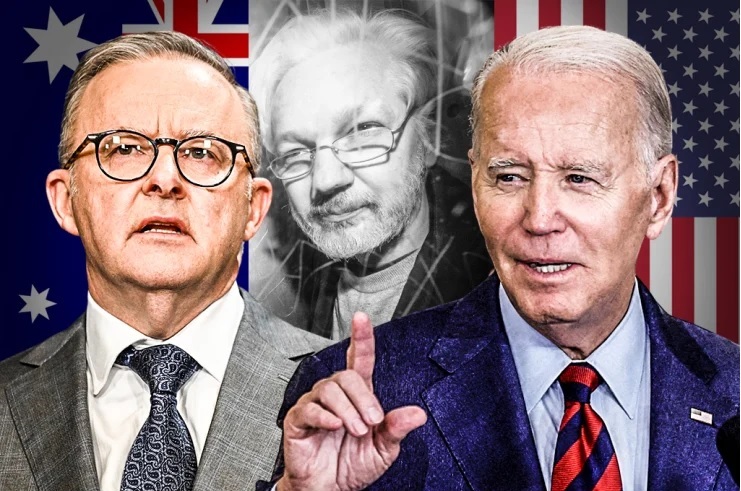
Then there is the issue of whether the delegation’s urgings will have any purchase beyond being a performing flea act. US State Department officials remain glacial in their dismissal of Canberra’s “enough is enough” concerns and defer matters to the US Department of Justice. The unimpressive ambassador Kennedy has been the perfect barometer of this sentiment: host Australian MPs for lunch, keep up appearances, listen politely and ignore their views. Such is the relationship between lord and vassal.
September 6, 2023 Dr Binoy Kampmark https://theaimn.com/educating-the-us-imperium-australias-mission-for-assange/
An odder political bunch you could not find, at least when it comes to pursuing a single goal. Given that the goal is the release of WikiLeaks publisher Julian Assange makes it all the more striking. Six Australian parliamentarians of various stripes will be heading to Washington ahead of Prime Minister Anthony Albanese’s October visit to test the ground of empire, maybe even plant a few seeds of doubt, about why the indictment against their countryman should be dropped.
That indictment, an outrageous, piffling shambles of a document comprising 18 charges, 17 based on that nasty, brutish statute, the Espionage Act of 1917, risks earning Assange a prison sentence in the order of 175 years. But in any instrumental sense, his incarceration remains ongoing, with the United Kingdom currently acting as prison warden and custodian.
In the politics of his homeland, the icy polarisation that came with Assange’s initial publishing exploits (former Australian Prime Minister Julia Gillard was convinced Cablegate was a crime) has shifted to something almost amounting to a consensus. The cynic will say that votes are in the offing, if not at risk if nothing is done; the principled will argue that enlightenment has finally dawned.
The Australian Prime Minister Anthony Albanese and the Opposition leader, Peter Dutton, agree on almost nothing else but the fact that Assange has suffered enough. In Parliament, the tireless work of the independent MP from Tasmania, Andrew Wilkie, has bloomed into the garrulous Bring Julian Assange Home Parliamentary Group.
The Washington mission, which will arrive in the US on September 20, comprises former deputy prime minister Barnaby Joyce, the scattergun former Nationals leader, Labor MP Tony Zappia, Greens Senators David Shoebridge and Peter Whish-Wilson, Liberal Senator Alex Antic and the competent independent member for Kooyong, Dr. Monique Ryan.
What will be said will hardly be pleasing to the ears of the Washington establishment. Senator Shoebridge, for instance, promises to make the case that Assange was merely telling the truth about US war crimes, hardly music for guardians from Freedom’s Land. Sounding like an impassioned pastor, he will tell his unsuspecting flock “the truth about this prosecution.”
Joyce, however, tried to pour some oil over troubled waters by insisting on ABC News that the delegates were not there “to pick a fight”. He did not necessarily want to give the impression that his views aligned with WikiLeaks. The principles, soundly, were that Assange had not committed any of the alleged offences as a US national, let alone in the United States itself. The material Assange had published had not been appropriated by himself. He had received it from Chelsea Manning, a US military source, “who is now walking the streets as a free person.”
To pursue the indictment to its logical conclusion would mean that Assange, or any journalist for that matter, could be extradited to the US from, say, Australia, for the activities in question. This extraterritorial eccentricity set a “very, very bad precedent”, and it was a “duty” to defend his status as an Australian citizen.
The Nationals MP also noted, rather saliently, that Beijing was currently interested in pursuing four Chinese nationals on Australian soil for a number of alleged offences that did not, necessarily, have a nexus to Chinese territory. Should Australia now extradite them as a matter of course? (The same observation has been made by an adviser to the Assange campaign, Greg Barns SC: “You’ve got China using the Assange case as a sort of moral equivalence argument.”)
Broadly speaking, the delegation is hoping to draw attention to the nature of publishing itself and the risks posed to free speech and the journalistic craft by the indictment. But there is another catch. In Shoebridge’s words, the delegates will also remind US lawmakers “that one of their closest allies sees the treatment of Julian Assange as a key indicator on the health of the bilateral relationship.”
Ryan expressed much the same view. “Australia is an excellent friend of the US and it’s not unreasonable to request to ask the US to cease this extradition attempt on Mr Assange.” The WikiLeaks founder was “a “journalist; he should not be prosecuted for crimes against journalism.”
While these efforts are laudable, they are also revealing. The first is that the clout of the Albanese government in Washington, on this point, has been minimal. Meekly, the government awaits the legal process in the UK to exhaust itself, possibly leading to a plea deal with all its attendant dangers to Assange. (The recent floating of that idea, based on remarks made by US ambassador to Australia Caroline Kennedy, was scotched by former British diplomat and Assange confidante Craig Murray in an interview with WBAI radio last week.) Best, then, to leave it to a diverse set of politicians representative of the “Australian voice” to convey the message across the pond.
Then there is the issue of whether the delegation’s urgings will have any purchase beyond being a performing flea act. US State Department officials remain glacial in their dismissal of Canberra’s “enough is enough” concerns and defer matters to the US Department of Justice. The unimpressive ambassador Kennedy has been the perfect barometer of this sentiment: host Australian MPs for lunch, keep up appearances, listen politely and ignore their views. Such is the relationship between lord and vassal.
In Washington, the perspective remains ossified, retributive and wrongheaded. Assange is myth and monster, the hacker who pilfered state secrets and compromised US national security; the man who revealed confidential sources and endangered informants; a propagandist who harmed the sweet sombre warriors of freedom by encouraging a new army of whistleblowers and transparency advocates.
Whatever the outcome from this trip, some stirring of hope is at least possible. The recent political movement down under shows that Assange is increasingly being seen less in the narrow context of personality than high principle. Forget whether you know the man, his habits, his inclinations. Remember him as the principle, or even a set of principles: the publisher who, with audacity, exposed the crimes and misdeeds of power; that, in doing so, he is now being hounded and persecuted in a way that will chill global efforts to do something similar.
Biden’s horse-trading on nuclear technology and fuels is an unprecedented proliferation risk

he is funding not just prudent nuclear research, but also their boondoggles to expand use of plutonium and HEU fuel. To ensure US military support for the trilateral Australia-United Kingdom-United States (AUKUS) deal, he is acquiescing to Navy insistence on using weapons-grade uranium reactor fuel, even in exported submarines. However, recent spikes in demand for nuclear weapons, among friends and foes alike, suggests this is a dangerously short-sighted approach.
Bulletin, By Alan J. Kuperman | September 6, 2023
News media in the United States rarely report on nuclear proliferation until it reaches the crisis stage—as in North Korea and Iran. By then, however, it is typically too late to stop the spread of nuclear weapons. Effective nonproliferation must begin much earlier, not only by suppressing demand for nuclear weapons but also by restricting supplies of the fissionable materials necessary to build them in the first place. Sadly, the Biden administration is bungling this latter responsibility.
To acquire the bomb, nuclear aspirants must first obtain its key ingredient: plutonium or highly enriched uranium (HEU). So, as demand for nuclear weapons grows in Asia, the Middle East, and Europe, one would expect the US government to do everything it can to clamp down on supply. Instead, President Joe Biden is actually doing just the opposite, by promoting commerce in weapon-usable nuclear materials as a bargaining chip for other issues. Unless the president reverses course, one of his greatest foreign policy legacies could wind up being global nuclear proliferation.
The spike in demand for nuclear weapons has been driven by several key events over the past two decades………………………………………………………………………………………………………….
Considering this growing demand for nuclear weapons, an essential policy to avert proliferation is to block the supply of the necessary fissionable materials. Regrettably, the Biden administration instead has taken four steps that would foster proliferation of both plutonium and weapons-grade uranium.
First, President Biden is funding US companies like Oklo that want to reprocess used reactor fuel—how plutonium is obtained in the first place, by separating it from nuclear waste—and then deploy its fuel recycling technology “on a global scale.” This would reverse nearly half a century of bipartisan US policy opposing such activity at home and abroad, which has succeeded at restricting commercial reprocessing to only two countries, France and Russia, both of which already have nuclear weapons.

Second, the Biden administration is providing a $2 billion subsidy to Bill Gates (currently the fifth richest person in the world) to develop exotic “fast” nuclear reactors, which originally were designed explicitly to increase supplies of plutonium. Gates’s nuclear energy startup Terrapower promises not to use them this way, but the reactors are so expensive that countries importing them could cite economics to justify turning them into plutonium factories.

Third, the president is pursuing construction of a civilian US research reactor using weapons-grade HEU fuel for the first time since the 1960s, thereby threatening to undermine decades of progress in delegitimizing this dangerous fuel globally.

Fourth, the White House has agreed to export tons of weapons-grade uranium—an amount sufficient for hundreds of nuclear bombs—to fuel Australia’s forthcoming SSN-AUKUS nuclear-powered submarines. This announcement already has prompted at least one other country, Iran, to suggest that it too may produce HEU for naval fuel—a well-known back door to nuclear weapons. The good news is that Australia’s submarines likely could be redesigned to use low-enriched uranium that is unsuitable for nuclear weapons. Unfortunately, the Biden administration recently canceled funding for the eight-year-old program to develop such proliferation-resistant naval fuel.
Why is President Biden doing all this? The US president seems to think he can prevent proliferation solely by quashing demand—using carrots and sticks to persuade countries not to seek the bomb—despite evidence to the contrary. So, he feels free to relax supply restrictions in political horse-trades. For example, to persuade legislators to support solar and wind power, he is funding not just prudent nuclear research, but also their boondoggles to expand use of plutonium and HEU fuel. To ensure US military support for the trilateral Australia-United Kingdom-United States (AUKUS) deal, he is acquiescing to Navy insistence on using weapons-grade uranium reactor fuel, even in exported submarines. However, recent spikes in demand for nuclear weapons, among friends and foes alike, suggests this is a dangerously short-sighted approach.
Of course, the United States should continue trying to reduce demand for proliferation, including by avoiding attacking any more countries that have halted their nuclear weapons programs like Iraq and Libya. But if President Biden imagines that demand-suppression is a silver bullet that gives him license to expand civilian commerce in nuclear weapons-usable materials, he is deeply mistaken. Unless Biden changes course, his promotion of such dangerous nuclear technologies will enable supply to meet demand—in the market of mass destruction. https://thebulletin.org/2023/09/bidens-horse-trading-on-nuclear-technology-and-fuels-is-an-unprecedented-proliferation-risk/
Act, or die: the climate and nuclear juggernaut

perhaps the most lethal human branch has become the media, which with few exceptions turned into a global propaganda machine skilful in distorting facts, promoting conflicts, manufacturing untruths, concealing avenues to peace and promoting wars in the tradition of Goebbels.
perhaps the most lethal human branch has become the media, which with few exceptions turned into a global propaganda machine skilful in distorting facts, promoting conflicts, manufacturing untruths, concealing avenues to peace and promoting wars in the tradition of Goebbels.
By Andrew GliksonSep 7, 2023 https://johnmenadue.com/act-or-die-the-climate-nuclear-juggernaut/
Under the guise of lies and cover-ups, the global powers to be have set the stage for the unthinkable, a world-wide hair-trigger human suicide system taking much of nature with it. With the exception abstract ideas or experimental attempts no actual steps are being taken to slow down, or even reverse, the inexorable rise of atmospheric greenhouse gases, now rising into Miocene-like levels of >400 parts per million CO2 within the century, the fastest rise rate identified in the geological record.
Saturating the atmosphere with toxic gases, coating the land with carbon and plastic particles and acidifying the oceans amounts to the poisoning of the biosphere.
Nor are steps undertaken to try and dismantle the global doomsday fleet of more than 12,700 nuclear warheads, where space and the oceans have become nuclear playgrounds, enough to render large parts of the Earth uninhabitable.
The criminal insanity of political, military, strategic, economic and scientific leaders, matched only by the naive blindness of billions of people, is consistent with what has been referred to as the ‘Fermi Paradox’ ─ the apparent absence of signals from technological civilisations in the Milky Way, interpreted in terms of a self-destruction of such civilisations.
Even at this stage the litany of denial and betrayal never stops. Political leaders who have vowed to adhere to the science shift to promote the mining and export fossil fuels, as if greenhouse gases do not disperse in the atmosphere world-wide, or they adopt nuclear weaponry as soon as they reach power. A suicidal element in human nature?
While the multitudes are fixated on domestic issues and regional troubles, including genocidal conflicts and in corners of the world (Ukraine, Chechnya, Korea, Vietnam, Cambodia, Laos, Mein-Mar, Iraq, Syria, Afghanistan, Yemen, and other), the price of maintaining an Orwellian ‘peace and stability ’, including ethnic cleansing, drowning refugees, economic hardships, misanthropic violence, football games, the tour de France, tennis rackets, relatively few are concerned with the deadly games of empire. Even symbolic gestures toward original people, like the “Voice” are being objected to.
As in the history of Athens and Sparta, the stronger force is more inclined to start a war. Like schoolboys seeking association with bully alpha males so do weaker nations look for the protection of an empire, which end up using them as cannon fodder. It is more difficult to understand why, given the scientific and empirical evidence of global heating, intelligent people are prepared to sacrifice the future of their off-springs generations to the $multi-trillion fossil fuel industry and their advocates in governments. It would appear that, once representatives acquire real or apparent power, they leave conscience behind, adopting the Faustian bargain.
“Where does responsibility lie? Where humans are caught up in the anthropogenic genome, not enough “good” angels exist. Where competition for food, shelter and reproduction are inherent, ethics, compassion and empathy may not be easy to find. Humanity may be more readily detected among small tribes than in large civilisations. A young child born in a bubble has few or no impressions impinging on its brain to respond to. By contrast children exposed to obscene violence and lies paraded on fluorescent screens are more likely to grow into distorted brain-washed multitudes.
But perhaps the most lethal human branch has become the media, which with few exceptions turned into a global propaganda machine skilful in distorting facts, promoting conflicts, manufacturing untruths, concealing avenues to peace and promoting wars in the tradition of Goebbels.
Surprisingly, the only significant resistance to the genocidal behaviour of alpha male-dominated groups has arisen from the not-yet spoiled minds of children, led by the young Greta Thunberg.
Nuclear Energy is Not a Viable Option

Nuclear Waste Dump Threatens Kichi Sìbì (Ottawa River), Indigenous Climate Action, August 23
“……………………………………………..According to scenarios from the World Nuclear Association and the OECD Nuclear Energy Agency, doubling the capacity of nuclear power worldwide in 2050 would only decrease greenhouse gas (GHG) emissions by around 4%, yet would require 37 new large nuclear reactors to the grid every year from now until 2050. In other words, nuclear energy delivers too little energy to matter.
Nuclear power plants are too dangerous and leave communities vulnerable. Power plants require some of the most complex set of resources to be ready at all times—this is not guaranteed with the growing climate crisis and resulting extreme weather events that will affect operations. Additionally, nuclear energy is too expensive to be sustainable. It costs on average more than double the cost of other energy alternatives like solar and wind—and those costs continue to increase. The large amounts of waste that is produced by the nuclear fuel cycle is highly radioactive, and will remain so for several thousand years—and yet no government has ever been able to find a way to safely manage it.
…………………………………………………………………………………………………………………………………………………………………………………………………………………….. more https://www.indigenousclimateaction.com/entries/nuclear-dump-threatens-kichi-sibi
World meteorologists point to ‘vicious cycle’ of heatwaves and air pollution.
Heatwaves across the world are worsening air quality and pollution,
scientists have said. The World Meteorological Organization (WMO) has said
extreme temperatures are not the only hazard from heatwaves but that they
also cause pollution-related health problems. In their annual air quality
and climate bulletin, the meteorologists have highlighted a “vicious
cycle” of climate breakdown and air pollution.
They have shown that
heatwaves sparked wildfires in the north-western US and heatwaves
accompanied by desert dust intrusions across Europe, which both caused
dangerous air quality in 2022. The hot temperatures in Europe, which in
2022 were record-breaking, led to higher levels of particulate matter in
the air, the bulletin says. During the second half of August 2022, there
was also an unusually high intrusion of desert dust over the Mediterranean
and Europe.
Guardian 6th Sept 2023
1 This month

of the week – Australians for War Powers Reform (AWPR)
To see nuclear-related stories in greater depth and intensity
 Antinuclear