The push for nuclear energy in Australia is driven by delay and denial, not evidence.
Adam Morton 21 Sept 23 https://www.theguardian.com/commentisfree/2023/sep/21/nuclear-energy-australia-smokescreen-climate-denialism-coalition
Unsubstantiated claims of nuclear energy’s worth distracts from the urgency to act now on climate crisis
he vague, ideological push for nuclear energy backed by the Coalition and News Corp and given legitimacy this week on the ABC’s Q+A should be treated as what it is: the latest step in a decades-long campaign of delay and denial on the climate crisis.
Nuclear energy likely has a role to play in the global shift to zero-emissions energy in places that already use it or that have few other options. As with other technology, its role may grow or recede over time as the world moves. This stuff is going to change.
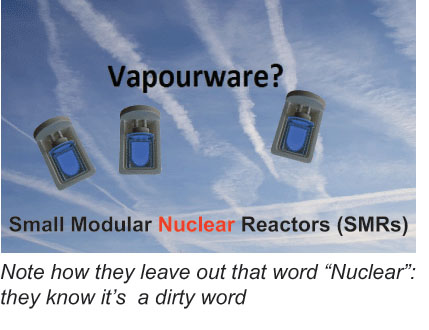
But no case has been made to support claims it has a place in the rapid transition under way in Australia. The reason for this is pretty straightforward: the technology that is being spruiked – small modular reactors (SMRs) – doesn’t exist. Not meaningfully.
That alone tells you that, with few exceptions, the current wave of nuclear boosterism is at its heart an anti-renewable energy campaign.
It is based on an arrogant and – despite the reams of column inches given over to it – unsubstantiated rejection of the detailed evidence from the Australian Energy Market Operator (and plenty of others) that solar, wind, hydro, batteries and other “firming” support can provide a reliable, affordable, low-emissions electricity supply.
Coincidentally or otherwise, many prominent members of the pro-nuclear and anti-renewable energy campaign dismiss climate science. Some do it directly. Others do it indirectly by arguing there is no urgency to act.
The primary sources of this climate rejection are the federal Coalition, the Australian newspaper and the misinformation sewer of Sky News After Dark. The Australian is happy to run unquestioning news stories claiming multibillion-dollar “black holes” in renewable energy plans based on flawed analyses by former mining executives, but then devote pages to tut-tutting over an estimate by Chris Bowen’s energy department that says nuclear energy would be – shock horror – really expensive.
This is, of course, a newspaper that gives more space to contrarian campaigns by individual scientists who claim that the Great Barrier Reef is not under threat and the Bureau of Meteorology’s temperature records cannot be trusted than it does to the overwhelming weight of thousands of peer-reviewed science papers. Considered and balanced scepticism is healthy. The Australian’s coverage of these issues has the rigour of an old bloke shouting in the corner of a pub as last drinks are served.
The Coalition’s position on nuclear energy is a little more slippery. In its limited defence, we’re only 16 months on from the last election and it’s reasonable that it doesn’t yet have a developed energy policy. But the language it uses is not that of a party gently exploring an idea. Peter Dutton has asserted that Australia could build nuclear plants, which are banned here, on existing coal-fired plants.
The Coalition considered, and rejected, abolishing the nuclear ban while it was in power for nearly nine years. Then, the party stuck with its status quo on climate, including hyping a subsidised “gas-fired recovery” that never happened. Now, Dutton and Ted O’Brien, the energy and climate spokesperson, speak of nuclear as the obvious solution and mock those who back the rollout of renewable energy and transmission lines.
Bowen’s back-of-envelope claim is that it could cost $387bn to replace every Australian coal plant with nuclear SMRs – a step that, at this stage, the Coalition has not proposed. O’Brien’s response was to cite the nuclear-heavy Canadian province of Ontario as an example of a power grid that is much cleaner and cheaper than here.
This was a red herring. The Ontario system runs on old, large-scale nuclear technology that nobody is proposing for Australia. It has a different cost profile, has been heavily subsidised and a new plant has not been completed for 30 years.
A true comparison would involve looking at the cost of SMRs today and considering what it would cost to start an industry in Australia.
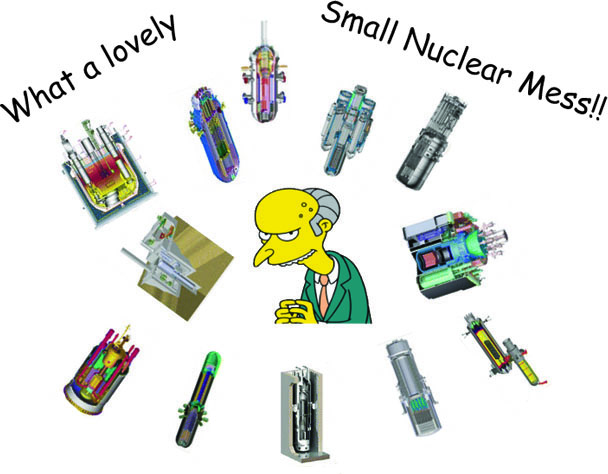
The CSIRO, which has looked at the evidence, concluded this is near impossible due to a lack of robust data. It says there are only two known SMRs in operation – one in Russia (on a barge) and one in China. Both suffered the cost blowouts and delays that have become common with nuclear projects.
According to the International Atomic Energy Agency, there are more than 80 other SMR designs in development, only some of which would be used for electricity generation if successful. But it says their economic competitiveness is “still to be proven in practice”.
The CSIRO, which has looked at the evidence, concluded this is near impossible due to a lack of robust data. It says there are only two known SMRs in operation – one in Russia (on a barge) and one in China. Both suffered the cost blowouts and delays that have become common with nuclear projects.
According to the International Atomic Energy Agency, there are more than 80 other SMR designs in development, only some of which would be used for electricity generation if successful. But it says their economic competitiveness is “still to be proven in practice”.
But the idea Australia should wait for an unproven technology to possibly arrive when it already has extraordinary clean energy resources at its disposal defies all logic.
There is a genuine opportunity cost here. Time focused on the nuclear sideshow is playing into the delay game. I’m giving it succour just by writing this column.
Meanwhile, the world is in the grip of the hottest year on record. The fire season is under way in mid-September. Antarctic sea ice is at a record low level. Credible bodies such as the Australian Academy of Technological Sciences and Engineering now argue the country should be aiming to be net zero by 2035 – a date by which, if things go really well, just a small handful of SMRs may be in operation.
The transition away from fossil fuels is genuinely challenging. There are huge policy and social licence issues that need to be navigated so the rollout of renewable energy can accelerate. Emissions from transport, major industry and agriculture are not coming down. We barely talk about what adapting to the changes under way will mean.
But solutions are available. Imagine what might be possible if the political energy dedicated to the nuclear energy furphy went into developing those.
South Asian leader slams AUKUS pact.
“It is a military alliance moved against one country – China.”
The US-led initiative was created to antagonize Beijing, Sri Lanka’s president has said.
https://www.rt.com/news/583182-sri-lanka-slam-aukus-pact/ 20 Sept 23
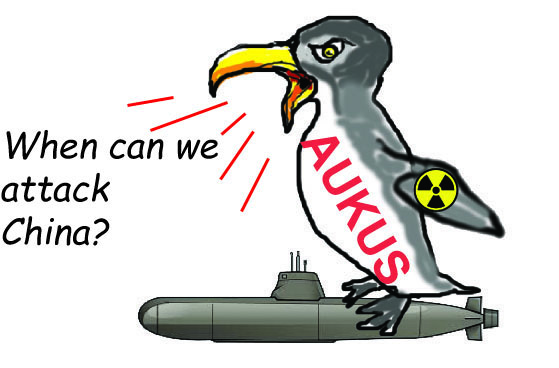
Sri Lankan President Ranil Wickremesinghe has condemned the AUKUS pact as an alliance designed to target China, calling it a “strategic misstep,” and insisting it will only divide Asia into rival camps and destabilize the region.
Speaking on the sidelines of the UN General Assembly on Monday, Wickremesing he took aim at AUKUS, which was formed by the US, UK, and Australia in 2021. “I don’t think it was needed,” he said.
“I think it’s a strategic misstep. I think they made a mistake,” the president stated. “It is a military alliance moved against one country – China.”
Wickremesinghe went on to say that Sri Lanka wants no part in the growing tensions between Washington and Beijing, adding that his country would like to maintain good relations with both powers and does not wish to see Asia divided into competing blocs.
“The next round of rivalry is going on. And that’s taking place in Asia. It’s the question of China versus the US, on how they are going to divide their region of influence in Asia,” he said. “Why are we getting pulled into it? It’s difficult for us to understand.”
The president also expressed concern about the stepped-up US military presence in the region in recent years – often labeled ‘freedom of navigation’ missions by American officials. “As far as the Indian Ocean is concerned, we don’t want any military activity,” he continued, saying most neighboring countries “will not want NATO anywhere close by.”
AUKUS was established in 2021 between Washington, Canberra, and London in part to facilitate the transfer of military technology among the three allies. Though officials from each country have maintained that the bloc is not a formal military alliance and is solely focused on technology sharing, Beijing has condemned the project, claiming it will only help to spread nuclear weapons around the globe and kick off an arms race in Asia.
“The three countries have gone further down the wrong and dangerous path for their own geopolitical self-interest, completely ignoring the concerns of the international community,” Chinese Foreign Ministry spokesman Wang Wenbin said earlier this year, adding that the AUKUS pact is based on a “Cold War mentality which will only motivate an arms race, damage the international nuclear nonproliferation regime, and harm regional stability and peace.”
Tensions between Washington and Beijing have steadily escalated in recent years, with former US President Donald Trump kicking off a low-level trade war with China which persists under his successor, Joe Biden.
The Biden administration has also deployed navy warships to waters near China on a near-monthly basis, including the disputed Taiwan Strait, drawing repeated condemnation from Chinese officials
Maintaining the USA nuclear arsenal, at $750 billion over the next decade

2 This is what it’s like to maintain the US nuclear arsenal
By Tara Copp, Associated Press, Sep 21, 23 C ISR NET
The U.S. will spend more than $750 billion over the next decade to revamp nearly every part of its aging nuclear defenses. Officials say they simply can’t wait any longer — some systems and parts are more than 50 years old.
For now, it’s up to young military troops and government technicians across the U.S. to maintain the existing bombs and related components. The jobs are exacting and often require a deft touch. That’s because many of the maintenance tasks must be performed by hand……………………………………
Because the U.S. no longer conducts explosive nuclear tests, scientists are not exactly sure how aging warhead plutonium cores affect detonation. For more common parts, like the plastics and metals and wiring inside each detonator, there are also questions about how the years spent in warheads might affect their integrity.
So, workers at the nation’s nuclear labs and production sites spend a lot of time stressing and testing parts to make sure they’re safe. . At the Energy Department’s Kansas City National Security Campus, where warheads are made and maintained, technicians put components through endless tests. They heat weapons parts to extreme temperatures, drop them at speeds simulating a plane crash, shoot them at high velocity out of testing guns and rattle and shake them for hours on end. The tests are meant to simulate real world scenarios — from hurtling toward a target to being carted in an Air Force truck over a long, rutty road.
Technicians at the Los Alamos National Lab conduct similar evaluations, putting plutonium under extreme stress, heat and pressure to ensure it is stable enough to blow up as intended. Just like the technicians in Kansas City, the ones in Los Alamos closely examine the tested parts and radioactive material to see if they caused any damage…………………………………………………………………………………………………………………………
Workers younger than the warheads
It’s not unusual to see a 50-year-old warhead guarded or maintained by someone just out of high school, and ultimate custody of a nuclear weapon can fall on the shoulders of a service member who’s just 23.
……………………………….. At the Kansas City campus, for example, just about 6% of the workforce has been there 30 years or more — and over 60% has been at the facility for five years or less.
That change has meant more women have joined the workforce, too. In the cavernous hallways between Kansas City’s secured warhead workrooms are green and white nursing pods with a greeting: “Welcome mothers.”
At Los Alamos, workers’ uniform allowance now covers sports bras. Why? Because underwire bras were not compatible with the secured facilities’ many layers of metal detection and radiation monitoring. https://www.c4isrnet.com/battlefield-tech/2023/09/20/this-is-what-its-like-to-maintain-the-us-nuclear-arsenal/
Elephant In The Climate Room: Rocket Launches
Proliferation of rocket launches and their environmental damage are almost never mentioned in reporting on space
LISA SAVAGE, SEP 20, 2023, Substack
… I’ve spent years collecting research and reporting on the climate harms of militarism. When I began this was an obscure perspective shared by few; it is now mainstream in climate movements (as long as they are not controlled by the Democratic Party, that is).
So it is gratifying to see this fact of modern life represented at last weekend’s big climate march in New York City.
Other points of view also trend in that direction.
If capitalism is the root cause of rapidly warming oceans and extreme weather events, then the wars that are necessary to sustain capitalism are implicated.
But what about war in space, which is already well underway even if few realize it? The proliferation of rocket launches in recent years and the accompanying environmental damage are almost never mentioned in reporting on either space topics or military topics.
This coming weekend I’ll attend Maine’s biggest annual green lifestyle event, the Common Ground Fair. It draws thousands from all over the region for a “celebration of country living” sponsored by the Maine Organic Farmers & Gardeners Association.
On Sunday morning in the political and social action tent a group of us will update fairgoers on plans to build a rocket launch site on the coast of Maine. Steuben is within sight of Acadia National Park, and the floating launch pad proposed would sit amid lobster fishing and seaweed harvesting activities already generating jobs and providing sustenance for the last several decades.
All rocket site construction involves toxic substances, including the PFAS foam used for fire fighting and stored in vast quantities on site until it may be needed. And when rockets and satellites fall from the sky, they disintegrate into a chemical soup that then falls to Earth. Mass deaths of birds and other animals have been observed at rocket launch sites in other states.
Maine was once considered Vacationland because of its deep forests, clean water, beautiful shoreline, and abundance of foods like lobsters, trout, and clams.
Although organized lobster fishermen in Jonesport blocked the construction of the toxic launch site in their fishing grounds, Steuben has not been so lucky. Resident Larch Hanson is ready to sue blueShift’s CEO for trampling on the democratic process and putting his seaweed harvesting business at risk. The town government of Steuben has squelched discussion of the rocket launch site plan and silenced critics, according to Hanson.
It’s worth noting that a bill rushed through supposedly as “emergency” legislation and passed under the gavel (i.e. without a roll call vote) established a private-public partnership called the Maine Space Corporation to support just this kind of project. So undemocratic methods are a signature of bringing rocket launches to Vacationland.
But isn’t space cool? you may ask. And educational?
All space programs are inherently military in nature, no matter what NASA or the University of Maine tell you. Every rocket launch site built on other pristine coasts such as Kodiak, Alaska or Mahia Peninsula, New Zealand was sold to local residents as non-military but once built has been used extensively and repeatedly to launch military satellites. (More details on that here.)
As a retired educator, I know STEM fans will enthuse about how much science, technology, engineering, and mathematics education will be advanced by projects such as this one. STEM educators in Australia are currently excited about how middle school students will be involved in projects connected to nuclear submarines the U.S. is forcing on them despite considerable pushback from the public.
STEM can be a force for good, but not when it’s used as a cover up for militarizing education and other public resources.
I have been astonished at the lack of interest among environmentalists who I might have expected would oppose building a rocket launch site on the Maine coast. No doubt it’s partly attributable to the slavish reprinting of bluShift press releases as “news” in corporate media. https://went2thebridge.substack.com/p/elephant-in-the-climate-room-rocket?utm_source=post-email-title&publication_id=1580975&post_id=137220260&utm_campaign=email-post-title&isFreemail=true&r=c9zhh&utm_medium=email
Cooling system at Zaporizhzhya stabilised – but military action in the area continues
In its Update 183 on the Ukraine situation International Atomic
Energy Agency director general Rafael Grossi announced that Zaporizhzhya
Nuclear Power Plant has been drilling more wells at the site as part of
efforts to find new sources of cooling water following the destruction of
the downstream Kakhovka dam more than three months ago.
ZNPP has built
another two groundwater wells to supply the sprinkler ponds that cool the
six reactors and spent fuel, bringing the total of new wells to nine.
Together they pump around 200 cubic metres of water per hour into the
sprinkler ponds, representing most of the cooling needs of the six shutdown
reactors.
The remainder of the water comes from the drainage system and
clean water that is periodically discharged from the plant’s chemical
water treatment facility. The IAEA has been informed that the water supply
situation will be assessed after a tenth well has been constructed to see
if more will be needed.
1 This month

of the week – Australians for War Powers Reform (AWPR)
To see nuclear-related stories in greater depth and intensity
 Antinuclear