Is nuclear energy feasible in Australia (and how much would it cost)?
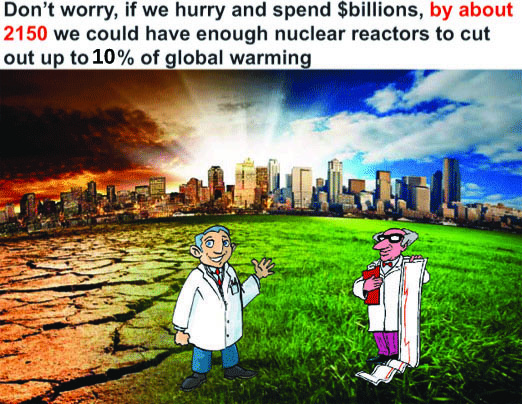
What problem is nuclear trying to provide a solution for, asks Ernst & Young climate change and sustainability partner Emma Herd. “If it’s cost of living, it’s expensive. If there are challenges with social licence for renewables then nuclear has got 10 times more social licence problems. If it is the need to rapidly deploy low-emissions energy technology to replace coal then nuclear takes a long time to get approval for, let alone to build, let alone to get up and operating. If it’s the need for rapid decarbonisation, again, it’s too slow.”
Debate has erupted over nuclear energy’s role in Australia’s shift from fossil fuels. Could it work? And why is it so controversial?
SMH, By Mike Foley, OCTOBER 7, 2023
Australia is in the middle of an unprecedented energy revolution, switching from the fossil fuel-powered electricity grid that’s been the bedrock of the nation’s economy for decades to clean energy, through a rush of renewables as wind and solar farms spring up across the country.
The shift is being driven by Australia’s commitment to help tackle climate change by cutting damaging greenhouse emissions.

But a fiery political debate has erupted over the future of Australia’s energy supply in recent months, with federal Opposition Leader Peter Dutton demanding the Albanese government remove the nation’s longstanding ban and deploy what he claims is clean, cheap and reliable nuclear power…………..
What would be the costs? And how does nuclear power work?
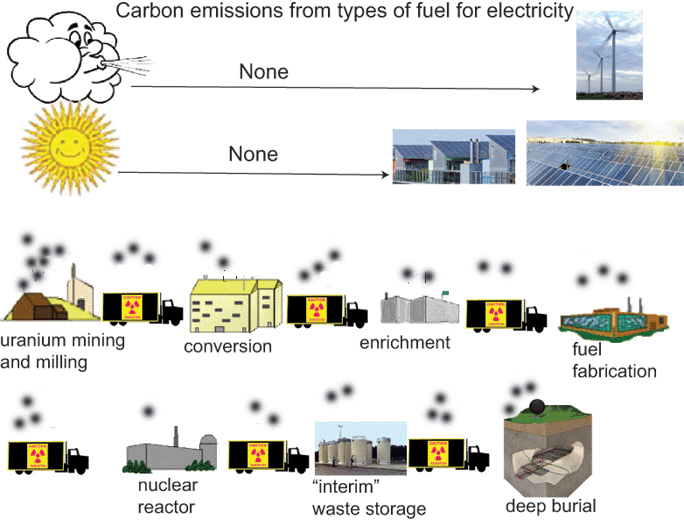
………………………………………………………………………… This atomic fission also creates zero greenhouse gases, [ed. note: in the reactor operation, but not in the entire fuel cycle] which is a key benefit cited by nuclear energy advocates, but its opponents point to the dangers associated with storing the radioactive waste and the potential for spent fuel from nuclear reactors to be used to make nuclear weapons.
Past accidents have undermined public confidence……………………………..

…………………………………. In Australia, a national ban on nuclear energy was put in place by the Howard government in 1999, after horse-trading with the Australian Democrats over the government’s signature green reform, the Environment Protection and Biodiversity Conservation Act, which stated that the relevant minister could not approve a nuclear power plant.
Seven years later, the Howard government asked Telstra chief executive and trained nuclear physicist Ziggy Switkowski to investigate the merits of nuclear power in Australia. That report delivered a hammer blow to the industry. Switkowski found that nuclear power could compete economically with coal power only if a politically contentious carbon tax was imposed.
In 2019, Switkowski also told a parliamentary inquiry there was little prospect for Australia to develop a nuclear energy industry because the “window for large gigawatts to go in nuclear generators has now closed for Australia”. He said a nuclear industry would take too long to establish and be too costly to build compared to alternative infrastructure. He also said it was unlikely the industry could establish enough support to gain a social licence to operate.
“Given that the investment in a power station, particularly a big one, would begin at $US10 billion and go up from there, and it would take around 15 years to make it work, you can’t progress without strong community support and bipartisanship at the federal level, and there is not too much evidence of that,” he said.
But now the federal Coalition is calling for the nuclear energy ban to be abolished.
……………………………. Nuclear energy proponents argue nuclear should replace coal. Those advocates include the Minerals Council, prominent Nationals including leader David Littleproud and former leader Barnaby Joyce, and some Liberal MPs including Dutton and his climate change and energy spokesman, Ted O’Brien.
……………………………….Renewable energy advocates point out that investors are flocking to large-scale wind and solar projects, which are pumping cheaper energy into the grid and outcompeting coal. The Australian Energy Market Operator (AEMO), which manages the electricity grid, says a grid based on renewables will be just as reliable as a system centred on baseload power.
Could we get a nuclear industry happening in time?
Speed is of the essence, say climate scientists. Global emissions are on track to exceed the goal of the Paris Agreement to limit global warming to less than 2 degrees, a level that would avoid the worst damages from climate change. While renewables are available now, and cheaply, it would likely take decades to establish a nuclear energy industry in Australia.
Australia’s former chief scientist, Alan Finkel, told this masthead in August it was highly unlikely Australia could open a nuclear power plant before the early 2040s, pointing out the autocratic United Arab Emirates took more than 15 years to complete its first nuclear plan using established technology.
What problem is nuclear trying to provide a solution for, asks Ernst & Young climate change and sustainability partner Emma Herd. “If it’s cost of living, it’s expensive. If there are challenges with social licence for renewables then nuclear has got 10 times more social licence problems. If it is the need to rapidly deploy low-emissions energy technology to replace coal then nuclear takes a long time to get approval for, let alone to build, let alone to get up and operating. If it’s the need for rapid decarbonisation, again, it’s too slow.”
Herd says it would take decades of investment in enabling services for the nuclear energy value chain before a new plant could be built, on top of the likely 20 years needed to plan, gain approval for and build a plant.
“Nuclear has got not just a 20-year timeframe to build something, it’s actually probably more a 30- to 50-year timeframe to build an industry,” she says. This includes either educating or importing a generation of nuclear experts to design and operate facilities, capability to construct the complex facilities, creating a bureaucracy to administer the industry and writing the laws to govern it.
Could nuclear energy solve the power line ‘problem’?
A key sticking point in the Opposition’s criticism of renewable energy is the Albanese government’s push to build some 10,000 kilometres of power lines to link the plethora of renewable energy projects springing up across the country with major cities. AEMO has forecast that could cost around $13 billion by 2030. Nuclear energy advocates say those costs could be avoided by building nuclear plants on the sites of existing coal plants, where existing transmission lines converge.
In fact, even if there were no renewable energy expansion, expensive new transmission lines are still needed to upgrade the grid and increase its capacity in line with population growth, but they have been delayed. Energy experts are increasingly worried that time is running out, risking Australia’s ability to compensate for the looming closures of coal-fired power plants.
A major factor in the delays is community backlash against transmission lines, with farmers denying land access to private companies. Littleproud is leading the charge against the renewable energy rollout and backing farm groups in their protest. Backed by Dutton, he has accused the government of running a “reckless race” to renewables and is calling for a halt to privately run transmission projects, for a Senate inquiry or summit into renewable energy and for a national discussion on removing Australia’s moratorium on nuclear power.
Isn’t there a new type of nuclear technology now?
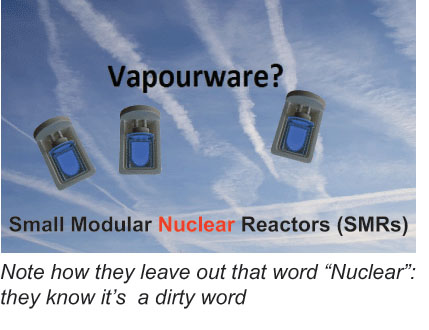
With Dutton heading the push for a plan to replace Australia’s existing fleet of coal plants with nuclear, Littleproud has declared he is open to having a plant in his Queensland electorate. The Coalition says Australia could deploy the next-generation of nuclear technology called small modular reactors, which are based on the energy units in nuclear submarines.
Finkel has said that, from a “purely engineering” perspective, nuclear technology is appealing, with zero emissions, a continuous supply of baseload power and a small mining footprint for fuel. But he has said that small modular reactors are not currently viable technology. “There’s no operating small modular reactor in Canada, America or the UK, or any country in Europe.”
Finkel noted that private company Nuscale is aiming to commission 12 small modular reactors starting from 2029, but he said it would take at least a decade to follow suit in Australia.
Is nuclear cheaper?
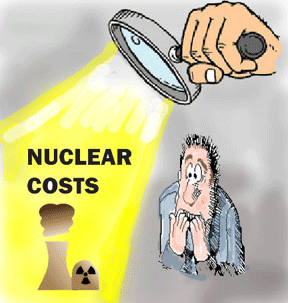
A joint study by the CSIRO and AEMO, the GenCost report, calculated the future cost of energy generation for a range of technologies. It found that solar and wind energy generation would cost between $60 and $100 per megawatt hour by 2030, including back-up power from either batteries, pumped hydro or gas plants. (This figure also includes CSIRO and AEMO-termed “sunk costs” of new transmission lines.)
GenCost forecast that one megawatt hour of power from a small modular reactor in 2030 would cost between $200 and $350 per megawatt hour.
Another energy advisory, Lazard from the US, calculated the levelised cost of nuclear and renewables – which means the average net present cost of electricity generation for a generator over its lifetime. It found that one megawatt hour from solar power, including back-up storage, costs between $72 to $160 per megawatt hour, while a traditional nuclear plant costs from $220 to $347.
Why is the politics of nuclear toxic?
Even if the Albanese government wanted to open a debate over the future of nuclear power in Australia, the party’s official policy platform that is formed by rank and file members states Labor will “prohibit the establishment of nuclear power plants and all other stages of the nuclear fuel cycle in Australia”.
While it’s not impossible for politicians to ignore the policy platform, it is extremely challenging.
In any case, the government has come out swinging against the opposition’s call for nuclear power in Australia. Bowen……………………. https://www.smh.com.au/politics/federal/is-nuclear-energy-feasible-in-australia-and-how-much-would-it-cost-20231004-p5e9qc.html
No comments yet.
1 This month
15 April – Zoom –Nuclear Power is Not the Solution
Apr 15, 2026 01:00 AM in Canberra, Melbourne, Sydney

Join the International Physicians for the Prevention of Nuclear War (IPPNW) on Tuesday, April 14th for a timely webinar exploring the risks associated with nuclear power and challenging the myth that it offers a simple, safe, carbon-free solution to the climate crisis

of the week – Australians for War Powers Reform (AWPR)
To see nuclear-related stories in greater depth and intensity
 Antinuclear
Leave a comment