Palestine is the genocide that we as Jewish people can halt
Amanda Gelender, 24 November 2023 https://www.middleeasteye.net/opinion/israel-palestine-genocide-jewish-people-can-halt—
We cannot allow the moral soul of Judaism to perish with our collective silence on Israel’s genocidal war on Palestinians in Gaza.
sit down to write this – a love letter for my treasured Jewish people – as a genocide unfolds on my screen.
This letter pours from my heart to yours. It is a call to action to rise in solidarity with Palestine. I have such deep tenderness for us, our history, and the proud traditions we have preserved through centuries of unspeakable injustice.
Like some of you, I grew up attending synagogue in a progressive American Jewish community. Celebrating and supporting Israel was part of what it meant to be culturally and religiously Jewish.
When I first came to understand what was actually happening in the occupied Palestinian territories, I was 18 and enrolled in my first year of college. A Jewish peer told me about the abuse Israel commits in our name.
I’m not proud to admit that the fact she was Jewish is likely the only reason I listened: I was taught by my community that only Jewish people can truly understand how important Israel is for our safety and wellbeing. Looking back, I wish I had believed Palestinians sooner.
Palestinians are the authorities on their own freedom struggle. But the indoctrination and fear instilled in me as a Jewish child was too strong to overcome, until the bubble of Zionism burst.
When I first came to learn about the extent of Israel’s ongoing brutality against the Palestinian people, I struggled to believe it. My Jewish elders taught me about justice, human rights and the Jewish moral mandate to cultivate social change and “repair the world” (tikkun olam).
How is it possible that my own people could omit the truth about Israeli apartheid and occupation? I was taught that Israel was founded on an empty plot of land, not that Zionist terrorist squads raided villages, killing 15,000 Palestinians and forcibly displacing 750,000 more in the Nakba. Like me, did they just not know?
Zionist fallacy
The line that “everyone who criticises Israel is antisemitic” felt increasingly flimsy in the face of a mounting list of war crimes committed by Israel. If everything taught to me about Israel wasn’t true, what else was a lie?
And what would this mean for participation in the Jewish community going forward, given that virtually all of my Jewish peers are still tacitly or actively invested in the fallacy of Zionist nationalism?
Once the denial faded, the rage set in. We have been lied to by people we trusted; deceived so that we would cheer on an apartheid state that abuses children and tortures mercilessly in our name. Jewish youth, including myself, have been implicated in a 75-year, ongoing genocide against the Palestinian people.
There have been tremendous, unfathomable human rights abuses committed under the guise of protecting Jewish livelihood – when in reality, a settler’s quiet peace is made possible only by continued Palestinian repression. There is no safety for anyone under occupation.
We were taught that Israel represented a whisper of refuge carved out for Jews after the Holocaust – something precious that we must protect at all costs. It was “the only nation for Jewish people”, our homeland, our birthright: Israel.
We were taught intrinsic entitlement over a piece of land on the other side of the earth. Israel was a second, optional home for us – but the story conveniently omitted that Palestine is the one and only home for Palestinians, who have tended to the land for generations.
Israel still denies Palestinians visitation rights and the inalienable right to return home, but as a Jewish person born in California, I can visit whenever I want, and Israel will even pay me to move there and live on stolen Palestinian land.
I wasn’t taught that Israel is funded to the teeth by the US, functioning as a strategic western imperial outpost for natural resource extraction, weapons testing, US police training, and more. No one told me that the birth of Israel required the death of Palestinians, an ethnic cleansing conveniently swept under the rug so that Jewish people could have something shiny and clean; that it was a militarised nation founded on piles of scorched Palestinian bodies, a Jewish homeland built on mass indigenous graves.
Decolonial freedom struggle
The story of Israel is not new. It is deeply familiar to colonised peoples the world over. It perpetuates the same white supremacist, colonial lie that settlers arriving to Turtle Island (North America) told themselves to justify the genocide of indigenous peoples: that in the name of progress, modernity and democracy, the coloniser must demolish, kill and destroy.
Under this lie, the coloniser must pillage the land as manifest destiny, from “sea to shining sea”, and violently execute as many of the “savage native terrorists” as possible to expand territorial gains and build safe homes for settler families.
Palestine is not engaged in a holy war; it is a decolonial freedom struggle. Palestinians did not choose Jewish people to colonise their land, and they have a moral and legal right to resist occupation, regardless of who the occupier is. Jewish safety is a non-starter, so long as the violent occupation of Palestine persists. Our liberation is bound together as one.
We are at an unprecedented moment in history. A genocide is unfolding before our eyes, as bodies pile up in mass graves outside of bombed hospitals and refugee camps. A global solidarity movement for Palestine has pierced through the veil of western comfort – a jailbreak from the prison of blockade.
And as the US-backed Israeli military continues to rain down bombs on the besieged people of Gaza, many of my fellow Jewish people are sitting back and watching, or actively cheering it on.
With our silence, Jewish people globally are co-signing this genocide. Many have calculated that it’s “too complicated”, with the threat of being alienated from friends, family and colleagues. We don’t want to risk anything real.
Delusional asymmetry
But Palestinian families are being murdered while they sleep, brutalised with burning white phosphorous, sniped in hospital maternity wards, starved and made to suffer from dehydration and a lack of clean water, and forced on death marches. They are pulling dead, bloodied children from the dusty ruins of bombed rubble.
And yet, my Jewish peers in the West say they are the ones who fear genocide. This delusional asymmetry must end so that we can point resources and attention towards those who face an actual threat of extinction in this completely preventable massacre of human dignity.
The call from Palestinians at this moment is clear: ceasefire now. End the siege on Gaza and the illegal occupation. Respect the right of return. Palestinians are asking us to bear witness to their genocide, pressure our representatives for an immediate ceasefire, and boycott those profiting from the illegal occupation. Every day without a ceasefire, the death toll increases and Israel wipes more lineages from the public record.
Palestine is the genocide that Jewish people can halt. We couldn’t intervene to stop millions of our ancestors from perishing in death camps, but we can and must stop this genocide from continuing one more day. Let us not squander our urgent, sacred duty by exploiting Jewish suffering as a shield and cudgel for violence against Palestinians.
If you consider yourself a Jewish person of conscience, understand that there is no moral or legal justification for this massacre. The time to speak is now. Palestinians can’t wait for history to redeem them, because the air strikes continue to beat down as I write this letter of love and rage to you, my Jewish kin.
We cannot allow the moral soul of Judaism to perish with the sound of our collective silence on genocide. Let our voices be a prayer for our Jewish ancestors and a blessing for our descendants to say once and for all: never again.
Small modular nuclear reactors: a history of failure

Jim Green 28 November 2023 https://reneweconomy.com.au/small-modular-nuclear-reactors-a-history-of-failure/
Small modular reactors (SMRs) are defined as reactors with a capacity of 300 megawatts (MW) or less. The term ‘modular’ refers to serial factory production of reactor components, which could drive down costs.
By that definition, no SMRs have ever been built and none are being built now. In all likelihood none will ever be built because of the prohibitive cost of setting up factories for mass production of reactor components.
No SMRs have been built, but dozens of small (<300 MW) power reactors have been built in numerous countries, without factory production of reactor components. The history of small reactors is a history of failure.
The US Army built and operated eight small reactors beginning in the 1950s, but they proved unreliable and expensive and the program was shut down in 1977. In addition, 17 small civilian reactors were built in the US in the 1950s and 1960s, but all have since shut down.
Twenty-six small Magnox reactors were built in the UK but all have shut down and no more will be built. The only operating Magnox is a mini-Magnox in North Korea: the design was made public at an Atoms for Peace conference and North Korea uses its 5 MW Magnox to produce plutonium for nuclear weapons.
India’s operates 14 small pressurised heavy water reactors, each with a capacity of about 200 MW. Prof. M.V. Ramana noted in his 2012 book, ‘The Power of Promise: Examining Nuclear Energy in India’, that despite a standardised approach to designing, constructing, and operating these reactors, many suffered cost overruns and lengthy delays. There are no plans to build more of these small reactors in India.
Elsewhere, the history of small reactors is just as underwhelming. This includes three small reactors in Canada (all shut down), six in France (all shut down), and four in Japan (all shut down).
Prof. Ramana concludes his history of small reactors with this downbeat assessment: “Without exception, small reactors cost too much for the little electricity they produced, the result of both their low output and their poor performance.”
Recent history
Just two SMRs are said to be operating — neither meeting the ‘modular’ definition of serial factory production of reactor components. The two SMRs — one each in Russia and China — exhibit familiar problems of massive cost blowouts and multi-year delays.
The construction cost of Russia’s floating nuclear power plant increased six-fold and the OECD’s Nuclear Energy Agency estimates that the electricity it produces costs US$200 (A$306) / megawatt-hour (MWh). The reactor is used to power fossil fuel mining operations in the Arctic.
The other operating SMR (loosely defined) is China’s demonstration 210 MW high-temperature gas-cooled reactor (HTGR). The World Nuclear Association states that the cost of the demonstration HTGR was US$6,000 (A$9,200 billion) per kilowatt, three times higher than early cost estimates and 2-3 times higher than the cost of China’s larger Hualong reactors per kilowatt.
NucNet reported in 2020 that China dropped plans to manufacture 20 HTGRs after levelised cost estimates rose to levels higher than conventional large reactors. Likewise, the World Nuclear Association states that plans for 18 additional HTGRs at the same site as the demonstration HTGR have been “dropped”. China’s demonstration HTGR demonstrates yet again that the economics of small reactors doesn’t stack up.
Three SMRs are under construction – again with the qualification that there’s nothing ‘modular’ about these projects.
Argentina’s CAREM reactor has been a disaster. Construction began in 2014 and the National Atomic Energy Commission now hopes to complete the reactor in 2027 — nearly 50 years after the project was conceived. The cost estimate in 2021 was US$750 million (A$1.1 billion) for a reactor with a capacity of just 32 MW. That’s over one billion Australian dollars for a plant with the capacity of a handful of large wind turbines.
In 2021, China began construction of a 125 MW pressurised water reactor. According to China National Nuclear Corporation, construction costs per kilowatt will be twice the cost of large reactors, and levelised costs will be 50 percent higher than large reactors.
Also in 2021, construction of the 300 MW demonstration lead-cooled BREST fast neutron reactor began in Russia. The cost estimate has more than doubled to 100 billion rubles (A$1.7 billion) and no doubt it will continue to climb.
NuScale and mPower
In 2012, the US Department of Energy (DOE) offered up to US$452 million to cover “the engineering, design, certification and licensing costs for up to two US SMR designs.” The two SMR designs that were selected by the DOE for funding were NuScale Power and Generation mPower.
Taking its cues from the US government, in 2015 the South Australian Nuclear Fuel Cycle Royal Commission commissioned research by WSP Parsons Brinckerhoff (now WSP) on the economic potential of the same two designs.

However NuScale recently abandoned its flagship project in Idaho as RenewEconomy recently reported. NuScale secured subsidies amounting to around US$4 billion (A$6.1 billion) from the US government comprising a US$1.4 billion subsidy from the DOE and an estimated US$30 per megawatt-hour (MWh) subsidy in the Inflation Reduction Act. Despite that government largesse, NuScale didn’t come close to securing sufficient funding to get the project off the ground.
NuScale’s most recent cost estimates were through the roof: US$9.3 billion (A$14.2 billion) for a 462 MW plant comprising six 77 MW reactors. That equates to US$20,100 (A$30,700) per kilowatt and a levelised cost of US$89 (A$135) / MWh. Without the Inflation Reduction Act subsidy of US$30/MWh, the figure would be US$129 (A$196) / MWh. That’s close to WSP’s estimate of A$225 / MWh.
To put those estimates in perspective, the Minerals Council of Australia states that SMRs won’t find a market in Australia unless they can produce power at a cost of A$60-80 / MWh, 2-3 times lower than the WSP and NuScale estimates.
NuScale still hopes to build SMRs but the company is burning cash and, some analysts suggest, heading towards bankruptcy.
Generation mPower — a collaboration between Babcock & Wilcox and Bechtel — was the other SMR design prioritised by the US DOE and the South Australian Royal Commission. mPower was to be a 195 MW pressurised light water reactor.
In 2012, the DOE announced that it would subsidise mPower in a five-year cost-share agreement. The DOE’s contribution would be capped at US$226 million, of which US$111 million was subsequently paid. The following year, Babcock & Wilcox said it intended to sell a majority stake in the joint venture, but was unable to find a buyer.
In 2014, Babcock & Wilcox announced it was sharply reducing investment in mPower to US$15 million annually, citing the inability “to secure significant additional investors or customer engineering, procurement and construction contracts to provide the financial support necessary to develop and deploy mPower reactors”.
The mPower project was abandoned in 2017. The joint venture companies spent more than US$375 million on the project, in addition to the DOE’s US$111 million contribution.
Iceberg Research analysts predicted the collapse of NuScale’s Idaho project, drawing a furious response from NuScale, and later drew the connections between NuScale and mPower:
“[NuScale’s] trajectory bears striking similarities to the B&W mPower project, a joint venture formed in 2010 between Babcock & Wilcox and Bechtel. Like NuScale, mPower was developing a small modular reactor and enjoyed DOE backing. Babcock & Wilcox, mPower’s 90%-shareholder, attempted but failed to sell a majority stake in the project. In a similar vein, NuScale’s largest shareholder Fluor is actively trying to sell around 30% of its equity interest in NuScale.
“There was eventually a significant reduction in funding for mPower. In March 2017, Bechtel withdrew from the joint venture, pointing to the challenges of securing a site and an investor for the first reactor. This led to the termination of the mPower project and Babcock & Wilcox paid Bechtel $30m as settlement.”
“There was eventually a significant reduction in funding for mPower. In March 2017, Bechtel withdrew from the joint venture, pointing to the challenges of securing a site and an investor for the first reactor. This led to the termination of the mPower project and Babcock & Wilcox paid Bechtel $30m as settlement.”
NuScale and mPower had everything going for them: large, experienced companies; conventional light-water reactor designs; and generous government subsidies. But they struggled to secure funding other than government subsidies. Needless to say, non-government funding is even more difficult to secure for projects without the backing of large companies, and for projects that envisage construction of unconventional reactors (molten salt reactors, fast neutron reactors, etc.).
NuScale’s failure is particularly striking given the extent of the government subsidies and given that NuScale had progressed further through the licensing process than other SMR designs (which isn’t saying much). Australia’s energy minister Chris Bowen said: “The opposition’s only energy policy is small modular reactors. Today, the most advanced prototype in the US has been cancelled. The LNP’s plan for energy security is just more hot air from Peter Dutton.”
NuScale’s failure is particularly striking given the extent of the government subsidies and given that NuScale had progressed further through the licensing process than other SMR designs (which isn’t saying much). Australia’s energy minister Chris Bowen said: “The opposition’s only energy policy is small modular reactors. Today, the most advanced prototype in the US has been cancelled. The LNP’s plan for energy security is just more hot air from Peter Dutton.”
Other failures
Many other plans to build small reactors have been abandoned. In 2013, US company Transatomic Power was promising that its ‘Waste-Annihilating Molten-Salt Reactor‘ would deliver safer nuclear power at half the price of power from conventional, large reactors. By the end of 2018, the company had given up on its ‘waste-annihilating’ claims, run out of money, and gone bust.
MidAmerican Energy gave up on its plans for SMRs in Iowa in 2013 after failing to secure legislation that would require ratepayers to partially fund construction costs.
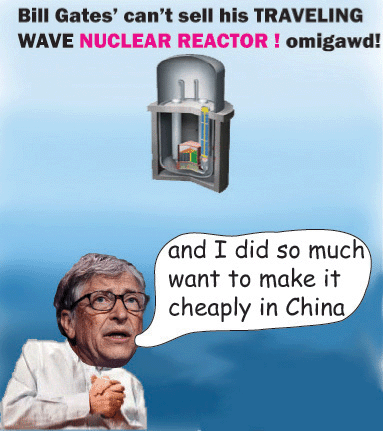
In 2018, TerraPower abandoned its plan for a prototype fast neutron reactor in China due to restrictions placed on nuclear trade with China by the Trump administration.
The French government abandoned the planned 100-200 MW ASTRID demonstration fast reactor in 2019.
The US government abandoned consideration of ‘integral fast reactors‘ for plutonium disposition in 2015 and the UK government did the same in in 2019. (Plutonium disposition means destroying weapons-useable plutonium through irradiation, or treating plutonium in such a way as to render it useless in nuclear weapons.)
During the South Australian Royal Commission, nuclear lobbyists united behind a push for integral fast reactors and they would have expected some support from the stridently pro-nuclear Royal Commission.
However the Royal Commission rejected the proposal, noting in its May 2016 report that advanced fast reactors and other innovative reactor designs are unlikely to be feasible or viable in the foreseeable future; that the development of such a first-of-a-kind project would have high commercial and technical risk; that there is no licensed, commercially proven design and development to that point would require substantial capital investment; and that electricity generated from such reactors has not been demonstrated to be cost competitive with current light water reactor designs.
Dozens of SMR designs are being promoted — mostly by start-ups with a Powerpoint presentation. Precious few will reach the construction stage and the likelihood of SMRs being built in large numbers is negligible.
Dr. Jim Green is the national nuclear campaigner with Friends of the Earth Australia and author of a detailed SMR briefing paper released in June.
Cop28: what to expect from the Dubai climate change conference.

On November 30 officials will begin to discuss an agenda in the UAE that
includes measures on fossil fuels and boosting funds for vulnerable
countries.
We were walking for 12 hours in 37 or 38-degree heat, and you
could feel the heat from the fire,” Joanna Harber said, recounting how
wildfires on Rhodes turned her summer holiday to hell. Images of thousands
of British holidaymakers evacuating the Greek island in July brought home
the widespread impacts of an era of “global boiling”, in a region that
scientists say is experiencing more fires because of climate change.
Across the year, heatwaves have blanketed large areas of the world, causing
burning in unprecedented areas of Canada and record levels of sea ice
melting in Antarctica. November looks set to be the sixth warmest month
globally in a row, with this year almost certain to be the hottest yet.
On Thursday, world leaders will meet in an attempt to slam the brakes on these
extremes. Officials from almost 200 countries will arrive in Dubai, at one
of the planet’s busiest airports, for a fortnight of talks in the
world’s seventh-largest oil-producing state.
The Cop28 summit will be chaired, controversially and for the first time, by the head of an oil
firm, Sultan Ahmed al-Jaber of the United Arab Emirates.
More than 45,000 people attended last year’s Cop27 climate summit in Egypt, which achieved a surprise deal on a “loss and damage” fund for vulnerable countries
hit by global warming. A similar number are expected in Dubai, among them
Rishi Sunak and more than a hundred heads of state.
Times 26th Nov 2023
https://www.thetimes.co.uk/article/cop28-dubai-climate-change-conference-what-to-expect-htjv27l9q
“We cannot afford to have a bad COP” – Mary Robinson
Mary Robinson: This year will go down in history as the one when global
temperature records were not merely surpassed but shattered. There is also
a risk that 2023 becomes the year that multilateral co-operation on climate
fractures, if leaders do not respond at the scale and with the urgency the
science demands.
As COP28 starts in Dubai against a backdrop of divisive
geopolitics, governments need to demonstrate that working together on our
shared challenges is not only necessary but possible. The need for
collective action is urgent, and the cost of inaction catastrophic. Yet
leaders have not done enough. We are well off-track in curbing global
warming to 1.5C above pre-industrial levels, the limit set out in the Paris
Agreement.
The latest UN assessment shows current climate policies would
mean a predicted 9 per cent rise in global emissions from 2010 to 2030,
despite scientific consensus demanding a 45 per cent reduction in the same
timeframe. Meanwhile, despite projections of global clean energy
investments reaching $1.7tn in 2023, oil and gas industry profits soared to
an estimated $4tn last year while fossil fuel subsidies hit a record $7tn.
FT 26th Nov 2023
https://www.ft.com/content/824664ec-4b20-48cc-8fc2-44ab4c31b75d
COP28: UAE planned to use climate talks to make oil deals

By Justin Rowlatt, Climate editor, BBC News 27 Nov 23
The United Arab Emirates planned to use its role as the host of UN climate talks as an opportunity to strike oil and gas deals, the BBC has learned.
Leaked briefing documents reveal plans to discuss fossil fuel deals with 15 nations.
The UN body responsible for the COP28 summit told the BBC hosts were expected to act without bias or self-interest.
The UAE team did not deny using COP28 meetings for business talks, and said “private meetings are private”.
It declined to comment on what was discussed in the meetings and said its work has been focused on “meaningful climate action”.
The documents – obtained by independent journalists at the Centre for Climate Reporting working alongside the BBC – were prepared by the UAE’s COP28 team for meetings with at least 27 foreign governments ahead of the COP28 summit, which starts on 30 November.
They included proposed “talking points”, such as one for China which says Adnoc, the UAE’s state oil company, is “willing to jointly evaluate international LNG [liquefied natural gas] opportunities” in Mozambique, Canada and Australia.
The documents suggest telling a Colombian minister that Adnoc “stands ready” to support Colombia to develop its fossil fuel resources.
There are talking points for 13 other countries, including Germany and Egypt, which suggest telling them Adnoc wants to work with their governments to develop fossil fuel projects………………………………………………….
COP28 is the UN’s latest round of global climate talks. This year it is being hosted by the UAE in Dubai and is due to be attended by 167 world leaders, including the Pope and King Charles III.
These summits are the world’s most important meetings to discuss how to tackle climate change.
The hope is COP28 will help limit the long-term global temperature rise to 1.5C, which the UN’s climate science body says is crucial to avoid the worst impacts of climate change. But that will require drastic cuts in greenhouse gas emissions, it says – a 43% reduction by 2030 from 2019 levels.
As part of the preparations for the conference, the UAE’s COP28 team arranged a series of ministerial meetings with governments from around the world.
The meetings were to be hosted by the president of COP28, Dr Sultan al-Jaber. Each year the host nation appoints a representative to be the COP president.
Meeting representatives of foreign governments is one of the core responsibilities of COP presidents. It is the president’s job to encourage countries to be as ambitious as possible in their efforts to cut emissions.
The leaked briefing documents seen by the BBC were prepared for Dr Jaber – who is also CEO of the UAE’s giant state oil company, Adnoc, and of the state renewables business, Masdar.
Israel’s Genocidal Antisemitism Against the Arab Civilians of Gaza

Netanyahu has unleashed a “unifying” genocidal war against every child, woman and man that comprise the 2.3 million population of Gaza.
By Ralph Nader / CounterPunch, https://scheerpost.com/2023/11/27/israels-genocidal-antisemitism-against-the-arab-civilians-of-gaza-2/
“It should never have happened,” an elderly Holocaust survivor of a Nazi death camp told the New York Times. He was referring to the colossal failure on October 7th, of Israel’s touted high-tech military and intelligence operations that opened the door to Hamas’ attack on Israeli soldiers and civilians. In many parliamentary countries, the government ministers who are responsible for this kind of failure would have immediately been forced to resign. Not so with Prime Minister Netanyahu’s ministers.
Instead, Netanyahu’s coalition of extremists, who know that the Israeli people are enraged about their government’s failure to defend the border, has unleashed a “unifying” genocidal war against every child, woman and man that comprise the 2.3 million population of Gaza. “No electricity, no food, no fuel, no water. … We are fighting human animals and will act accordingly” was the opening genocidal war cry from defense minister Yoav Gallant to defend the onslaught that massive military forces are implementing against the long-illegally blockaded Gazan population.
Israeli leaders declare that there are Hamas fighters possibly in and under every building in Gaza. Israel has long made computer models using their unprecedented surveillance technology (see Antony Loewenstein’s interview in the November/December 2023 issue of the Capitol Hill Citizen). Nothing and no one is off limits for the Israeli bombing.
Keep in mind that Israel is an ultra-modern military superpower, with hundreds of thousands of fighters on land, air and sea, going after the few thousand Hamas fighters who have limited supplies of rifles, grenade launchers and anti-tank weapons. Moreover, all of Israel’s supplies are being replenished daily from the U.S. stockpiles in Israel and new shipments arriving by sea, compliments of President Biden. The invasion is a “piece of cake” an experienced U.S. government official told reporter Sy Hersh.
Contradictions abound. First, Netanyahu has always referred to Hamas as a “terrorist organization.” Yet he told his own Likud party for years that his “strategy” to block a two-state solution was to “support and fund Hamas.” (See, the October 22, 2023 article by prominent journalist Roger Cohen in the New York Times).
If Netanyahu believes dropping over 20,000 bombs and missiles on the civilian infrastructure of this tiny crowded enclave and its people, nearly half of whom are children, is so restrained, why has he kept Western and Israeli journalists out of Gaza, other than a few recently embedded reporters restricted to their seats in Israeli armored vehicles? Why has he ordered four nightmarish total telecommunications and electricity blackouts, with excruciating consequences, over the whole Gaza Strip for as long as 30 hours at a time?
None of this or international laws matter to the prime minister whose top priority is to keep his job, with his coalition parties, as long as the invasion continues. And before an outraged majority in Israel ousts him from power for not defending their country on October 7th from some two thousand urban guerrilla fighters on a homicide/suicide mission.
As the slaughter of defenseless babies, children, mothers, fathers and grandparents in Gaza continues to drive the death, injury and disease toll to higher numbers each day, the observant world wonders what the Israeli government, which regularly blocks humanitarian aid, intends to do with Gaza and its destitute, homeless, starving, wounded, sick, dying and abandoned civilian Palestinians.
After all, Gaza has only so many hospitals, clinics, schools, apartment buildings, homes, water mains, ambulances, bakeries, markets, electricity networks, solar panels, shelters, refugee camps, mosques, churches, and the clearly marked remaining United Nations’ facilities left, to bomb to smithereens. Endless American tax dollars are funding the carnage. Israel has also killed over 50 journalists, including some of their families, in the past seven weeks – a record.
Why will it take months to clear out the tunnels? Not so, say military experts in urban warfare. Flooding the tunnels with water, gas, napalm and robotic explosives are quick and lethal and would be deployed were it not for the Israeli hostages.
In addition to the reality that all Gazans are now hostages, over 7,000 Palestinians are languishing in Israeli jails without charges. Many are youngsters and women who were abducted over the years to extort information and to control their extended families in Gaza and the West Bank. What’s holding up an exchange, as Israel did twice before in 2004 and 2011? Again, the Netanyahu coalition stays in power by postponing the pending official inquiries into their October 7th collapse, that Israelis are awaiting.
Meanwhile, the hapless Joe Biden dittoheaded the previously hapless presidential pleas for a two-state solution. The dominant politicians in Israel have always sought “a Greater Israel” using the phrase “from the river to the sea,” meaning all of Palestine. Year after year Israel has stolen more and more land and water from the twenty-two percent left of original Palestine, inhabited by five million Palestinians under oppressive military occupation.
With Congress overwhelmingly in Israel’s pocket, Israeli politicians laugh at proposals for a two-state solution by U.S. presidents. Recall when Obama was president, Netanyahu went around him and addressed a joint session of Congress whose members exhausted themselves with standing ovations – a brazen insult to a U.S. president, unheard of in U.S. diplomatic history!
Day after day, the surviving Palestinian families are trapped in what is widely called “an open-air prison” being pulverized by Israel and its aggressive co-belligerent, the Biden regime. A regime in Washington that urges Netanyahu to comply with “the laws of war,” while enabling Israel with more weapons and UN vetoes to violate daily “the laws of war” and the Genocide Convention. (See our October 24, 2023 Letter to President Joe Biden and the Declarations from genocide scholars William Schabas and other expert historians).
Consider the plight of these innocent civilians, caught in the deadly crossfire of F-16s, helicopter gunships, and thousands of precision 155mm artillery shells. Whether huddled in their homes and schools or fleeing to nowhere under Israeli orders, the IDF is still bombing them.
Palestinians cannot escape their blockaded prison. They cannot surrender because the Israeli army does not want to be responsible for prisoners of war. They cannot bury their dead, so their families’ corpses pile up, rotting in the sun being eaten by stray dogs.
They cannot even find water to drink, since Israel has destroyed the water infrastructure – another of its many war crimes.
For years under Israel’s occupation law, collection of rainwater with rainwater harvesting cisterns has not been permitted. Rain is considered the property of the Israeli authorities and Palestinians have been forbidden to gather rainwater!
The Israeli armed forces will soon control the entire Gaza Strip. Under international law, Israel would become responsible for the protection of the civilian population as well as the essential conditions for Palestinian safety and survival. Will they at last abide by just one international law? Or will they establish obstructive checkpoints to restrict humanitarian charities trying to save lives while Israel continues to push the Gazans into the desert or neighboring countries?
The Israeli operation precisely fits the Genocide Convention’s definition by “intentionally creating conditions of life calculated to physically destroy a racial, religious, ethnic, or national group in whole or in part.” Netanyahu’s regime further incriminates itself by defining the targets for annihilation as being between 21st-century progress and “the barbaric fanaticism of the Middle Ages” and a “struggle between the children of light and the children of darkness.”
What do we know about Israel’s nuclear weapons?

The New Arab Staff, 23 November, 2023
Israel is believed to possess between 80 and 400 nuclear weapons but has never faced serious international scrutiny over this.
Despite widespread speculation, Israel has neither confirmed nor denied having nuclear weapons, adhering to a policy of deliberate ambiguity.
Israel is believed to have between 80 to 400 nuclear warheads, with the first completed around late 1966 or early 1967.
This estimate would position Israel as the sixth nation globally to develop nuclear weapons. Delivery methods for these weapons are believed to include aircraft, submarine-launched cruise missiles, and the Jericho series ballistic missiles.
Israel consistently reiterates the cryptic refrain that it will “not be the first to introduce nuclear weapons to the Middle East”. The nation has not signed the Treaty on the Non-Proliferation of Nuclear Weapons (NPT) despite international calls to join.
Recently, the issue gained renewed attention when Israel’s Heritage Minister Amichai Eliyahu, of the extremist Otzma Yehudit (Jewish Power) party, suggested that using nuclear weapons against Gaza would be an option. He was suspended soon afterwards.
Turkish President Recep Tayyip Erdogan also recently said that the issue of Israel’s nuclear arsenal should remain a focus on the global agenda.
He accused Western nations of aiding and overlooking alleged crimes against humanity by Israel in Gaza, where over 14,000 people have been killed in indiscriminate bombardment.
History and implications
Israel’s first Prime Minister, David Ben-Gurion, was committed to acquiring nuclear weapons, justifying this by saying it was to prevent a recurrence of the Nazi Holocaust. …………………………..
By 1952, Israel Atomic Energy Commission chief Ernst David Bergmann sought nuclear collaboration with France, and laid the foundation for future French-Israeli cooperation. This partnership included Israeli scientists’ involvement in France’s nuclear facilities and knowledge sharing, particularly with those with experience on the Manhattan Project.
The relationship culminated in 1957, with France agreeing to build a nuclear reactor and reprocessing plant in Israel, a decision influenced by geopolitical factors and mutual scientific benefits.
This partnership was solidified through secret agreements, ostensibly concentrating on peaceful use of atomic technology but with implications for weapons development………………………………….
The Dimona reactor achieved criticality in 1962, and by 1966 Israel had reportedly developed its first operational nuclear weapon, marking the beginning of its full-scale nuclear weapons production.
The exact costs of Israel’s nuclear program are unknown, but substantial foreign aid and Mossad’s covert operations played crucial roles.
Israeli defector Mordechai Vanunu dramatically revealed the extent of the nuclear programme in 1986, and he was kidnapped by Mossad agents and brought back to Israel, serving long years in prison.
By the mid-2000s, estimates of Israel’s nuclear arsenal varied widely, with speculation about uranium enrichment capabilities adding to these uncertainties.
Despite occasional statements by other countries expressing concern about Israel’s nuclear capabilities, there has been little pressure on Israel to declare its nuclear activities or open up its facilities for inspection, let alone to destroy its weapons.
Double standards
The international community’s approach to nuclear proliferation exhibits notable disparities, especially when comparing the cases of Israel, Iran, and Pakistan.
Israel, despite widespread belief in its possession of nuclear weapons, has never publicly confirmed this and enjoys a unique position of strategic ambiguity. It does not face the same level of scrutiny or sanctions imposed on other nations.
In contrast, Iran, whose nuclear program has raised global concerns about potential weaponisation, has been subject to rigorous inspections, strict sanctions, and intense diplomatic negotiations under frameworks like the Joint Comprehensive Plan of Action (JCPOA).
Pakistan, having openly conducted nuclear tests in 1998, is often viewed through the lens of regional security dynamics, particularly its rivalry with India, and faces a distinct set of international concerns and regulatory measures. https://www.newarab.com/news/what-do-we-know-about-israels-nuclear-weapons
France goes for its own costly small nuclear reactor, following the USA NuScale flop, and UK’s lagging Rolls Royce one.

https://www.bnnbloomberg.ca/french-nuclear-startup-seeks-150-million-for-reactor-prototype-1.2003704 27 Nov 23
Naarea, a three-year-old French nuclear startup, is looking to raise €150 million ($164 million) as it seeks to develop a small reactor that would meet growing industrial decarbonization needs from the start of the next decade.
The company, which already raised €50 million from a handful of French family offices such as Eren Groupe SA and €10 million from the government, is reaching out to venture capital, industrial and institutional investors, and sovereign wealth funds for a Series A funding round with the help of Rothschild & Co., co-founder Jean-Luc Alexandre said in an interview in Paris Friday. He hopes to close the fundraising in the first quarter next year.
Naarea, which stands for Nuclear Abundant Affordable Resourceful Energy for All, is part of a growing wave of companies from Europe to North America promoting smaller, cheaper (?) and safer(?) designs for reactors. The burgeoning(?) sector of small modular and advanced nuclear reactors — which have a wide array of sizes and technologies — suffered a setback this month when NuScale Power Corp. canceled a plan to build a plant in the US amid mounting costs.
“NuScale isn’t dead, and still has projects,” the Naarea CEO said, while pointing out that the French startup, which employs 175 people, has a different business model and is developing another technology. Naarea aims “to produce power and heat, as close as possible to industrial companies, to relieve the grid.”
The startup, which is working with the French nuclear industry and foreign laboratories, is seeking to build a reactor that would produce 40 megawatts of electricity — enough to power a car factory or some of the biggest desalination plants — as well as heat, according to Alexandre.
Naarea is working on so-called molten salt fast neutron reactors that would be the size of a bus. It would burn plutonium and highly toxic radioactive waste that’s currently stored in France. It has found a ceramic that would prevent corrosion from the liquid fuel, something that has hampered the development of such reactors in the past, the company’s boss said.
The nuclear startup and Automotive Cells Co. — the electric-car battery venture of Stellantis NV, Mercedes-Benz Group AG and TotalEnergies SE — signed a memorandum of understanding to study whether Naarea’s mini-reactors might meet the future needs of ACC’s factories, Naarea said in a statement Monday.
If all goes according to plan, there would be a full-scale prototype in 2028. By 2030, a total of €2 billion would be required to complete the reactor development, build a fuel plant at or near Orano SA’s nuclear-waste recycling facility in La Hague, and a separate reactor factory elsewhere in France. The startup also needs to convince nuclear safety and regulatory authorities about the project.
These reactors “are competitive because they are small,” and safe by design, Alexandre said.
1 This month
Chernobyl: The Lost Tapes – A good documentary on Chernobyl on SBS available On Demand for the next 3 weeks– https://www.sbs.com.au/ondemand/tv-program/chernobyl-the-lost-tapes/2352741955560
15 April – Zoom –Nuclear Power is Not the Solution
Apr 15, 2026 01:00 AM in Canberra, Melbourne, Sydney

Join the International Physicians for the Prevention of Nuclear War (IPPNW) on Tuesday, April 14th for a timely webinar exploring the risks associated with nuclear power and challenging the myth that it offers a simple, safe, carbon-free solution to the climate crisis

21 April Webinar: No Nuclear Weapons in Australia
Start: 2026-04-21 18:00:00 UTC Canberra, Melbourne, Sydney (GMT+10:00)
End: 2026-04-21 19:30:00 UTC Canberra, Melbourne, Sydney (GMT+10:00)
Event Type: Virtual
A virtual link will be communicated before the event.
Host Contact Info: australia@icanw.org

of the week – Australians for War Powers Reform (AWPR)
To see nuclear-related stories in greater depth and intensity
 Antinuclear