University of Melbourne welcomes student places to support Nuclear-Powered Submarines Student Pathways

The University of Melbourne has welcomed the allocation of 300 domestic engineering and science student places under the Australian Government’s Nuclear-Powered Submarines (NPS) Student Pathways program.
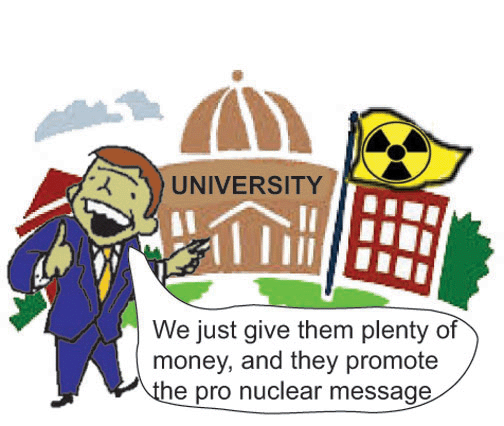
Overall, the NPS offers 4,001 Commonwealth supported places in STEM courses to help grow the skilled workforce required to deliver the AUKUS nuclear-powered submarine pathway, starting in 2024.
These places will be offered in identified priority areas including electrical engineering systems, mechanical engineering systems, chemical engineering systems, physics, chemistry, and mathematics and statistics.
Graduates from the NPS will form part of the future workforce needed to operate and build advanced technologies, including nuclear-powered submarines, that Australia will acquire from the United States and United Kingdom and build in South Australia.
The University of Melbourne students will study elective subjects including nuclear physics, Indo-Pacific relations and defence and legal policy. They will undertake an undergraduate science degree focusing on key areas in science and engineering needed to support the future workforce capabilities and then be eligible to transition straight into a postgraduate degree in engineering or science.
The first cohort will start in Semester 1, 2024. The program concludes in 2030………………………………………….
Professor Moira O’Bryan, Dean of the Faculty of Science, said: “The University of Melbourne is a strategic partner to the Australian government on issues of national importance. ………………. https://www.unimelb.edu.au/newsroom/news/2023/november/university-of-melbourne-welcomes-student-places-to-support-nuclear-powered-submarines-student-pathways
Have you noticed? The nuclear lobby is swamping the news media with its false “nuclear for climate”message

It’s a concerted effort.
It’s all over the media. Despite the obvious failure of small nuclear reactors.
Despite the fact that new nuclear reactors of any size will not be up and running in time to have any effect on global heating.
Yet the corporate media dutifully regurgitates these nuclear lies, all outlets using the same wording, the same optimistic “nuclear renaissance” lies
Who orchestrates this media blitz ? It could be the Atlas Network?

How wealthy countries, (like U.S., Canada, Australia, and Norway)evade responsibility for their fossil fuel exports
a remarkable new report from Oil Change International (OCI) found that those four countries (the U.S., Canada, Australia, and Norway), along with the U.K., account for just over half of the planned expansion in oil and gas between now and mid-century. In most cases the project licenses have already been granted, and unless officials intervene, the damage (enough carbon and methane to take us past the Paris climate targets) is locked in.
Bulletin, By Bill McKibben | November 30, 2023
When the world convenes in the United Arab Emirates for the next round of the endless climate slog, much attention will be paid to the pledges of individual nations to cut their emissions. This has been the basic scorecard of climate talks almost since the start. But it’s a wildly incomplete scorecard, in ways that are becoming ever clearer as we enter the endgame of the energy transition. We’ve been measuring it wrong.
That’s because a country’s exports of fossil fuel don’t count against its total. But it’s those exports that are driving fossil fuel expansion around the world, coming as they do from some of the most diplomatically powerful and wealthy nations on Earth.
To give the most obvious, and largest, example: the United States is, fitfully, cutting back on its carbon emissions; its envoys will be able to report, honestly, that the Inflation Reduction Act should soon actually be trimming our domestic use of oil, gas, and coal, as we subsidize heat pumps and build out EV charging networks. But at the very same moment, the U.S. production of fossil fuels is booming. That means, of course, that much of that supply is headed overseas.
And the numbers are truly staggering. If the liquefied natural gas (LNG) buildout continues as planned, for instance, by 2030 U.S. LNG exports will be responsible for more greenhouse gases than every house, car, and factory in the European Union. The emissions, under the U.N. accounting system, will show up on the scorecards of the EU and the dozens of mostly Asian nations that will buy the gas. But if you could see them in the atmosphere, they would be red, white, and blue.
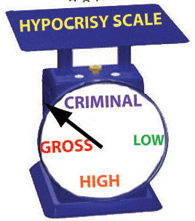
Exactly the same thing is true of a handful of other nations — in fact, some are even more grotesque in their hypocrisy, if not their impact. Norway has, arguably, done as good a job as any country on earth on moving past oil and gas; almost every new car in the country runs on electricity. But it’s planning one of the dozen biggest expansions in national oil and gas production, almost all of it for export. Canada and Australia fall into the same basket. Indeed, a remarkable new report from Oil Change International (OCI) found that those four countries (the U.S., Canada, Australia, and Norway), along with the U.K., account for just over half of the planned expansion in oil and gas between now and mid-century. In most cases the project licenses have already been granted, and unless officials intervene, the damage (enough carbon and methane to take us past the Paris climate targets) is locked in…………………………………………………………………………………………………….
the real question here may be, how do politics work? The fossil fuel industry demonstrated its firm grip on power in the U.S. in 2015 when it got the export ban lifted. Now the industry is flush with cash: Exxon reported a quarterly profit of $9.1 billion last month. It’s using its cash to buy up even more fracking real estate; clearly it concludes it has the political juice to enable it to face Biden down and keep on pumping gas for the planet.
………………………………. Canada’s huge contribution to our global crisis is its exports. Trudeau quite honestly summed up his nation’s position in 2017 in a talk to Texas oilmen, when he told the truth about the country’s vast tar sands complex: “No country would find 173 billion barrels of oil in the ground and just leave them there.” Canada couldn’t burn 173 billion barrels of oil if everyone in the country kept their car idling 24 hours a day, and they couldn’t burn the enormous quantity of natural gas that’s been found further north in Alberta if they all turned their thermostats to 115 and wore bathing suits all winter. That’s why they’re busy building pipelines to take the oil and the gas to the Pacific.
I could do the same math for Australia or the U.K. or Norway. No matter what they stand up and say in the UAE over the next month, remember: They’ve decided to hold a fire sale at the end of the world. https://thebulletin.org/2023/11/how-wealthy-countries-evade-responsibility-for-their-fossil-fuel-exports/?utm_source=Newsletter&utm_medium=Email&utm_campaign=ThursdayNewsletter11302023&utm_content=ClimateChange_WealthyCountries_11302023
The nuclear power renaissance has some way to run
EDF is vowing to build one reactor a year but challenges range from funding to a lack of skilled workers.
SARAH WHITE
https://www.ft.com/content/aaa33c5c-70e8-4f05-a45a-a45c7d2aba72 1 Dec 23
When France first hosted a nuclear power trade fair about a decade ago, in the wake of the Fukushima disaster, it was a low-key affair. Two years ago, organisers’ main worry was to avoid anti-nuclear protesters marring proceedings.
This week, the buzz at the vast salon on the outskirts of Paris was unequivocal. Miss America 2023, a nuclear engineering student, was on hand to help the event court the limelight, and champagne flowed on the stands displaying radioprotective gloves and designs for cutting-edge small reactors. The message was clear: nuclear power is back, and France, Europe’s atomic power champion with its 56 reactors, intends to be at the heart of this revival.
“We’re coming out of a period of taboos [over nuclear],” said Sylvie Bermann, a former French ambassador to China and Russia who heads the Paris show.
The industry and its low-emission technology would also have its moment for the first time at the COP28 climate summit in the United Arab Emirates, with a dedicated event, she added.
After years in the doldrums, mindsets over nuclear have shifted, spurred by climate worries and an energy crisis last year when Russia launched its full-scale invasion of Ukraine and cut gas supplies to Europe. Even Japan, home to the Fukushima meltdown of 2011, has restarted idled reactors, while a host of other nations are considering new plants, giving suppliers reasons to feel more optimistic.
What is less obvious will be the move from aspirations to reality, in a sector where building reactors is costly and slow, especially after decades without projects drained the industry of skilled workers.
Part of the promotional push by France and other pro-nuclear nations is aimed at solving some big obstacles. Chief among them, according to the head of the UN’s nuclear watchdog Rafael Grossi, is the financing, including from multilateral bodies.
Paris, which is riding high on recent EU wins to gain some subsidies for its existing plants, originally opposed by staunchly anti-nuclear Germany, has campaigned for instance for the European Investment Bank to help fund the construction of new reactors. “Nuclear has been constructed very fast when the money’s there,” said the International Atomic Energy Agency’s Grossi, citing the United Arab Emirates, which had gone from “zero to champions” in roughly eight years with a $20bn-plus project for four Korean-built reactors. They are almost all now online.
There’s also a lot to prove on the industrial front. France’s state-controlled nuclear power operator EDF aims to build roughly one 1.6 Gigawatt reactor a year once it gets going with its new orders for at least six new ones in France by the mid-2030s, according to chief executive Luc Rémont.
Considering its prototype in northern France known as Flamanville 3 has been 16 years in the making, it is an extremely ambitious goal. Rémont argues that parallel projects (the state-owned group is bidding for projects in India and the Czech Republic) would help EDF become better and faster.
There are other challenges. Many nations have long been dependent on Russian nuclear fuel, including the US reactor fleet, and finding sufficient alternative supplies could take years.
Meanwhile, the IAEA forecasts that over the next 20 years the industry’s share in the global energy mix — roughly 10 per cent of the world’s electricity generation today — will remain flat, if not decrease slightly, unless there are even more ambitious construction plans.
Developers argue, however, that the hardest battle is getting political buy-in to give them the visibility they need. Judging by the upbeat messaging coming out of Paris this week, that part of the complex nuclear equation at least is some way towards being solved.
1 This month

of the week – Australians for War Powers Reform (AWPR)
To see nuclear-related stories in greater depth and intensity
 Antinuclear