Nuclear, and climate, news to 4th December

Some bits of good news. England’s rainforests breathed easier. Treaty on the Prohibition of Nuclear Weapons: A Bright Constellation in a Very Dark Sky.
TOP STORIES
Plot to Triple Nuclear Power by 2050 Decried as ‘Dangerous Distraction’ at COP28.
Ralph Nader -on Israel’s Genocidal Antisemitism Against the Arab Civilians of Gaza.
Small modular nuclear reactors: a history of failure.
Drones Target Ukrainian, Russian Nuclear Facilities.
******************
Climate. “We cannot afford to have a bad COP” – Mary Robinson. COP28: UAE planned to use climate talks to make oil deals. Climate summit in an oil state: can COP28 change anything?Bah Humbug!– to COP Climate Conference sponsored by Dubai, an oil & natural gas nation. COP28: Hopes of fossil fuel ‘phase out’ hit by revelations of Saudi plan to boost oil demand. Cop28: what to expect from the Dubai climate change conference- (behind a pay wall, but read it on nuclear-news.net) How wealthy countries, l(ike U.S., Canada, Australia, and Norway), evade responsibility for their fossil fuel exports. Why the UN Report is right to say we’re heading for at least 3 degrees of warming. ‘Progress this decade is critical’: Why a 1.5C world hinges on doubling down on energy efficiency.
Christina notes. Have you noticed? The nuclear lobby is swamping the news media with its false “nuclear for climate”message. COP 28 A sorry tale of climate hypocrisy.
Nuclear. It’s full on nuclear propaganda time. It’s all in the wording. At COP 28, 20 countries signed up to promote nuclear. 179 COUNTRIES DID NOT SIGN UP TO PROMOTE NUCLEAR.
******************
AUSTRALIA. Sovereignty Surrendered: Subordinating Australia’s Defence Industry. Australia’s AUKUS nuclear submarines could fuel regional arms race despite assurance. Karina Lester addresses the Second Meeting of States Parties to the TPNW.
‘Part of a balanced mix’: Coalition continues nuclear energy push. Australia backs Cop28 promise to triple renewables but not nuclear capacity pledge. Online event: Heart of Country: online film screening and panel discussion.
******************
CLIMATE. DOUBLING DOWN ON NUCLEAR POWER IS NO SOLUTION TO CLIMATE CRISIS. Nuclear vs. Climate: Is nuclear power needed to contain the climate crisis? John Kerry at Cop28 to lobby for the nuclear industry. Nuclear lobby’s big push to ‘shine’ at COP28.
ECONOMICS.
- The nuclear power renaissance has some way to run.
- France goes for its own costly small nuclear reactor, following the USA NuScale flop, and UK’s lagging Rolls Royce one. French nuclear tax is leap into the dark – analysts. EDF to “build 1 reactor a year in 2030s” – CEO.
- The President of the Canadian Nuclear Safety Commission spent $288,000 on travel in 19 months. Hydro- Quebec decides against restarting Gentilly 2 nuclear station.
- NuScale cancels first planned SMR nuclear project due to lack of interest.
- Why Britain’s mini-nukes dream is hanging by a thread. Failure of USA’s NuScale small nuclear reactors (SMRs) not a good omen for Rolls Royce and other UK SMR developers. UK’s first small nuclear reactor deal ‘poised’ for signing but not with Rolls-Royce.
- Operators extend Finnish, Swedish nuclear reactor outages.
EMPLOYMENT. Swiss nuclear power plants are running out of staff.
ETHICS and RELIGION. Holy See advocates collaboration on nuclear disarmament.
LEGAL. Musk’s Lawsuit Is About Destroying Free Speech. Portland nuclear power startup NuScale hit with investor lawsuit.
NUCLEAR TECHNOLOGY. Nuclear Power Expansion Predictions Failed. SMRs two examples: NuScale in the US, NUWARD in France . Can thorium solve the nuclear problem? That’s doubtful.
OPPOSITION to NUCLEAR . Halt the US-Philippines Nuclear Deal –Sign on to Letter to US Congress – Full statement and sign on: tinyurl.com/haltUSPHdeal
PERSONAL STORIES. ‘Let us be a lesson’, say Kazakhs wary of return to nuclear testing.
POLITICS. UK government hopes that United Arab Emirates will invest in Sizewell C nuclear power plan. Energy-rich Scotland does not require any nuclear power stations. Nuclear energy in Philippines? Group says there’s not even a Filipino expert on safety, radiation. Sweden to slug tax-payers for the costs of small nuclear reactors, and big ones.
POLITICS INTERNATIONAL and DIPLOMACY. Second meeting of states parties agrees nuclear deterrence is the problem. UK’s Sizewell C Nuclear stake seized from China may go to United Arab Emirates. (behind a pay wall, but read it on nuclear-news.net) TELL THE UNITED ARAB EMIRATES NOT TO INVEST IN SIZEWELL C.
PUBLIC OPINION. Renewable or nuclear? What your energy preference says about you – public opinion.
SAFETY. Closer to nuclear plant than ever, latest Korean quake renews calls to retire aging reactors. Olkiluoto 3 nuclear power station shuts down again. Incidents. IAEA experts record explosions near two Ukrainian nuclear power plants. Zaporizhzhia nuclear plant suffered power outage, energy ministry says. Freezing consequences for Mississippi River as nuclear units down.
SPACE. EXPLORATION, WEAPONS. SpaceX rockets keep tearing blood-red ‘atmospheric holes’ in the sky, and scientists are concerned.
SPINBUSTER. Nuclear lobby’s latest gimmick – making nuclear BEAUTIFUL !
WASTES. A blank cheque for France’s Industrial Centre for Geological Disposal (Cigéo) does not prove that it is safe. How to Scrap the First-Ever Nuclear-Powered Aircraft Carrier: USS Enterprise? A sobering analysis of the Canadian plan for small modular nuclear reactors (SMRs) and their toxic waste problem..
WAR and CONFLICT. President Biden has morphed into the Murder Monster. The New York Times Reports Gaza Civilians ‘Are Being Killed at Historic Pace’. Israel’s Savagery Is So Shocking It’s Sometimes Hard To Take In.
A Nuclear Attack by Design — or by Accident — Must Never Happen. A planned US-Israeli attack on Iran is contemplated. AI and the Bomb: Nuclear Strategy and Risk in the Digital Age. URANIUM WARHEAD POISONING IS THE SPECIALTY OF US AGAINST RUSSIANS, ISRAEL AGAINST PALESTINIANS.
WEAPONS and WEAPONS SALES. US nuclear bombs ‘set to return to UK‘ for first time in 15 years – making Lakenheath a “nuclear target”. U.S. to Develop Unanticipated New Nuclear Bomb. Pentagon struggling to pay for Middle East buildup – Politico. The Military’s Big Bet on Artificial Intelligence. ‘The Gospel’: how Israel uses AI to select bombing targets in Gaza. US Sent Israel 15,000 Bombs Since October 7.
Australia’s AUKUS nuclear submarines could fuel regional arms race despite assurance
“AUKUS is designed to shore up American power in East Asia, not de-escalate tensions,”
By Su-Lin TanDec 4, 2023, https://johnmenadue.com/australias-aukus-nuclear-submarines-could-fuel-regional-arms-race-despite-assurance/
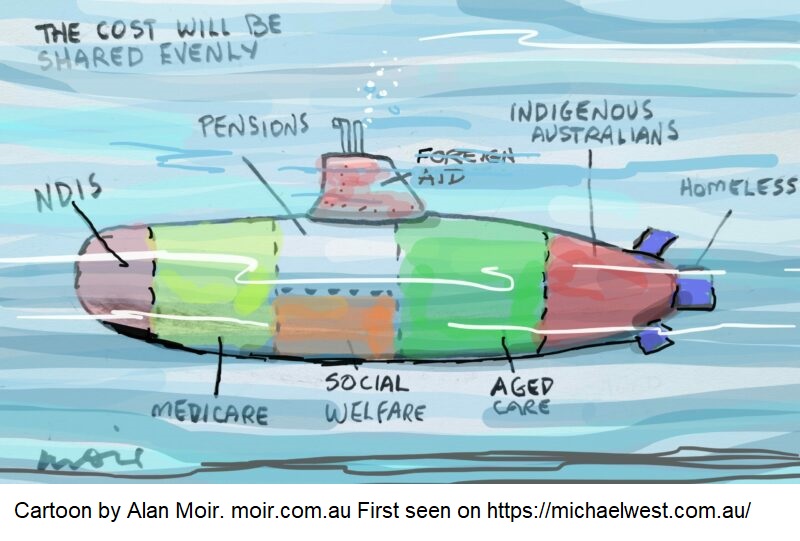
Defence Industry Minister Pat Conroy says Australia is not worsening the arms race and gives assurance about the submarines’ nuclear reactors. The deal could still spark a defence build-up in Asia-Pacific while Australia lacks the facilities to deal with nuclear waste, analysts say.
Australia may have asserted that its acquisition of nuclear-powered submarines under AUKUS is not aggravating the “arms race”, but the deal and the three-nation alliance could still fuel a defence build-up in the Asia-Pacific and heighten regional tensions, security analysts say.
At the national press club in Canberra on Tuesday, Australian Defence Industry Minister Pat Conroy reiterated the importance of the submarines to the country’s defence while debunking “myths” about the trilateral deal struck with Britain and the United States, which is largely seen as a countermeasure targeting China.
“The arms race is the greatest it’s been since 1945, and that is why I reject assertions … that Australia is somehow fuelling that arms race,” he said, adding that rising tensions in the Asia-Pacific had posed the most challenging strategic environment for Australia since World War II. “We are responding to it in a responsible and mature manner, like Australian governments should.”
Australia will own at least eight submarines over the next three decades through the A$368 billion (US$243 billion) deal. First announced in 2021 and finalised earlier this year, the controversial pact has raised concerns in the region.
Collin Koh, a senior fellow at the S. Rajaratnam School of International Studies in Singapore, said Conroy’s comment was not a surprise as countries including China and others in Asia-Pacific often couched their arms acquisitions in “defensive terms”.
Most countries would do so in the name of national security interests but it did not mean such actions ensured peace or safety, he said.
Even before AUKUS was announced in 2021, China and other regional countries had already embarked on significant military build-up since the 1990s, Koh said.
“Conroy may not be necessarily wrong to say AUKUS responds to this already ongoing condition, yet at the same time, it’s also not wrong to say that AUKUS … may not only be used by Beijing to legitimise its naval build-up, it also could be exploited as a justification for other regional countries’ military build-up programmes,” Koh said.
Australia’s acquisition of the submarines might trigger new problems as other countries could argue that they should also acquire similar capabilities, said Maria Rost Rublee, a nuclear politics expert at Monash University.
These countries are not limited to “dangerous actors”, for instance, in South Korea where the majority of its people have expressed a desire for their country to own nuclear weapons, Rublee added.
“Just having this type of technology in the hands of a country where you have strong popular support for nuclear weapons could be an issue,” she said.
In an analysis earlier this month, Ankit Panda, the Stanton Senior Fellow in the Nuclear Policy Programme at the Carnegie Endowment for International Peace, warned the accumulation of weapons such as missiles could potentially lead to unintended attacks.
“The Indo-Pacific region has entered a new missile age … each nation individually seeking deterrence while as a whole steering the region into ever more dangerous waters,” he said. “A particular risk concerns the prospects of attacks on the nuclear forces of countries like North Korea and China, by US or allied forces in ways that may not be intended.”
By the 2030s, the Indo-Pacific region would be “full of thousands of new missiles that can be expected to be used widely in the context of a major regional war”, Panda said.
Responding to Conroy’s comments, the national convenor of Labor Against War in Australia, Marcus Strom, said: “If your answer to growing regional tension is to add offensive weaponry, you create a logic towards war.
“AUKUS is designed to shore up American power in East Asia, not de-escalate tensions,” he added.
While Conroy has given assurances about the safety of sealed nuclear reactors within the submarines, analysts argued that the lack of facilities in Australia for the eventual disposal of these reactors is worrying.
“The strength of this agreement is that the reactor module comes to us sealed. It comes sealed, designed to be never opened over the life of a submarine. You don’t have to refuel it, you don’t have to insert new fuel rods … [over] the life of the submarine,” Conroy said.
But nuclear waste expert Ian Lowe said in an analysis on The Conversation website earlier this year that Australia has failed for decades to find long-term storage solutions for small quantities of low- and intermediate-level nuclear waste.
Even Australia’s allies and AUKUS partners, the US and the UK, do not have long-term solutions for nuclear waste storage, according to Lowe.
“This should be concerning. To manage the waste from our proposed nuclear submarines properly, we’ll have to develop systems and sites which do not currently exist in Australia,” Lowe said.
Australian states such as Victoria, Queensland and South Australia have said they would not accept a nuclear waste facility within their borders.
While it will be another 30 years before Australia has to worry about dumping the submarine’s nuclear reactors, it is not a long time, Rublee said.
“If they take their nuclear stewardship obligations seriously, they must immediately begin working on the long-term storage of high-level nuclear waste,” she added.
‘Part of a balanced mix’: Coalition continues nuclear energy push.

They did it with the “Voice to Parliament referendum – Dutton and the rest of the mindless right-wing dinosaurs just kept to the script (written for them by the ATLAS network) – “If you don’t know. vote No“
That was a meaningless lie. (If you didn’t know, it should be Undecided)
Now the nuclear lobby comes up with “Part of a balanced mix”. Nothing balanced about including super-expensive, dangerous, ever too late-for-climate nuclear power into climate action strategies.
ABC Listen 4 Dec 23, Thousands have gathered in Dubai this week for the COP28 climate summit, with more than 100 countries this year pledging to triple world renewable energy use by 2030.
20 countries have also pledged to triple nuclear energy capacity by 2050, a move the opposition Climate Change spokesperson Ted O’Brien supports, but still can’t say how much it would cost taxpayers to build.
Australia backs Cop28 promise to triple renewables but not nuclear capacity pledge
More than 115 countries vow to triple renewable energy capacity by 2030 – though not China and India
Adam Morton and Katharine Murphy, Guardian, Sun 3 Dec 2023
Australia has backed a pledge at Cop28 climate summit to triple global renewable energy capacity and double the annual rate of energy efficiency improvements by 2030.
The climate change minister, Chris Bowen, said the Albanese government had joined 117 other countries in making the pledge, reiterating an agreement reached by G20 countries in September.
The renewable energy agreement was one of a series of headline declarations made as more than 100 global leaders arrived in the United Arab Emirates for the opening days of the two-week conference.
Anthony Albanese is not attending, and Bowen is not due to fly to Dubai until later this week for the event’s final week, when ministers will attempt to wrangle a consensus position on how to lift action to tackle the climate crisis in the face of rising geopolitical tensions. Australia was represented at the opening plenary by its climate change ambassador, Kristin Tilley.
Bowen said Australia had joined other major energy exporters, including the US, Canada and Norway, in supporting the renewables and energy efficiency push.
“We know that renewables are the cleanest and cheapest form of energy, and that energy efficiency can also help drive down bills and emissions,” he said in a statement. “For emissions to go down around the world, we need a big international push. Australia has the resources and the smarts to help supply the world with clean energy technologies to drive down those emissions while spurring new Australian industry.”
The renewable energy pledge was welcomed by climate campaigners and analysts. Tim Buckley, director of the independent think tank Clean Energy Finance, said it was excellent to see Australia backing the commitment. He said falling costs had made the transition to renewables “an entirely economically sensible and viable commitment”………………………………………………………………………..
Australia is the chair of the “umbrella group” of countries at the talks, which includes the US, UK, New Zealand, Canada, Ukraine, Israel and Norway. Bowen said he intended “to be quite an active chair” and that meant “bringing other countries with us” to help reach a consensus.
An initial draft Cop text released on Saturday listed included a range of expressions to be debated, including that either fossil fuels or coal should be “phased out” or “phased down”. The same applied to fossil fuel subsidies. Saudi Arabia, China and India have previously resisted calls to agree that all fossil fuels should be phased out.
Australia was also among more than 100 countries to back declarations pledging to strengthen climate action in healthcare and farming. It did not sign up to a commitment by 22 countries, including the US, Canada, Japan and Britain, to triple nuclear energy capacity by 2050.
The Albanese government is hoping to win support for Australia to host Cop31 in 2026 with Pacific countries, but it is unclear whether a decision will be made in Dubai. The UN climate process faces a more pressing decision on where next year’s annual summit will be held. It is due to be hosted in eastern Europe but Russia has blocked agreement on which country will take the reins.
Plot to Triple Nuclear Power by 2050 Decried as ‘Dangerous Distraction’ at COP28

“Investing now in nuclear energy is an inefficient route to take to reduce emissions at the scale and pace needed to tackle climate change,” said one campaigner.
JON QUEALLY, Dec 02, 2023
Climate campaigners scoffed Saturday at a 22-nation pledge to triple nuclear power capacity by mid-century as a way to ward off the increasing damage of warming temperatures, with opponents calling it a costly and “dangerous” distraction from the urgent need for a fossil fuel phaseout alongside a rapid increase in more affordable and scaleable renewable sources such as wind and solar.
The Declaration to Triple Nuclear Energy—backed by the United States, Canada, France, the Czech Republic, and others—was announced as part of the Climate Action Summit taking place in Dubai as a part of the two-week U.N. climate talks known as COP28.
While the document claims a “key role” for nuclear energy to keep “a 1.5°C limit on temperature rise within reach” by 2050 and to help attain the so-called “net-zero emissions” goal that governments and the fossil fuel industry deploy to justify the continued burning of coal, oil, and gas, critics say the false solution of atomic power actually harms the effort to reduce emissions by wasting precious time and money that could be spent better and faster elsewhere.
“There is no space for dangerous nuclear power to accelerate the decarbonization needed to achieve the Paris climate goal,” said Masayoshi Iyoda, a 350.org campaigner in Japan who cited the 2011 Fukushima disaster as evidence of the inherent dangers of nuclear power.
Nuclear energy, said Iyoda, “is nothing more than a dangerous distraction. The attempt of a ‘nuclear renaissance’ led by nuclear industries’ lobbyists since the 2000s has never been successful—it is simply too costly, too risky, too undemocratic, and too time-consuming. We already have cheaper, safer, democratic, and faster solutions to the climate crisis, and they are renewable energy and energy efficiency.”
When word of the multi-nation pledge emerged last month, Mark Jacobson, professor of civil and environmental engineering at Stanford University and co-founder of The Solutions Project which offers a roadmap for 100% renewable energy that excludes nuclear energy, called the proposal the “stupidest policy proposal I’ve ever seen.”
Jacobson said the plan to boost nuclear capacity in a manner to avert the worst impacts of the climate crisis “will never happen no matter how many goals are set” and added that President Joe Biden was getting “bad advice in the White House” for supporting it.
In comments from Dubai, U.S. climate envoy John Kerry said that while he agrees nuclear will be a “sweeping alternative to every other energy source,” but claimed that “science and the reality of facts” shows the world cannot “get to net-zero by 2050 with some nuclear.”
Numerous studies and blueprints towards a renewable energy future, however, have shown this is not established fact, but rather the position taken by both the nuclear power industry itself and those who would otherwise like to slow the transition to a truly renewable energy system.
Pauline Boyer, energy transition campaign manager with Greenpeace France, said the scientific evidence is clear and it is not in favor of a surge in nuclear power.
“If we wish to maintain a chance of a trajectory of 1.5°C, we must massively reduce greenhouse gas emissions over the coming years, but nuclear power is too slow to deploy in the face of the climate emergency,” she said.
Climate campaigners scoffed Saturday at a 22-nation pledge to triple nuclear power capacity by mid-century as a way to ward off the increasing damage of warming temperatures, with opponents calling it a costly and “dangerous” distraction from the urgent need for a fossil fuel phaseout alongside a rapid increase in more affordable and scaleable renewable sources such as wind and solar.
The Declaration to Triple Nuclear Energy—backed by the United States, Canada, France, the Czech Republic, and others—was announced as part of the Climate Action Summit taking place in Dubai as a part of the two-week U.N. climate talks known as COP28.
While the document claims a “key role” for nuclear energy to keep “a 1.5°C limit on temperature rise within reach” by 2050 and to help attain the so-called “net-zero emissions” goal that governments and the fossil fuel industry deploy to justify the continued burning of coal, oil, and gas, critics say the false solution of atomic power actually harms the effort to reduce emissions by wasting precious time and money that could be spent better and faster elsewhere.
“There is no space for dangerous nuclear power to accelerate the decarbonization needed to achieve the Paris climate goal,” said Masayoshi Iyoda, a 350.org campaigner in Japan who cited the 2011 Fukushima disaster as evidence of the inherent dangers of nuclear power.
“There is no space for dangerous nuclear power to accelerate the decarbonization needed to achieve the Paris climate goal.”
Nuclear energy, said Iyoda, “is nothing more than a dangerous distraction. The attempt of a ‘nuclear renaissance’ led by nuclear industries’ lobbyists since the 2000s has never been successful—it is simply too costly, too risky, too undemocratic, and too time-consuming. We already have cheaper, safer, democratic, and faster solutions to the climate crisis, and they are renewable energy and energy efficiency.”
When word of the multi-nation pledge emerged last month, Mark Jacobson, professor of civil and environmental engineering at Stanford University and co-founder of The Solutions Project which offers a roadmap for 100% renewable energy that excludes nuclear energy, called the proposal the “stupidest policy proposal I’ve ever seen.”
Jacobson said the plan to boost nuclear capacity in a manner to avert the worst impacts of the climate crisis “will never happen no matter how many goals are set” and added that President Joe Biden was getting “bad advice in the White House” for supporting it.
In comments from Dubai, U.S. climate envoy John Kerry said that while he agrees nuclear will be a “sweeping alternative to every other energy source,” but claimed that “science and the reality of facts” shows the world cannot “get to net-zero by 2050 with some nuclear.”
Numerous studies and blueprints towards a renewable energy future, however, have shown this is not established fact, but rather the position taken by both the nuclear power industry itself and those who would otherwise like to slow the transition to a truly renewable energy system.
Pauline Boyer, energy transition campaign manager with Greenpeace France, said the scientific evidence is clear and it is not in favor of a surge in nuclear power.
“If we wish to maintain a chance of a trajectory of 1.5°C, we must massively reduce greenhouse gas emissions over the coming years, but nuclear power is too slow to deploy in the face of the climate emergency,” she said.
“The announcement of a tripling of capacities is disconnected from reality,” Boyer continued. Citing delays and soaring costs, she said the nuclear industry “is losing ground in the global energy mix every day” in favor of renewable energy options that are cheaper, quicker to deploy, and more accessible to developing countries.
Climate campaigners scoffed Saturday at a 22-nation pledge to triple nuclear power capacity by mid-century as a way to ward off the increasing damage of warming temperatures, with opponents calling it a costly and “dangerous” distraction from the urgent need for a fossil fuel phaseout alongside a rapid increase in more affordable and scaleable renewable sources such as wind and solar.
The Declaration to Triple Nuclear Energy—backed by the United States, Canada, France, the Czech Republic, and others—was announced as part of the Climate Action Summit taking place in Dubai as a part of the two-week U.N. climate talks known as COP28.
While the document claims a “key role” for nuclear energy to keep “a 1.5°C limit on temperature rise within reach” by 2050 and to help attain the so-called “net-zero emissions” goal that governments and the fossil fuel industry deploy to justify the continued burning of coal, oil, and gas, critics say the false solution of atomic power actually harms the effort to reduce emissions by wasting precious time and money that could be spent better and faster elsewhere.
“There is no space for dangerous nuclear power to accelerate the decarbonization needed to achieve the Paris climate goal,” said Masayoshi Iyoda, a 350.org campaigner in Japan who cited the 2011 Fukushima disaster as evidence of the inherent dangers of nuclear power.
“There is no space for dangerous nuclear power to accelerate the decarbonization needed to achieve the Paris climate goal.”
Nuclear energy, said Iyoda, “is nothing more than a dangerous distraction. The attempt of a ‘nuclear renaissance’ led by nuclear industries’ lobbyists since the 2000s has never been successful—it is simply too costly, too risky, too undemocratic, and too time-consuming. We already have cheaper, safer, democratic, and faster solutions to the climate crisis, and they are renewable energy and energy efficiency.”
When word of the multi-nation pledge emerged last month, Mark Jacobson, professor of civil and environmental engineering at Stanford University and co-founder of The Solutions Project which offers a roadmap for 100% renewable energy that excludes nuclear energy, called the proposal the “stupidest policy proposal I’ve ever seen.”
Jacobson said the plan to boost nuclear capacity in a manner to avert the worst impacts of the climate crisis “will never happen no matter how many goals are set” and added that President Joe Biden was getting “bad advice in the White House” for supporting it.
In comments from Dubai, U.S. climate envoy John Kerry said that while he agrees nuclear will be a “sweeping alternative to every other energy source,” but claimed that “science and the reality of facts” shows the world cannot “get to net-zero by 2050 with some nuclear.”
Numerous studies and blueprints towards a renewable energy future, however, have shown this is not established fact, but rather the position taken by both the nuclear power industry itself and those who would otherwise like to slow the transition to a truly renewable energy system.
Pauline Boyer, energy transition campaign manager with Greenpeace France, said the scientific evidence is clear and it is not in favor of a surge in nuclear power.
“If we wish to maintain a chance of a trajectory of 1.5°C, we must massively reduce greenhouse gas emissions over the coming years, but nuclear power is too slow to deploy in the face of the climate emergency,” she said.
“The announcement of a tripling of capacities is disconnected from reality,” Boyer continued. Citing delays and soaring costs, she said the nuclear industry “is losing ground in the global energy mix every day” in favor of renewable energy options that are cheaper, quicker to deploy, and more accessible to developing countries.
In 2016, researchers at the University of Sussex and the Vienna School of International Studies showed that “entrenched commitments to nuclear power” were likely “counterproductive” towards achieving renewable energy targets, especially as “better ways to meet climate goals”—namely solar, wind, geothermal, and hydropower–were suppressed.
In response to Saturday’s announcement, Soraya Fettih, a 350.org campaigner from France, which relies heavily on nuclear power, said it’s simply a move in the wrong direction. “Investing now in nuclear energy is an inefficient route to take to reduce emissions at the scale and pace needed to tackle climate change,” said Fettih. “Nuclear energy takes much longer than renewable energy to be operational.”
Climate campaigners scoffed Saturday at a 22-nation pledge to triple nuclear power capacity by mid-century as a way to ward off the increasing damage of warming temperatures, with opponents calling it a costly and “dangerous” distraction from the urgent need for a fossil fuel phaseout alongside a rapid increase in more affordable and scaleable renewable sources such as wind and solar.
The Declaration to Triple Nuclear Energy—backed by the United States, Canada, France, the Czech Republic, and others—was announced as part of the Climate Action Summit taking place in Dubai as a part of the two-week U.N. climate talks known as COP28.
While the document claims a “key role” for nuclear energy to keep “a 1.5°C limit on temperature rise within reach” by 2050 and to help attain the so-called “net-zero emissions” goal that governments and the fossil fuel industry deploy to justify the continued burning of coal, oil, and gas, critics say the false solution of atomic power actually harms the effort to reduce emissions by wasting precious time and money that could be spent better and faster elsewhere.
“There is no space for dangerous nuclear power to accelerate the decarbonization needed to achieve the Paris climate goal,” said Masayoshi Iyoda, a 350.org campaigner in Japan who cited the 2011 Fukushima disaster as evidence of the inherent dangers of nuclear power.
“There is no space for dangerous nuclear power to accelerate the decarbonization needed to achieve the Paris climate goal.”
Nuclear energy, said Iyoda, “is nothing more than a dangerous distraction. The attempt of a ‘nuclear renaissance’ led by nuclear industries’ lobbyists since the 2000s has never been successful—it is simply too costly, too risky, too undemocratic, and too time-consuming. We already have cheaper, safer, democratic, and faster solutions to the climate crisis, and they are renewable energy and energy efficiency.”
When word of the multi-nation pledge emerged last month, Mark Jacobson, professor of civil and environmental engineering at Stanford University and co-founder of The Solutions Project which offers a roadmap for 100% renewable energy that excludes nuclear energy, called the proposal the “stupidest policy proposal I’ve ever seen.”
Jacobson said the plan to boost nuclear capacity in a manner to avert the worst impacts of the climate crisis “will never happen no matter how many goals are set” and added that President Joe Biden was getting “bad advice in the White House” for supporting it.
In comments from Dubai, U.S. climate envoy John Kerry said that while he agrees nuclear will be a “sweeping alternative to every other energy source,” but claimed that “science and the reality of facts” shows the world cannot “get to net-zero by 2050 with some nuclear.”
Numerous studies and blueprints towards a renewable energy future, however, have shown this is not established fact, but rather the position taken by both the nuclear power industry itself and those who would otherwise like to slow the transition to a truly renewable energy system.
Pauline Boyer, energy transition campaign manager with Greenpeace France, said the scientific evidence is clear and it is not in favor of a surge in nuclear power.
“If we wish to maintain a chance of a trajectory of 1.5°C, we must massively reduce greenhouse gas emissions over the coming years, but nuclear power is too slow to deploy in the face of the climate emergency,” she said.
“The announcement of a tripling of capacities is disconnected from reality,” Boyer continued. Citing delays and soaring costs, she said the nuclear industry “is losing ground in the global energy mix every day” in favor of renewable energy options that are cheaper, quicker to deploy, and more accessible to developing countries.
In 2016, researchers at the University of Sussex and the Vienna School of International Studies showed that “entrenched commitments to nuclear power” were likely “counterproductive” towards achieving renewable energy targets, especially as “better ways to meet climate goals”—namely solar, wind, geothermal, and hydropower–were suppressed.
In response to Saturday’s announcement, Soraya Fettih, a 350.org campaigner from France, which relies heavily on nuclear power, said it’s simply a move in the wrong direction. “Investing now in nuclear energy is an inefficient route to take to reduce emissions at the scale and pace needed to tackle climate change,” said Fettih. “Nuclear energy takes much longer than renewable energy to be operational.”
Writing on the subject in 2019, Harvard University professor Naomi Orseskes and renowned author and psychohistorian Robert Jay Lifton observed how advocates of nuclear power declare the technology “clean, efficient, economical, and safe” while in reality “it is none of these. It is expensive and poses grave dangers to our physical and psychological well-being.”
“There are now more than 450 nuclear reactors throughout the world,” they wrote at the time. “If nuclear power is embraced as a rescue technology, there would be many times that number, creating a worldwide chain of nuclear danger zones—a planetary system of potential self-annihilation.”
Nuclear lobby’s latest gimmick – making nuclear BEAUTIFUL !

Making nuclear power plants look great, World Nuclear News, 01 December 2023

They must be desperate. They’ve tried – renewable, -clean, – safe – cheap, – nothing-to-do-with weapons
They’re still lying their heads off about –fixes climate change
Nobody believes them. Now they’re going for beautiful and feel-good.
Good luck with that.
Amber Rudd, a previous UK Minister for Energy tried that, years ago, and it went down like a lead balloon.
We hear from an award-winning architect on the benefits of designing nuclear power plants that make people feel good ..
Technology and function, ensuring their reliable and safe operation have long been the priorities when designing nuclear power plants. But why can’t they look beautiful too? Dutch architect and designer Erick van Egeraat says that part of the way to continue to build public support for nuclear energy is to make nuclear power plants look good, “to make people feel good” when they see them.
The award-winning professor and director of Design Erick van Egeraat outlined his thinking at World Nuclear Symposium, explaining the background to the work he is doing at Akkuyu nuclear power plant, which is being built in Turkey.
Israel Planning for Gaza War To Last Over a Year

In either case, the Israeli military operations have killed more children, at least 6,000, than members of Hamas.
https://news.antiwar.com/2023/12/01/israel-planning-for-gaza-war-to-last-over-a-year/
One source said, “This will be a very long war . . . We’re currently not near halfway to achieving our objectives.”
The Financial Times reported speaking with sources who said that Israel plans to wage war on Gaza for over a year. In a little less than two months, Israel has killed at least 15,000 people, damaged 100,000 buildings, displaced 1.7 million Palestinians, and destroyed most of Gaza’s medical facilities.
On Friday, FT reported sources said Israel was preparing for a multi-phase conflict in Gaza that will last at least a year. “This will be a very long war…We’re currently not near halfway to achieving our objectives,” said one person familiar with the Israeli war plans.
According to the sources, Israel’s goals include “killing the three top Hamas leaders — Yahya Sinwar, Mohammed Deif, and Marwan Issa — while securing a decisive military victory against the group’s 24 battalions and underground tunnel network and destroying its governing capability in Gaza.”
Israel does not appear close to achieving these goals. US sources have said that Israel’s military operations in Gaza have failed to impact high or even mid-level Hamas members. On Sunday, the Guardian reported that Israeli officials estimated that 1,000 – 2,000 Hamas members had been killed. However, FT spoke with an Israeli military source who gave an estimate of 5,000 dead Hamas members. It is unclear why there is such a large discrepancy in the numbers, as both were given during the week-long pause in fighting.
In either case, the Israeli military operations have killed more children, at least 6,000, than members of Hamas. The massive civilian toll has led to mounting world opinion against Israeli military operations.

Secretary of State Antony Blinken attended a meeting of the Israeli war cabinet on Thursday and warned that Tel Aviv will lose more international support as the conflict continues. Gen. Herzi Halevi, the Israeli Defense Forces (IDF) chief of staff, said military operations in Gaza will take “more than a few additional weeks,” suggesting Tel Aviv did not plan to follow Washington’s advice. Still, America’s top diplomat said Washington was still firmly committed to arming Tel Aviv.
The first phase of the war, an intense bombing campaign and ground invasion, is expected to last well into 2024. One source said the first phase of the war is about 40% complete. “Gaza City isn’t finished yet, nor fully conquered. It’s probably 40% done,” the person explained. “For the north as a whole, it will probably require another two weeks to a month.”
The second phase will be an operation with fewer military operations aimed at stabilizing Gaza. While the sources told FT that the second phase is projected to continue until late 2024, Israeli officials say they cannot predict a firm endpoint to the conflict.
The Biden administration has pushed Israeli Prime Minister Benjamin Netanyahu to agree to allow the Palestinian Authority to control Gaza after Hamas is defeated. However, one source told FT that Tel Aviv will not listen to Washington, even as the US provides Israel with billions of dollars in weapons. “No one, not even the US, can talk to them about this,” said one of the sources familiar with the matter. That person emphasized that this point was crucial to Netanyahu keeping his far-right war cabinet together.
1 This month

of the week – Australians for War Powers Reform (AWPR)
To see nuclear-related stories in greater depth and intensity
 Antinuclear