Dutton takes the nuclear option

Despite his enthusiasm, Peter Dutton has been reluctant to explain which electorates would host the reactors, where the waste would be stored, or how to pay for the proposal, with experimental micro-reactors in Russia, China and the USA all facing major cost blowouts and delays, despite massive amounts of government assistance.
By David Lowe, December 18, 2023, https://www.echo.net.au/2023/12/dutton-takes-the-nuclear-option/
The Coalition has produced a policy! Don’t get too excited – this policy is recycled, and not in a good way – in fact it’s radioactive. Like Robert Menzies, John Howard and Tony Abbott before him, Peter Dutton wants to legalise nuclear electricity generation in Australia.
After lambasting Labor for the emissions caused by Climate Change Minister Chris Bowen attending COP28, the Liberal and National parties sent not one, not two, but seven elected representatives to the Dubai conference, or at least a sideline event designed to boost the interests of the nuclear industry. That well-known international energy expert, Lismore’s own Kevin Hogan, was one of those who joined the junket.
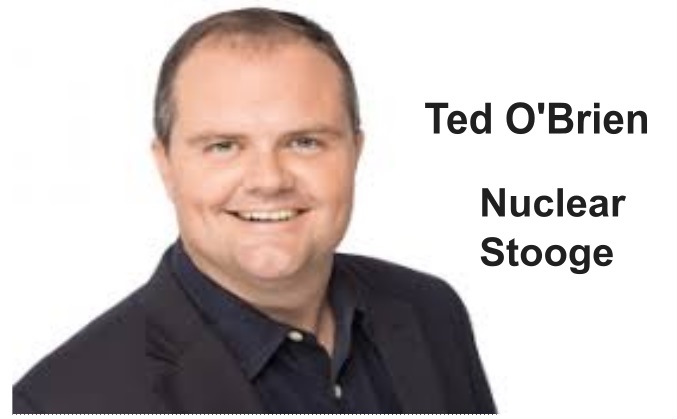
The group was led by the opposition’s climate change and energy spokesperson, Queenslander Ted O’Brien, who declared ‘COP28 will be known as the nuclear COP’, despite the fact that only 11 percent of countries at the Dubai talks agreed it was a good idea to triple nuclear power by 2050 as a response to the climate emergency. Apparently not everyone finds it as easy as the Coalition to forget Chernobyl, Fukushima and Three Mile Island.

The Liberals and Nationals were in the UAE at the behest of the World Nuclear Association and the Orwellian-sounding Coalition for Conservation, which has a stated goal to ‘reduce emissions and protect the environment’, as long as obvious solutions like renewable energy and reducing energy consumption are not involved.
Smoke ’em if you’ve got ’em
As part of his ongoing quest for relevance and media attention, Peter Dutton’s enthusiasm for nuclear energy has been steadily growing over the last couple of years, particularly in the form of Small (don’t be scared!) Modular Reactors, which he’s suggested might be built on defunct coal power generation sites, using plentiful Australian uranium.
The opposition leader appears to have been heartened by Labor’s wholehearted support of Scott Morrison’s very expensive AUKUS submarine thought bubble, which has further opened the nuclear crack in this country. The Nationals’ David Littleproud has jumped happily on board, saying the market should decide what sort of power generation we have in Australia, not the government.
Chris Bowen has called the Coalition’s nuclear boosters post-truth ‘climate charlatans’ with Prime Minister Anthony Albanese describing the nuclear debate as ‘a huge distraction from what we need to do’. Former PM Malcolm Turnbull and former NSW Liberal treasurer Matt Kean are also public nuclear sceptics.
As Teals-backer Simon Holmes a Court put it last week, ‘We could throw a trillion dollars at SMRs today, and they still wouldn’t be operating in the time that we need the energy to replace the coal power stations that have reached end of life.’
Despite his enthusiasm, Peter Dutton has been reluctant to explain which electorates would host the reactors, where the waste would be stored, or how to pay for the proposal, with experimental micro-reactors in Russia, China and the USA all facing major cost blowouts and delays, despite massive amounts of government assistance.
The bottom line
The CSIRO has recently said there’s no way that small modular reactors can compete economically with the plummeting costs of renewable energy technology, even without considering the political and environmental issues. Their latest detailed report found that small reactors would cost up to twice as much per kilowatt-hour as large nuclear reactors. Renewable power, by contrast, costs one eighth as much.
US and UK nuclear waste coming to Australia

A ‘low-level radioactive waste management’ facility is planned for near Perth and US and UK nuclear waste could be stored here as early as 2027, and the latest Newspoll has Labor leading the Coalition 52% to 48% two-party-preferred.
Crikey EMMA ELSWORTHYDEC 18, 2023
DUMPED ON
Australia could start taking radioactive waste from the US and UK as early as 2027, Rex Patrick writes for Michael West Media after FOI-ing documents from Defence, which is somewhat at odds with Defence Minister Richard Marles’ insistence that Australia will not be taking US or UK nuclear waste. The ABC continues that a “low-level radioactive waste management” facility is being planned in Perth, with Australian Submarine Agency briefing documents confirming: “All low- and intermediate-level radioactive waste will be safely stored at Defence sites in Australia.” As many as 700 US personnel will head there to look after up to four US nuclear submarines too — there will be fewer British with shorter rotations, however……….. (Subscribers only) more https://www.crikey.com.au/2023/12/18/us-uk-nuclear-waste-australia/
What I want for Christmas – for people, especially the media, to tell the truth a bit more often.

I was 7 when I discovered that Father Christmas was not real. Yes, a bit slow indeed. I felt so betrayed that my parents had lied to me. At least it solved the mystery of why I (badly behaved) got beaut presents, and my best friend (well behaved) got little ones. Twas all about the money available in each household, not about being naughty or nice.
The world, especially my world – the “Western world” continues to perpetrate comfortable weasel words and downright lies. And it all goes a bit crazy at this time of year - the addiction to rampant consumerism taking precedence over spending lovely times with family and friends.
Some of my favourite current lies. Top lie is ‘THE CLOUD’, and “CLOUD COMPUTING”. The only genuine cloud here is the veil of lies that covers the truth about the digital system – uncontrolled spread of steel and concrete datafarm monstrosities, guzzling water and electricity.
Then there are all the military lies and euphemisms “collateral damage” “special military operation” . In the case of the Israeli obliteration of Palestinians – there are the “targeting Hamas, not Palestinions” , “right to self-defence” , ”saving civilian lives” ”lowering the intensity” – when what is really meant is genocide.
Climate change action – is full of dubiously worded stuff, vaguely worded COP 28 statements with no effective target or date to “transition away from fossil fuels”- and “transitional fuels can play a role”
Then there are the obfuscations, weasel words, and downright lies of the nuclear lobby – “clean” “green” “sustainable” “low carbon” “low cost” ………….
So, for Christmas and the New Year, it would be nice to read and hear some straight words that actually match the facts.
Price Waterhouse Cooper’s (PWC’s) $8m nuclear submarine payday revealed

18 DECEMBER 2023, By: Liam Garman, https://www.defenceconnect.com.au/naval/13341-pwc-s-8-million-nuclear-submarine-payday-revealed
Talking points prepared for Vice Admiral Jonathan Mead, director general of the Australian Submarine Agency, on the Nuclear-Powered Submarine Taskforce’s engagement with the embattled professional services firm have come to light following a freedom of information request from former independent senator Rex Patrick.
Information seen by Defence Connect have detailed two separate contracts between the Nuclear-Powered Submarine Taskforce and the consulting firm via the Defence Support Services Panel.
In total, Defence spent $8,055,928.56 with PwC between 2021 and 2023, with one contract phase costing Defence $560,142.57 for just 12 weeks of consulting work.
The revelation comes as PwC grapples with the fallout of the widely reported tax scandal in early 2023, which saw senior partners at the firm share confidential Commonwealth information with clients to avoid paying tax.
Leaked internal emails from PwC showed that confidential tax information was shared with over 50 of the company’s partners, some of whom then used the information to approach 14 global companies.
The talking points sourced by former South Australian independent senator Rex Patrick were developed for the head of the ASA, Vice Admiral Mead, for budget estimates, who justified the engagements, outlining that “value for money was a core consideration in the Nuclear-Powered Submarine Taskforce’s engagement of PwC”.
The ASA has not engaged with PwC since its creation on 1 July 2023.
Speaking to Defence Connect, an ASA spokesperson explained the taskforce’s engagement with PwC: “The Nuclear-Powered Submarine Taskforce entered into two contracts with PwC, during the 18-month consultation period.
At no time was PwC briefed into any security compartment, nor were they part of any development of the Optimal Pathway during the 18-month consultation period.”
The contracts were awarded to support the development of a domestic nuclear-powered submarine industry and included $5,275,135.90 for the development of Program Management Office (PMO) artefacts, scheduling support, program development and management, and “governance mechanisms”.
The second contract, valued at a total $2,780,792.66, was for the delivery of an enterprise-wide solution on the reporting of workforce demographics, and supported the development and implementation of a workforce support concept development plan.
At its time of writing, the talking points detailed that the Australian Submarine Agency had five ongoing consulting contracts valued at $2.756 million with KPMG and Deloitte.
More to follow.
Nuclear expert Mycle Schneider on the COP28 pledge to triple nuclear energy production: ‘Trumpism enters energy policy’

The entire logic that has been built up for small modular reactors is with the background of climate change emergency. That’s the big problem we have………………… Climate change emergency contains the notion of urgency. And so we are talking about something where the time factor needs to kick in………………….. And if we are talking about SMRs picking up any kind of substantial amounts of generating capacity in the current market, if ever, we’re talking about the 2040s at the very earliest.
Now, we’re talking of tens of $billions that are going into subsidizing nuclear energy, especially as I said existing nuclear power plants.
The pledge was worded as a commitment “to work together to advance a global aspirational goal of tripling nuclear energy capacity from 2020 by 2050″………… “This pledge is completely, utterly unrealistic.”…………………….“It’s like Trumpism enters energy policy.”
The Bulletin, By François Diaz-Maurin | December 18, 2023
Last week, a group of independent energy consultants and analysts released the much-anticipated 2023 edition of the World Nuclear Industry Status Report 2023 (WNISR). In over 500 pages, the report provides a detailed assessment of the status and trends of the international nuclear industry, covering more than 40 countries. Now in its 18th edition, the report is known for its fact-based approach providing details on operation, construction, and decommissioning of the world’s nuclear reactors. Although it regularly points out failings of the nuclear industry, it has become a landmark study, widely read within the industry. Its release last week was covered by major energy and business news media, including Reuters (twice) and Bloomberg.
On December 2, the United States and 21 other countries pledged to triple the global nuclear energy capacity by 2050. The declaration, made during the UN climate summit of the 28th Conference of the Parties (COP28) in Dubai, United Arab Emirates, sought to recognize “the key role of nuclear energy in achieving global net-zero greenhouse gas emissions-carbon neutrality by or around mid-century and in keeping a 1.5-degree Celsius limit on temperature rise within reach.” The pledge was worded as a commitment “to work together to advance a global aspirational goal of tripling nuclear energy capacity from 2020 by 2050.” It was aspirational—and ambitious.
To discuss this pledge against the nuclear industry’s current trends and status, I sat down with Mycle Schneider, lead author of the World Nuclear Industry Status Report.
………… Diaz-Maurin: It’s undoubtedly a landmark report. With over 500 pages, it’s also massive. In a nutshell, what should our readers know about the main developments in the world nuclear industry over the past year?
Schneider: It really depends on from which angle you approach the issue. I think, overall, the mind-boggling fact is that the statistical outcome of this analysis is dramatically different from the perception that you can get when you open the newspapers or any kind of media reporting on nuclear power. Everybody gets the impression that this is kind of a blooming industry and people get the idea that there are nuclear power plants popping up all over the world.
But what we’ve seen is that some of the key indicators are showing a dramatic decline. In fact, the share of nuclear power in the world commercial electricity mix has been dropping by almost half since the middle of the 1990s. And the drop in 2022 was by 0.6 percentage points, which is the largest drop in a decade, since the post-Fukushima year 2012.
We have seen a four percent drop in electricity generation by nuclear power in 2022, which, if you take into account that China increased by three percent and if you look at the world, means that the drop was five percent outside China. So it’s significantly different from the perception you can get, and we can dig into some of the additional indicators. For example, constructions [of new reactors] give you an idea what the trends are and what the dynamic is in the industry. And so, when you look at constructions you realize that, since the construction start of Hinkley Point C in the United Kingdom in late 2019 until the middle of 2023, there were 28 construction starts of nuclear reactors in the world. Of these, 17 were in China and all 11 others were carried out by the Russian nuclear industry in various countries. There was no other construction start worldwide.
………………………………………………………………………………..The point is that we have had actually an increasing capacity that generates less. And, for obvious reasons, the most dramatic drop was in France. The French reactor performance has been in decline since 2015. That is, to me, one of the really remarkable outcomes in recent years. If you compare the year 2010 to 2022, in France, the drop [in electricity generated] was 129 terawatt hours. What happened is basically that, from 2015 onward, the trend line was toward a reducing electricity generation due to an accumulation of events, which are important to understand.
It’s not so much the stress corrosion cracking [in reactor vessels] that everybody has been talking about or another technical phenomenon that hit the French nuclear power plants worst, although it’s true it had a significant impact and was totally unexpected. So, it’s not an aging effect, although you do have aging effects on top of it because a lot of reactors are reaching 40 years and need to pass inspections and require refurbishment, etc. But you had climate effects in France too. And strikes also hit nuclear power plants. You don’t have that in other countries. So, it’s the accumulation of effects that explain the decline in electricity generation. This unplanned and chaotic drop in nuclear power generation in France compares with the loss of nuclear generation in Germany of 106 terawatt hours between 2010 and 2022, but in this case due to a planned and coordinated nuclear phaseout.
Diaz-Maurin: That is an interesting way to look at the data. What is the biggest risk of keeping existing reactors operating up to 80 years, as some suggest, or even more?
Schneider: Well, nobody knows. This has never been done. It’s like: “What’s the risk of keeping a car on the street for 50 years?” I don’t know. It’s not the way you do things, usually. First, I should say that we’re not looking at risk in that Status Report. This is not the subject of the report. But the lifetime extension of reactors raises the questions of nuclear safety—and security, which has always been a topic for the Bulletin.
If you have a reactor that has been designed in the 1970s, at the time nobody was talking or even thinking about drones or hacking, for example. People think of drones in general as a means to attack a nuclear power plant by X Y, Z. But in fact, what we’ve seen in the past are numerous drone flights over nuclear facilities. And so, there is the danger of sucking up information during those overflights. This raises security risks in another way. So, this idea of modernizing nuclear facilities continuously is obviously only possible to some degree. You can replace everything in a car, except for the body of the car. At some point, it’s not the same facility anymore. But you can’t do that with a nuclear power plant.
Diaz-Maurin: Talking about old facilities, Holtec International—the US-based company that specializes in nuclear waste management—say they want to restart the shutdown Palisades generating station in Michigan. Is it good news?
Schneider: To my knowledge, the only time that a closed nuclear power plant has been restarted was in Armenia, after the two units had been closed [in 1989] after a massive earthquake. We don’t have precise knowledge of the conditions of that restart, so I’m not so sure that this would be a good reference case. One has to understand that when a nuclear reactor is closed, it’s for some reason. It is not closed because [the utility] doesn’t like to do this anymore. In general, the most prominent reason [for closing reactors] over the past few years was poor economics.
This is, by the way, one of the key issues we’ve been looking at in the 2023 report: These entirely new massive subsidy programs in the US in particular didn’t exist [a year ago]. There were some limited programs on state level. Now these state support programs have been increased significantly and they are coupled in with federal programs, because the reactors are not competitive. So we’re talking really about a mechanism to keep these reactors online. That Palisades would restart is unique, in Western countries at least. For a plant that has been set to be decommissioned to restart, this has never been done. And, by the way, Holtec is not a nuclear operator. It is a firm that has specialized in nuclear decommissioning.
Now, that companies like Holtec can actually buy closed nuclear power plants and access their decommissioning funds with the promise to dismantle faster than would have been done otherwise, this is an entirely recent approach with absolutely no guarantee that it works. Under this scheme, there is no precedent where this has been done from A to Z. And obviously, there is the risk of financial default. For instance, it is unclear what happens if Holtec exhausts the funds before the decommissioning work is complete. Holtec’s level of liability is unclear to me prior to the taxpayer picking up the bill.
Diaz-Maurin: At Palisades, Holtec’s plan is to build two small modular reactors.
Schneider: Holtec is not a company that has any experience in operating—even less constructing—a nuclear power plant. So having no experience is not a good sign to begin with. Now, when it comes to SMRs—I call them “small miraculous reactors”—they are not existing in the Western world. One must be very clear about that. There are, worldwide, four [SMR] units that are in operation: two in China and two in Russia. And the actual construction history [for these reactors] is exactly the opposite to what was promised. The idea of small modular reactors was essentially to say: “We can build those fast. They are easy to build. They are cheap. It’s a modular production. They will be basically built in a factory and then assembled on site like Lego bricks.” That was the promise.
For the Russian project, the plant was planned for 3.7 years of construction. The reality was 12.7 years. In China, it took 10 years instead of five. And it’s not even only about delays. If you look at the load factors that were published by the Russian industry on the Power Reactor Information System (PRIS) of the IAEA, these SMRs have ridiculously low load factors, and we don’t understand the reasons why they don’t produce much. We know nothing about the Chinese operational record.
Diaz-Maurin: Last month, NuScale, the US-based company that develops America’s flagship SMR, lost its only customer, the Utah Associated Municipal Power System, a conglomerate of municipalities and utilities. This happened allegedly after a financial advisory firm reported on NuScale’s problems of financial viability. Have you followed this demise?
Schneider: Yes, of course. What happened there is that NuScale had promised in 2008 that it would start generating power by 2015. We are now in 2023 and they haven’t started construction of a single reactor. They have not even actually a certification license for the model that they’ve been promoting in the Utah municipal conglomerate. That’s because they have increased [the capacity of each module] from originally 40 megawatts to 77 megawatts.
Diaz-Maurin: Why is that? Is it a matter of economy of scale?
Schneider: Yes, of course. You need to build many modules if you want to get into economies of scale by number, if you don’t get into it by size. This is actually the entire history of nuclear power. So NuScale sought to increase the unit size in Utah. But then the deal with the municipalities collapsed after the new cost assessment in early 2023 showed that the six-module facility NuScale had planned would cost $9.3 billion, a huge increase over earlier estimates. It’s about $20,000 per kilowatt installed—almost twice as expensive as the most expensive [large-scale] EPR reactors in Europe.
Diaz-Maurin: Is it the same with the waste generated? Some analysts looking at the waste streams of SMRs conclude that smaller reactors will produce more radioactive materials per unit of kilowatt hour generated compared to larger reactors.
Schneider: That’s the MacFarlane and colleagues’ paper, which is pretty logical if you think about it. If you have a small quantity of nuclear material that irradiates other materials, then it’s proportionally more per installed megawatt than for a large reactor in which there is a larger core.
,………………Schneider: many technologies have been supported under the Inflation Reduction Act and many others will continue to receive significant support. But the problem here is different. The entire logic that has been built up for small modular reactors is with the background of climate change emergency. That’s the big problem we have.
Diaz-Maurin: Can you explain this?
Schneider: Climate change emergency contains the notion of urgency. And so we are talking about something where the time factor needs to kick in. If we look at how other reactor technologies have been introduced, a lot of them were supported by government funding, like the EPR in Europe or Westinghouse’s AP-1000 in the United States. Comparatively, the current status of SMR development—whether it’s NuScale, which is the most advanced, or others—corresponds to that of the middle of the 1990s [of the large light-water reactors]. The first EPR started electricity generation in 2022 and commercial operation only in 2023. And it’s the same with the AP-1000. By the way, both reactor types are not operating smoothly; they are still having some issues. So, considering the status of development, we’re not going to see any SMR generating power before the 2030s. It’s very clear: none. And if we are talking about SMRs picking up any kind of substantial amounts of generating capacity in the current market, if ever, we’re talking about the 2040s at the very earliest.
Diaz-Maurin: And that’s exactly where I want to turn the discussion now: nuclear and climate. At the COP28 last week in Dubai, 22 countries pledged to triple the global nuclear energy capacity of 2020 by 2050. What do these countries have in common when it comes to nuclear energy? In other words, why these 22 countries and not others?
Schneider: Most of them are countries that are already operating nuclear power plants and have their own interest in trying to drag money support, most of which by the way would go into their current fleets. Take EDF [France’s state-owned utility company], for example. Through the French government, EDF is lobbying like mad to get support from the European Union—European taxpayers’ money—for its current fleet. It’s not even for new construction, because the French know that they won’t do much until 2040 anyway. There is also another aspect that is related and that illustrates how this pledge is completely, utterly unrealistic.
The pledge to triple nuclear energy capacity is not to be discussed first in terms of pros or cons, but from the point of view of feasibility. And from this point of view, just looking at the numbers, it’s impossible. We are talking about a target date of 2050, which is 27 years from now. In terms of nuclear development, that’s tomorrow morning. If we look at what happened in the industry over the past 20 years since 2003, there have been 103 new nuclear reactors starting operation. But there have been also 110 that closed operation up until mid 2023. Overall, it’s a slightly negative balance. It’s not even positive. Now if you consider the fact that 50 of those new reactors that were connected to the grid were in China alone and that China closed none, the world outside China experienced a negative balance of 57 reactors over the past 20 years.
………………………………………….Now, if we look forward 27 years, if all the reactors that have lifetime extension licenses (or have other schemes that define longer operation) were to operate until the end of their license, 270 reactors will still be closed by 2050. This is very unlikely anyway because, empirically, reactors close much earlier: The average closing age over the past five years is approximately 43 years, and hardly any reactor reached the end of its license period. But even if they did, it would be 270 reactors closed in 27 years.
You don’t have to do math studies to know that it’s 10 per year. At some point it’s over. Just to replace those closing reactors, you’d have to start building, operating, grid connecting 10 reactors per year, starting next year. In the past two decades, the construction rate has been of five per year on average. So, you would need to double that construction rate only to maintain the status quo. Now, tripling again that rate, excuse me, there is just no sign there. I am not forecasting the future, but what the industry has been demonstrating yesterday and what is it is demonstrating today shows that it’s simply impossible, from an industrial point of view, to put this pledge into reality. To me, this pledge is very close to absurd, compared to what the industry has shown.
Diaz-Maurin: Based on your report, just to replace the closures, the nuclear industry would need to build and start operating one new reactor of an average size of 700-megawatt per month. And tripling the global capacity would require an additional 2.5 new reactors per month.
Schneider: Exactly; it’s a little less if you talk in terms of capacity. The capacity to be replaced by 2050 of those 270 units would be 230 gigawatts. Now, if small modular reactors were to be a significant contributor to this pledge, hundreds or even thousands of these things would need to be built to come anywhere near that objective. It’s impossible. We should come back to reality and discuss what’s actually feasible. Only then can we discuss what would be the pros and cons of a pledge.
But there was another pledge at the COP28, which is to triple the output of renewable energies by 2030. That’s seven years from now. To me, this pledge on renewable energy, if implemented, is the final nail in the coffin of the pledge on nuclear energy. It is very ambitious. Don’t underestimate that. Tripling renewables in seven years is phenomenally ambitious.
Diaz-Maurin: Is it feasible?
Schneider: Very difficult to say. But one important thing is that it’s not 22 countries. It’s over 100 countries that have already pledged their commitment to this objective. Also, a key player—if not the key player—is China. An important finding of our Status Report is that China generated for the first time in 2022 more power with solar energy than with nuclear energy. And this happened despite China being the only country to have been building [nuclear capacity] massively over the past 20 years. But still, the country is now generating more power with solar than with nuclear. The good news for the [renewable] pledge is that China is more or less on track with that tripling target. The rest of the world would have to speed up on renewables in a dramatic way to achieve this pledge. But at least China’s example shows that it’s feasible. That’s the interesting part. Because, on the contrary, there is no country—not even China—demonstrating that the nuclear pledge is possible.
Diaz-Maurin: If it’s not feasible, does the nuclear pledge impede other climate actions that are urgently needed then?
Schneider: That’s a good question. I think it’s a terrible signal, indeed. It’s like Trumpism enters energy policy: It’s a pledge that has nothing to do with reality, and it doesn’t matter. It is giving you the impression that it is feasible, that it is possible. And all that completely dilutes the attention and capital that are urgently needed to put schemes into place that work. And it doesn’t start with renewables, that’s very important to stress. It starts with sufficiency, efficiency, storage, and demand response. Only later comes renewable energy.
But these options are all on the table. They’re all demonstrated to be economic and competitive. That’s not the case with nuclear energy. It’s a pledge that has no realistic foundation that is taking away significant funding and focus. It used to be negligible funding. Up until a few years back, we were talking at most tens of millions of dollars. Now, we’re talking of tens of billions that are going into subsidizing nuclear energy, especially as I said existing nuclear power plants………………………………………………………………………………………………………………………………..
Schneider: What really has motivated most of my work over the past decades is that I can’t stand what you would call today “fake news.” All my work since the 1980s has been actually driven by the attempt to increase the level of information in—and having some kind of impact on—the decision-making process. To offer a service to civil society so it can take decisions based on facts, not beliefs. When I see what happens in terms of misinformation around nuclear power, it’s scary.
I think, today, the Status Report is probably more important than ever. Because there’s such an unbelievable amount of hype out there. It’s almost becoming an issue for psychologists. It has less and less to do with rationality because the numbers are clear. They are utterly clear: The cost figures are clear; the development is clear; the trend analysis is clear. So it is clear, but it doesn’t matter. It’s like the claim of stolen elections of Trump supporters. All court cases have shown that this was not the case. But, for half of the US population, it doesn’t matter. And I find this absolutely scary. When it comes to issues like nuclear power, it’s fundamental that decisions are made on the basis of facts.
Diaz-Maurin: Why is that?
Schneider: Because the stakes are incredibly high. First because of the capital involved. Researchers studying corruption cases know that the size of large projects’ contracts is a key driver for corruption. And the nuclear industry has been struggling with all kinds of mechanisms that are fraud yields. Financial corruption is only one issue.
Another is falsification. For a long time, we thought Japan Steel Works [JSW] was the absolute exemplary industry. Japanese factories used to build high quality and highly reliable key forged parts for nuclear power plants. It turns out, they have been falsifying quality-control documentation in hundreds of cases for decades. Corruption and falsification are two of the issues affecting the nuclear industry.
And, of course, the Bulletin has had a long focus on military issues related to nuclear energy. When we are talking about issues like SMRs, the key issue is not whether they are going to be safer or not, because there are not going to be many around anyway. So, safety is not the primary issue. But once you start signing cooperation agreements, it opens the valves to the proliferation of nuclear knowledge. And that is a big problem, because this knowledge can always be used in two ways: One is military for nuclear explosives, and the other is civilian for nuclear electricity and medical applications. Opening these valves on the basis of hype or false promise is a disaster. And the ones most actively opening these valves are the Russians. They are educating thousands of people from all around the world in nuclear materials and nuclear technology. In the United States, part of the thinking appears to say: “Oh, for God’s sake, better we train these people.” https://thebulletin.org/2023/12/nuclear-expert-mycle-schneider-on-the-cop28-pledge-to-triple-nuclear-energy-production-trumpism-enters-energy-policy/?utm_source=Newsletter&utm_medium=Email&utm_campaign=MondayNewsletter12182023&utm_content=NuclearRisk_TripleNuclear_11182023
Nuclear folks are exaggerating their “win” at COP 28

There was no COP28 pledge to triple nuclear.
After a fight, nuclear got listed as one of a number of possible technologies to use in accelerating transition from fossil fuels.
22 countries, including Canada tried to drive the triple nukes “pledge” but over 200 countries signed on to triple renewables and double energy efficiency ” the renewables pledge is IN the final GST decisions.
Nuclear push- will it unravel?

, https://renewextraweekly.blogspot.com/2023/12/nuclear-push-will-it-unravel.html—
There has of late been something of a global nuclear PR push, but it’s perhaps been oddly timed in that not everything has been going its own way. The USA’s flagship NuScale Small Modular Reactor (SMR) has taken a dive. It was seen as the pioneer for cheap fast-build mini-reactors, a scaled down but otherwise conventional pressurised water reactor. But, despite some speculative funding, it was looking increasingly dodgy financially, with lawyers circling like vultures.

And then the big Idaho Falls NuScale project was cancelled. WIRED said this had been on the cards since ‘the utilities backing the plant were spooked by a 50% increase in the projected costs’. That was not seen as good news for other SMRs further back in development. Some see it all as a bit of a dangerous gamble.
Maybe not the right time then for the UK to launch what amounted to a promotional report ‘Made in Britain: The Pathway to a Nuclear Renaissance’. Produced by the All-Party Parliamentary Group (APPG) it says that the UK government decision to invest in Sizewell C was a turning point. Well yes- it recognises that few others are likely to! Unlike with Hinkley Point C, with China playing a financial support role- although it recently halted that. To that extent, unless the UAE can be enticed to step in, if Sizewell C goes ahead, it will be ‘made in Britain’, though, as with Hinkley, most of the technology will be imported.

However, progress on funding and project contacts is all going rather slowly. Sir John Armitt, chair of the National Infrastructure Commission, said that ‘at the moment, we’re not making any progress really on Sizewell C, there is no deal being done with EDF… so we don’t see nuclear as really having a significant part to play in any new stations other than Hinkley before 2035.’ And, making it even harder for any potential investors, the government wants new tighter Regulated Asset Base funding rules– perhaps they are getting nervous about likely costs to consumers?

Nevertheless, the APPG seem confident that all can be made well soon- with the newly established Great British Nuclear (GBN) organisation seen as playing key role. APPG calls on the government to ‘commit the funding to GBN necessary to build its developer capabilities and to invest directly in at least the first two SMR projects & next large-scale project,’ on the way to 24GW by 2050. It welcomed the £20bn SMR contract value figure that the government mentioned last year, but that’s not been confirmed. And would the big Rolls Royce SMR be chosen to make it all UK? Rolls certainly thinks it will be the winner...
Globally, while there are some new nuclear projects underway or planned, for example in China, it all still mostly looks a bit uncertain. It is true that, ever optimistic, the nuclear lobby keeps talking its future up. Over 20 nations, led by the United States, including the UAE, South Korea, Japan, France, the Netherlands, Poland, Sweden and the UK, issued a call at COP28 climate summit in the UAE to triple global nuclear power capacity by 2050.
However, despite that being twenty years after the 2030 target date for renewables to be tripled, as pushed by Bloomberg NEF and also backed at COP28 (see later), several commentators said that, even by then, the triple nuclear target was unlikely to be reached – it would need unprecedented expansion. And the annual World Nuclear Industry Status Report (WNISR), which emerged at more or less the same time as the COP nuclear statement, certainly made clear that nuclear was already being far outstripped by renewables globally.
A significant reversal of its prospects does not seem unlikely. Indeed, as an earlier article in the FT had noted, even the International Atomic Energy Agency has forecasts that, given expected growth energy demand, over the next 20 years, the nuclear industry share in the global energy mix, roughly10% of the world’s electricity generation today, will remain flat, if not decrease slightly, unless there are very ambitious construction plans.
So maybe that’s why are we seeing such optimistic projections- otherwise nuclear will be sidelined. We have been here before with ambitious nuclear projections and plans- which failed to materialise. A recent study has looked back at why earlier scenario model-based predictions had not come true, and it may be that we may be about to see a repeat exercise.
Of late, there have certainly been some scenarios with major expansion of nuclear, for example, in the IPCC Sixth Assessment Report, with nuclear capacity doubling by 2050. However, it also said renewables were much more efficient at reducing carbon and there are many scenarios with renewables accelerating very rapidly. That’s not surprising given the recent fall in their cost. Though, sadly, aided by inflation pressures due to the rise in the costs of fossil fuels, it seems to be taking a while for new funding patterns to be adopted, and for linked energy demand stabilisation programmes to be introduced. That being so, a recent study has suggested that ‘there is the risk that considerable public and private funds will be invested in developing technologies for the commercial use of nuclear energy despite the fact that other technologies are expected to offer a significantly better cost-performance ratio with fewer economic, technical, and military risks’.
Of course it can be argued that we will need to expand both nuclear and renewables and certainly there are strong lobby pressures to do that- or else, it is claimed, we will face ever expanding fossil fuel use and carbon emissions. But are nuclear and renewables equally valuable and capable of rapid expansion? To many, renewable expansion does look more credible- at COP28 118 countries renewed their pledge to triple renewable power by 2030, a target backed by the EU and shared by IRENA. That, along with investment in energy saving and demand management, should arguably help us to cut global use of fossil fuel, and the consequent carbon emissions, faster than investment in nuclear and at less cost.
However, it won’t be easy, and that’s just for power. And although there are scenarios suggesting that, given careful energy management, 100% of all energy globally could come from renewables by 2050, there’s a long way to go to get to that. Some may be tempted to look to carbon capture to help on the way for a while, although it’s hard to see that being cheap or easy. Like nuclear, with CCS projects failing or stalled, it looks more like another costly dead-end diversion. What’s wrong with accelerating the full range of green energy systems– renewables, energy storage and smart demand management, which of course includes energy efficiency?

Chris Hedges: The Death of Israel

Settler colonial states have a terminal shelf life. Israel is no exception. https://scheerpost.com/2023/12/17/chris-hedges-the-death-of-israel/
Israel will appear triumphant after it finishes its genocidal campaign in Gaza and the West Bank. Backed by the United States, it will achieve its demented goal. Its murderous rampages and genocidal violence will exterminate or ethnically cleanse Palestinians. Its dream of a state exclusively for Jews, with any Palestinians who remain stripped of basic rights, will be realized. It will revel in its blood-soaked victory. It will celebrate its war criminals. Its genocide will be erased from public consciousness and tossed into Israel’s huge black hole of historical amnesia. Those with a conscience in Israel will be silenced and persecuted.
But by the time Israel achieves its decimation of Gaza — Israel is talking about months of warfare — it will have signed its own death sentence. Its facade of civility, its supposed vaunted respect for the rule of law and democracy, its mythical story of the courageous Israeli military and miraculous birth of the Jewish nation, will lie in ash heaps. Israel’s social capital will be spent. It will be revealed as an ugly, repressive, hate-filled apartheid regime, alienating younger generations of American Jews. Its patron, the United States, as new generations come into power, will distance itself from Israel the way it is distancing itself from Ukraine. Its popular support, already eroded in the U.S., will come from America’s Christianized fascists who see Israel’s domination of ancient Biblical land as a harbinger of the Second Coming and in its subjugation of Arabs a kindred racism and white supremacy.
Palestinian blood and suffering — 10 times the number of children have been killed in Gaza as in two years of war in Ukraine — will pave the road to Israel’s oblivion. The tens, perhaps hundreds, of thousands of ghosts will have their revenge. Israel will become synonymous with its victims the way Turks are synonymous with the Armenians, Germans are with the Namibians and later the Jews, and Serbs are with the Bosniaks. Israel’s cultural, artistic, journalistic and intellectual life will be exterminated. Israel will be a stagnant nation where the religious fanatics, bigots and Jewish extremists who have seized power will dominate public discourse. It will find its allies among other despotic regimes. Israel’s repugnant racial and religious supremacy will be its defining attribute, which is why the most retrograde white supremists in the U.S. and Europe, including philo-semites such as John Hagee, Paul Gosar and Marjorie Taylor Greene, fervently back Israel. The vaunted fight against anti-Semitism is a thinly disguised celebration of White Power.
Despotisms can exist long after their past due date. But they are terminal. You don’t have to be a Biblical scholar to see that Israel’s lust for rivers of blood is antithetical to the core values of Judaism. The cynical weaponization of the Holocaust, including branding Palestinians as Nazis, has little efficacy when you carry out a live streamed genocide against 2.3 million people trapped in a concentration camp.
Nations need more than force to survive. They need a mystique. This mystique provides purpose, civility and even nobility to inspire citizens to sacrifice for the nation. The mystique offers hope for the future. It provides meaning. It provides national identity.
When mystiques implode, when they are exposed as lies, a central foundation of state power collapses. I reported on the death of the communist mystiques in 1989 during the revolutions in East Germany, Czechoslovakia and Romania. The police and the military decided there was nothing left to defend. Israel’s decay will engender the same lassitude and apathy. It will not be able to recruit indigenous collaborators, such as Mahmoud Abbas and the Palestinian Authority — reviled by most Palestinians — to do the bidding of the colonizers. The historian Ronald Robinson cites the inability to recruit indigenous allies by the British Empire as the point at which collaboration inverted into noncooperation, a defining moment for the start of decolonization. Once noncooperation by native elites morphs into active opposition, Robinson explains, the Empire’s “rapid retreat” is assured.
All Israel has left is escalating violence, including torture, which accelerates the decline. This wholesale violence works in the short term, as it did in the war waged by the French in Algeria, the Dirty War waged by Argentina’s military dictatorship and during Britain’s conflict in Northern Ireland. But in the long term it is suicidal.
“You might say that the battle of Algiers was won through the use of torture,” the British historian Alistair Horne observed, “but that the war, the Algerian war, was lost.”
The genocide in Gaza has turned Hamas fighters into heroes in the Muslim world and the Global South. Israel may wipe out the Hamas leadership. But the past — and current — assassinations of scores of Palestinian leaders has done little to blunt resistance. The siege and genocide in Gaza has produced a new generation of deeply traumatized and enraged young men and women whose families have been killed and whose communities have been obliterated. They are prepared to take the place of martyred leaders. Israel has sent the stock of its adversary into the stratosphere.
Israel was at war with itself before Oct. 7. Israelis were protesting to prevent Prime Minister Benjamin Netanyahu’s abolition of judicial independence. Its religious bigots and fanatics, currently in power, had mounted a determined attack on Israeli secularism. Israel’s unity since the attacks is precarious. It is a negative unity. It is held together by hatred. And even this hatred is not enough to keep protestors from decrying the government’s abandonment of Israeli hostages in Gaza.
Hatred is a dangerous political commodity. Once finished with one enemy, those who stoke hatred go in search of another. The Palestinian “human animals,” when eradicated or subdued, will be replaced by Jewish apostates and traitors. The demonized group can never be redeemed or cured. A politics of hatred creates a permanent instability that is exploited by those seeking the destruction of civil society.
Israel was far down this road on Oct. 7 when it promulgated a series of discriminatory laws against non-Jews that resemble the racist Nuremberg Laws that disenfranchised Jews in Nazi Germany. The Communities Acceptance Law permits exclusively Jewish settlements to bar applicants for residency on the basis of “suitability to the community’s fundamental outlook.”
Many of Israel’s best educated and young have left the country to places like Canada, Australia and the U.K., with as many as one million moving to the United States. Even Germany has seen an influx of around 20,000 Israelis in the first two decades of this century. Around 470,000 Israelis have left the country since Oct. 7. Within Israel, human rights campaigners, intellectuals and journalists — Israeli and Palestinian — are attacked as traitors in government-sponsored smear campaigns, placed under state surveillance and subjected to arbitrary arrests. The Israeli educational system is an indoctrination machine for the military.
The Israeli scholar Yeshayahu Leibowitz warned that if Israel did not separate church and state and end its occupation of the Palestinians, it would give rise to a corrupt Rabbinate that would warp Judaism into a fascistic cult. “Israel,” he said, “would not deserve to exist, and it will not be worthwhile to preserve it.”
The global mystique of the U.S., after two decades of disastrous wars in the Middle East and the assault on the Capitol on Jan. 6, is as contaminated as its Israeli ally. The Biden administration, in its fervor to unconditionally support Israel and appease the powerful Israel lobby, has bypassed the congressional review process with the Department of State to approve the transfer of 14,000 rounds of tank ammunition to Israel. Secretary of State Antony Blinken argued that “an emergency exists that requires the immediate sale.” At the same time he has cynically called on Israel to minimize civilian casualties.
Israel has no intention of minimizing civilian casualties. It has already killed 18,800 Palestinians, 0.82 percent of the Gazan population — the equivalent of around 2.7 million Americans. Another 51,000 have been wounded. Half of Gaza’s population is starving, according to the U.N. All Palestinian institutions and services that sustain life — hospitals (only 11 out of 36 hospitals in Gaza are still “partially functioning”), water treatment plants, power grids, sewer systems, housing, schools, government buildings, cultural centers, telecommunications systems, mosques, churches, U.N. food distribution points — have been destroyed. Israel has assassinated at least 80 Palestinian journalists alongside dozens of their family members and over 130 U.N. aid workers along with members of their families. Civilian casualties are the point. This is not a war against Hamas. It is a war against the Palestinians. The objective is to kill or remove 2.3 million Palestinians from Gaza.
The shooting dead of three Israeli hostages who apparently escaped their captors and approached Israeli forces with their shirts off, waving a white flag and calling out for help in Hebrew is not only tragic, but a glimpse of Israel’s rules of engagement in Gaza. These rules are — kill anything that moves.
As the retired Israeli Major General Giora Eiland, who formerly headed the Israeli National Security Council, wrote in Yedioth Ahronoth, “[T]he State of Israel has no choice but to turn Gaza into a place that is temporarily or permanently impossible to live in…Creating a severe humanitarian crisis in Gaza is a necessary means to achieve the goal.” “Gaza will become a place where no human being can exist,” he wrote. Major General Ghassan Alian declared that in Gaza, “there will be no electricity and no water, there will only be destruction. You wanted hell; you will get hell.”
Settler colonial states that endure, including the United States, exterminate through diseases and violence nearly the entirety of their indigenous populations. Old World plagues brought by the colonizers to the Americas, such as smallpox, killed an estimated 56 million indigenous people over about 100 years in South, Central and North America. By 1600 less than a tenth of the original population remained. Israel cannot kill on this scale, with nearly 5.5 million Palestinians living under occupation and another 9 million in the diaspora.
The Biden presidency, which ironically may have signed its own political death certificate, is tethered to Israel’s genocide. It will try to distance itself rhetorically, but at the same time it will funnel the billions of dollars of weapons demanded by Israel — including $14.3 billion in supplemental military aid to augment the $3.8 billion in annual aid — to “finish the job.” It is a full partner in Israel’s genocide project.
1 This month

of the week – Australians for War Powers Reform (AWPR)
To see nuclear-related stories in greater depth and intensity
 Antinuclear