Nuclear dreams rudely awoken by blast of CSIRO reality
National Party Leader David Littleproud has publicly stated that the National’s goal is to stop renewables and wait for nuclear, and it’s a similar story with the Liberals
by Rosco Jones | Dec 27, 2023 , https://michaelwest.com.au/nuclear-energy-too-expensive-csiro-gencost/?utm_source=newsletter&utm_medium=email&utm_term=2023-12-28&utm_campaign=Michael+West+Media+Weekly+Update
CSIRO, Australia’s top science agency, has relegated nuclear reactors and hydrogen to the energy bench. They simply cost too much to be viable sources for our energy future.
on the latest GenCost report.
It was revealed in the shadows of Christmas, and its impact has so far been muted as there were more pressing matters to attend to, such as last-minute shopping and holidays. Yet the importance of the latest big-ticket analysis of energy costs cannot be understated. Indeed it will shape decision-making in politics and the energy markets this year and Australia’s energy future.
The CSIRO’s annual GenCost report has confirmed the view of new energy experts that small nuclear reactors and hydrogen – lauded as ‘wonder-technologies’ by pro-fossil-fuel political figures in their ideological campaign against renewable energy are fast losing allure as price projections skyrocket.
The 2023-24 GenCost report by CSIRO and AEMO is Australia’s most comprehensive electricity generation cost projection report. It uses the best available information each cycle to provide a benchmark on cost projections and updates forecasts to guide decision-making, as electricity costs change significantly each year.
This year’s analysis has cast ever more doubt on the Coalition’s nuclear fantasy, with a raft of issues plaguing nascent Small Modular Reactor (SMR) technology, accompanied by investor disinterest in large-scale nuclear power plants. Additionally, renewables are still by far the cheapest option for Australia’s grid despite this year’s inclusion of infrastructure costs. Unsurprisingly these results have left a wave of frustration rippling across the political right. They also come as a slap to Opposition Leader Peter Dutton’s campaigning against the Albanese government.
Although sidetracked by fossil industry distractions such as carbon capture and storage (CCS) technology, the government has pressed ahead with wind, solar and hydro as its focus for Australia’s energy future. The Coalition, in the absence of constructive policy ideas, has been pushing nuclear power through its usual media channels. However, the GenCost report estimates that SMR cost of production has risen 70% and also suggests demand for hydrogen is massively overinflated given the cost outlook.
…………. Utah venture dashes hopes

The much-hyped UAMPS project in Utah has proven commercially unviable and was cancelled with inflationary pressures on construction costs contributing to its demise.
This failure of the argument for nuclear in the face of cheaper, proven renewable technologies has inflamed Australia’s conservative pro-nuclear lobby, which has resorted to attacking the CSIRO’s credibility and analysis.
Critics have taken issue with the usage of a single project’s failure as a broad indicator of SMR’s capital costings. However, as noted in GenCost, UAMPS is an industry leader in the SMR field and represents one of the only sources of data available to derive non-theoretical cost estimates.
“GenCost requires first-of-a-kind cost estimates given the first commercial project is yet to be completed”.
UAMPS was set to be the first completed commercial SMR. With the added context of Chinese ventures into SMRs having similarly rising costs even prior to 2023. It seems likely that theoretical estimates, most of which have been performed by organisations heavily influenced by the nuclear industry, were likely of poor quality rather than UAMPS being an improper proxy.
This explanation, included within the report, did not prevent scathing commentary by the likes of lobbyist turned LNP minister Ted O’Brien:
“They’re not looking at companies like Westinghouse, GE or Hitachi, and they’ve chosen that one design from a start-up for one customer that has run into problems and based the entire analysis of nuclear on that.”
UAMPS is the only SMR that has actually received design approval.
In addition to the cost hikes, the delivery timeframe for the implementation of SMRs was larger than expected. A common criticism of Nuclear Power is, of course, its lengthy set up times, which range from 6-8 years for conventional power stations. SMRs were intended to address this, with construction as short as 3-5 years, however this seems to no longer be an advantage in an Australian context:
“If a decision to pursue a nuclear SMR project in Australia were taken today, with political support for the required legislative changes, then the first full operation would be in 2038.”
Waiting until 2038 to begin using nuclear power guarantees another 15 years of dependence upon fossil fuels for energy production. Party Leader David Littleproud has publicly stated that the National’s goal is to stop renewables and wait for nuclear, continuing their tradition of unwavering support for petrochemical extraction and use, and it’s a similar story with the Liberals, who have publicly stated that no nuclear means no net zero.
TODAY. The rise of the Übermensch – the tech gods

Douglas Rushkoff ,in his new book Survival of the Richest: Escape Fantasies of the Tech Billionaires, alerts us to this disturbing phenomenon of our decade – the influence of those super-wealthy individuals – Elon Musk, Bill Gates, Jeff Bezos, Mark Zuckerberg, Sam Altman, Peter Thiel.

Rushkoff explains the extraordinary breadth and power of these men. – “Musk not only owns X and Tesla but also SpaceX, StarLink, the Boring Company, Solar City, NeuraLink, xAI, and someday, he hopes, another finance company like PayPal” “Bezos doesn’t just control Amazon – but the Washington Post, IMDb, MGM, Twitch, Zoox, Kiva, Whole Foods, Ring, Ivona, One Medical, Blue Origin and, of course, Amazon Web Services” “Gates 20bn dollars’ worth of Microsoft stock and assets are Microsoft Azure (his 23% of the cloud), LinkedIn, Skype and GitHub.”
The really worrying thing is that these individuals think that they are experts on everything, and the world seems to be believing this.
Their individual expertise is in each case, in some form of advanced technology. Yet in fact, it is apparent that they are woefully ignorant of just about everything else that really matters. They have no interest in ecology – in the web of life that exists on this planet, and which is essential for human survival. Nor do they have any grasp of the significance of workplace conditions - consider the exploitation of Bezos’ Amazon workers. And they show no understanding of the environmental effects of the tech resource boom.
Yet their fantasies for the future seem to be accepted as realistic propositions: colonies on Mars and the moon, “doomsday” escape settlements, uploading a person’s consciousness to “the cloud”. So media coverage and tax-payers money go to approving and encouraging their schemes.
The part of all this that I find particularly sinister and dangerous is the complete downgrading of studies and expertise that are not highly technical. Studies in ecology, public health, sociology, history, culture and the arts.
We are marvelling at the “genius”, the “success” – of these lop-sided “experts” - all of whom seem to be significantly lacking in common sense. We follow them at our peril .

With the Persecution of Julian Assange Biden Is Overseeing the Silent Death of the First Amendment

By continuing the persecution of Julian Assange, the US government is signaling how little it cares about press freedom.
YANIS VAROUFAKIS, LINA ATTALAH, and JOHN KIRIAKOU, December 25, 2023/January 1, 2024, Issue, https://www.thenation.com/donate-display/?utm_medium=display&utm_source=Display&utm_campaign=2023-eoy&sourceid=1082390&ms=300-600&utm_content=300-600
In early 2024, a new, grim chapter may be written in the annals of journalistic history. Julian Assange, the publisher of Wikileaks, could board a plane for extradition to the United States, where he faces up to 175 years in prison on espionage charges for the crime of publishing newsworthy information
The persecution of Assange is clear evidence that the Biden administration is overseeing the silent death of the First Amendment—with global consequences.
Bob Woodward and Carl Bernstein’s exposé during the Watergate scandal is seen as a triumph of truth over power. Their investigative reporting led to the downfall of President Nixon, cementing their status as champions of press freedom. However, what if this tale had taken a dark turn, with the journalists prosecuted for espionage and silenced under the guise of national security? While this is mere fiction, Assange’s plight is all too real.
Assange, the standard-bearer of our era’s investigative journalism, awaits extradition in a British cell in Belmarsh Prison, a fate that could stifle the beacon of transparency he represents. At a time when the world grapples with the erosion of press freedom, with journalists imprisoned and killed, Assange’s case raises profound questions about the consequences of challenging power and unveiling uncomfortable realities.
The legacy of WikiLeaks goes beyond exposing government misconduct; it pierces the veil of secrecy shrouding global affairs. The release of Collateral Murder, the haunting camera footage from a 2007 Apache helicopter attack in Baghdad showing the murder of several civilians, including two Reuters journalists, shocked the world. As we’ve seen in the past two months, the killing of civilians and journalists in war continues. In the last two months, Israel’s bombardment of Gaza has killed dozens of journalists, according to the Committee to Protect Journalists. On Thursday, human rights groups determined that Israel had deliberately fired on a Reuters journalist in southern Lebanon—a blatant war crime.
The aim of targeting journalists is to keep information where governments want it—under lock and key. That is why Wikileaks is such a threat—because, since its founding, it has fearlessly worked to wrest that information out of the hands of the powerful and put it in the hands of the people.
Wikileaks exposed not only civilian casualties, torture, and other human rights abuses through projects such as the Iraq War Logs, but also published documents that offer invaluable insight into conflicts still raging today. For example, cables released by Wikileaks in the 2010 Cablegate leaks show Israel’s policy towards Gaza in the years following Hamas’s election victory in 2006 and the group’s 2007 takeover of the strip. According to the cable, Israel determined that Hamas’s rise in Gaza would benefit them as it would allow the Israeli military to “deal with Gaza as a hostile state” and so turned down a Palestinian Authority request for assistance in defeating Hamas. Israeli policy to blockaded Gaza was to “keep the Gazan economy functioning at the lowest possible level consistent with avoiding humanitarian crisis.”
This information is essential, and we need more of it. That’s why the three of us, as members of the Belmarsh Tribunal—a group of experts that gathers together at regular intervals to present evidence about Assange’s persecution—are raising our voices together to free the truth and free Assange.
The extradition case against Assange is now entering its final phase, with his final UK court hearing expected in early 2024. He could then be brought to the US to face charges under the Espionage Act. The potential ramifications for power-challenging, truth-seeking journalism cannot be overstated.
The application of the Espionage Act in the US sets a chilling precedent that reverberates far beyond Assange’s individual fate. The silencing of a truth-seeker sends a dangerous message, signaling a decline in the resilience of a free press against the forces of authoritarianism.
The latest meeting of the tribunal is taking place in Washington, D.C., on Saturday. (The Nation is a cosponsor of the event.) One of us, Lina Attalah, the chief editor of the Egyptian publication Mada Masr, is unable to attend in person. Her publication’s reporting of the ongoing assault on Gaza has raised the ire of the US-allied Egyptian state. If the US can imprison those who reveal torture and persecute journalists who reveal truths, what’s to stop the US government’s authoritarian allies?
In defending Assange, we defend the right to know, to question, and to challenge power. The echoes of history remind us that the struggle for press freedom is ongoing, and the fate of Julian Assange is a litmus test for the resilience of truth in the face of oppression. The world needs more journalism that fearlessly confronts power, not less.
The pressure is mounting on the Biden administration to free Julian Assange. It’s not only one man’s life that is at stake, but the First Amendment and freedom of the press itself. As long as the Espionage Act is deployed to imprison those who exposed war crimes, no publisher and no journalist will be safe.
Ralph Nader: ‘Nothing Will Stop Us’

There is only one institution that could stop Netanyahu’s mass military massacres of the Palestinian people. That is the U.S. Congress.
In 2015, over 400 Rabbis from Israel, the USA and Canada called on Prime Minister Netanyahu to stop the practice of demolishing hundreds of Palestinian homes as being contrary to international law and Jewish tradition. Their successors Rabbis for Human Rights are being ignored by the regime.
By Ralph Nader / Nader.org, https://scheerpost.com/2023/12/27/ralph-nader-nothing-will-stop-us/
The unstoppable Israeli U.S. armed military juggernaut continues its genocidal destruction of Gaza’s Palestinians. The onslaught includes blocking the provision of “food, water, medicine, electricity and fuel,” openly genocidal orders decreed by Netanyahu and his extreme, blood-thirsty ministers.
The stunning atrocities going on day after day is being recorded by U.S. drones over Gaza and by brave Palestinian journalists directly targeted by the Israeli army. Over 66 journalists and larger numbers of their families have been slain. Israel has excluded foreign and Israeli journalists for years from Gaza.
This no-holds-barred ferocity came out of the Israeli government’s slumber on October 7th which allowed a few thousand Hamas and other fighters to take their smuggled hand-held weapons and attack soldiers and civilians before being destroyed or driven back to Gaza.
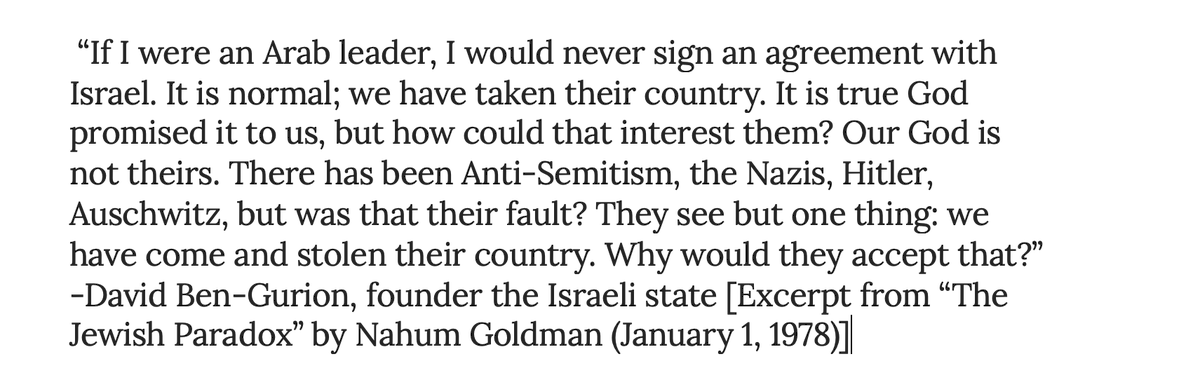
Seventy-five years of Israel military violence against defenseless Palestinians and fifty-six years of violently and illegally occupying their remaining slice of the original Palestine provides some background for Israel’s Founder, David Ben-Gurion’s candid statement: “We have taken their country.” (See, his full statement here).
The overwhelming military superiority of Israel – a nuclear armed nation – in the Middle East has produced a more aggressive Israeli government. Being more secure than ever before doesn’t seem to temper the expansionist missions of right-wing Israeli colonies in the West Bank.
Presently, the narrow Netanyahu majority in the Parliament believes that “nothing can stop us.” Presently, they are right.
Joe Biden and Congress are vigorously enabling the annihilations. The UN is frozen by the Joe Biden administration’s vetoes in the Security Council against ending the carnage in Gaza. The Arab nations either lay in ruins – Syria, Iraq – or are too weak to cause Israeli generals any worry. The rich Arab nations in the Gulf want to do business with prosperous Israel and, other than Qatar, care little about their Palestinian brethren.
The International Criminal Court (ICC) and the International Court of Justice (ICJ) are no obstacle. Israel, along with Russia and the U.S. do not belong to the International Criminal Court. The Palestinian Authority is a party, but the practical difficulties of investigating Israeli war crimes in Gaza and apprehending the accused are insurmountable. The ICJ’s jurisdiction requires a country to bring Israel before the Court for war crimes or genocide. In any event, the Court’s lead-footed procedures trespass on eternity. So much for international law and the Geneva Conventions. Netanyahu rejects the moral authority of seventeen Israeli human rights groups, including Rabbis and reservist soldiers. Their open letter to President Biden in the December 13, 2023 issue of the New York Times on “The Humanitarian Catastrophe in the Gaza Strip” was ignored by the media despite the truth and courage it embodied.
In the U.S., protests and demonstrations are everywhere. Many are organized by Jewish human rights groups such as Jewish Voice for Peace, If Not Now, Standing Together, Veterans for Peace and various student organizations. Everywhere Biden travels there are people from all backgrounds protesting.
A few days ago, the first protests by labor union members occurred in Oakland, California. Union activists could turn their attention to why, for years, union leaders put billions of dollars into riskier lower-interest Israeli bonds rather than U.S. Treasuries or bond funds investing in America. Like U.S. weapon deliveries, purchases of Israeli bonds by states, cities and unions have surged since October 7th.
Pope Francis, informed of the Israeli attack on the only Catholic Church and Convent in Gaza, which housed people with disabilities, killing and injuring Christians sheltering there, sorrowfully said: “Some would say, ‘It is war. It is terrorism.’ Yes, it is war. It is terrorism.”
In 2015, over 400 Rabbis from Israel, the USA and Canada called on Prime Minister Netanyahu to stop the practice of demolishing hundreds of Palestinian homes as being contrary to international law and Jewish tradition. Their successors Rabbis for Human Rights are being ignored by the regime.
The Head of the U.S. Bishops Conference and the National Council of Churches, representing millions of parishioners, condemned the bombings but received little coverage.
There is only one institution that could stop Netanyahu’s mass military massacres of the Palestinian people. That is the U.S. Congress. As long as over 90% of the politicians there automatically support AIPAC, the Israeli Government Can Do No Wrong Lobby, even a peace-loving Joe Biden cannot deter Netanyahu. Bibi (his nickname) could simply say to a hypothetically transformed Biden “Joe, take it up with OUR Congress.”
How has AIPAC achieved such domination on Capitol Hill? By years of relentless lobbying and the smear of “anti-semitism” to anyone defying them. AIPAC and its chapters don’t bother with marches or demonstrations. They personally focus on the legislator – one by one. Carrots or sticks. Praise, PAC money and junkets are the Carrots. The Sticks are smears and money for selected primary challengers in their Districts or States. Rep. Betty McCollum (D-MN) called AIPAC “a Hate Group.”
There are about 300,000 citizens spending significant time back in the states working Congress in AIPAC’s favor. They know the doctors, lawyers, accountants, clergy, local politicians, donors, golf champions and other friends of the Senators and Representatives, and forcefully promote Israeli expansionism backed to the hilt by the U.S. government.
AIPAC is proficient in part for lack of any organized opposition. It is also practicing state-of-the-art non-stop grassroots lobbying.
Congress is poised to send $14.3 billion to Israeli militarism – a “genocide tax” on U.S. taxpayers – without public hearings. While growing public opinion in the U.S. is against unconditional backing of the Israeli regime, it has not changed a single vote in Congress. Someday, more organized support for America’s national interest will.
(For calls to your legislators, the Congressional switchboard is 202-224-3121.)
‘We will coup whoever we want!’: the unbearable hubris of Musk and the billionaire tech bros

Unlike their forebears, contemporary billionaires do not hope to build the biggest house in town, but the biggest colony on the moon,
Today’s billionaire philanthropists, frequently espousing the philosophy of “effective altruism”, donate to their own organisations, often in the form of their own stock, and make their own decisions about how the money is spent because they are, after all, experts in everything.
Guardian, Douglas Rushkoff. 25 Dec 23,
Challenging each other to cage fights, building apocalypse bunkers – the behaviour of today’s mega-moguls is becoming increasingly outlandish and imperial.
ven their downfalls are spectacular. Like a latter-day Icarus flying too close to the sun, disgraced crypto-god Sam Bankman-Fried crashed and burned this month, recasting Michael Lewis’s exuberant biography of the convicted fraudster – Going Infinite – into the story of a supervillain. Even his potential sentence of up to 115 years in prison seems more suitable for a larger-than-life comic book character – the Joker being carted off to Arkham Asylum – than a nerdy, crooked currency trader.
But that’s the way this generation of tech billionaires rolls. The Elon Musk we meet in Walter Isaacson’s biography posts selfies of himself as Marvel comic character Doctor Strange – the “Sorcerer Supreme” who protects the Earth against magical threats. Musk is so fascinated with figures such as Iron Man that he gave a tour of the SpaceX factory to the actor who plays him, Robert Downey Jr, and the film’s director, Jon Favreau. As if believing he really has acquired these characters’ martial arts prowess, in June Musk challenged fellow übermensch Mark Zuckerberg to “a cage match” after Zuck launched an app to compete with the floundering Twitter. Musk and Zuck exchanged taunts in the style of superheroes or perhaps professional wrestlers. “I’m up for a cage match if he is,” tweeted Musk. “Send Me Location,” responded Zuck from Instagram’s Threads.
Billionaires, or their equivalents, have been around a long time, but there’s something different about today’s tech titans, as evidenced by a rash of recent books. Reading about their apocalypse bunkers, vampiric longevity strategies, outlandish social media pronouncements, private space programmes and virtual world-building ambitions, it’s hard to remember they’re not actors in a reality series or characters from a new Avengers movie.
Unlike their forebears, contemporary billionaires do not hope to build the biggest house in town, but the biggest colony on the moon, underground lair in New Zealand, or virtual reality server in the cloud. In contrast, however avaricious, the titans of past gilded eras still saw themselves as human members of civil society. Contemporary billionaires appear to understand civics and civilians as impediments to their progress, necessary victims of the externalities of their companies’ growth, sad artefacts of the civilisation they will leave behind in their inexorable colonisation of the next dimension.
While plans for Peter Thiel’s 193-hectare (477-acre) “doomsday” escape, complete with spa, theatre, meditation lounge and library, were ultimately rejected on environmental grounds, he still wants to build a startup community that floats on the ocean, where so-called seasteaders can live beyond government regulation as well as whatever disasters may befall us back on the continents.
To escape “near-term” problems such as poverty and pollution, Jeff Bezos imagines building millions of space colonies housing trillions of people on the moon, asteroids and in other parts of the solar system, where inhabitants will harvest the resources of space for themselves and those left back on Earth. Elon Musk is convinced he will build a city of a million people on Mars by 2050 at a cost of up to $10bn a person. The ChatGPT impresario Sam Altman, whose board of directors sacked him as CEO before he made a dramatic comeback this week, wants to upload his consciousness to the cloud (if the AIs he helped build and now fears will permit him).
…………………….. as chronicled by Peter Turchin in End Times, his book on elite excess and what it portends, today there are far more centimillionaires and billionaires than there were in the gilded age, and they have collectively accumulated a much larger proportion of the world’s wealth. ………………………………………..
What evidence we do see of their operations in the real world mostly take the form of externalised harm. Digital businesses depend on mineral slavery in Africa, dump toxic waste in China, facilitate the undermining of democracy across the globe and spread destabilising disinformation for profit – all from the sociopathic remove afforded by remote administration.
Indeed, there is an imperiousness to the way the new billionaire class disregard people and places for which it is hard to find historical precedent………………………………………………………………….
At least Zuckerberg’s anti-democratic measures are expressed as the decrees of a benevolent dictator. Musk exercises no such restraint. In response to the accusation that the US government organised a coup against Evo Morales in Bolivia in order for Tesla to secure lithium there, Musk tweeted: “We will coup whoever we want! Deal with it.”
Musk now has the ability to tweet this way as much as he likes: Twitter/X is his own platform. He bought it………………………………………………..
Musk not only owns X and Tesla but also SpaceX, StarLink, the Boring Company, Solar City, NeuraLink, xAI, and someday, he hopes, another finance company like PayPal (which he co-founded with Thiel but then sold to eBay). Similarly, Bezos doesn’t just control Amazon – the world’s biggest ever retailer, if that even does justice to the monolith – but the Washington Post, IMDb, MGM, Twitch, Zoox, Kiva, Whole Foods, Ring, Ivona, One Medical, Blue Origin and, of course, Amazon Web Services, which owns at least one-third of the cloud computing market. Included in Gates’s 20bn dollars’ worth of Microsoft stock and assets are Microsoft Azure (his 23% of the cloud), LinkedIn, Skype and GitHub. He also, incidentally, owns 109,000 hectares (270,000 acres) of US farmland.
This is unprecedentedly broad, or what could be called “horizontal” power. It is success across such a wide spectrum that has given today’s tech billionaires false confidence in the extent of their own expertise. Gates, who regularly dispensed advice on vaccines and public health in television interviews, eventually issued a report in which he graded each country’s pandemic response as if he were a school teacher who knew better than every nation’s department of health (no one got an A).
……………………. Today’s billionaire philanthropists, frequently espousing the philosophy of “effective altruism”, donate to their own organisations, often in the form of their own stock, and make their own decisions about how the money is spent because they are, after all, experts in everything.
Rather than donating to a university, Thiel’s Fellowship pays $100,000 “to young people who want to build new things instead of sitting in a classroom”. Meanwhile, contests such as Musk’s X Prize and Singularity University focus on “exponential technologies” that solve “global grand challenges”. Such moonshots reward the bold thinking that “aims to make something 10 times better”.
Their words and actions suggest an approach to life, technology and business that I have come to call “The Mindset” – a belief that with enough money, one can escape the harms created by earning money in that way. It’s a belief that with enough genius and technology, they can rise above the plane of mere mortals and exist on an entirely different level, or planet, altogether.
……………………………… This distorted image of the übermensch as a godlike creator, pushing confidently towards his clear vision of how things should be, persists as an essential component of The Mindset………………..
Any new business idea, Thiel says, should be an order of magnitude better than what’s already out there. Don’t compare yourself to everyone else; instead operate one level above the competing masses. For Thiel, this requires being what he calls a “definite optimist”. Most entrepreneurs are too process-oriented, making incremental decisions based on how the market responds. They should instead be like Steve Jobs or Elon Musk, pressing on with their singular vision no matter what. The definite optimist doesn’t take feedback into account, but ploughs forward with his new design for a better world. It happens ex nihilo – literally “from zero to one”. So like a supervillain constructing an all-seeing eye, Thiel builds a giant data analytics system, Palantir, through which he can observe and predict threats before they even manifest – all while preparing for Armageddon, just in case.
…………………………………………………… This is not capitalism, as Yanis Varoufakis explains in his new book Technofeudalism. Capitalists sought to extract value from workers by disconnecting them from the value they created, but they still made stuff. Feudalists seek an entirely passive income by “going meta” on business itself. They are rent-seekers, whose aim is to own the very platform on which other people do the work.
……………………………………………………………………. that’s what is really going on here. The antics of the tech feudalists make for better science fiction stories than they chart legitimate paths to sustainable futures. Musk and Zuckerberg challenge each other to duels as a way of advertising their platforms. Musk is less X’s CEO than its troll in chief. They are not gods; they are entertainers.
Instead of emulating them, we should first laugh at them, and then dismiss them. They’re like the contestants in an episode of Survivor, trying to be the last one on the island. It’s perversely amusing, and sometimes hard to look away. It’s the same impulse that leads many Americans to vote for Trump – less because they want him for president than because he will make for better television.
But it’s time to turn off this show, this car accident of a tech future, and get on with reclaiming the world from this new generation of robber barons rather than continuing to fund their fantasies. These are not the demigods we’re looking for.
Douglas Rushkoff is the author of Survival of the Richest: Escape Fantasies of the Tech Billionaires (Scribe). https://www.theguardian.com/books/2023/nov/25/we-will-coup-whoever-we-want-the-unbearable-hubris-of-musk-and-the-billionaire-tech-bros
COP28’s Unrealistic Tripling of Nuclear Power

according to the Bulletin of the Atomic Scientists, the declaration by 22 countries calling for a tripling of nuclear energy by 2050 is more fantasy than reality: “Even at best, a shift to invest more heavily in nuclear energy over the next two decades could actually worsen the climate crisis, as cheaper, quicker alternatives are ignored for more expensive, slow-to-deploy nuclear reactors.” (Bulletin of the Atomic Scientists, Dec. 13th, 2023)
BY ROBERT HUNZIKER, 22 Dec 23, https://www.counterpunch.org/2023/12/22/cop28s-unrealistic-tripling-of-nuclear-power/
UN climate conferences since 1992 have failed to follow thru with results, as CO2 emissions continue higher and higher with every passing year. In fact, post climate conference impact of adopted proposals has become something 0f an inside joke. The most recent conference, COP28, embraced nuclear power as a godsend challenging climate change.
“Triple Nuclear Power” still echoes throughout the halls of COP28. If one stands at the podium in the convention center now empty and listens intently, echoes reverberate “triple nuclear power” spewing out of red-faced maniacs from over 20 countries that committed to tripling nuclear power to bail our global asses out of a crazed climate system of epic proportions.
The US, UK, UAE, and others signed a declaration. Since they couldn’t budge oil and gas, it was decided to favor nuclear power as a surrogate for fixing the rip snorting global heating imbroglio found from pole to pole, from ocean to ocean. It’s real, it’s palpable; it’s now, much earlier than forecasts, as 1.5C prematurely comes to surface during irregular episodes.
Yet, according to the Bulletin of the Atomic Scientists, the declaration by 22 countries calling for a tripling of nuclear energy by 2050 is more fantasy than reality: “Even at best, a shift to invest more heavily in nuclear energy over the next two decades could actually worsen the climate crisis, as cheaper, quicker alternatives are ignored for more expensive, slow-to-deploy nuclear reactors.” (Bulletin of the Atomic Scientists, Dec. 13th, 2023)
Building nuclear power facilities has a long history that unfortunately casts a doubtful shadow over the idea of tripling by 2050. A now-famous plan by Princeton University in 2004 called for a “stabilization wedge” to avoid one billion tons of carbon emissions per year by 2055 by building 700 large nuclear reactors over 50 years.
In 2022, there were 416 operating reactors in the world. Starting in 2005 when the Princeton plan was announced, it would have meant building 14 reactors per year, assuming all existing reactors continued to function. However, over the 50-year cycle aging reactors and those going into retirement would ultimately require 40 new reactors per year. But throughout the entire history of nuclear power, on average 10 nuclear power plants connected to the electricity grid per year, and the number of new units was only 5 per year from 2011-2021.
Once again, like the sticky issue of direct carbon capture, achieving the scale of proposed solutions to climate change’s biggest weapon, or global warming, is beyond reality. Talk is cheap.
Meanwhile less expensive safer wind and solar easily trounce nuclear power’s newly installed output, by a country mile, to wit:
New nuclear energy capacity 2000-2020 42 GWe
New wind capacity from 2000-2020 605 GWe
New solar capacity from 2000-2020 578 GWe
Nuclear costs are prohibitively high: It’ll cost $15 trillion to triple nuclear capacity, assuming existing reactors continue to function, which will not be the case, raising this big bet well over $15T. Who’s putting up $15T?
And is there enough time to triple by 2050? From design to projected operation of the NuScale VOYGR plant takes 13 years. According to the International Energy Agency, the design and build phase for a country’s first nuclear reactor is 15 years. Several countries that signed on to the declaration to triple nuclear power are newbies.
According to a Foreign Policy article, Dec. 13th 2023 entitled: COP28’s Dramatic But Empty Nuclear Pledge: several reasons for skepticism about the nuclear energy triple buildout were enumerated, concluding: “The combination of macroeconomic pressures and regulatory restrictions means that neither pledges such as those made at COP28 nor memorandums of understanding with various industries, utilities, and governments should give anyone much confidence that a major expansion of nuclear energy is forthcoming.”
Nuclear expert Mycle Schneider, the lead author of the prestigious World Nuclear Industry Status Report (500 pgs.) now in in its 18th edition known for its fact-based approach on details of operation, construction, and decommissioning of the world’s reactors was recently interviewed by the Bulletin: Schneider’s publication is considered the landmark study of the industry.
Regarding NuScale, the US-based company that develops America’s flagship SMR (Small Nuclear Reactors), the company initially promised in 2008 to start generating power by 2015. As of 2023, they haven’t started construction of a single reactor. They do not have a certification license for the model they promoted for a Utah municipality. NuScale’s six module facility would cost $20,000 per kilowatt installed, twice as expensive as the most expensive large-scale reactors in Europe. And SMRs will generate disproportionate amounts of nuclear waste. No bargain here, assuming it even works efficiently enough, which is doubtful.
Schneider: “The entire logic that has been built up for small modular reactors is with the background of climate change emergency. That’s the big problem we have.” A sense of urgency cannot be met: “Considering the status of development, we’re not going to see any SMR generating power before the 2030s. It’s very clear: none. And if we are talking about SMRs picking up any kind of substantial amounts of generating capacity in the current market, if ever, we’re talking about the 2040s at the very earliest.”
Schneider on COP’s pledge to triple nuclear power: “From an industrial point of view, to put this pledge into reality. To me, this pledge is very close to absurd, compared to what the industry has shown.”
Looked at another way: “It took 70 years to bring global nuclear capacity to the current level of 370 gigawatts (GW), and the industry must now select technologies, raise finance and develop the rules to build another 740 GW in half that time… Why would anyone spend a single dollar on a technology that, if planned today, won’t even be available to help until 2035-2045?’ said Mark Jacobson, an energy specialist at Stanford University.” (Source: Nuclear Sector Must Overcome Decades of Stagnation to Meet COP28 Tripling, Reuters, Dec. 7, 2023) How about $15 trillion?
COP28 did not deliver on phase down of fossil fuels, and it’ll likely miss on tripling nuclear power. But once the results are finally known, it’s too late. The heat’s already on.
1 This month

of the week – Australians for War Powers Reform (AWPR)
To see nuclear-related stories in greater depth and intensity
 Antinuclear