TODAY. Nuclear Industry’s New Year Resolution – “Let’s get sloppier about safety

yeah, well - it’s a new day, it’s a beautiful new year - let’s look on the bright side. The global nuclear lobby is certainly doing that with its glowing plans for tripling of nuclear energy by 2050

Safety is now a downgraded priority. A couple of today’s examples – Japanese nuclear safety regulators lifted an operational ban on a nuclear plant owned by Tokyo Electric Power Company Holdings, deciding that it’s now safe after all. In the USA, the NRC (federal nuclear safety agency) decides that cracks in a backup emergency fuel line at a South Carolina nuclear plant are not so serious any more.
Let’s forget the nuclear industry’s history of major (and continuing) disasters, “minor” mishaps and near-misses. And let’s forget the dangers of crumbling old reactors, untested new gee-whiz ones, cracking and corroding copper pipes and waste containers, terrorism risks, drone dangers, cyber-security hazards, transport risks, extreme weather events, weapons proliferation, mishaps in space, and crookedness and corruption in the industry.
Yey! let’s waltz away into 2024 with the jolly prospect of nuclear power solving the climate crisis, energy crisis and so on. We can brush up the old big reactors (saves us the cost of scrapping them – leave that job to our grandchildren ), build myriad little tiny reactors in every country, (sell them especially developing places that have no expertise in nuclear technology) , and bring happiness and wealth to that small but highly organised phalanx of global nuclear ‘Influencers” – while the rest of us party on, and our bought politicians smile benignly.
After all, there are the various nationall safety and radiation protection agencies to save us . Right?
Trouble is – safety reporting procedures are designed to protect the nuclear industry, not the public.
Agencies like USA’s Nuclear Regulatory Commission rely on the International Atomic Energy Agency – whose brief is to promote the nuclear industry - a brief beautifully expressed by its slimy Director General, Rafael Grossi.

Let’s consider- the “safety” of ionising radiation:
- The established health ministeries rely on the Commission on Radiological Protection, which relies on The Radiation Protection Commission which relies on the international Commission on Radiological Protection, which relies on the IAEA / RERF (Reference Materials)
- The IAEA / RERF relies on the military industrial nuclear complex of five veto-wielding Security Council members
They pass the nuclear safety handball back and forth between each other - as the nuclear-industrial-military complex rolls on towards armageddon.

Constitutional Violations: Julian Assange, Privacy and the CIA

December 28, 2023, Dr Binoy Kampmark, https://theaimn.com/constitutional-violations-julian-assange-privacy-and-the-cia/
As a private citizen, the options for suing an intelligence agency are few and far between. The US Central Intelligence Agency, as with other members of the secret club, pour scorn on such efforts. To a degree, such a dismissive sentiment is understandable: Why sue an agency for its bread-and-butter task, which is surveillance?
This matter has cropped up in the US courts in what has become an international affair, namely, the case of WikiLeaks founder and publisher, Julian Assange. While the US Department of Justice battles to sink its fangs into the Australian national for absurd espionage charges, various offshoots of his case have begun to grow. The issue of CIA sponsored surveillance during his stint in the Ecuadorian embassy in London has been of particular interest, since it violated both general principles of privacy and more specific ones regarding attorney-client privilege. Of particular interest to US Constitution watchers was whether such actions violated the reasonable expectation of privacy protected by the Fourth Amendment.
Four US citizens took issue with such surveillance, which was executed by the Spanish security firm Undercover (UC) Global and its starry-eyed, impressionable director David Morales under instruction from the CIA. Civil rights attorney Margaret Ratner Kunstler and media lawyer Deborah Hrbek, and journalists John Goetz and Charles Glass, took the matter to the US District Court of the Southern District of New York in August last year. They had four targets of litigation: the CIA itself, its former director, Michael R. Pompeo, Morales and his company, UC Global SL.
All four alleged that the US Government had conducted surveillance on them and copied their information during visits to Assange in the embassy, thereby violating the Fourth Amendment. In doing so, the plaintiffs argued they were entitled to money damages and injunctive relief. The government moved to dismiss the complaint as amended.
On December 19, District Judge John G. Koeltl delivered a judgment of much interest, granting, in part, the US government’s motion to dismiss but denying other parts of it. Before turning to the relevant features of Koeltl’s reasons, various observations made in the case bear repeating. The judge notes, for instance, Pompeo’s April 2017 speech, in which he “‘pledged that his office would embark upon a ‘long term’ campaign against WikiLeaks.’” He is cognisant of the plaintiffs’ claims “Morales was recruited to conduct surveillance on Assange and his visitors on behalf of the CIA and that this recruitment occurred at a January 2017 private security industry convention at the Las Vegas Sands Hotel in Las Vegas, Nevada.”
From that meeting, it is claimed that “Morales created an operations unit, improved UC Global’s systems, and set up live streaming from the United States so that surveillance could be accessed instantly by the CIA.” The data gathered from UC Global “was either personally delivered to Las Vegas; Washington, D.C.; and New York City by Morales (who travelled to these locations more than sixty times in the three years following the Las Vegas convention) or placed on a server that provided external access to the CIA.”
Koeltl preferred to avoid deciding on the claims that Morales and UC Global were, in fact, “acting as agents of Pompeo and the CIA.” Such matters were questions of fact “that cannot be decided on a motion to dismiss.”
A vital issue in the case was whether the plaintiffs had standing to sue the CIA in the first place. Citing the case of ACLU v Clapper, which involved a challenge to the National Security Agency’s bulk telephone metadata collection program, Koeltl accepted that they did. In doing so, he rejected a similar argument made by the government in Clapper – that the injuries alleged were simply “too speculative and generalized” and that the information gathered via surveillance would necessarily even be used against them. “In this case, the plaintiffs need not allege, as the Government argues, that the Government will imminently use their information collected at the Ecuadorean Embassy in London.” If the search of the conversations and electronic devices along with the seizure of the contents of the electronic devices “were unlawful, the plaintiffs have suffered a concrete and particularized injury fairly traceable to the challenged program and redressable by favorable ruling.”
Less satisfactory for the plaintiffs was the finding they had no reasonable expectation of privacy regarding their conversations with the publisher given that “they knew Assange was surveilled even before the CIA’s alleged involvement.” The judge thought it significant that they did “not allege that they would not have met Assange had they known their conversations would be surveilled.” Additionally, it “would not be recognized as reasonable by society” to have expected conversations held with Assange at the embassy in London to be protected, given such societal acceptance of, for instance video surveillance in government buildings.
This reasoning is faulty, given that the visits by the four plaintiffs to the embassy did not take place with their knowledge of the operation being conducted by UC Global with CIA blessing. In a general sense, anyone visiting the embassy could not help but suspect that Assange might be the object of surveillance, but to suggest something akin to a waiver of privacy rights on the part of attorneys and journalists aiding a persecuted publisher is an odd turn.
The US Government also succeeded on the point that the plaintiffs had no reasonable expectation to privacy regarding their passports or their devices they voluntarily left at the Embassy reception desk. In doing so, they “assumed the risk that the information may be conveyed to the Government.” Those visiting embassies must, it would seem, be perennially on guard.
That said, the plaintiffs convinced the judge that they had “sufficient allegations that the CIA and Pompeo, through Morales and UC Global, violated their reasonable expectation to privacy in the contents of their electronic devices.” The government even went so far as to concede that point.
Unfortunately for the plaintiffs, the biggest fish was let off the hook. The plaintiffs had attempted to use the 1971 US Supreme Court case of Bivens to argue that the former CIA director be held accountable and liable for violating constitutional rights. Koeltl thought the effort to extend the application of Bivens inappropriate in terms of the high standing nature of the defendant and the context. “As a presidential appointee confirmed by Congress […] Defendant Pompeo is in a different category of defendant from a law enforcement agent of the Federal Bureau of Narcotics.” More’s the pity.
Leaving aside some of the more questionable turns of reasoning in Koeltl’s judgment, public interest litigants and activists can take heart from the prospect that civil trials against the CIA for violations of the US Constitution are no longer unrealistic. “We are thrilled,” declared Richard Roth, the plaintiffs’ attorney, “that the court rejected the CIA’s efforts to silence the plaintiffs, who merely seek to expose the CIA’s attempt to carry out Pompeo’s vendetta against WikiLeaks.” The appeals process, however, is bound to be tested.
The failed Nuscale project lets Utah down — again

Every time we gamble on a nuclear project like Nuscale to deliver carbon-free power, we are hampering our ability to meet critical climate goals by 2030.
By Lexi Tuddenham | For The Salt Lake Tribune, Dec. 29, 2023 https://www.sltrib.com/opinion/commentary/2023/12/29/opinion-failed-nuscale-project/
Early last month, Nuscale made headlines by canceling its 462 MW proposal for a small modular nuclear reactor (SMNR) at the Idaho National Laboratory. Here in Utah, the news was met with little surprise.
For the past six years, we’ve been raising crucial questions about the viability of the so-called “Carbon Free Power Project” (CFPP). Was it a project that could deliver power on time and at a reasonable cost to ratepayers? How much would taxpayers and ratepayers ultimately pay, and who would bear the environmental, public health and financial risks? Could it meet our energy needs at a time when electrification is more critical than ever?
In 2015, the Nuscale project was eight years out. In 2022, it was still eight years out. As we watched other nuclear power projects be abandoned or blunder online years late and billions of dollars over cost, there was a sense of inevitability about who would suffer when this project failed: the communities who had placed their faith in its fantastical promises of affordable, reliable and “clean” power.
We were told that these SMNRs would be revolutionary — smaller, more cost-effective and with cutting-edge technology, but as we watched the costs swell from $55/MWh to $89/MWh and well beyond, even with huge federal subsidies, it was clear the financial risks were only mounting. With the collapse of the hypothetical project, Utah Associated Municipal Power Systems (UAMPS) member communities in rapidly growing areas like Hurricane and Washington City are now left with the reality of scrambling for alternatives to meet their future energy needs.
As we see nuclear projects around the country experience delay after delay, the Nuscale experience is one reason why we continue to watch the developments of the Terrapower Natrium reactor in Kemmerer, Wyoming, with a mix of skepticism and concern. The other reason is that the Terrapower project has promised not just electricity to Pacificorp customers, but also jobs in a community that desperately needs them. This is irresponsible at best.
The projected timeline for the Terrapower reactor to come online has already been pushed to 2030, which Terrapower external affairs director Jeff Navin admits is “cutting it close.” In addition, the community faces an economic abyss between the projected closure of the coal plant and the startup of the nuclear facility, and federal officials recently noted that with no permanent waste repository existent in the U.S., spent nuclear fuel will be stored “temporarily” on-site. Similar concerns can and should be raised about the proposed nuclear plants at Hunter and Huntington in Utah. At the end of the day, it is workers who are being let down, and it is communities who have to deal with the long term consequences.
We know that the next few years are of critical importance in our ability to combat the worst effects of climate change before we kick off even more warming feedback loops. Every time we gamble on a nuclear project like Nuscale to deliver carbon-free power, we are hampering our ability to meet critical climate goals by 2030. As timelines for such projects are inevitably dragged out, in the interim we continue to burn fossil fuels that choke the air that people breathe and force the climate ever closer to its tipping point.
The hard truth is that there is no silver bullet for climate change. Relying on nuclear power maintains dependence on a flawed energy system that primarily benefits industries that have historically profited from past harms. Now they promise to seamlessly plug in nuclear power and conduct business as usual.
According to the latest estimates, about a billion dollars was sunk into the now-abandoned Nuscale CFPP. This is a drop in the bucket compared to some other nuclear projects this country has seen over the last 30 years. But imagine that $1 billion spent elsewhere on legacy cleanups of the nuclear and uranium mining industry, aiding Downwinders or boosting renewable energy capacity that we know can work. There is an opportunity cost for investing in nuclear when we have faster, lower-risk options that we can prioritize now. Instead, we can take on climate change with what has been called “rational hope,” by investing in wind, solar, geothermal power, storage, grid improvements and efficiency technologies that offer cost-effective climate solutions. And Utah’s potential in these areas is immense.
But this energy future requires a reimagining. It requires permitting and energy-sourcing processes that put the health and vitality of communities front and center. It means changing course to avoid mistakes of the past.
Here at HEAL Utah, we collaborate with communities to shape an energy future crafted by the people it serves. This future prioritizes clean air, a healthy environment and family-sustaining jobs, all powered by accessible, sustainable and affordable renewable energy sources. In short, this is rational hope in practice. Together, we can make it a reality.
Lexi Tuddenham is the executive director of the Healthy Environment Alliance of Utah (HEAL Utah).
Christmas Eve Massacre in Gaza Refugee Camp
The Grayzone goes to the scene of one of the most heinous crimes Israel committed in the besieged Gaza Strip: the Christmas Eve massacre in Maghazi Refugee Camp, which left over 70 dead in a single airstrike. We speak to survivors of the attack and expose the scale of damage with exclusive drone footage.
The Long History Of Zionist Proposals To Ethnically Cleanse The Gaza Strip

Ethnic cleansing or “transfer” is an intrinsic part of Zionism’s early history, and has remained an essential feature of Israeli political life. More recently, “transfer” has been mainstreamed by billing it as encouraging “voluntary emigration.”
SCHEERPOST, By Mouin Rabbani / Mondoweiss, December 29, 2023
Senior Israeli leaders, including Prime Minister Binyamin Netanyahu, are again publicly advocating the ethnic cleansing of the Gaza Strip. Their proposals are being presented as voluntary emigration schemes, in which Israel is merely playing the role of Good Samaritan, selflessly mediating with foreign governments to find new homes for destitute and desperate Palestinians. But it is ethnic cleansing all the same.

Alarm bells should have started ringing in early November when U.S. Secretary of State Antony Blinken and other Western politicians began insisting there could be “no forcible displacement of Palestinians from Gaza.” Rather than rejecting any mass removal of Palestinians, Blinken and colleagues objected only to optically challenging expulsions at gunpoint. The option of “voluntary” displacement by leaving residents of the Gaza Strip with no choice but departure was pointedly left open.

Ethnic cleansing, or “transfer” as it is known in Israeli parlance, has a long pedigree that goes back to the late-nineteenth-century beginnings of the Zionist movement. While the early Zionists adopted the slogan, “A Land Without a People for a People Without a Land,” the evidence demonstrates that, from the very outset, their leaders knew better. More to the point, they clearly understood that the Palestinians formed the main obstacle to the establishment of a Jewish state in Palestine. This is for the simple reason that, to them, a “Jewish state” denotes one in which its Jewish population acquires and maintains unchallenged demographic, territorial, and political supremacy.
Enter “transfer.” As early as 1895, Theodor Herzl, the founder of the contemporary Zionist movement, identified the necessity of removing the inhabitants of Palestine in the following terms: “We shall try to spirit the penniless population across the border by procuring employment for it in the transit countries, while denying it any employment in our own country … expropriation and the removal of the poor must be carried out discreetly and circumspectly.” David Ben-Gurion (née Grün), Chairman of the Executive Committee of the Jewish Agency for Palestine, and later Israel’s first prime minister, was more blunt. In a 1937 letter to his son, he wrote: “We must expel the Arabs and take their place.”
Writing in his diary in 1940, Yosef Weitz, a senior Jewish National Fund official who chaired the influential Transfer Committee before and during the Nakba (“Catastrophe”), and became known as the Architect of Transfer, put it thus: “The only solution is a Land of Israel devoid of Arabs. There is no room here for compromise. They must all be moved. Not one village, not one tribe, can remain. Only through this transfer of the Arabs living in the Land of Israel will redemption come.” His diaries are littered with similar sentiments.
The point of the above is not to demonstrate that individual Zionist leaders held such views, but that the senior leadership of the Zionist movement consistently considered the ethnic cleansing of Palestine an objective and priority. Initiatives such as the Transfer Committee, and Plan Dalet, initially formulated in 1944 and described by the pre-eminent Palestinian historian Walid Khalidi as the “Master Plan for the Conquest of Palestine,” additionally demonstrate that the Zionist movement actively planned for it.
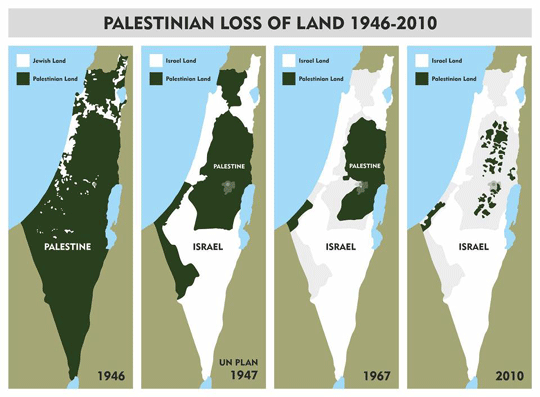
The 1948 Nakba, during which more than four-fifths of Palestinians residing in territory that came under Israeli rule were ethnically cleansed, should, therefore, be seen as the fulfillment of a longstanding ambition and implementation of a key policy. A product of design, not of war (historical Christmas footnote: the Palestinian town of Nazareth was spared a similar fate only because the commander of Israeli forces that seized the city, a Canadian Jew named Ben Dunkelman, disobeyed orders to expel the population, and was relieved of his command the following day).
That the Nakba was a product of design is further substantiated by the Transfer Committee’s terms of reference. These comprised not only proposals for the expulsion of the Palestinians but, just as importantly, active measures to prevent their return, destroy their homes and villages, expropriate their property, and resettle those territories with Jewish immigrants. Weitz, together with fellow Committee members Eliahu Sassoon and Ezra Danin, on June 5, 1948, presented a three-page blueprint, entitled “Scheme for the Solution of the Arab Problem in the State of Israel,” to Prime Minister Ben-Gurion to achieve these goals. According to leading Israeli historian Benny Morris, “there is no doubt Ben-Gurion agreed to Weitz’s scheme,” which included “what amounted to an enormous project of destruction” that saw more than 450 Palestinian villages razed to the ground.
The understandable focus on the expulsions of 1948 often overlooks the fact that ethnic cleansing remains incomplete unless its victims are barred from returning to their homes by a combination of armed force and legislation, and thereafter replaced by others. It is Israel’s determination to make Palestinian dispossession permanent that distinguishes Palestinian refugees from many other war refugees.
After 1948, Israel put out a whole series of fabrications to shift responsibility for the transformation of the Palestinians into dispossessed and stateless refugees onto the Arab states and the refugees themselves. These included claims that the refugees voluntarily left (they were either expelled or fled in justified terror); that Arab radio broadcasts ordered the Palestinians to flee (in fact, they were encouraged to stay put); that Israel conducted a population exchange with Arab states (there was nothing of the sort); and the bizarre argument that because they’re Arabs, Palestinians had numerous other states while Jews have only Israel (by the same logic, Sikhs would be entitled to seize British Columbia and deport its population to either the rest of Canada or the United States). More importantly, even if uniformly substantiated, none of these pretexts entitles Israel to prohibit the right of Palestinian refugees to return to their homes at the conclusion of hostilities. It is, furthermore, a right that was consecrated in United Nations General Assembly resolution 194 of December 11, 1948, which has been reaffirmed repeatedly since.
Ethnic cleansing after 1967
In 1967, Israel seized the remaining 22 percent of Mandatory Palestine — the West Bank (including East Jerusalem) and the Gaza Strip. Depopulation in these territories operated differently than in 1948. Most importantly, Israel, in addition to prohibiting the return of Palestinians who fled hostilities during the 1967 June War, and encouraging others to leave (by, for example, providing a daily bus service from Gaza City to the Allenby Bridge connecting the West Bank to Jordan), conducted a census during the summer of 1967 . Any resident who was not present during the census was ineligible for an Israeli identity document and automatically lost their right of residency.
As a result, the population of these territories declined by more than twenty percent overnight. Many of those thus displaced were already refugees from 1948. Aqbat Jabr Refugee Camp near Jericho, for example — until 1967, the West Bank’s largest — became a virtual ghost town after almost all its inhabitants became refugees once again in Jordan. So many Palestinians from the Gaza Strip ended up in Jordan that a new refugee camp, Gaza Camp, was established on the outskirts of Jerash. The occupied Palestinian territories would not recover their 1967 population levels until the early 1980s.
Within the West Bank, there were also cases of mass expulsion………………………………………………….
Depopulation through administrative rule
In subsequent years, Israel employed all kinds of administrative shenanigans to further reduce the Palestinian population of the West Bank and Gaza Strip. Until the 1993 Oslo Accords, for example, an exit permit from Israel’s military government was required to leave the occupied territory. It was valid for only three years and thereafter renewable annually for a maximum of three additional years (for a fee) at an Israeli consulate. If a Palestinian lost an exit permit or failed to renew an exit permit prior to its expiration for any reason (including bureaucratic foot-dragging), or couldn’t pay the renewal fee, or failed to return to Palestine prior to its expiration, that Palestinian automatically lost residency rights………………………………………………..
………………………………………. the mass expulsion was, as always in such matters, approved by Israel’s High Court of Justice after minor modifications. It ruled, among other things, that this was not a collective deportation but rather a collection of individual deportations……………………………………………….
Israel’s strategies to ‘thin’ Gaza’s population
With the focus in recent years on the intensified campaigns of ethnic cleansing in the West Bank, it is often forgotten that, for decades, the primary target for depopulation was the Gaza Strip, particularly its refugee population, which accounts for approximately three-quarters of the territory’s residents. Even before it occupied Gaza in 1967, Israel regularly promoted initiatives to achieve the “thinning” of its refugee population, with destinations as far afield as Libya and Iraq………………………………………………………………………………….
‘Transfer’ and Gaza today
In the decades since, “transfer,” often presented as the encouragement of voluntary emigration either by providing material incentives or making the conditions of life impossible, has become increasingly mainstreamed in Israeli political life. In 2019, for example, a “senior government official,” quoted in the Israeli newspaper Ha’aretz, expressed a willingness to help Palestinians emigrate from the Gaza Strip.
Mass expulsion has been gaining its share of adherents as well, and it is a position that is today represented within Israel’s coalition government. As has the idea that “transfer” should include Palestinian citizens of Israel — Avigdor Lieberman, for example, who was Israel’s Minister of Defense several years ago, is an advocate of not only emptying the West Bank and Gaza Strip of Palestinians but of getting rid of Palestinian citizens of Israel as well. As one might expect from a minister who was in charge of the Israeli military, he is also an advocate of “beheading” disloyal Palestinian citizens of Israel with “an axe.”
Against this background, Israel saw the attacks of October 7 as not only a threat but also as an opportunity. Fortified with unconditional U.S. and European support, Israeli political and military leaders immediately began promoting the transfer of Gaza’s Palestinian population to the Sinai desert.
The proposal was enthusiastically embraced by the United States and by Secretary of State Antony Blinken in particular. As ever hopelessly out of his depth when it comes to the Middle East, he appears to have genuinely believed he could recruit or pressure Washington’s Arab client regimes to make Israel’s wish a reality. Given Egyptian strongman Abdel-Fatah al-Sisi’s economic troubles, the fallout of the Menendez scandal, and the looming Egyptian presidential elections, it was suggested to him by the Washington echo chamber that it would take only an IMF loan, debt relief, and a promise to file away Menendez to bring Cairo on board. As so often when it comes to the Middle East, Blinken, armed only with Israel’s latest wish list, didn’t have a clue his indecent proposal would be categorically rejected, first and foremost by Egypt.
‘Transfer’ as ‘voluntary immigration’
The fallback position is opposition to “forcible displacement” at the point of a gun, while anything else is fair game. This includes reducing the Gaza Strip to rubble in what may well be the most intensive bombing campaign in history; a genocidal assault on an entire society that has killed civilians at an unprecedentedly rapid pace; the deliberate destruction of an entire civilian infrastructure, including the targeted obliteration of its health and education sectors; the highest proportion of households in hunger crisis ever recorded globally and the real prospect of pre-meditated famine; severance of the water and electricity supply leading to acute thirst, widespread consumption of non-potable water, and termination of sewage treatment; and promotion of a sharp rise in infectious disease. …………………………………………………..
In other words, if desperate Palestinians seek to flee this seventh circle of hell to save their skins, that’s considered voluntary emigration — their choice……………………………………………………………….
As an editorial in the Israeli newspaper Ha’aretz put it on December 27: “Israeli lawmakers keep pushing for transfer under the guise of humanitarian aid.”………………………………………………
Not individual Gazans, but “the people of Gaza.” Notably, such proposals consistently take it as a given that those departing will never return. ………………………………………….
While ethnic cleansing has been intrinsic to Zionist/Israeli ideology and practice from the very outset, it also has a flip side: the 1948 expulsion of the Palestinians expanded what had been a conflict between the Zionist movement and the Palestinians into a regional, Arab-Israeli one. The second Nakba Israel is currently inflicting on the Gaza Strip similarly appears well on its way to instigating the renewal of hostilities across the Middle East.
As importantly, the 1948 Nakba did not defeat the Palestinians, who initiated their struggle from the camps of exile, those in the Gaza Strip most prominently among them. It would take a Blinken level of foolishness to assume the expulsion of Palestinians from the Gaza Strip would produce a different outcome. https://scheerpost.com/2023/12/29/the-long-history-of-zionist-proposals-to-ethnically-cleanse-the-gaza-strip/
1 This month

of the week – Australians for War Powers Reform (AWPR)
To see nuclear-related stories in greater depth and intensity
 Antinuclear