Nuclear news for the first week of 20246
Some bits of good news . Wild and Wonderful Saiga is No Longer Endangered with a Million Roaming Now in Central Asia. 10 Things that Give us HOPE for 2024.
TOP STORIES. How Long Can Israel Defy the World?
Rokkasho redux: Japan’s never-ending nuclear reprocessing saga.
Bill Introduced in US Congress Calls for US to Drop Charges Against Julian Assange.
From the archives: Japan’s nuclear companies bribed local governments: consumers eventually pay.
Climate. What a farce! Another veteran of the oil and gas industry to lead the next round of COP 29 climate talks.
Nuclear. I try to stay off the topics of Israel and Ukrainian wars – but that’s tricky, as we teeter on the nuclear brink. Japan’s earthquake disaster lingers, – their nuclear reactors are OK, but it’s early days.
Noel’s notes: Japan’s earthquake: The world must not be conned by the irrational optimism of the nuclear lobby. The subtle ways that the nuclear lobby manipulates corporate media: example KISHA CLUBS OF JAPAN.
AUSTRALIA. Nuke policy quietly nuked: Australia to fund US nuclear weapon delivery program. Funding the imperium: Australia subsidises U.S. nuclear submarines.
US officials monitored pro-Assange protests in Australia for ‘anti-US sentiment’, documents reveal. Legendary Australian journalist John Pilger dies, aged 84. Uranium ship sneaks into ‘nuclear free’ Fremantle port, sparking concern by wharfies over safety.
*****************************************************
ECONOMICS. EDF using Pontins Brean Sands has ‘big determinantal impact’ on local economy, tourism firm fears. COP28’s Nuclear Energy Promise Is Still a Long Way Off. Nuclear Fuel: Russian Cutoff Would Upend Global Market.
EMPLOYMENT. Mass layoffs at small nuclear reactor companies. Nuclear Free Local Authorities (NFLAs) call upon nuke cops chief to issue statement on ‘toxic’ Sellafield allegations.
ENERGY. ‘Renewable surge powers all UK homes in 2023’. More than half of eligible schools enlist in new solar scheme in Ireland. Nuclear weapons test treaty fears sink plans for major wind farm. UK Nuclear Output Slumps to 42-Year Low . Swedish nuclear outage extended by 3 weeks . Germany’s coal power production drops to lowest level in 60 years in2023 after nuclear exit.
ENVIRONMENT. NRC still concerned with Air Force’s monitoring of thorium contamination at Kirtland. A ‘natural alternative’ plan for protecting fish from Hinkley nuclear station’s cooling system. Hinkley Point C proposes new wetland reserve to protect fish from cooling system.
HEALTH. Prolonged impact of the Fukushima Nuclear Power Plant Accident on health and society.
MEDIA. Burial review – deep dive into underworld of nuclear power and its toxic legacy. https://youtu.be/fw4Fp7e-9PM?si=SaQXhz1FobT2K3yb
BBC Panorama to feature RAF Lakenheath nuclear weapons saga- BBC Two on Thursday, January 18. https://www.youtube.com/watch?v=cZcg409HYIc
All CNN Gaza Coverage Seen by Bureau Monitored by Israeli Defense Force Before Publication.
PERSONAL STORIES. A Visit to Belmarsh Prison, Where Julian Assange Awaits His Final Appeal Against Extradition to the US.
POLITICS. Kim Jong Un announces launch of new spy satellites, nuclear resolutions for 2024.
POLITICS INTERNATIONAL and DIPLOMACY.
- The real reason why the USA pushed for the world to “triple nuclear power” at COP 28.
- Iran Says Prospect for Talks Over Nuclear Deal ‘Still Exists’.
- India, Pakistan exchange list of nuclear installations under 1988 bilateral pact.
- “The coming US-Saudi nuclear deal: Keep it honest,” The Bulletin of Atomic Scientists. “Improving Saudi-Israeli Ties Shouldn’t Breed Nuclear Bombs,” The Hill,
- European Parliament resolution of 12 December 2023 on small modular reactor.
SAFETY. Japan earthquake casts cloud over push to restart nuclear plants. Japan earthquake raises concerns over restarting country’s nuclear plants. We care about Japan’s disaster situation and are concerned about nuclear safety. Operational Ban Lifted on Major Japan Nuclear Plant.
Nuclear concerns as a magnitude-7.6 earthquake hits north central Japan, prompting tsunami warnings. How Japanese earthquake has chilling echoes of 2011 tsunami disaster that killed at least 20,000 and caused nuclear meltdown. In Quake-Scarred Japan, 2011 Fukushima Disaster Still Looms Large. Following earthquake, Japan’s nuclear reactors escaped serious problems – THIS TIME. “Forbidden news”- Water Containing Radioactive Materials Spills Over atKashiwazaki-Kariwa nuclear power plant . Japan Earthquake: Water Levels Rose At Shika Nuclear Plant After Monday’s Tsunami, Says Report. Systems to supply power to nuclear plant in Ishikawa partially unusable. Radioactive water spills over after quakes hit Japan.
- Fears after warning of ‘rotting’ nuclear infrastructure on Clyde.
- Nuclear disasters–in–waiting,
- IAEA says its inspectors are denied access to parts of Ukraine nuclear plant ..
- Incident: Hackers use LinkedIn to target UK nuclear waste firm.
- Volcanic hazard to planned Natrium fast nuclear reactor – even the NRC admits.
- Diablo Canyon nuclear plant must be shut down.
SECRETS and LIES. More nuclear corruption?
SPINBUSTER. Another Voice: Nuclear (yet again).
TECHNOLOGY. DOE docs: Carbon removal proposal bets on rare nuclear reactors.
WASTES. Nuclear waste site a potential danger to all who live here. Nuclear waste could threaten rare spot where endangered mussel thrives, experts say. UK’s Nuclear Waste Service (NWS) to grant £millions to the 3 Community Partnerships, to seek a site for nuclear waste dump. Challenging questions concerning UK’s Geological Disposal Facility (GDF)Test of Public Support.
WEAPONS and WEAPONS SALES. US Foreign Policy Is a Scam Built on Corruption. Once Again, Biden Bypasses Congress to Approve Arms Sale to Israel. Ukraine war – NATO provides a new bonanza for Raytheon and MBDA Germany weapons companies. American weapons company Lockheed Martin scores again with sale of more F-35s to South Korea. “Civil nuclear power” has always been a cover story for wasting public money on nuclear weapons. https://www.youtube.com/watch?v=tgQ1PtkZvGU
 | |||
| |||
Bill Introduced in US Congress Calls for US to Drop Charges Against Julian Assange.

Call your representative and tell them to support H.Res. 934
By Dave DeCamp / Antiwar.com January 7, 2024 https://scheerpost.com/2024/01/07/bill-introduced-in-house-calls-for-us-to-drop-charges-against-julian-assange/
Aresolution introduced in the House last month calls for the US to drop the charges against WikiLeaks founder Julian Assange, who faces up to 175 years in prison if extradited to the US and convicted for journalism that exposed US war crimes.
The bill, introduced by Rep. Paul Gosar (R-AZ), expresses “the sense of the House of Representatives that regular journalistic activities, including the obtainment and publication of information, are protected under the First Amendment and that the federal government should drop all charges against and attempts to extradite Julian Assange.”
Assange, who’s been held in London’s Belmarsh Prison since 2019, has a hearing scheduled at the UK High Court on February 20 and 21 to appeal his extradition to the US, which is likely his final chance. Ahead of the hearing, WikiLeaks and Assange’s supporters are asking Americans to contact their House representatives and urge them to support Gosar’s resolution.
Click here to find your representative, or call the House switchboard operator at (202) 224-3121. Tell them to support H.Res. 934 to protect the First Amendment and press freedom.
So far, the resolution has eight co-sponsors: Reps. James McGovern D-MA), Thomas Massie (R-KY), Marjorie Taylor Greene (R-GA), Anna Paulina Luna (R-FL), Eric Burlison (R-MO), Jeff Duncan (R-SC), Ilhan Omar (D-MN), and Clay Higgins (R-LA).
Vale Uncle Kevin Buzzacott, fierce advocate for his people and a nuclear free Australia
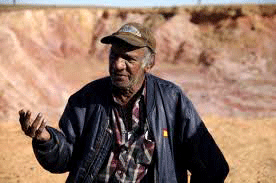
Green Left , Jim Green, January 8, 2024 Issue 1397
Arabunna Elder Uncle Kevin Buzzacott passed away in Alice Springs on November 29, 2023. A fierce advocate for his people and for a nuclear-free Australia, Kevin will be sorely missed.
Kevin was born in 1946 at Finniss Springs, on Arabunna country in South Australia. As a youngster, he learnt culture, language, how to live off the land and he learnt to work with cattle and horses.
Over the years, Kevin and his family lived in many places including Alice Springs, Tarcoola and Gawler. He worked on the railways for many years.
In 1984, Kevin moved to Port Augusta, where he worked as alcohol and drug worker. In 1985 he moved to Alice Springs where he worked on the successful campaign to stop the Todd River from being dammed. He helped establish the Arrernte Council in Alice Springs and served as an Aboriginal and Torres Strait Islander Commission regional councillor.
Kevin returned to South Australia in the mid-1990s to protect Arabunna country.
One of his major campaigns was to try to stop the rapacious water take from the Great Artesian Basin by mining company WMC (and later BHP) to supply the Olympic Dam copper/uranium mine at Roxby Downs.
The extraction of around 40 million litres of water has adversely affected the precious Mound Springs on Arabunna country — desert oases supported by the underlying Great Artesian Basin.
Kevin’s campaign might eventually succeed: there are plans to build a desalination plant on Spencer Gulf which could lead to a reduction and possible cessation of the water take from the Great Artesian Basin.
Kevin explained: “I’ve been at this game of calling for justice and peace for 30, maybe 40 years, but what really got me going was when Western Mining Corporation (WMC) set up the Olympic Dam mine. They started doing deals with the government on pastoral leases. So they did deals with S. Kidman & Co. and took up one of their cattle stations, Stuart’s Creek Station, which is on Arabunna land. Because of our native title and ongoing land rights campaigning, we’ve been fighting for these places for a long time. Stuart’s Creek is a very special, sacred place for us, and we’ve been trying to get it back for a long time.
“I thought that just before they bought that place I’d go and protest and camp on it. Also, it is on that station, on the shores of the Lake Eyre, where WMC started taking the sacred water out of the Lake Eyre Basin. That was where they started sucking the life blood out of us. That is where they put their big bore down, right on the shores of the lake. That was a real kick in the guts for me and really got me going.”
……………………………………………………………………….. Protest camp
Kevin set up a protest camp on Arabunna country in March 1999. WMC was among the most viciously racist mining companies in Australia and, true to form, the company tried to have Arabunna Elder Kevin Buzzacott evicted. The protest camp lasted until it was busted up by WMC goons and local police in December 1999.
Kevin initiated court actions against WMC and the federal government. These actions weren’t successful in the courts, but helped draw attention to the issues Kevin was fighting for.
“I did a court action against Hugh Morgan, who was the head of WMC. I charged Hugh Morgan with genocide, trying to flush him out and some of the shareholders. Hugh Morgan is based in Victoria. People in Melbourne deserve to live in a good place, they don’t need to live with these criminals and warmongers. Another court action I did was one I brought against Alexander Downer and Senator Robert Hill for stopping Lake Eyre from becoming a World Heritage site.”
After the protest camp on Arabunna country was busted up, Kevin set up a protest camp at Genocide Corner, outside the SA Governor’s residence in the centre of Kaurna Yerta/Adelaide.
“I had to go to Adelaide for the court case against Hugh Morgan, and when I was there the charges against Hugh Morgan were dismissed. The judge was a pastor in the Lutheran Church, and I asked him to stand down because I believed he had a conflict of interest as his church was a shareholder in the WMC. When he refused to do so I told him to get stuffed, walked out and went straight down to Government House to start a protest. I took banners, and whatever things I had,” Kevin said
“While I was talking to the media I was confronted by the cops. I looked over the road and saw a patch of grass and thought, ‘Bugger it, I’ll make camp and a fire here’. I ended up calling it ‘genocide Corner’, and renamed Adelaide the ‘City of Genocide’. It was on the intersection of King William Street and North Terrace [one of the main intersections in the city] so loads of people were passing by.
“Four ceremonial fires for peace were lit and, after 21 days, the Adelaide City Council and 50 police came down and arrested me for failing to cease to loiter. It was one of those laws they hadn’t used in a long time, but they used it to clear away all my stuff and my supporters.
“One of the court conditions was that I was not able to walk within the vicinity of Genocide Corner. I was of a mind just to walk straight back there, but I had the Peace Walk from Lake Eyre to Sydney coming up so I had to let that one go.”
The Peace Walk was timed to reach Sydney for the Olympics in September 2000.
“We walked for months, for 3000 kilometres, and all sorts of people from all walks of life joined us. We were carrying the fire for peace and justice. I made sure that we went through lots of different Aboriginal communities. I got a lot of support, but the government also pressured a lot of people not to support me by threatening their jobs and funding. Each place we went to, people took us through their land and we respected each mob.
There were all types of pressure put on people along the way. The cops were nasty and threatened some of the walkers with guns and everything. I visited all the jails along the way from Broken Hill to Dubbo and Bathurst. It was sad to see so many young brothers confined and locked up.
“We went to Canberra and met up with the Tent Embassy mob. A couple of politicians came to meet us and then we all went to Government House to present the Governor-General with a document of peace and justice.
“When we arrived in Sydney for the Olympic Games the Tent Embassy mob had already set up a camp [in Victoria Park], so we joined up with them. We did all sorts of things. We did a re-enactment at the beach where Captain Cook came in. We re-enacted the bad way in which he came with guns and all that and then the next day we did how they should have come.”
Reclaiming totems
In 2002, Kevin reclaimed the Emu and Kangaroo totems from the Australian Coat of Arms hanging outside Parliament House, Canberra………………………………………………………..
In 2004, Kevin participated in the Peace Pilgrimage from the Olympic Dam uranium mine to Hiroshima, Japan.
“During the first walk and then in Sydney we met people from all over and that got everything going. Aboriginal nations from Queensland were saying there should be a walk up the coast to show the world the things they were suffering. Then some people made contact with people in Hiroshima to have a walk from the uranium mine in Roxby to where the bomb was dropped in order to show how all these things are linked. Aboriginal people, Japanese monks, all sorts of people were involved. It started at Roxby and then went to Canberra and then an aeroplane took us to Japan where we walked all over the country. We visited Nagasaki and Hiroshima and met a lot of people who were kids when the bombs were falling. We did talks and took part in a huge ceremony on the anniversary of the bomb being dropped. There were people everywhere and lanterns lit and people crying, it was full on.”
In 2006, Kevin went to Melbourne for the Stolenwealth Games…………………………………………..
And Kevin was back in Melbourne in 2008 for BHP’s Annual General Meeting.
‘Born to be peacemakers’
“BHP have taken over WMC. They now own Olympic Dam and want to make it bigger. Myself and others who want to stop the mine got to be proxies for shareholders, they gave us tickets and we got to go inside on their behalf. I got to speak and I told the people there about the damage they are doing and that they need to stop it immediately.
“Aboriginal people have lived here for more than 40,000 years and cared for this country, but now it’s being turned into a sick and evil place. Myself, and others around this country, were born to be peacemakers.
“We mustn’t be frightened to educate others and fight, but not in a warlike way, to protect the earth and let everything run free. I don’t want to shoot or bomb the people from BHP and the others who are destroying this country because two wrongs don’t make a right. I think if I can help them to wake up to what they are doing then that will be punishment enough.”
Kevin was at the first meeting of the Alliance Against Uranium (later renamed the Australian Nuclear Free Alliance) in 1997 and, for many years, he served as the Alliance’s President.
He actively supported countless campaigns against uranium mining and plans to dump nuclear waste on Aboriginal land. He was at the Beverley uranium mine supporting Adnyamathanha Traditional Owners in May 2000 when SA Police viciously and illegally attacked protesters, children and journalists.
Kevin was at the Lizard’s Revenge protest at Olympic Dam in 2012.
Kevin was awarded Nuclear-Free Future Resistance Award in 2001 by the Nuclear-Free Future Foundation and travelled to Ireland to accept the award. Kevin was awarded the SA Conservation Council’s Jill Hudson Award in 2006.
Kevin was awarded the Australian Conservation Foundation’s Peter Rawlinson Award in 2007 for two decades of work highlighting the impacts of uranium mining and promoting a nuclear free Australia.
ACF Executive Director Don Henry said: “Kevin is a cultural practitioner, an activist, an advocate and an educator. He has travelled tirelessly, talking to groups large and small about the impacts of uranium mining and the threats posed by the nuclear industry. Kevin has had a profound impact on the lives of many people – especially young people – with his many tours and ‘on-country’ events. For many young activists ‘Uncle Kev’ is truly an unsung hero and, against the current pro-nuclear tide, his is a very important struggle and story.”
Kevin participated in many of the Radioactive Exposure Tours run by Friends of the Earth. We camped at the ‘Old Lake’ (Lake Eyre) and generations of young activists learnt first-hand about the impacts of the Olympic Dam mine on country and culture.
Kevin’s partner Margret Gilchrist passed on Kevin’s final message when he returned to Alice Springs with his health failing: “Keep that old fire burning; don’t stop til we’ve won; Lake Eyre for World Heritage.”
[Kevin’s funeral service can be viewed online and many videos featuring Kevin can be found at Cinemata and YouTube. Jim Green is the national nuclear campaigner with Friends of the Earth.]
Uranium ship sneaks into ‘nuclear free’ Fremantle port, sparking concern by wharfies over safety
The West Australian, Sat, 6 January 2024
A container ship carrying uranium ore was allowed to dock at Fremantle on Thursday, but was forced to wait for several hours whilst officials checked it was safe for it to berth.
The Maritime Union of Australia said wharfies expressed safety concerns when they became aware of the radioactive cargo.
”They’ve never had that cargo on board that anyone can remember so there was some push back from the workforce, to make sure all the safety requirements were in place,” union organiser Daniel Piccoli told The Sunday Times.
The vessel APL Mexico City was eventually allowed in on Thursday morning and the ship was due to sail on Sunday night.
The uranium stayed in 18 containers on the ship, which had left Adelaide on December 30.
Fremantle Port Authority said that while the cargo was prohibited from being handled, it was permitted for transit through the Port…………………………
Fremantle was a nuclear free zone under a long-time City of Fremantle policy.
According to the policy, “Council would object to uranium, nuclear waste or other material connected with the nuclear power industry being stored or transported in or through the municipality.“
Fremantle Greens MLC and former mayor Brad Pettitt said the transit was unusual, but it raised questions about whether the port workers were adequately informed about the dangerous cargo and were all the safety protocols adhered to.
He said protocols should be transparent as well as strong………. https://thewest.com.au/news/wa/uranium-ship-sneaks-into-nuclear-free-fremantle-port-sparking-concern-by-wharfies-over-safety-c-13132756
The real reason why the USA pushed for the world to “triple nuclear power” at COP 28.

While China dominates the wind- and solar-power sectors, nuclear energy is one area where officials believe the U.S. could compete with its long menu of newer reactor types and fuels.
U.S. puts diplomatic clout behind sales of cutting-edge reactors that have yet to show commercial success
Washington Heats Up Nuclear Energy Competition With Russia, China
By William Mauldin and Jennifer Hiller, Jan. 6, 2024 https://www.wsj.com/politics/national-security/washington-heats-up-nuclear-energy-competition-with-russia-china-f2f18e75
WASHINGTON—To compete with its biggest geopolitical rivals, the U.S. government is looking toward small nuclear reactors.
Not a single so-called small modular reactor has been sold or even built in the U.S., but American officials are trying to persuade partner countries to acquire the cutting-edge nuclear reactors still under development by U.S. firms. The goal: to wrest nuclear market share from Russia—the global industry giant—and defend against China’s fast-growing nuclear-technology industry.

The U.S. hopes that putting its clout behind a new technology can cement future commercial and diplomatic relationships and chip away at China’s and Russia’s ability to dominate their neighbors’ energy supply.
The Biden administration also sees nuclear energy as a way to export reliable green (?) energy, since nuclear-power plants split atoms and don’t burn carbon-based fuels that contribute most to climate change. With Russia’s broad 2022 invasion of Ukraine sending Poland and other European countries looking for new energy partners, U.S. officials and industry leaders see a potential opening in the market for U.S. exports to compete with China’s growing nuclear ambitions.
While China dominates the wind- and solar-power sectors, nuclear energy is one area where officials believe the U.S. could compete with its long menu of newer reactor types and fuels. The U.S. aims to sign agreements for partnerships lasting 50 years or longer to provide U.S. technology to Moscow’s former energy partners and to fast-growing countries in Southeast Asia worried about overreliance on Chinese and Russian energy.
“If we’re the supplier, we support the energy security of our allies and partners,” said Ted Jones, head of national security and international programs at the Nuclear Energy Institute, a U.S. industry group. “We help prevent them from finding themselves in the situation of Europe with respect to Russian gas and nuclear.”
At the core of the U.S. campaign is a technology, yet-unproven in the U.S., called a small modular reactor, or SMR. SMRs generate about one-third the energy of a conventional nuclear reactor and can be prefabricated and shipped to the site. Among other potential advantages, they are intended to be cheaper than larger reactors, which often have to be custom designed, and they can be installed to meet growing demand for energy, according to the International Atomic Energy Agency.
‘Very, very long-term strategic partnership’
U.S. officials say they are working with developers of SMRs, and the government-run Export-Import Bank and the U.S. International Development Finance Corp., to win overseas orders that will bring down costs and build an order book for the new technology, all while linking the countries’ energy systems to the U.S. and its allies. By 2035, the U.S. Nuclear Energy Agency estimates that the global SMR market could reach 21 gigawatts of power, enough to power two billion LED lightbulbs.
“It’s important that the United States maintains that leadership in the transition from the laboratory to the grid and deployment and commerciality,” said Geoffrey Pyatt, the State Department’s assistant secretary of energy resources. “It’s about building a very, very long term strategic partnership.”
To make nuclear-energy exports a viable tool of foreign policy, U.S. companies will have to prove they can deliver smaller reactors for export on time and budget, a goal that has eluded larger nuclear-power plants in the West.
The U.S. has yet to build an SMR, and none is yet under construction in the U.S. The concept’s economics remain unproven, as does the timeline for building such a reactor. One company, Kairos Power, recently received construction approval for a demonstration project in Tennessee. It plans to focus on the domestic market. NuScale Power, one of the major U.S. players, recently canceled an SMR project in Idaho when a group of utilities in the Mountain West couldn’t get enough members to commit.
To make the concept work, most SMRs’ developers would need a pipeline of orders so they could move into factory-style production, lowering unit costs.
Among the potential customers U.S. industry and government officials are looking at are Polish energy company Orlen, which wants to build SMRs designed by GE Hitachi Nuclear Energy.
The U.S. Export-Import Bank and U.S. International Development Finance Corp. have offered to arrange up to $4 billion in financing for a plant planned by NuScale in Romania, with an aim of going online in 2029 or 2030. U.S. officials also say they are in discussions with Bulgaria, Ghana, Indonesia, Kazakhstan and the Philippines on new nuclear projects.
China is leading the world in reactor construction and recently started commercial operations of a plant with two SMRs. The country is now building 22 of the 58 reactors under construction around the world, according to the International Atomic Energy Agency. China has built reactors in Pakistan and aims to join Russia as a major exporter of nuclear technology.
Last year, China and the U.S. were jockeying to provide civilian nuclear technology to Saudi Arabia. Washington appeared close to a deal, part of a regional pact with Israel, but it was derailed by Hamas’s attack on Israelis in October and the subsequent war in Gaza.
U.S. sales pitch: We’re less risky than Russia and China
Russia’s state-owned Rosatom, meanwhile, is a major exporter of both reactors and nuclear fuel.
According to the latest World Nuclear Industry Status Report, it was building 24 reactors: 19 large reactors in countries from Turkey to Bangladesh, a barge to be equipped with two small reactors under construction in China but intended for use in Russia, and three reactors at home. Of the reactors under construction in Russia, two are large; the third is an SMR that would use liquid metal for cooling. Rosatom started commercial operations of two SMRs on a floating barge in 2020, though that project took longer and cost more than expected.
Washington is counting on partner countries’ interest in working with U.S. firms and what officials are selling as a less risky tie-up than working with Moscow and Beijing on projects that have a lifespan of 50 years or more.
“It’s never good if our allies are dependent on a potential adversarial country for energy,” said Bret Kugelmass, chief executive of nuclear-power startup Last Energy, which plans to build microreactors that would generate 20 megawatts of electricity and be sited near factories.
The process for hammering out a network of government and commercial deals can take years, with U.S. officials working alongside foreign counterparts, export credit agencies, nuclear-energy firms and utilities, not to mention the U.S. Congress. Russia and China have the advantage of state-led financial sectors to fund projects that can span a decade until power flows.
U.S. industry executives and government officials say they are now working on shortcuts to marketing reactors, including setting up a single government-to-government deal that includes corporate contracts and public and private financing assistance.
The new deals are designed to appeal to partner countries that want a simpler path to getting a reactor, without the heavy dose of Chinese financing that U.S. officials say might have strings attached.
1 This month
To see nuclear-related stories in greater depth and intensity
– go to https://nuclearinformation.wordpress.com/


 Antinuclear