TODAY. UK govt has come clean about it! Nuclear power- no use, really – just essential for the nuclear weapons industry.

” Civil Nuclear: Roadmap to 2050, – in this supposedly “civil” strategy – are multiple statements about addressing “civil and military nuclear ambitions” together to “identify opportunities to align the two across government”.
Some pesky British scientists have gone badly off script – the naughty troublemakers. Andy Stirling and Philip Johnstone should be talking about the wonderful ability of the nuclear industry to fix climate problems and energy needs.
But dammit, these guys don’t seem to understand which side their bread is buttered on. They have blatantly explained what the UK government has quietly acknowledged – THE REAL REASON FOR THE NUCLEAR INDUSTRY.
The industry is not economic, not clean, not healthy, not safe, not effective against global heating, - BUT – it provides a good, respectable cover for continuing to use tax-payer to prop up the killing industry - nuclear weapons.
We probably all knew this, underneath. But it is obscured by some comfortable fantasy that we are safer “protected” by mass-killing weapons, than by friendship, understanding, negotiating, with other nations. By the fantasy that “strong” (though stupid) governments care about our survival. The reality is that those in power in government just want to hang on to their prestigious jobs and hope that the bad stuff doesn’t happen until after they retire. In the meantime they’ve got the support of the killing industries and macho military.
Stirling, Johnstone, and also Jonathon Porritt have publicised what the government rather quietly admitted:
” Civil Nuclear: Roadmap to 2050, – in this supposedly “civil” strategy – are multiple statements about addressing “civil and military nuclear ambitions” together to “identify opportunities to align the two across government”.
Jonathon Porritt is probably already persona non grata with the authorities. As for Stirling and Johnstone – telling the truth is probably not a good career move.
The Last Flurry: The US Congress and Australian Parliamentarians seek Assange’s Release
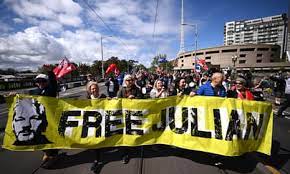
January 19, 2024 : Dr Binoy Kampmark, https://theaimn.com/the-last-flurry-the-us-congress-and-australian-parliamentarians-seek-assanges-release/
On February 20, Julian Assange, the daredevil publisher of WikiLeaks, will be going into battle, yet again, with the British justice system – or what counts for it. The UK High Court will hear arguments from his team that his extradition to the United States from Britain to face 18 charges under the Espionage Act of 1917 would violate various precepts of justice. The proceedings hope to reverse the curt, impoverished decision by the remarkably misnamed Justice Jonathan Swift of the same court on June 6, 2023.
At this point, the number of claims the defence team can make are potentially many. Economy, however, has been called for: the two judges hearing the case have asked for a substantially shortened argument, showing, yet again, that the quality of British mercy tends to be sourly short. The grounds Assange can resort to are troublingly vast: CIA-sponsored surveillance, his contemplated assassination, his contemplated abduction, violation of attorney-client privilege, his poor health, the violation of free-speech, a naked, politicised attempt by an imperium to capture one of its greatest and most trenchant critics, and bad faith by the US government.
Campaigners for the cause have been frenzied. But as the solution to Assange’s plight is likely to be political, the burden falls on politicians to stomp and drum from within their various chambers to convince their executive counterparts. In the US Congress, House Resolution 934, introduced on December 13 by Rep. Paul A. Gosar, an Arizona Republican, expresses “the sense of the House of Representatives that regular journalistic activities are protected under the First Amendment, and that the United States ought to drop all charges against and attempts to extradite Julian Assange.”
The resolution sees a dramatic shift from the punishing, haute view taken by such figures as the late Democratic Senator Dianne Feinstein, who was one of the first political figures to suggest that Assange be crucified on the unsteady timber of the Espionage Act for disclosing US cables and classified information in 2010. The resolution acknowledges, for instance, that the disclosures by WikiLeaks “promoted public transparency through the exposure of the hiring of child prostitutes by Defense Department contractors, friendly fire incidents, human rights abuses, civilian killings, and United States use of psychological warfare.” The list could be sordidly longer but let’s not quibble.
Impressively, drafters of the resolution finally acknowledge that charging Assange under the Computer Fraud and Abuse Act (CFAA) for alleged conspiracy to help US Army intelligence analyst Chelsea (then Bradley) Manning access Defense Department computers was a fabled nonsense. For one, it was “impossible” – Manning “already had access to the mentioned computer.” Furthermore, “there was no proof Mr Assange had any contact with said intelligence analyst.”
Ire is also directed at the espionage counts, with the resolution noting that “no other publisher has ever been prosecuted under the Espionage Act prior to these 17 charges.” A successful prosecution of the publisher “would set a precedent allowing the United States to prosecute and imprison journalists for First Amendment protected activities, including the obtainment and publication of information, something that occurs on a regular basis.”
Acknowledgment is duly made of the importance of press freedoms to promote transparency and protect the Republic, the support for Assange, “sincere and steadfast”, no less, shown by “numerous human rights, press freedom, and privacy rights advocates and organizations”, and the desire by “at least 70 Senators and Members of Parliament from Australia, a critical United States ally and Mr Assange’s native country” for his return.
Members of Australia’s parliament, adding to the efforts last September to convince members of Congress that the prosecution be dropped, have also written to the UK Home Secretary, James Cleverly, requesting that he “undertake an urgent, thorough and independent assessment of the risks to Mr Assange’s health and welfare in the event that he is extradited to the United States.”
-ADVERTISEMENT-
The members of the Bring Julian Assange Home Parliamentary Group draw Cleverly’s attention to the recent UK Supreme Court case of AAA v Secretary of State for the Home Department which found “that courts in the United Kingdom cannot just rely on third party assurances by foreign governments but rather are required to make independent assessments of the risk of persecution to individuals before any order is made removing them from the UK.
It follows that the approach taken by Lord Justices Burnett and Holroyde in USA v Assange [2021] EWHC 3133 was, to put it politely, a touch too confident in accepting assurances given by the US government regarding Assange’s treatment, were he to be extradited. “These assurances were not tested, nor was there any evidence of independent assessment as to the basis on which they could be given and relied upon.”
The conveners of the group point to Assange’s detention in Belmarsh prison since April 2019, his “significant health issues, exacerbated to a dangerous degree by his prolonged incarceration, that are of very real concern to us as his elected representatives.” They also point out the rather unusual consensus between the current Australian Prime Minister, Anthony Albanese, and his opposition number, Peter Dutton, that the “case has gone on for too long.” Continued legal proceedings, both in the UK, and then in the US were extradition to take place “would add yet more years to Mr Assange’s detention and further imperil his health.”
In terms of posterity’s calling, there are surely fewer better things at this point for a US president nearing mental oblivion to do, or a Tory government peering at electoral termination to facilitate, than the release of Assange. At the very least, it would show a grudging acknowledgment that the fourth estate, watchful of government’s egregious abuses, is no corpse, but a vital, thriving necessity.
Perth could be an ‘especially important target’ due to AUKUS
January 12, 2024
Curtin University Dean of Global Futures Professor Joe Siracusa says while Australia has always been a nuclear target, Perth has particularly become a target for China and Russia due to AUKUS.“They see the AUKUS development here, not only nuclear-propelled submarines, but they’re going to have nuclear cruise missile type things here,” he told Sky News Australia.
UK’s nuclear obsessions kill off its net zero strategy

The new Roadmap reads like an outing to a massive nuclear sweet shop. On top of Hinkley Point C and Sizewell C, we’ll have one more big one. And then we’ll have lots of Small Modular Reactors, all over the country. And we’ll have a new fuel processing plant. And a new Geological Disposal Facility – at some much more distance point. And so on and on. 24 fantastical Gigawatts to be designed and delivered by 2050.
Jonathon Porritt, 18 Jan 24
After 14 years of Tory mismanagement, the UK finds itself bereft of an energy strategy.
This was finally confirmed in the release last week of the Government’s new Nuclear Roadmap. At one level, it’s just the same old, same old, the latest in a very long line of PR-driven, more or less fantastical wishlists for new nuclear in the UK. But at another, it’s a total revelation.
For years, a small group of dedicated academics and campaigners have suggested that the UK Government’s Nuclear Energy Strategy is being driven more by the UK’s continuing commitment to an “independent” nuclear weapons capability than by any authoritative energy analysis. For an equal number of years, this was aggressively rebutted by one Energy Minister after another, both Tory and Labour.
The new Nuclear Roadmap dramatically changes all that. It sets to one side any pretence that the links between our civil nuclear programme and our military defence needs were anything other than small-scale – and of no material strategic significance. With quite startling transparency and clarity, the Roadmap not only reveals the full extent of those links, but positively celebrates that co-dependency as a massive plus in our ambition to achieve a Net Zero economy by 2050.
“Startling” is actually an understatement. Such a comprehensive volte-face is rare in policy-making circles. Every effort is usually made by Ministers to obscure the scale (let along the significance) of any such screeching handbrake turns. That is so not the case with the new Roadmap.
Courtesy of the latest forensic work done by Professors Andy Stirling and Phil Johnstone at Sussex University (who have been absolutely at the forefront of seeking to bring these links into the public domain over many years – often with mighty little support from mainstream environmental organisations, let alone “independent” commentators), chapter and verse of this volte-face can be laid bare. Just three o examples from the Roadmap:
- “Not only does this Roadmap set a clear path for the growth of nuclear fission…it acknowledges the crucial importance of the nuclear industry to our national security, both in terms of energy supply and the defence nuclear enterprise.”
- “Government will proactively look for opportunities to align delivery of the civil and nuclear defence enterprises, whilst maintaining the highest standards of non-proliferation.”
- “To address the commonalities across the civil and defence supply chains, and the potential risk to our respective nuclear programmes due to competing demand for the supply chain, the Department of Energy Security and Net Zero (DESNZ) is working closely with the Ministry of Defence and the Defence Nuclear Sector.”
And there’s a whole lot more than that! As Andy Stirling has said: “Without any reflection on what this says about previous efforts to suppress discussion of this issue, the Government is now openly emphasising its significance.”
Indeed!
As usual, the UK’s ill-informed and unbelievably gullible mainstream media would appear to have missed the significance of this gobsmacking inflection point. So one can hardly expect them to have grasped its even more significant implications for UK energy strategy as a whole. In every single particular.
Let me briefly unpack some of those particulars:
- Nuclear
The new Roadmap reads like an outing to a massive nuclear sweet shop. On top of Hinkley Point C and Sizewell C, we’ll have one more big one. And then we’ll have lots of Small Modular Reactors, all over the country. And we’ll have a new fuel processing plant. And a new Geological Disposal Facility – at some much more distance point. And so on and on. 24 fantastical Gigawatts to be designed and delivered by 2050.
The reality couldn’t be more different:
- We will indeed end up with Hinkley Point C – at a staggering of cost of somewhere between £26 billion and £30 billion, with consumers paying twice as much for its electricity as they will for offshore wind. And it will almost certainly not come online until the end of the decade, 15 years on from the time it was meant to be up and running.
- We may possibly get Sizewell C, though the Government cannot currently guarantee the required level of investment. So a Final Investment Decision is unlikely before the next Election. At which point, Starmer may come to his senses and kill off this absurd white elephant.
- We will never get a third big reactor. The economics are literally impossible to justify.
- We are unlikely to get more than a couple of hugely expensive Small Modular Reactors, at some indeterminate point in the future, even with a new “flexible approach” to planning and financial inducements. Even that may prove to be an illusion. As Professor Steve Thomas has written: “Advocates of Small Nuclear Reactors claim they are cheaper and easier to build, safer, generate less waste, and will create many jobs compared to existing large reactor designs. These claims are unproven, misleading, or just plain wrong. Worldwide, no commercial design of SMR has even received a firm order yet.”
- And we may or may not get life extensions for the last five power stations in the “legacy fleet” – subject to regulatory approval, which may not be all that easy given extensive cracking in their reactor cores.
In short, the Roadmap is just a massive diversion from reality. Entailing incalculable opportunity costs. And putting at risk our entire Net Zero by 2050 strategy.

Ministers know all that. But they don’t really care. Our nuclear weapons programme (including upgrading Trident) will be protected as a consequence of this, via an unceasing flow of public money into the civil nuclear cul-de-sac, at a time when our defence budget is already massively overstretched. So who cares about the missing 24GW?
- Renewables
We’ll continue to see new investment into renewables here in the UK, despite (not because of) government policy, which has seriously messed up our offshore wind industry, maintained a de facto ban on onshore wind, couldn’t care less about solar, witters on vapidly about tidal without doing anything etc etc.
Meanwhile, on a global basis, renewables continue to boom. Here are a few facts – in contrast to over-excited sightings of nuclear unicorns:…………………………………………………………………………………………………………………………………………………………
Why don’t people see this?
Why don’t our mainstream media offer any serious critique of what’s going on here?
Why don’t our opposition parties rip to shreds this tissue of preposterous illusions?
The reasons for this almost complete silence can be traced back to successive governments’ grim intent to hang onto our so-called “independent nuclear deterrent”. At literally any costs…………………………………………………………………….more https://www.jonathonporritt.com/uks-nuclear-obsessions-kill-off-its-net-zero-strategy/
Zelensky Courts JPMorgan, Bank of America & Bridgewater CEOs At Davos, Urges More Money From West
Zero Hedge, BY TYLER DURDEN, WEDNESDAY, JAN 17, 2024
As expected, anything related to Ukraine presented at the World Economic Forum (WEF) in Davos has been focused on more weaponry and seeking more vows of integration among Western allies.
“Ukrainians need predictable financing throughout 2024 and beyond,” European Commission president Ursula von der Leyen told World Economic Forum participants. “They need a sufficient and sustained supply of weapons to defend Ukraine and regain its rightful territory.”
As for President Zelensky, in addressing world leaders at the forum he emphasized that the West needs to help Ukraine achieve air superiority if his forces are to have a chance to emerge victorious against Russia……………………………………

At the summit, US Secretary of State Antony Blinken promised that Washington will keep up its support for Ukraine, however while keeping things vague – following Biden’s proposed foreign defense budget request being reject by GOP members in Congress; and NATO chief Jens Stoltenberg suggested Ukraine is moving closer to entry into the alliance.
Stoltenberg acknowledged a “serious battlefield situation” but also said there is “cause for optimism” after nearly two years of fighting, and NATO’s constant support.
Below is a portion of the NATO press readout based on his panel speech:
………… Ukrainians are now firmly oriented to the West, aspiring for membership in NATO and the European Union. The Secretary General also stressed that “support for Ukraine is not charity; it’s an investment in our own security”.………
But realistically, the prospect of Ukraine gaining full NATO membership would be a process of years, and would likely trigger WW3 with Russia–so to some degree this is all empty posturing.
But here’s what’s happening at Davos which is arguably more important to Kiev at the moment:
Ukraine is seeking new ways to finance its rebuilding plans as vital aid from the West slows down. President Volodymyr Zelenskyy reportedly has plans to meet JP Morgan’s CEO at the World Economic Forum.
Ukraine’s President Zelenskyy is reportedly planning to meet JPMorgan CEO Jamie Dimon at the World Economic Forum in Davos to seek new ways of financing its rebuilding plans.
JP Morgan, the biggest US bank with almost half a trillion dollars of market capitalization, has already been advising Ukraine on financing reconstruction.
It’s as yet unclear if any firm promises were made or agreements struck at the Davos meeting which also included Bank of America’s Brian Moynihan, as well as Bridgewater’s Ray Dalio.
According to further details of who was in attendance via Fox Business: “Other meeting attendees included David Rubinstein of the private equity firm Carlyle Group; billionaire entrepreneur Michael Dell, the founder of Dell Technologies; Ray Dalio of Bridgewater Associates, the world’s largest hedge fund; Steve Schwarzman, the CEO of Blackstone, the world’s largest private equity fund; and Philipp Hildebrand, representing BlackRock, the world’s largest money manager.”
Additionally, “Dimon was accompanied by Mary Erdoes, who runs JPMorgan’s asset-management unit. The White House was represented by Penny Pritzker, of the super-wealthy Pritzker family and a major Democratic Party donor.” Pritzker has been appointed Biden administration’s special representative for Ukraine’s economic recovery. https://www.zerohedge.com/geopolitical/zelensky-courts-jpmorgan-bank-america-bridgewater-ceos-davos-urges-more-west
It’s All About Me: Netanyahu Rejects Palestinian Statehood

January 20, 2024Written by: Dr Binoy Kampmark, https://theaimn.com/its-all-about-me-netanyahu-rejects-palestinian-statehood/
Israel has been given enormous license to control the security narrative in the Middle East for decades. This is not to say it is always in control of it – the attacks of October 7 by Hamas show that such control is rickety and bound, at stages, to come undone. What matters for Israeli security is that certain neighbours always understand that they are never to do certain things, lest they risk existential oblivion.
For instance, no Middle Eastern state will be permitted to acquire nuclear weapons on the Jewish State’s watch. Nuclear reactors and facilities will be struck, infected, or pulverised altogether (Osirak at Tuwaitha, Iraq; the Natanz site in Iran), with, or without knowledge, approval or participation of the United States.
This is a signature mark of Israeli foreign and defence policy: the nuclear option remains the greatest, single affirmation of sovereignty in international relations. To possess it, precisely because of its destructive and shielding potential, is to proclaim to the community of nation states that you have lethal insurance against invasion and regime change. Best, then, to make sure others do not possess it.
Israel, on the other hand, will be permitted to develop its own cataclysmic inventory of weapons, platforms, and doomsday options, all the while claiming strategic ambiguity about the whole matter. In that strangulating way, Israeli policy resembles the thornily disingenuous former US President Bill Clinton’s approach to taking drugs and oral sex: he did not inhale, and oral pleasuring by one by another is simply not sex.
The latest remarks from Israeli Prime Minister Benjamin Netanyahu on January 18 suggest that the license also extends to ensuring that Palestinians will never be permitted a sovereign homeland, that they will be, in a perverse biblical echo, kept in a form of bondage, downtrodden, oppressed and, given what happened on October 7 last year, suppressed. This is to ensure that, whatever the grievance, that they never err, never threaten, and never cause grief to the Israeli State. To that end, it is axiomatic that their political authorities are kept incipient, inchoate, corrupt and permanently on life support, the tolerated beggars and charity seekers of the Middle East.
At the press conference in question, held at the Kirya military base in Tel Aviv, Netanyahu claimed that, “Whoever is talking about the ‘day after Netanyahu’ is essentially talking about the establishment of the Palestinian state with the Palestinian Authority.” (How very like the Israeli PM to make it all about him.) The Israel-Palestinian conflict, he wanted to clarify, was “not about the absence of a state, a Palestinian state, but rather about the existence of a state, a Jewish state.”
With monumental gall, he complained that “All territory we evacuate, we get terror, terrible terror against us.” His examples, enumerated much like sins at a confessional, were instances where Israel, as an occupying force, had left or reduced their presence: Gaza, southern Lebanon, parts of Judea and Samaria (the West Bank). It followed that “any future arrangement, or in the absence of any future arrangement,” Israel would continue to maintain “security control” of all lands west of the Jordan River. “That is a vital condition.”
As such lands comprise Israeli territory, Gaza and the West Bank, Palestinian sovereignty can be assuredly ignored as a tenable outcome in Netanyahu’s policed paradise. He even went so far as to acknowledge that this “contradicts the idea of sovereignty” as far as the Palestinians are concerned. “What can you do? I tell this truth to our American friends.”
As to sceptical mutterings in the Israeli press about the country’s prospects of defeating Hamas decisively, Netanyahu was all foamy with indignation. “We will continue to fight at full strength until we achieve our goals: the return of all our hostages – and I say again, only military pressure will lead to their release; the elimination of Hamas; the certainty that Gaza will never again represent a threat to Israel. There won’t be any party that educates for terror, funds terror, sends terrorists against us.”
This hairbrained policy of ethno-religious lunacy masquerading as sane military strategy ensures that permanent war nourished by the poison of blood-rich hatred and revenge will continue unabated. In keeping such a powder keg stocked, there is always the risk that other powers and antagonists willing to have a say through bombs, rockets and drones will light it. Should this or that state be permitted to exist or come into being? The answer is bound to be convulsively violent.
It is of minor interest that officials in the United States found Netanyahu’s comments a touch off-putting. US Secretary of State Antony Blinken had, it is reported, dangled a proposal before the Israeli PM that would see Saudi Arabia normalise relations with Israel in exchange for an agreement to facilitate the pathway to Palestinian statehood. Netanyahu did not bite, insisting that he would not be a party to any agreement that would see the creation of a Palestinian state.
Blinken, if one is to rely on the veracity of the account, suggested that the removal of Hamas could never be achieved in purely military terms; a failure on the part of Israel’s leadership to recognise that fact would lead to a continuation of violence and history repeating itself.
In Washington, State Department spokesperson Matthew Miller stated in the daily press briefing that “Israel faces some very difficult choices in the months ahead.” The conflict in Gaza would eventually end; reconstruction would follow; agreement from various countries in the region to aid in that effort had been secured – all on the proviso that a “tangible path to the establishment of a Palestinian state” could be agreed upon.
For decades, administrations in Washington have fantasised about castles in the skies, the outlandish notion that Palestinians and Israelis might exist in cosy accord upon lands stolen and manured by brutal death. Washington, playing the Hegemonic Father, could then perch above the fray, gaze paternally upon the scrapping disputants, and suggest what was best for both. But the two-state solution was always encumbered and heavily conditioned to take place on Israeli terms, leaving all mediation and interventions by outsiders flitting gestures lacking substance.
Now, no one can claim otherwise that Palestinian statehood is anything other than spectral, fantastic, and doomed – at least under the current warring regime. Netanyahu’s own political survival, profanely linked to Israel’s own existence, depends on not just stifling pregnancies in Gaza but preventing the birth of a nationally recognised Palestinian state.
Work officially ‘started’ at Sizewell C Nuclear on Monday – but it was really only political theatre.

Ipswich Star, By Paul Geater 18 Jan 24
This week we had big fanfares and a major ceremony to “mark the start” of construction at Sizewell C.
But what did it all mean?
In one sense construction has already started. Land has been dug up, mature trees have been cut down, and one of the new entrances to the site is being cleared.
However, the Final Investment Decision (FID), the point at which the various parties are committed to building the station is still, apparently, several months away – so Monday’s ceremony really does look like nothing but a piece of political theatre.
What is clear, though, is that there is clear political will for this project to go ahead. The Government and the official opposition are both committed to it whatever the cost they may be exposed to.
I can understand that. I still don’t think it makes a great deal of economic sense – but given the uncertainties across the globe and the need to move to carbon zero energy I can see why they want to proceed with nuclear whatever the cost.
Personally I don’t have any concerns about the potential safety of the plant – while there are potential dangers with nuclear generation the experience over the last 60 years in this country suggests it can be operated safely.
And given that there are already two nuclear plants at Sizewell that need to be protected from the sea, it doesn’t seem unreasonable to put the new plant next to them so the protection can be shared.
I still have serious concerns with EDF and the government – who must be seen as equal partners in the project – over the way it is going to be built and the devastating impact it will have on local communities.
By adopting a “bull in a china shop” attitude towards its construction, EDF and the government are planning to cause substantial environmental damage to some of the most precious parts of the Heritage Coast that are closely linked in with Minsmere and Dunwich Heath……………………………………
Creating a new nature reserve two miles inland is great – but it can’t replace a massive area that’s directly linked to the coast.
But I fear that battle is lost now. With both the current government and the likely future government keen on the project, the best we can hope for is that some new habitats will make up for the lost treasures………………….
There’s also been a failure to really engage with local people. There have now been local community forums set up but they are being treated with suspicion by many. https://www.ipswichstar.co.uk/news/24054795.opinion-sizewell-c-still-doesnt-engage-residents/
1 This month

of the week – Australians for War Powers Reform (AWPR)
To see nuclear-related stories in greater depth and intensity
 Antinuclear