TODAY. Julian Assange, atrocities, nuclear war, AI, “Oppenheimer”, and the whole damn thing.

Julian Assange languishes in his solitary confinement cell for 23 hours a day in a British dungeon. He awaits the decision of the High Court on whether to let him appeal against extradition to the USA., for trial on the trumped up charges of espionage. Doesn’t really matter – even if he wins this one- then his appeal won’t be heard for months. Either way, the USA is killing this man – dragging out the whole abusive process.
It’s an atrocity against an individual. But the, the USA, especially under the Biden administration, (and I’m sure, under a Trump one) – is cool with atrocities.
Indeed – that’s why they’re persecuting Assange – because he exposed the USA’s military atrocities to the world. That is investigative journalism. The USA MUST kill Assange (probably slowly and “respectably”) so that the world will accept that no-one is to call the USA to account for military atrocities.
It’s almost comic – right now the USA is sending aid to starving Gazans with one hand, and with the other hand, sending to Israel weapons and money for the mass killing of Gazans.

America is participating in this atrocity –
and doing the profitable business that it loves most – selling killing machines to the world. I was fascinated to find the USA Naval Institute enthusiastically welcome a new murder toy a “transnational coalition kill chain”, for war against China.
America’s military-industrial-nuclear-complex is ecstatic with this system, already used , in the Navy’s own word in the “kill chain architecture leveraged against Russia”. Now they’re selling it to Taiwan – Link 16 – a system for kinetic warfare which will allow the Taiwan/ROC military to integrate and coordinate all its warfighting platforms with US, NATO, Japanese, Korean, Australian militaries in combined arms warfare. – sea, air, and land forces linked for lethal effect. All to be linked with low-earth orbit satellites and other Space Force assets. Taiwan can lead a multinational war offensive against China.

This war could involve a nuclear first strike. “The United States should consider nuclear first use if conventional forces cannot stop a Chinese invasion force from reaching Taiwan.“
If we’re talking about atrocities, I think that for the USA to make a nuclear strike on China – would be an atrocity. Deputy Secretary of State Kurt Campbell sees Ukraine as a “unified field” of war with China. He revels in the possibility of a “magnificent symphony of death” in Asia.
With Julian Assange dead – what journalist would dare investigate and expose these plans and events?
Now, what about AI? New military AI technology is being developed in the name of national security. “The U.S. has stated a very active interest in integrating AI across all warfighting functions,” said Benjamin Boudreaux, a policy researcher at the RAND Corporation. It’s a bit of a worry. Previous near-nuclear-attacks were prevented by the instinctive actions of individuals like Stanislav Petrov. Is AI going to be intelligent in that way?
The film “Oppenheimer” swept seven Academy Awards. Certainly a great film, but now being used by the nuclear lobby in this case The Nuclear Threat Initiative, to promote nuclear power, pretending that this industry has nothing to do with nuclear weapons. By the way, “Barbie’s $1.4 billion gross far exceeds Oppenheimer’s $950 million gross. But then “Barbie” was the story of Barbie finding the real world to be dominated by men (not perhaps the message to appeal to the men who run things like the Oscars, and just about everything else)
What do do about all this? Just let it all happen?
Well, there are millions of people who don’t want this insane militaristic system- so we all should be able stop the madness controlled by a relatively small phalanx world-wide. But how?
Cold turkeys: The demise of nuclear power
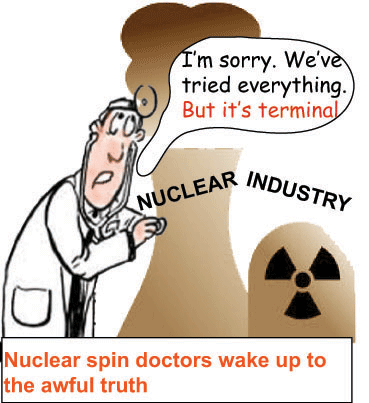
Jim Green, Mar 12, 2024, https://reneweconomy.com.au/cold-turkeys-the-demise-of-nuclear-power-in-australias-aukus-partner-countries/
When announcing the AUKUS agreement in 2021, then Prime Minister (and secret energy minister) Scott Morrison said: “Let me be clear: Australia is not seeking to establish … a civil nuclear capability.” He also said that “a civil nuclear energy industry is not a requirement for us to go through the submarine program.”
However, Coalition Senators argued in a report last year that Australia’s “national security” would be put at risk by retaining federal legislation banning nuclear power and that the “decision to purchase nuclear submarines makes it imperative for Australia to drop its ban on nuclear energy.”
So, let’s see how nuclear power is faring in our AUKUS partners, the UK and the US.
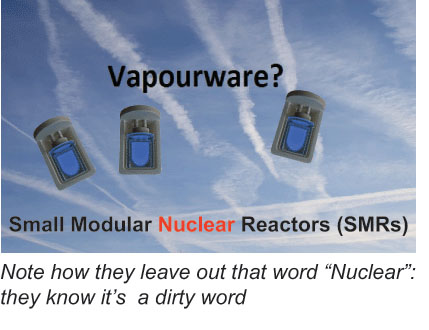
This is a story about conventional, large reactors. All that needs to be said about ‘small modular reactors’ in the UK and the US is that none exist and none are under construction.
This is a story about conventional, large reactors. All that needs to be said about ‘small modular reactors’ in the UK and the US is that none exist and none are under construction.
The UK
The last power reactor start-up in the UK was 29 years ago — Sizewell B in 1995.
Over the past decade, several proposed new nuclear power plants have been abandoned (Moorside, Wylfa, Oldbury) and the only project to reach the construction stage is Hinkley Point C, comprising two French-designed EPR reactors.
In the late 2000s, the estimated construction cost for one EPR reactor in the UK was £2 billion (A$3.9 billion). When construction of two EPR reactors at Hinkley Point commenced in 2018 and 2019, the cost estimate for the two reactors was £19.6 billion.
The current cost estimate for the two reactors has ballooned to £46 billion (A$89 billion) or £23 billion (A$44.5 billion) per reactor. That is 11.5 times higher than the estimate in the late 2000s. Further cost overruns are certain. This is an example of the Golden Rule of Nuclear Economics: Add a Zero to Nuclear Industry Estimates.
The UK National Audit Office estimates that taxpayer subsidies for Hinkley Point — primarily in the form of a guaranteed payment of £92.50 (A$180) per megawatt-hour (2012 prices), indexed for inflation, for 35 years — could amount to £30 billion (A$58 billion) while other credible estimates put the figure as high as £48.3 billion (A$94 billion).
Delays
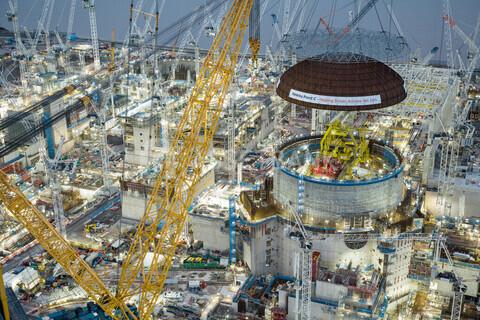
The delays associated with Hinkley Point have been as shocking as the cost overruns. In 2007, French utility EDF boasted that Britons would be using electricity from an EPR reactor at Hinkley Point to cook their Christmas turkeys in 2017. In 2008, the UK government said the reactors would be complete “well before 2020”.
But construction of the two reactors didn’t even begin until 2018 and 2019, respectively, at which time completion was expected in 2026. Now, completion is expected in 2030 or 2031.
Undoubtedly there will be further delays and if the reactors are completed, it will be more than a quarter of a century after the 2007 EDF boast that Britons would finally be using electricity from Hinkley Point to cook their Christmas turkeys.
Construction will take well over 10 years; planning and construction over 25 years. Yet in Australia, the Coalition argues that Australians could be cooking Christmas turkeys with nuclear power 10 years from now.
‘Something of a crisis’
Nuclear industry lobbyist Tim Yeo said in 2017 that the UK’s nuclear power program faced “something of a crisis”. The following year, Toshiba abandoned the planned Moorside nuclear power project near Sellafield despite generous offers of government support — a “crushing blow” according to Yeo.
Then in 2019, Hitachi abandoned the planned Wylfa reactor project in Wales after the estimated cost of the twin-reactor project had risen by 50 percent.
Hitachi abandoned the project despite an offer from the UK government to take a one-third equity stake in the project; to consider providing all of the required debt financing; and to consider providing a guarantee of a generous minimum payment per unit of electricity.
Long gone was the 2006 assertion from then UK industry secretary Alistair Darling that the private sector would have to “initiate, fund, construct and operate” nuclear power plants.
The UK Nuclear Free Local Authorities noted that Hitachi joined a growing list of companies and utilities backing out of the UK nuclear new-build program:
“Let’s not forget that Hitachi are not the first energy utility to come to the conclusion that new nuclear build in the UK is not a particularly viable prospect. The German utilities RWE Npower and E-on previously tried to develop the site before they sold it on Hitachi in order to protect their own vulnerable energy market share in the UK and Germany.
“British Gas owner Centrica pulled out of supporting Hinkley Point C, as did GDF Suez and Iberdrola at Moorside, before Toshiba almost collapsed after unwise new nuclear investments in the United States forced it to pull out of the Sellafield Moorside development just a couple of months ago.”
Sizewell C

The UK government hopes to progress the Sizewell C project in Suffolk, comprising two EPR reactors, and is once again offering very generous support including taking an equity stake in the project and using a ‘regulated asset base‘ model which foists financial risks onto taxpayers and could result in taxpayers paying billions for failed projects — as it has in the US.
If recent experience is any guide, the government will struggle to find corporations or utilities willing to invest in Sizewell regardless of generous government support.
(The same could be said for plans for small modular reactors or mid-sized reactors envisaged by Rolls-Royce — it is doubtful whether private finance can be secured despite generous taxpayer subsidies.)
Many reactors have been permanently shut down in the UK: the IAEA lists 36 such reactors. Since the Sizewell B reactor startup in 1995, there have been 24 permanent reactors shut-downs and zero startups.
Repeat: since the last reactor startup in the UK, there have been 24 shut-downs!
The capacity of the nine remaining reactors (5.9 gigawatts — GW) is less than half of the peak of 13 GW in the late 1990s. Nuclear power’s contribution to electricity supply has fallen from 22 percent in the early 2000s to 14.2 percent.
Meanwhile, the UK government reports that renewable power sources accounted for 44.5 percent of total UK generation in the third quarter of 2023, a higher share than fossil fuels and around three times more than nuclear’s share.
What to make of the conservative UK government’s goal of quadrupling nuclear capacity to 24 GW by 2050? It is deeply implausible. The facts speak for themselves. Two dozen reactor shutdowns and zero startups since 1995.
The Hinkley Point project has been extremely slow and extremely expensive. The Sizewell C project is uncertain. Other proposals — including proposals for small modular reactors — are even more uncertain and distant.
Unsurprisingly, the extraordinary cost overruns and delays associated with Hinkley Point have complicated plans to advance the proposed Sizewell C project.
In 2010, the UK government announced that Sizewell was one of the locations slated for new reactors. Fourteen years later, construction is some years away and it remains uncertain if the project will reach the construction stage. EDF and the UK government are seeking to raise a further £20 billion from new investors. All reasonable offers considered.
France

The Sizewell C project is equally complicated across the channel due to EDF’s massive debts and its plan to replace the EPR design with an EPR2 design, about which little is known except that safety will be sacrificed on the altar of economics. EDF’s debt as of early 2023 was €64.5 billion (A$107 billion) and it was fully nationalised later in 2023 due to its crushing debts.
In addition to its adventures across the channel, EDF has a “colossal maintenance and investment programme to fund” in France as the Financial Times noted in October 2021.
As in the UK, there has not been a single reactor startup in France since the last millennium. The only current reactor construction project is one EPR reactor under construction at Flamanville. The current cost estimate of €19.1 billion (A$31.6 billion) is nearly six times higher than the original estimate of €3.3 billion (A$5.5 billion).
Construction of the Flamanville reactor began in 2007 and it remains incomplete 17 years later. Planning plus construction have taken over a quarter of a century. Yet the Coalition argues that Australians could be cooking Christmas turkeys with nuclear power 10 years from now.
France’s nuclear industry was in its “worst situation ever“, a former EDF director said in 2016 — and the situation has worsened since then. Another former EDF director said in early 2024 that the French nuclear industry is “on a slow descent to hell” and he has “fierce doubts about EDF’s ability to build more reactors.”
The US

The V.C. Summer project in South Carolina (two AP1000 reactors) was abandoned in 2017 after the expenditure of around US$9 billion (A$13.6 billion). Construction began in 2013 and the project was abandoned in 2017.
The project was initially estimated to cost US$11.5 billion; when it was abandoned, the estimate was US$25 billion (A$38 billion).
Largely as a result of the V.C. Summer disaster, Westinghouse filed for bankruptcy in 2017 and its parent company Toshiba only avoided bankruptcy by selling its most profitable assets. Both companies decided that they would no longer take on the huge risks associated with reactor construction projects. A year earlier, Westinghouse said its goal was to win overseas orders for at least 45 AP1000 reactors by 2030.
Criminal investigations and prosecutions related to the V.C. Summer project are ongoing: the fiasco is known as the ‘nukegate’ scandal.
Vogtle

With the abandonment of the V.C. Summer project in South Carolina, the only remaining reactor construction project in the US was the Vogtle project in Georgia (two AP1000 reactors).
Construction of the Vogtle reactors began in 2013 and the expected completion dates of 2016 and 2017 were pushed back seven years to 2023 and 2024. In 2014, Westinghouse claimed a three-year construction schedule for AP1000 reactors but the Vogtle reactors took 10 and 11 years to complete.
The first licence application for the Vogtle project was submitted in 2006 so planning and construction took 17 years in addition to the time spent before the 2006 application.
The latest cost estimate for the Vogtle project is $34 billion (A$51 billion), more than twice the estimate when construction began (US$14–15.5 billion). The project only survived because of multi-billion-dollar taxpayer bailouts.
In 2006, Westinghouse said it could build an AP1000 reactor for as little as US$1.4 billion (A$2.1 billion) — 12 times lower than the latest Vogtle estimate of US$17 billion (A$25.5 billion) per reactor. Another example of the Golden Rule of Nuclear Economics: Add a Zero to Nuclear Industry Estimates.
Corruption scandals
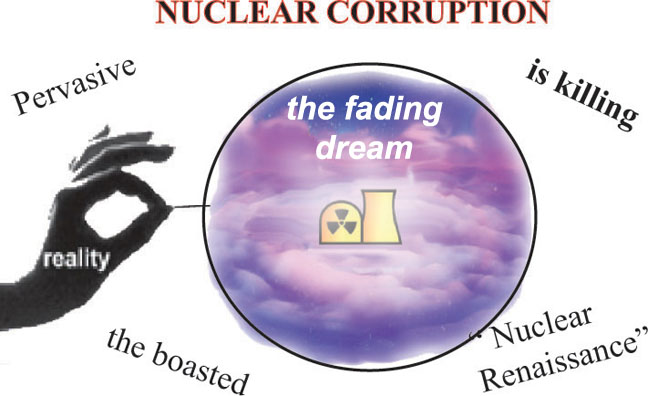
In 2005, the US Nuclear Energy Institute claimed that Westinghouse’s estimate of US$1,365 per kilowatt “has a solid analytical basis, has been peer-reviewed, and reflects a rigorous design, engineering and constructability assessment.”
In fact, the estimate was out by an order of magnitude and the Institute’s involvement in a raft of corruption scandals has been exposed. No doubt the Dutton Coalition would happily parrot whatever lies the Institute chose to feed them, and no doubt the Murdoch/Sky/AFR echo-chamber would happily amplify those lies.
During the ill-fated ‘nuclear renaissance’, the US Nuclear Regulatory Commission received applications to build 31 reactors, but only the Vogtle and V.C. Summer projects reached the construction stage and only the twin-reactor Vogtle project was completed. Two out of 31 ain’t bad. Well it is, actually.
Thirteen reactors have been permanently shut down since 2013 with many more closures in the pipeline. The US has one of the oldest reactor fleets in the world with a mean age of 42.1 years. The mean age of the 29 reactors closed worldwide from 2018‒2022 was 43.5 years.
Around 20 unprofitable, ageing reactors have been saved by nuclear bailout funding but their future is precarious. In addition to the V.C. Summer corruption scandal, nuclear bailout programs are mired in corruption scandals (see here, here, here and here and if you’re still not convinced see here, here, and here).
Dr. Jim Green is the national nuclear campaigner with Friends of the Earth Australia and a member of the Nuclear Consulting Group.
Coalition will seek a social licence for nuclear: Dutton

AFR, Phillip Coorey, 12 Mar 24
Communities will be consulted and “incentivised” to adopt nuclear power, Opposition Leader Peter Dutton says as he amplifies his case for the energy source to play a central role in Australia reducing its emissions.
Mr Dutton will also pledge to “ramp up” the domestic production of gas to help firm renewable energy, in his keynote speech to be delivered to The Australian Financial Review Business Summit on Tuesday.
He will also hint at an expansion of rooftop solar, as already flagged by Nationals leader David Littleproud, as an alternative to large-scale renewable energy projects and the thousands of kilometres of transmission infrastructure that those will require……………………….
In setting the scene for his nuclear announcement, Mr Dutton will outline three principles that will guide the policy.
“First and foremost, we want to get the highest yield of energy using the smallest amount of land,” he will say.
“We want to maximise the amount of energy we can obtain per square metre and minimise our environmental footprint.”
This will be achieved by putting reactors on or near the sites of old coal-fired power stations so they can use the existing transmission grid.
The second principle will involve seeking a “social licence” for the policy “by listening to and incentivising communities to adopt nuclear power”.
A third principle is that the Coalition will put people at the centre of our energy policy by making lower energy bills a key consideration.
Mr Dutton dared the government to lift the nuclear power moratorium and let the market decide.
‘Does not make sense’
But energy experts appearing at the Summit continued to cast doubt on the feasibility of the Coalition’s approach.
Carbon Market Institute chair Kerry Schott said she was technology neutral but nuclear “really does not make sense for Australia”.
“Nuclear by far, like daylight by far, [is] the most expensive,” she said.
“It really doesn’t make sense for Australia because we have so much renewable energy resources.”
She said firming wind and solar with hydro and “a little bit of gas” until hydrogen was commercially available was “by far the cheapest and easiest”.
She did, however, agree, that putting solar panels on every rooftop would alleviate the need for Labor’s thousands of kilometres of transmission infrastructure……………………………… https://www.afr.com/business-summit/coalition-will-seek-a-social-licence-for-nuclear-dutton-20240311-p5fbby
Dutton’s nuclear plan will require huge subsidies
AFR 12 Mar 24
So the two prongs of Peter Dutton’s energy plan are to adopt nuclear power and to ramp up production of gas? (“Coalition to seek ‘social licence’ for nuclear power,” March 11)
Well, we know which of the two prongs will actually happen, and it won’t be the nuclear one.
To go down the nuclear path would require massive government subsidies – not just in the construction phase, but over their entire life of the power stations.
This is what is happening in France, where nuclear supplies 70 per cent of the nation’s electricity, and in Ontario, where the figure is 59 per cent.
Otherwise, the government would have to set electricity prices at a level that would underwrite the power companies’ profitability – irrespective of whether those prices were competitive with other forms of energy.
Either way, nuclear is not viable in Australia – at least, not on economic grounds.
Ken Enderby, Concord, NSW
Coalition must consider nuclear cost
Peter Dutton’s nuclear ideas (“Coalition to seek ‘social licence’ for nuclear power,” March 11) fly in the face of evidence.
The cost to build, the huge subsidies, the intellectual capital required, the siting, the water use, the lead-up time for power generation, the cost to consumers, the decommissioning costs, the half-life of plutonium 239 – none of this will deter him. He will continue to juxtapose the idea of nuclear against the reality of renewables.
He and his party will continue to stymie, mock and disparage our transition efforts. The Coalition’s “all of the above” approach sounds open-minded but disguises the fact that “all” does not include the necessary all-out push for renewables.
Nuclear has no chance of getting us to where we need to be, either in terms of emissions or in developing our crucial renewables industries.
Fiona Colin, Malvern East, Victoria……………………. https://www.afr.com/policy/economy/dutton-s-nuclear-plan-will-require-huge-subsidies-20240311-p5fbhj
Canada, Sweden Restore UNRWA Funds as Report Accuses Israel of Torturing Agency Staff
“The work that UNWRA does cannot be overstated,” said Canadian lawmaker Salma Zahid. “It will save lives as we have seen the visuals of children dying of hunger in Gaza. The need for immediate aid is non-negotiable.”
JON QUEALLY, Mar 09, 2024 https://scheerpost.com/2024/03/09/canada-sweden-restore-unrwa-funds-as-report-accuses-israel-of-torturing-agency-staff/
The governments of Canada and Sweden have announced they will resume funding for the United Nation’s agency that provides humanitarian aide and protection to Palestinians living in Gaza and elsewhere—a move that other powerful nations, including Israel’s most powerful ally the United States, continue to refuse.
Calling the lack of humanitarian relief inside Gaza “catastrophic,” Canadian Minister of International Development Ahmed Hussen said Friday his nation would restore funding for the United Nations Relief and Works Agency for Palestine Refugees in the Near East (UNRWA) in order to help address the “dire” situation on the ground living.
Sweden made its announcement Saturday and said a $20 million disbursement would be made to help UNRWA regain its financial footing.
The restoration of funds follows weeks of global criticism and protest for the decision by many Western nations to withhold UNRWA funds after Israel claimed, without presenting evidence, that a few members of the agency—the largest employer in the Gaza Strip—had participated in the Hamas-led attacks of October 7.
As a result, UNRWA has said it’s ability to provide aid and services to Gaza—where over 100,000 people have been killed or wounded in five months of constant bombardment and blockade by the Israeli military—has been pushed to the “breaking point” as malnutrition and starvation has been documented among the displaced population of over 2 million people.
“Canada is resuming its funding to UNRWA so more can be done to respond to the urgent needs of Palestinian civilians,” Hussen said. “Canada will continue to take the allegations against some of UNRWA’s staff extremely seriously and we will remain closely engaged with UNRWA and the UN to pursue accountability and reforms.”
“I welcome Canada lifting the pause on funding for UNWRA,” said Canadian MP Salma Zahid, a member of the Liberal party representing Scarborough Centre in the House of Commons. “The work that UNWRA does cannot be overstated. It will save lives as we have seen the visuals of children dying of hunger in Gaza. The need for immediate aid is non-negotiable.”
Earlier this week, UNRWA Commissioner-General Philippe Lazzarini told a special meeting of the U.N. General Assembly the agency was “facing a deliberate and concerted campaign” by Israel “to undermine its operations, and ultimately end them.”
On Friday, Reutersreported on an internal UNRWA report that included testimony of employees who said they were tortured by Israeli officers while in detention to make false admissions about involvement in the October 7 attack.
U.S. Sells ‘Link 16’ Battlefield Communications System to Taiwan
22 February 2024
Taipei, February 22 (EFE).- The United States has approved the possible sale of an advanced military data link system upgrade to Taiwan, the first acquisition of this type following Taipei’s January election, the island’s government confirmed Thursday.
In a statement, Taiwan’s foreign ministry said it received formal notification from the US government about the possible sale of the Link-16 system to Taiwan for an estimated value of $75 million.
Link-16 is a standardized communications system used by the armed forces of the US and other countries to transmit and exchange real-time tactical data through the use of links between allied military network participants…………………………………….. https://efe.com/en/latest-news/2024-02-22/us-approves-possible-sale-of-advanced-military-data-link-system-to-taiwan/
1 This month

of the week – Australians for War Powers Reform (AWPR)
To see nuclear-related stories in greater depth and intensity
 Antinuclear