Nuclear news – week to 18 March

Some bits of good news. Notable wins in climate and environmental justice. Scotland made rewilding progress. The Danish City Reimagining Reuse.
TOP STORIES. Why the US is trying to imprison Assange: Report from inside the Court.
Reversing Europe’s and Australia’s slide into irrelevance & insecurity – National Press Club of Australia speech- Yanis Varoufakis.
There is no such thing as a “nuclear waste-eating” reactor .
Nuclear industry wants Canada to lift ban on reprocessing plutonium, despite proliferation risks.
Cold turkeys: The demise of nuclear power.
Conditions inside Fukushima’s melted nuclear reactors still unclear 13 years after disaster struck – also at https://nuclear-news.net/2024/03/14/3-a-conditions-inside-fukushimas-melted-nuclear-reactors-still-unclear-13-years-after-disaster-struck/
Climate. ‘Greenhushing’ Is On the Rise as Companies Go Silent on Climate Pledges.
Nuclear. Australia media – normally focussed on football, has a spasm about nuclear. Rest of the anglophone world gives climate, nuclear, a nod, amongst gaffes of UK royalty, and fashion, celebrities and sport. Gaza gets a mention, too,
Noel’s notes. Julian Assange, atrocities, nuclear war, AI, “Oppenheimer”, and the whole damn thing. AUKUS nuclear pact – a lame duck? Nuclear power and the ignorance of journalists – it’s almost criminal.
nb. Huge number of articles on nuclear in the Australian media. From next week, I will cut them back to just a representative few.
*******************************************
AUSTRALIA. (There are more articles than this – but I had to stop!)
- Decisions on the Northern Water Project could protect GAB Mound Springs from BHP impacts OR condemn the Springs to ‘ongoing degradation’
- NUCLEAR POWER STATIONS ARE NOT APPROPRIATE FOR AUSTRALIA – AND NEVER WILL BE. Pentagon sparks fresh AUKUS doubts on anniversary of Australia’s nuclear-powered submarine plans. AUKUS anniversary brings a sinking feeling. Dead in the Water- The AUKUS Delusion. – PIC Turnbull says Australia ‘mugged by reality’ on Aukus deal as US set to halve submarine build.
- Dutton’s blast of radioactive rhetoric on nuclear power leaves facts in the dust . Refuting Peter Dutton’s recycled nuclear contamination. Coalition will seek a social licence for nuclear: Dutton. Opposition eyeing off six sites for nuclear reactors, Dutton’s nuclear plan will require huge subsidies. AUKwardUS: Peter Dutton’s Albo nuclear wedge may cost us hundreds of billions, ABC interview- Sarah Ferguson and Tom O’Brien – a case study in exposing Trumpian-style deceptive spin. Nuclear power in Australia — a silver bullet or white elephant?
- Peter Dutton refuses to say where his nuclear reactors will go. CSIRO chief warns against ‘disparaging science’ after Peter Dutton criticises nuclear energy costings. ‘The most beige person’:T ed O’Brien, The man behind the Coalition’s nuclear plans. Surf Coast federal member rejects nuclear reactor in region.
- The Government will dictate where the high level nuclear dump will be.
- Australia’s biggest smelter to launch massive wind and solar tender, says nuclear too costly. Victorian Premier blasts nuclear plan as renewable appeals curbed.
NUCLEAR ISSUES
| ARTS and CULTURE. The ideology of war in Ukraine and Israel. | ECONOMICS. HSBC leads Sizewell C investment push as time ticks on final investment decision. NuScale nuclear power is among Top 5 Industrials Stocks That May Fall Off A Cliff In Q1. | EMPLOYMENT, Dounreay workers vote on strike action after pay talks stall, |
Hollywood stars put their name to a good message, but it’s the messengers who are problematic.
Film poses moral questions about 2011 Fukushima disaster displacement . The Film RADIOACTIVE: The women of Three Mile Island will start streaming on Apple TV and Amazon Prime Video from March 12. https://www.youtube.com/watch?v=Is3jlNhicFY
Keep Your Money Out of Nukes! Anti-Nuclear Financial Fitness w/Domini’s Mary Beth Gallagher: PODCAST.
UN report finds Israel deliberately targeted journalists – Reuters.
OPPOSITION to NUCLEAR . Bridgwater activists shine light on nuclear power in UK.
| POLITICS.Japan’s Nuclear Energy Policy Disaster. Japan Ramps Up Drive to Restart World’s Biggest Nuclear Plant. Ralph Nader: Open Letter to President Biden 3.12.24. Decision time Democrats: Oppose Biden’s genocide in Gaza or tacitly support it. UK Steps Up Sizewell Nuclear Push With State-Backed Loans. UK’s Spring budget a ‘myopic sop’ to nuclear obsessives. UK government plans to block foreign control of newspapers – what about foreign control of Sizewell nuclear project ?The U.S. Is Betting Big on Small Nuclear Reactors (done up with green paint) | POLITICS INTERNATIONAL and DIPLOMACY. French president Emmanuel Macron tells Putin ‘WE are a nuclear power and WE are ready’ in latest WW3 rhetoric. As ‘Oppenheimer’ wins big, we should worry about lowering of nuclear thresholds. |
PUBLIC OPINION.
‘Don’t hold your breath’ – people living in Wylfa’s shadow have say on nuclear development plans.
SAFETY. Incidents. Zaporizhzhia nuclear plant reports shelling by Ukraine army
Shelling continues near Zaporizhzhia Nuclear Power Station.
Observing the 45th Anniversary of the Worst U.S. Commercial Nuclear Power Plant Accident.
SECRETS and LIES.
The International Atomic Energy Agency recruiting spies?
SPACE. EXPLORATION, WEAPONS.
Musk’s SpaceX is building spy satellite network for US intelligence agency, sources say
SPINBUSTER. Exposing myths about building French nuclear power.
IAEA director’s visit to Japan widely questioned, seeks to downplay nuclear water dumping.
TECHNOLOGY. La Hague reprocessing plant: expansion and continued operation until at least 2100.
WAR and CONFLICT. Putin warns again that Russia is ready to use nuclear weapons if its sovereignty is threatened.
Will Biden’s, NATO’s military personnel in Ukraine cross the last red line to Armageddon?
Netanyahu approves Rafah ground invasion, despite Biden opposition.
War Games in Arctic: What’s Driving the West’s New Passion?
WEAPONS and WEAPONS SALES. Nuclear Regulatory Commission Paves Way for Increase in Production in Commercial Reactors of Tritium for Nuclear Weapons.
Huge UK £286bn nuclear submarine deal with US at risk for one reason warns ex Navy chief.
EU to use Russian assets to buy arms for Ukraine – Scholz.
Turnbull says Australia ‘mugged by reality’ on Aukus deal as US set to halve submarine build
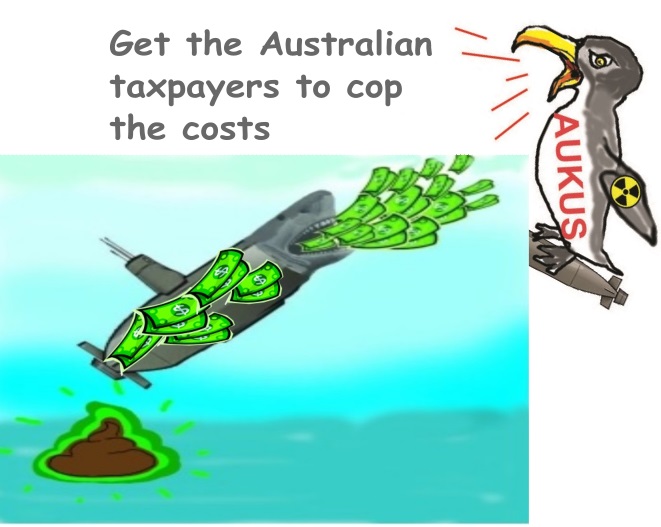
“Australian taxpayers should not be footing the bill for America’s dockyards.
We are on the hook to the tune of $3bn as soon as next year as a downpayment for subs that might never arrive and be useless on delivery,”
Former PM says the reality is the US will not make their submarine deficit worse by giving or selling submarines to Australia
Amy Remeikis, Wed 13 Mar 2024 , https://www.theguardian.com/world/2024/mar/13/turnbull-says-australia-mugged-by-reality-on-aukus-deal-as-us-set-to-halve-submarine-build
Australian taxpayers should not be footing the bill for America’s dockyards.
We are on the hook to the tune of $3bn as soon as next year as a downpayment for subs that might never arrive and be useless on delivery,”
The former prime minister Malcolm Turnbull said Australia has been “mugged by reality” over the Aukus submarine deal after the US announced it will halve the number of submarines it will build next year, throwing the Australia end of the agreement into doubt.
With the US president, Joe Biden, continuing to face a hostile Congress, the Pentagon budget draft request includes construction of just one Virginia-class nuclear submarine for 2025.
Under the Aukus agreement, production is meant to be ramped up to ensure Australia will have access to at least three Virginia-class submarines from the US in the 2030s. That is to fill a “capability gap” before nuclear-powered submarines to be built in Adelaide enter into service from the 2040s.
The prime minister, Anthony Albanese, played down the impact of the US budget announcement, insisting that “our plans are very clear”.
“We have an agreement that was reached with the United States and the UK,” Albanese told reporters in Darwin on Wednesday. “That legislation went through the US Congress last year. That was a product of a lot of hard work.”
The defence minister, Richard Marles, said earlier that the US remained committed to the deal.
“As we approach the one-year anniversary of Aukus, Australia, the United States and United Kingdom remain steadfast in our commitment to the pathway announced last March, which will see Australia acquire conventionally armed, nuclear-powered submarines,” he said.
“All three Aukus partners are working at pace to integrate our industrial bases and to realise this historic initiative between our countries.”
Greens senator David Shoebridge, who has been critical of the Aukus deal from the start, said the US budget announcement was the beginning of the end of Aukus.
“When the US passed the law to set up Aukus, they put in kill switches, one of which allowed the US to not transfer the submarines if doing so would ‘degrade the US undersea capabilities’. Budgeting for one submarine all but guarantees this,” he said on X.
4/ The failure is almost too big to wrap your head around.
We are providing billions of dollars to the US, have given up an independent foreign policy and made Australia a parking lot for US weapons. In exchange, we get nothing.
Nothing but a big target and empty pockets.— David Shoebridge (@DavidShoebridge) March 12, 2024
The US budget does include increased spending on the submarine industrial base, which was a key component of the Aukus pillar one deal, as it laid the groundwork to increase production in the coming years.
But Turnbull, an architect of the French submarine deal which was unceremoniously dumped by the Morrison government in favour of the Aukus deal, said Australia was now at the mercy of the United States for a key part of its defence strategy.
He said that the US needed to increase submarine production to meet its own needs before it was able to transfer boats to Australia, but were now only producing about half as many that were needed for the US navy and were struggling to maintain the boats they held, due to labour shortages.
“What does that mean for Australia? It means because the Morrison government, adopted by Albanese, has basically abandoned our sovereignty in terms of submarines, we are completely dependent on what happens in the United States as to whether we get them now,” he told ABC radio.
“The reality is the Americans are not going to make their submarine deficit worse than it is already by giving or selling submarines to Australia and the Aukus legislation actually sets that out quite specifically.skip past newsletter promotion
“So you know, this is really a case of us being mugged by reality. I mean, there’s a lot of Aukus cheerleaders, and anyone that has any criticism of Aukus is almost described as being unpatriotic. We’ve got to be realistic here.”
The ALP grassroots activist group, Labor Against War, want the Albanese government to freeze Aukus payments to the US so as not to “underwrite the US navy industrial shipyards”.
The national convenor of Labor Against War, Marcus Strom, said Australian taxpayers should not be footing the bill for America’s dockyards.
We are on the hook to the tune of $3bn as soon as next year as a downpayment for subs that might never arrive and be useless on delivery,” he said.
“This Labor government managed to junk Scott Morrison’s tax plan. Why would it be so stupid to continue with his war plan?”
While the Pentagon has sought to assure Australia its submarine production will be back on track by 2028, the looming threat of Donald Trump returning to the White House has raised further concerns the deal will be scuttled.
“On Aukus pillar 1 we are effectively in conflict with the needs of the US navy, and you know as well as I do the American government, when it comes to a choice between the needs of the US navy and the Australian navy, are always going to back their own,” Turnbull said.
Marles has previously denied Aukus will erode Australia’s sovereignty. In a speech to parliament last year, Marles said Australia would “always make sovereign, independent decisions on how our capabilities are employed”.
Additional reporting by Daniel Hurst
Nuclear energy debate ‘many years’ away: Qld Deputy Opposition leader
Queensland Deputy Opposition leader Jarrod Bleijie claims the nuclear energy debate is “many years” away as he focuses on lowering power prices in the immediate future.
Mr Bleijie said he is focusing on making sure energy is affordable and reliable as the Opposition pushes to bring its coal power stations back online.
“There is a lot of water to go under that bridge before that is the case and I suspect we will be at an election before our federal counterparts,” Mr Bleijie told Sky News Australia.
“I stood at the booths in Ipswich West and Inala and every second person was talking about the cost of living crisis in Queensland now.
“People are hurting, they need to see their electricity bills reduced now and that has to be our priority.”
How Biden’s budget plunged the Aukus submarines pact into doubt
Alarm in Australia as the US suddenly struggles to fortify its own fleet
Matt Oliver, INDUSTRY EDITOR, 18 March 2024
A year on from the trio’s meeting, the Aukus partnership is suddenly
looking decidedly more fragile. Inside defence circles, there are growing
doubts about America’s ability and willingness to deliver following a
shock proposal from the Biden administration that cuts to the heart of the
deal.
Amid a row at home over government budgets, the White House this
month suggested halving the number of Virginia-class submarines it builds
next year – the very same type it has promised to Australia under Aukus.
That means the US faces a shortfall itself, raising the prospect it may
refuse to sell its existing vessels and leave Canberra in the lurch.
Telegraph 18th March 2024
100,000 years and counting: how do we tell future generations about highly radioactive nuclear waste repositories?
Sweden and Finland have described KBS-3 as a world-first nuclear-waste management solution.

Critical questions remain about the storage method, however. There have been widely publicised concerns in Sweden about the corrosion of test copper canisters after just a few decades. This is worrying, to say the least, because it’s based on a principle of passive safety. The storage sites will be constructed, the canisters filled and sealed, and then everything will be left in the ground without any human monitoring its safe functioning and with no technological option for retrieving it. Yet, over 100,000 years the prospect of human or non-human intrusion into the site – both accidental or intentional – remains a serious threat.

International attention is increasingly fixated on “impactful” short-term responses to environmental problems – usually limited to the lifespan of two or three future generations of human life. Yet the nature of long-lived nuclear waste requires us to imagine and care for a future well beyond that time horizon, and perhaps even beyond the existence of humanity.
International attention is increasingly fixated on “impactful” short-term responses to environmental problems – usually limited to the lifespan of two or three future generations of human life. Yet the nature of long-lived nuclear waste requires us to imagine and care for a future well beyond that time horizon, and perhaps even beyond the existence of humanity.
March 19, 2024 Thomas Keating. Postdoctoral Researcher, Linköping University, Anna Storm, Professor of Technology and Social Change, Linköping University https://theconversation.com/100-000-years-and-counting-how-do-we-tell-future-generations-about-highly-radioactive-nuclear-waste-repositories-199441
In Europe, increasing efforts on climate change mitigation, a sudden focus on energy independence after Russia’s invasion of Ukraine, and reported breakthroughs in nuclear fusion have sparked renewed interest in the potential of nuclear power. So-called small modular reactors (SMRs) are increasingly under development, and familiar promises about nuclear power’s potential are being revived.
Nuclear power is routinely portrayed by proponents as the source of “limitless” amounts of carbon-free electricity. The rhetorical move from speaking about “renewable energy” to “fossil-free energy” is increasingly evident, and telling.
Yet nuclear energy production requires managing what is known as “spent” nuclear fuel where major problems arise about how best to safeguard these waste materials into the future – especially should nuclear energy production increase. Short-term storage facilities have been in place for decades, but the question of their long-term deposition has caused intense political debates, with a number of projects being delayed or cancelled entirely. In the United States, work on the Yucca Mountain facility has stopped completely leaving the country with 93 nuclear reactors and no long-term storage site for the waste they produce.
Nuclear power plants produce three kinds of radioactive waste:
- Short-lived low- and intermediate-level waste;
- Long-lived low- and intermediate-level waste;
- Long-lived and highly radioactive waste, known as spent nuclear fuel.
The critical challenge for nuclear energy production is the management of long-lived waste, which refers to nuclear materials that take thousands of years to return to a level of radioactivity that is deemed “safe”. According to the US Nuclear Regulatory Commission (NRC), in spent fuel half of the radiation in strontium-90 and cesium-137 can decay in 30 years, while it would take 24,000 years for plutonium-239 to return to a state considered “harmless”. However, exactly what is meant by “safe” and “harmless” in this context is something that remains poorly defined by international nuclear management organisations, and there is surprisingly little international consensus about the time it takes for radioactive waste to return to a state considered “safe” for organic life.
“Permanent” geological repositories
Despite the seeming revival of nuclear energy production today, very few of the countries that produce nuclear energy have defined a long-term strategy for managing highly radioactive spent fuel into the future. Only Finland and Sweden have confirmed plans for so-called “final” or “permanent” geological repositories.
The Swedish government granted approval for a final repository in the village of Forsmark in January 2022, with plans to construct, fill and seal the facility over the next century. This repository is designed to last 100,000 years, which is how long planners say that it will take to return to a level of radioactivity comparable to uranium found in the earth’s bedrock.
Finland is well underway in the construction of its Onkalo high-level nuclear waste repository, which they began building in 2004 with plans to seal their facility by the end of the 21st century.
The technological method that Finland and Sweden plan to use in their permanent repositories is referred to as KBS-3 storage. In this method, spent nuclear fuel is encased in cast iron, which is then placed inside copper canisters, which are then surrounded by clay and bedrock approximately 500 metres below ground. The same or similar methods are being considered by other countries, such as the United Kingdom.
Sweden and Finland have described KBS-3 as a world-first nuclear-waste management solution. It is the product of decades of scientific research and negotiation with stakeholders, in particular with the communities that will eventually live near the buried waste.
Critical questions remain about the storage method, however. There have been widely publicised concerns in Sweden about the corrosion of test copper canisters after just a few decades. This is worrying, to say the least, because it’s based on a principle of passive safety. The storage sites will be constructed, the canisters filled and sealed, and then everything will be left in the ground without any human monitoring its safe functioning and with no technological option for retrieving it. Yet, over 100,000 years the prospect of human or non-human intrusion into the site – both accidental or intentional – remains a serious threat.
The Key Information File
Another major problem is how to communicate the presence of buried nuclear waste to future generations. If spent fuel remains dangerous for 100,000 years, then clearly this is a time frame where languages can disappear and where the existence of humanity cannot be guaranteed. Transferring information about these sites into the future is a sizeable task that demands expertise and collaboration internationally across the social sciences and sciences into practices of nuclear waste memory transfer – what we refer to as nuclear memory communication.
In a project commissioned by the Swedish Nuclear Waste Management Company (SKB), we take up this precise task by writing the “Key Information File” – a document aimed at non-expert readers containing only the most essential information about Sweden’s nuclear waste repository under development.
The Key Information File has been formulated as a summary document that would help future readers understand the dangers posed by buried waste. Its purpose is to guide the reader to where they can find more detailed information about the repository – acting as a “key” to other archives and forms of nuclear memory communication until the site’s closure at the end of the 21st century. What happens to the Key Information File after this time is undecided, yet communicating the information that it contains to future generations is crucial.
The Key Information File we will publish in 2024 is intended to be securely stored at the entrance to the nuclear waste repository in Sweden, as well as at the National Archives in Stockholm. To ensure its durability and survival through time, the plan is for it to be reproduced in different media formats and translated into multiple languages. The initial version is in English and, when finalised, it will be translated into Swedish and other languages that have yet to be decided.
Our aim is for the file to be updated every 10 years to ensure that essential information is correct and that it remains understandable to a wide audience. We also see the need for the file to be incorporated into other intergenerational practices of knowledge transfer in the future – from its inclusion into educational syllabi in schools, to the use of graphic design and artwork to make the document distinctive and memorable, to the formation of international networks of Key Information File writing and storage in countries where, at the time of writing, decisions have not yet been made about how to store highly radioactive long-lived nuclear waste.
Fragility and short-termism: a great irony
In the process of writing the Key Information File, we have discovered many issues surrounding the efficacy of these strategies for communicating memory of nuclear waste repositories into the future. One is the remarkable fragility of programs and institutions – on more than one occasion in recent years, it has taken just one person to retire from a nuclear organisation for the knowledge of an entire programme of memory communication to be halted or even lost.
And if it is difficult to preserve and communicate crucial information even in the short term, what chance do we have over 100,000 years?
International attention is increasingly fixated on “impactful” short-term responses to environmental problems – usually limited to the lifespan of two or three future generations of human life. Yet the nature of long-lived nuclear waste requires us to imagine and care for a future well beyond that time horizon, and perhaps even beyond the existence of humanity.
Responding to these challenges, even partially, requires governments and research funders internationally to provide the capacity for long-term intergenerational research on these and related issues. It also demands care in developing succession plans for retiring experts to ensure their institutional knowledge and expertise is not lost. In Sweden, this could also mean committing long-term funding from the Swedish nuclear waste fund so that not only future technical problems with the waste deposition are tackled, but also future societal problems of memory and information transfer can be addressed by people with appropriate capacity and expertise.
Concerns and complaints continue as fourth Fukushima wastewater discharge completed

Concerns and complaints from home and abroad remain while Japan’s crippled Fukushima Daiichi Nuclear Power Plant has finished its first year of discharging nuclear-contaminated wastewater into the ocean.
The plant completed its fourth and final round of discharge for the current fiscal year, which ends in March, Tokyo Electric Power Company (TEPCO) said on Sunday.
As per the initial plan, approximately 31,200 tonnes of wastewater containing radioactive tritium has been released into the ocean since August 2023, with each discharge running for about two weeks.
Earlier this week, International Atomic Energy Agency Director-General Rafael Grossi emphasized continued efforts to monitor the discharging process.
Stressing that the discharge marks merely the initial phase of a long process, Grossi said that “much effort will be required in the lengthy process ahead,” and reiterated the organization’s stance on maintaining vigilance throughout the process.
While the Japanese government and TEPCO have asserted the safety and necessity of the process, there are still concerns from other countries and local stakeholders regarding environmental impacts.
Sophia from the U.S. complained that the release of nuclear-contaminated water into the sea made her fear for the future.
Najee Johnson, a college student from Canada, suggested the Japanese government find a different plan because it could pollute our ocean and harm our sea life.
Haruo Ono, a fisherman in the town of Shinchi in Fukushima, said “All fishermen are against ocean dumping. The contaminated water has flowed into what we fishermen call ‘the sea of treasure’, and the process will last for at least 30 years.”
“Is it really necessary, in the first place, to dump what has been stored in tanks into the sea? How can we say it’s ‘safe’ when the discharged water clearly consists of harmful radioactive substances? I think the government and TEPCO must provide a solid answer,” said Chiyo Oda, a resident of Fukushima’s Iwaki city.
The recent leakage of contaminated water from pipes at the Fukushima plant also fueled concerns among the Japanese public.
Besides, the promised fund of more than 100 billion yen (around $670 million) to compensate and support local fishermen and fishing industry remains doubtful as a court ruling last December relieved the government of responsibility to pay damages to Fukushima evacuees.
A Tokyo court ruled that only the operator of the tsunami-wrecked Fukushima nuclear power plant has to pay damages to the evacuees, relieving the government of responsibility. Plaintiffs criticized the ruling as belittling their suffering and the severity of the disaster. The court also slashed the amount by ordering the TEPCO to pay a total of 23.5 million yen to 44 of the 47 plaintiffs.
The ruling backpedaled from an earlier decision in March 2018, when the Tokyo District Court held both the government and TEPCO accountable for the disaster, which the ruling said could have been prevented if they both took better precautionary measures, ordering both to pay 59 million yen in damages.
1 This month

of the week – Australians for War Powers Reform (AWPR)
To see nuclear-related stories in greater depth and intensity
 Antinuclear