TODAY. A SUMMIT of nuclear fantasy, folly and ignorance

Yes they all gathered in Brussels, all those very well-paid stuffed-shirt blokes, and that one even-better paid token woman.
First there was propaganda to “more than 70 young science communicators” – with top salesman Rafael Grossi in full flight, (necessary because the marketing body IAEA has decided that we must make nuclear power look lively and YOUTHFUL)
Then the top bananas – Prime Minister of Belgium Alexander De Croo and the Director General of the IAEA Rafael Mariano Grossi kicked off the spin buildup, leading to the adoption of a key declaration about nuclear energy.

Then the trail of international followers-on had their bit of a say.
Then heaps of big-wigs from nuclear energy agencies – panel talks on how to get nuclear power resuscitated world-wide
Finally – the Big One – how on earth to con taxpayers worldwide, and investors, to suddenly come up with the $billions needed to resuscitate this dirty and failing industry, with its only raison d’etre being nuclear weapons-making.
Julian Assange and the Plea Nibble

Barry Pollack, one of Assange’s legal representatives, has not been given any indication that the department would, as such, accept the deal, a point he reiterated to Consortium News: “[W]e have been given no indication that the Department of Justice intends to resolve the case.”
March 23, 2024 by: Dr Binoy Kampmark https://theaimn.com/julian-assange-and-the-plea-nibble/
Be wary of what Washington offers in negotiations at the best of times. The empire gives and takes when it can; the hegemon proffers and in equal measure and withdraws offers it deems fit. This is all well known to the legal team of WikiLeaks’ founder Julian Assange, who, the Wall Street Journal “exclusively” reveals, is in ongoing negotiations with US Justice Department officials on a possible plea deal.
As things stand, the US Department of Justice is determined to get its mitts on Assange on the dubious strength of 18 charges, 17 confected from the brutal Espionage Act of 1917. Any conviction from these charges risks a 175-year jail term, effectively constituting a death sentence for the Australian publisher.
The war time statute, which was intended to curb free speech and muzzle the press for the duration of the First World War, was assailed by Wisconsin Republican Senator Robert La Follette as a rotten device that impaired “the right of the people to discuss the war in all its phases.” It was exactly in time of war that the citizen “be more alert to the preservation of his right to control his government. He must be most watchful of the encroachment of the military upon the civil power.” And that encroachment is all the more pressing, given the Act’s repurposing as a weapon against leakers and publishers of national security material. In its most obscene incarnation, it has become the US government’s political spear against a non-US national who published US classified documents outside the United States.
The plea deal idea is not new. In August last year, the Sydney Morning Herald pounced upon comments from US Ambassador to Australia Caroline Kennedy that a “resolution” to the Assange imbroglio might be on the table. “There is a way to resolve it,” the ambassador suggested at the time. Any such resolution could involve a reduction of any charges in favour of a guilty plea, subject to finalisation by the Department of Justice. Her remarks were heavily caveated: this was more a matter for the DOJ than the State Department or any other agency. “So it’s not really a diplomatic issue, but I think there absolutely could be a resolution.”
The WSJ now reports that officials from the DOJ and Assange’s legal team “have had preliminary discussions in recent months about what a plea deal could look like to end the lengthy legal drama.” These talks “remain in flux” and “could fizzle.” Redundantly, the Journal reports that any such agreement “would require approval at the highest levels of the Justice Department.”
Barry Pollack, one of Assange’s legal representatives, has not been given any indication that the department would, as such, accept the deal, a point he reiterated to Consortium News: “[W]e have been given no indication that the Department of Justice intends to resolve the case.”
One floated possibility would be a guilty plea on a charge of mishandling classified documents, which would be classed as a misdemeanour. Doing so would take some of the sting out of the indictment, which is currently thick with felonies and one conspiracy charge of computer intrusion. “Under the deal, Assange could potentially enter that plea remotely, without setting foot in the US.” Speculation from the paper follows. “The time he has spent behind bars in London would count toward any US sentence, and he would be likely to be free to leave prison shortly after any deal has concluded.”
With little basis for the claim, the report lightly declares that the failure of plea talks would not necessarily be a bad thing for Assange. He could still “be sent to the US for trial”, where “he may not stay for long, given the Australia pledge.” The pledge in question is part of a series of highly questionable assurances given to the UK government that Assange’s carceral conditions would not include detention in the supermax ADX Florence facility, the imposition of notorious Special Administrative Measures, and the provision of appropriate healthcare. Were he to receive a sentence, it would be open to him to apply and serve its balance in Australia. But all such undertakings have been given on condition that they can be broken, and transfer deals between the US and other countries have been plagued by delays, inconsistencies, and bad faith.
-ADVERTISEMENT-
The dangers and opportunities to Assange have been bundled together, a sniff of an idea rather than a formulation of a concrete deal. And deals can be broken. It is hard to imagine that Assange would not be expected to board a flight bound for the United States, even if he could make his plea remotely. Constitutional attorney Bruce Afran, in an interview with CN Live! last August, suggested that a plea, taken internationally, was “not barred by any laws. If all parties consent to it, then the court has jurisdiction.” Yes, but what then?
In any event, once on US soil, there is nothing stopping a grand volte face, that nasty legal practice of tagging on new charges that would carry even more onerous penalties. It should be never forgotten that Assange would be delivered up to a country whose authorities had contemplated, at points, abduction, illegal rendition, and assassination.
Either way, the current process is one of gradual judicial and penal assassination, conducted through prolonged proceedings that continue to assail the publisher’s health even as he stays confined to Belmarsh Prison. (Assange awaits the UK High Court’s decision on whether he will be granted leave to appeal the extradition order from the Home Office.) The concerns will be how to spare WikiLeaks founder further punishment while still forcing Washington to concede defeat in its quest to jail a publisher. That quest, unfortunately, remains an ongoing one.
Here’s why there is no nuclear option for Australia to reach net zero
Dr Alan Finkel, Guardian, 22 Mar 24
Any call to go directly from coal to nuclear is effectively a call to delay decarbonisation of our electricity system by 20 years.
The battle lines have been drawn over Australia’s energy future.
With the nation signed up to net zero emissions by 2050, the Albanese Labor government is committed to renewables. The Coalition wants nuclear.
The opposition leader, Peter Dutton, has a vision for meeting Australia’s energy needs that would include large-scale nuclear power plants and small modular reactors, a technology that is not yet proven, but which the shadow minister for energy, Ted O’Brien, says could be “up and running within a 10-year period.”
While nuclear power might experience a resurgence globally and eventually have a role in Australia, right now, no matter how much intent there might be to activate a nuclear power industry, it is difficult to envision before 2040.
The reality is there is no substitute for solar and wind power this decade and next, supported by batteries, transmission lines and peaking gas generation.
Any call to go directly from coal to nuclear is effectively a call to delay decarbonisation of our electricity system by 20 years……………………………………………………………………….
The cons
There are challenges for nuclear power in Australia, most notably timetable and cost.
Legislation. Commonwealth legislation passed by the Howard government in 1998 prohibits nuclear power. Australia is the only country in the G20 to have a legislated ban on nuclear power. This would need to be lifted before anything else could happen.
Public support. An August 2023 poll by the Resolve Political Monitor found 40% of people backed nuclear power, 33% were undecided and 27% were opposed. It is likely that no matter how small the opposition, it will be vocal.
Ramp rate. Large nuclear power generators cannot ramp up and down rapidly like batteries or peaking gas generators. This reduces their compatibility with a predominantly solar and wind powered electricity grid. It is expected, though, that small modular reactors (SMRs) will be better in this respect than large, conventional reactors.
Falling investment. The various operational, political and cost challenges faced by the nuclear industry have led to nuclear’s share of global electricity generation falling from more than 17% in 1996 to 9% in 2022.
Starting from scratch. It is unlikely that Australia would switch from being a laggard to a leader. That is, we would not proceed before we saw a licensed SMR (not a prototype) operating in the US, Canada, UK or another OECD country.
After that, we would need to beef up the regulatory system, find the first site, find and license the first operator, approve and issue construction contracts, establish a waste-management system, establish the decommissioning rules and decommissioning fund, run the environmental and safety regulatory gamut, train a workforce, respond to the inevitable protests and respond to the inevitable legal opposition all the way to the high court.
Only then could construction begin. It is difficult to imagine all this could be accomplished and provide an operational nuclear reactor in Australia before the mid 2040s.
The cost of wind versus nuclear
Coal-fired generators and nuclear power generators can dispatch electricity at full power more than 90% of the year. In practice, because demand fluctuates, the typical dispatch level from the Australian coal-fired fleet is about 60%.
For comparison, what would be the capital cost of a wind farm to dispatch 60% of the year? A simplified approach would be to ignore market economics and the variability of solar electricity in the system, and assume a 30% capacity factor for the wind energy. With these assumptions, for a windfarm to dispatch 60% of the year, we would need to install 2GW of wind turbines. The first 1GW of turbines would dispatch when the wind is blowing. The second 1GW of turbines would be used to charge a 7GW-hour (GWh) battery, to be discharged into the grid on demand.
Using figures from the CSIRO’s GenCost draft 2023-2024 report, the cost in this simplified model would be around $7bn per GW. Other, less costly, integration configurations are available. In comparison, based on the latest cost estimates for the Hinkley Point C plant under construction in the UK, the cost for nuclear power would be $27bn per GW.
The big opportunity in thinking small
In Australia, we would be looking to use SMRs because of the enormous cost and construction delays of large-scale nuclear plants. But we will want the reassurance of first seeing SMRs work safely and well in the UK, Europe, Canada, the US or another OECD country.
The trouble is, there are no SMRs operating in the UK, Europe, Canada, the US or any other OECD country. Nor are any SMRs under construction or approved in an OECD country.
There is no data to support any claims about how much SMRs will cost when deployed as operating power stations………………………………………https://www.theguardian.com/commentisfree/2024/mar/22/heres-why-there-is-no-nuclear-option-for-australia-to-reach-net-zero
Australia moves to prop up Aukus with $4.6bn pledge to help clear Rolls-Royce nuclear reactor bottlenecks in UK
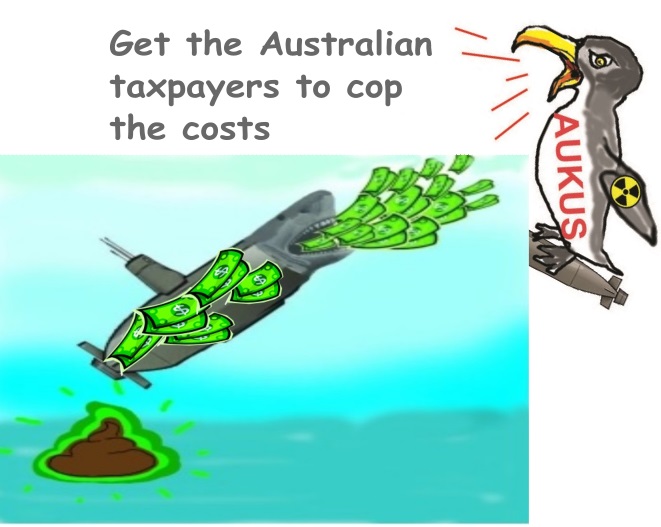
Funding revealed on eve of government talks is in addition to billions of dollars to be sent to US
Guardian, Daniel Hurst in Canberra, 21 Mar 24
The Australian government will seek to prop up the Aukus pact by sending A$4.6bn (£2.4bn) to the UK to clear bottlenecks at the Rolls-Royce nuclear reactor production line.
The funding – revealed on the eve of high-level talks between the Australian and UK governments on Friday – is in addition to billions of dollars that will be sent to the US to smooth over production delays there.
The Australian government will also announce on Friday that the government-owned shipbuilder ASC and the British defence firm BAE Systems will jointly build the nuclear-powered submarines for the Royal Australian Navy.
The nuclear reactors for the boats are to be manufactured at Rolls-Royce in the English city of Derby, but doubts have already been raised about whether reactor cores will be made in time for the UK’s first Dreadnought nuclear submarine.
Australia has now allocated £2.4bn over 10 years to expand the production capacity at Derby to deliver reactors for Australia’s submarines, to be known as SSN-Aukus……………………………………..
Cameron and the UK defence secretary, Grant Shapps, arrived in Canberra on Thursday for talks with their Australian counterparts, Penny Wong and Richard Marles.
They will hold an annual 2+2 meeting in Adelaide on Friday, with Aukus expected to be a major focus along with the war in Ukraine, the conflict in the Middle East and China’s position in the Indo-Pacific…………………..
Marles, the deputy prime minister and defence minister, said at the same media conference that the Australian government was “really aware of the stretched industrial base in the UK and in the US”.

Australia’s commitment to help clear backlogs in the US and the UK “was not without controversy” but was necessary for Aukus to succeed, Marles said.
Under the staged plans announced last March, Australia will buy at least three Virginia-class submarines from the US in the 2030s, prior to the domestically built SSN-Aukus entering into service from the 2040s.
But revelations that the US Navy plans to build only one Virginia-class nuclear-powered submarine next year have prompted renewed concerns about lagging performance on US production lines.
Marles, Shapps and the US defence secretary, Lloyd Austin, issued a joint statement on Thursday declaring the three countries remained “fully committed to this shared endeavour” and were “investing significantly” to ensure its success.
Australia plans to set up a joint venture between ASC and BAE Systems to build the SSN-Aukus submarines. This structure will allow the Australian government to be heavily involved in delivering the strategically important project.
But the finer details have yet to be locked in, and ASC and BAE will work cooperatively in the meantime to develop the new submarine construction yard at South Australia’s Osborne shipbuilding precinct.
ASC built Australia’s conventionally powered Collins-class submarines, but has not previously worked with nuclear-powered boats.
In 2014 the then defence minister, David Johnston, was censured by the Senate for saying he “wouldn’t trust them [ASC] to build a canoe”…………………………
Australia and the UK on Thursday also signed a new defence and security cooperation agreement that formalises a commitment to consult each other on threats to sovereignty and regional security.
It includes a status of forces agreement, clearing regulatory hurdles for their forces to operate in each other’s countries.https://www.theguardian.com/world/2024/mar/21/australia-moves-to-prop-up-aukus-with-46bn-pledge-to-help-clear-rolls-royce-nuclear-reactor-bottlenecks-in-uk
Filling Nuclear Power’s $5 Trillion Hole Is Beyond the Banks

“We need to find a way to make it predictable, stable, bankable and affordable.”
“The project risks, as we have seen in reality, seem to be very high,” said European Investment Bank Vice President Thomas Ostros. – the world’s biggest multilateral lender recommends that countries needing power quickly focus on renewables and energy efficiency,
Nuclear-energy officials arrived in Brussels this week amid a growing wave of public support for atomic power. They left humbled by the tepid reaction of bankers assessing the price tag of their ambitions.
Bloomberg News, Jonathan Tirone, https://financialpost.com/pmn/business-pmn/filling-nuclear-powers-5-trillion-hole-is-beyond-the-banks/wcm/0d2062d5-7120-4480-b53a-a52e70ef2b45/amp/ 22 Mar 24,
The International Atomic Energy Agency convened a summit to build momentum for a low-emissions technology that many expect will be critical for hitting climate targets. A group of mostly Western countries pledged to triple nuclear generation by 2050. But lenders balked at the eyewatering cost of doing so.
“If the bankers are uniformly pessimistic, it’s a self-fulfilling prophecy,” former US Energy Secretary Ernest Moniz said Thursday after listening to a panel of international lenders explain why they’re unwilling to provide the $5 trillion the industry needs by mid-century.
“The bankers are calling for a proven business case,” said Jozef Sikela, the Czech Republic’s industry and trade minister. “We need to find a way to make it predictable, stable, bankable and affordable.”
Projects in Western economies have been plagued by construction delays and ballooning costs in recent decades. The newest reactor in the European Union — Olkiluoto 3 in Finland — started generating power last year, more than a decade late and three times over budget. Similarly in the US, Southern Co.’s Vogtle facility came in seven years behind schedule and $16 billion over estimates.
“The project risks, as we have seen in reality, seem to be very high,” said European Investment Bank Vice President Thomas Ostros. While the world’s biggest multilateral lender won’t close the door on nuclear, it recommends that countries needing power quickly focus on renewables and energy efficiency, he said.
China and Russia are building the most reactors. But their state-owned model of development is at odds with the European and US emphasis on private capital. That will likely need to change if Western economies want to maintain nuclear’s market share.
“We need state involvement, I don’t see any other model,” Ostros said. “Probably we need quite heavy state involvement to make projects bankable.”
Ines Rocha, a director at the European Bank of Reconstruction and Development, and Fernando Cubillos, a banker at the Development Bank of Latin America, also said their lending priorities lean toward renewables and transmission grids. “Nuclear comes last,” Cubillos said.

Potential new investors could include sovereign wealth funds or philanthropists, according to Charles Oppenheimer, who advocates for nuclear energy at The Oppenheimer Project.
“If it’s a safe and secure investment with a predictable return, there’s a huge amount of capital,” said the grandson of J. Robert Oppenheimer, the US physicist who ran the Manhattan Project. “What is lacking generally is capital for that risky build.”
Europe and the US have been trying to engineer nuclear out of its malaise, proposing a new generation of smaller reactors that can be factory-made and assembled on-site. Theoretically, that approach could cut costs, but has yet to be proven.
In the meantime, with global temperatures soaring and international climate targets in peril, some nuclear advocates say the focus on such innovations may be misguided.
“We’ve heard a lot about a leapfrogging to the next generation of nuclear technologies,” Moniz said. “I would submit it might just be better to focus on getting some technologies deployed right now.”
—With assistance from John Ainger.
Zion Lights and her lying, climate-denying mentor Michael Shellenberger

The only nuclear industry that is booming is nuclear decommissioning ‒ the World Nuclear Association anticipates US$111 billion (A$145 billion) worth of decommissioning projects to 2035. [written in 2017 – but nothing’s changed]
Zion Lights was sucked into nuclear advocacy by self-confessed liar, climate denier and MAGA lunatic Michael Shellenberger.
JIM GREEN, https://jimkgreen1.substack.com/p/zion-lights-and-her-lying-climate 21 Mar 24
The latest substack missive from British nuclear power advocate Zion Lights reflects the cognitive dissonance that all nuclear advocates must be experiencing. Mixed in with anger and nuttiness. In the UK, if the two Hinkley Point C reactors are ever completed (the only two reactors under construction in the UK), the cost will be at least A$44 billion per reactor and it will be at least 25 years between the announcement that new reactors will be built and grid-connection of the reactors. If we allow for the usual pattern of overruns and delays, the figures are likely to be A$50+ billion per reactor, and 30 years between announcement and grid-connection.
Since the last reactor startup in the UK (Sizewell B in 1995), 24 reactors have been permanently shut-down. If the Hinkley Point C reactors begin operating in the early- to mid-30s, it will be 35‒40 years between reactors startups in the UK, during which time there will have been 32 permanent reactor-shutdowns. Only Sizewell B is likely to be operating.
If not for the military connections (which Lights studiously ignores), Hinkley Point C would likely be abandoned and plans for more reactors would also be abandoned.
Lights was sucked into nuclear advocacy by self-confessed liar, climate denier and MAGA lunatic Michael Shellenberger. You can read more about Lights here, Shellenberger here, and you can read Extinction Rebellion’s important statement about both of them here. The Extinction Rebellion statement concludes: “Zion Lights, Michael Shellenberger, the Breakthrough Institute and their associated deniers and delayers are intentionally spreading doubt about the severity of the [climate] crisis and the action needed to respond to it.”
Presumably Lights did at least some research beforehand but still thought it a good idea to work for self-confessed liar and climate denier Shellenberger.
I mention Shellenberger because Lights’ latest substack post is nothing more than a cut-and-paste of lies and distortions that Shellenberger has been peddling for decades. Lights might at least have the decency to come up with her own lies and distortions.
That being the case, I won’t trawl through Lights’ post here. Instead, here is an article about Shellenberger which covers the same ground. “Nuclear power will solve global warming and feed all the world’s children.”
Is there a future for ‘pro-nuclear environmentalism’?
Jim Green, 30 Oct 2017, RenewEconomy. For a longer version of this article please click here.
Michael Shellenberger is visiting Australia this week. He has been a prominent environmentalist (of sorts) since he co-authored the 2004 essay, The Death of Environmentalism. These days, as the President of the California-based ‘Environmental Progress’ lobby group, he is stridently pro-nuclear, hostile towards renewable energy and hostile towards the environment movement.
Shellenberger is visiting to speak at the International Mining and Resources Conference in Melbourne. His visit was promoted by Graham Lloyd in The Australian in September. Shellenberger is “one of the world’s leading new-generation environmental thinkers” according to The Australian, and if the newspaper is any guide he is here to promote his message that wind and solar have failed, that they are doubling the cost of electricity, and that “all existing renewable technologies do is make the electricity system chaotic and provide greenwash for fossil fuels.”
Trawling through Environmental Progress literature, one of their recurring themes is the falsehood that “every time nuclear plants close they are replaced almost entirely by fossil fuels”. South Korea, for example, plans to reduce reliance on coal and nuclear under recently-elected President Moon Jae-in, and to boost reliance on gas and renewables. But Shellenberger and Environmental Progress ignore those plans and concoct their own scare-story in which coal and gas replace nuclear power, electricity prices soar, thousands die from increased air pollution, and greenhouse emissions increase.
Fake scientists and radiation quackery
Environmental Progress’ UK director John Lindberg is described as an “expert on radiation” on the lobby group’s website. In fact, he has no scientific qualifications. Likewise, a South Korean article falsely claims that Shellenberger is a scientist and that article is reposted, without correction, on the Environmental Progress website.
Shellenberger says that at a recent talk in Berlin: “Many Germans simply could not believe how few people died and will die from the Chernobyl accident (under 200) and that nobody died or will die from the meltdowns at Fukushima. How could it be that everything we were told is not only wrong, but often the opposite of the truth?”
There’s a simple reason that Germans didn’t believe Shellenberger’s claims about Chernobyl and Fukushima ‒ they are false.
Continue reading‘We are the masters of the house’: Israeli channels air snuff videos featuring systematic torture of Palestinians

It’s hard to imagine the depths to which Israeli society has sunk. The official tells the Channel 13 reporter that “the feeling is one of pride.”
Israeli TV channels aired a number of reports showing the torture and humiliation of Palestinians in Israeli prisons. The videos are consumed by the Israeli public as entertainment, revealing the sadism of Israeli society.
BY JONATHAN OFIR , https://mondoweiss.net/2024/03/we-are-the-masters-of-the-house-israeli-channels-air-snuff-videos-featuring-systematic-torture-of-palestinians/
Over the past month, mainstream Israeli television channels have aired what can only be described as snuff films. They depict the systematic torture of Palestinians from Gaza in Israeli jails. Such videos have aired on at least three occasions — twice on Channel 14, and once on the public broadcaster, Channel 13. While Channel 14 is considered right-wing, so is about two-thirds of the Israeli public, and the more “mainstream” Channel 13 has shown no qualms about airing similar footage.
The broadcasts follow prison officials into detention centers to document the mistreatment of prisoners, which seems to be something that the officials — and apparently the viewers — find satisfying rather than revolting. The airing of these snuff films is a demonstration of societal sadism.
As Yumna Patel has recently reported, several rights groups have sounded the alarm over the widespread and systemic abuse that Palestinian prisoners face at the hands of the Israeli authorities. These groups’ calls have been unintentionally buttressed by Israeli soldiers’ unapologetic videos of themselves torturing or demeaning Palestinian detainees, which they boastfully post on social media. Now, it seems that the phenomenon has expanded to mainstream Israeli television.
The two aforementioned reports on Channel 14 (threads with subtitles can be found here and here) contained footage of actual interrogation sessions during which torture was used. The Channel 13 report did not, but it exposed some of the worst prison conditions to be broadcast to the public. These conditions include forcing prisoners to live in inhumane conditions and subjecting them to torture and harassment. Here’s the 11-minute video with translated subtitles.
‘The feeling is one of pride’
“Here, we see the cells in which the Nukhba terrorists are held,” the narrator says.
The “Nukhba” refers to elite Hamas-led fighters who carried out the October 7 attack. In the cell, viewers notice metal bunkbeds without mattresses, and instead of a toilet, there is just a hole in the floor. The room is almost completely dark throughout the day, and prisoners have their hands and legs chained together.
We hear attack dogs barking constantly as prisoners are made to kneel while bound and blindfolded, their heads touching the floor.
“This is how it should be,” a guard says. “This is how a Nukhba prisoner should be…what happened on October 7 will never return.”
In another scene, a guard shouts at prisoners as dogs continue to bark incessantly. “Heads down! Heads on the floor!” he yells.
“There are many prisoners here that I personally saw at the [October 7] events,” a prison official says, taking pride in humiliating them. “The difference is that this time, he is afraid, shaking, with his head on the floor…no Allahu Akbar, nothing. You won’t hear a squeak from him.”
“They have no mattresses,” says a warden shift commander. “They have nothing…we control them 100% — their food, their shackling, their sleep…[we] show them we are the masters of the house.” Even without knowing the background to that phrase, to hear him say it is chilling.
“Masters of the house” was the election slogan of Itamar Ben-Gvir, the Jewish Power leader and current Minister of National Security. Ben-Gvir declared war on Palestinian prisoners long before October 7, and this has included shutting down bakeries that supply bread to prisoners — described by Ben-Gvir as an “indulgence” — and drastically limiting prisoners’ water use. So now it’s become much worse.
While one is tempted to believe that all prisoners here are “Nukhba” members, it turns out that many of them aren’t even suspected of that. Rather, they were rounded up in Gaza after October 7, during mass arrests in which hundreds of Gazan men were stripped and paraded in a most sadistic demonstration of power. The mass arrests also included hundreds of women, including pregnant women detained with their babies. Israeli security officials told Haaretz that by their own estimate, “only 10 to 15 percent of the hundreds of the semi-naked and bound Gazan men arrested in the Strip during the recent days are Hamas members or those who identified with the organization.”
Back to the Channel 13 coverage, viewers can hear the nonstop blasting of the Zionist anthem, Am Israel Hai (“the people of Israel live”).
“The prison authorities claim that it is meant to boost the morale of the staff,” the narrator declares. “But it is clear that this is another part of the psychological warfare against the prisoners.”
Torture, in other words.
It’s hard to imagine the depths to which Israeli society has sunk. The official tells the Channel 13 reporter that “the feeling is one of pride.”
The reason such sadism has become formalized as a matter of policy is because this is what the Israeli public demands. The Israeli Democracy Institute released a survey last week showing that two-thirds of Jewish Israelis oppose “the transfer of humanitarian aid to Gaza residents at this time,” even if “via international bodies that are not linked to Hamas or to UNRWA.” For right-wing voters, the opposition to aid jumps from 68% to 80%.
This is not Israel’s Abu Ghraib moment, because when Abu Ghraib was revealed, most Americans were revolted. Israeli society, on the other hand, is thirsting for genocide. No wonder they consume such videos as entertainment on mainstream TV.
Thanks to Tali Shapiro, B.M.@ireallyhatyou, Hilel Biton-Rosen, and Dave Reed.
1 This month
7 April – WEBINAR – Australia and the Doomsday Clock – Preventing nuclear war through NoFirstUse and other policies
Online | Tuesday April 7, 4:00-5:30pm, Australian Eastern Time / 8:00-9:30am Central Europe Time
– Access the registration link
15 April – Zoom –Nuclear Power is Not the Solution
Apr 15, 2026 01:00 AM in Canberra, Melbourne, Sydney

Join the International Physicians for the Prevention of Nuclear War (IPPNW) on Tuesday, April 14th for a timely webinar exploring the risks associated with nuclear power and challenging the myth that it offers a simple, safe, carbon-free solution to the climate crisis

of the week – Australians for War Powers Reform (AWPR)
To see nuclear-related stories in greater depth and intensity
 Antinuclear