Melissa Parke: The nuclear threat Australia is ignoring
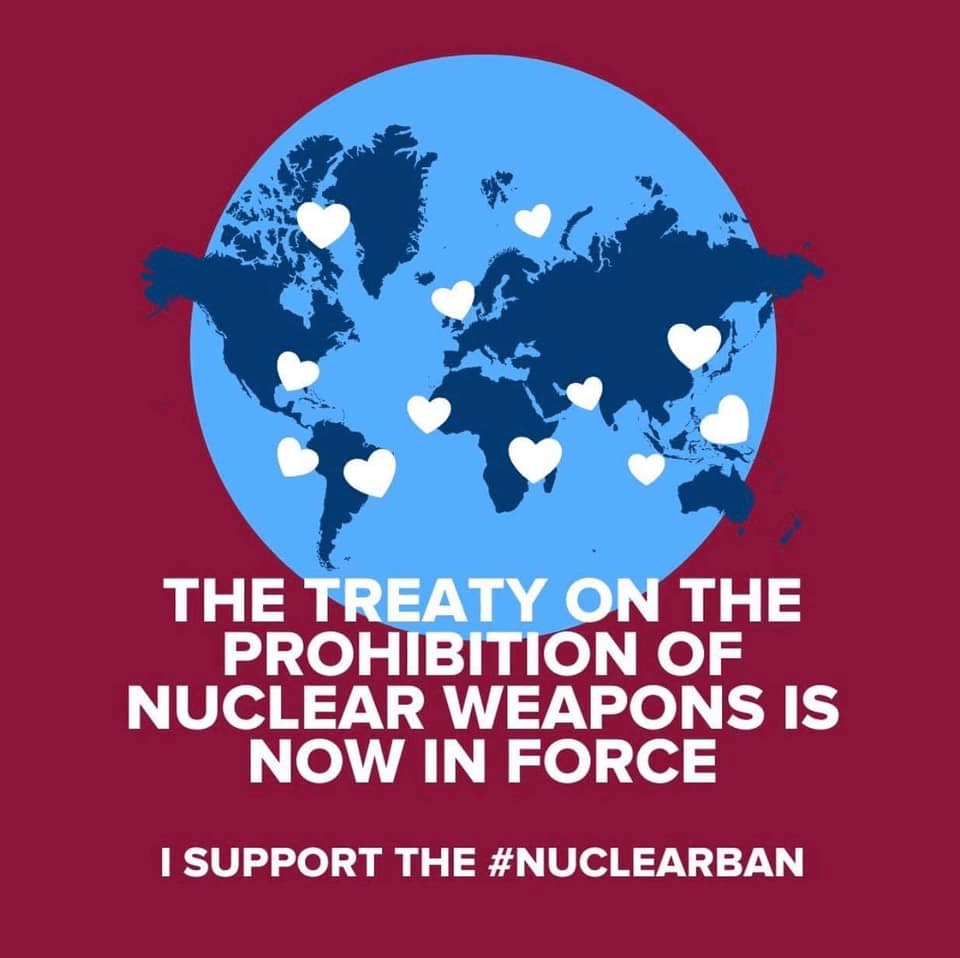
In its 2018 policy platform, Labor committed to signing and ratifying the TPNW in government, after taking account of a number of factors, including the new treaty’s interaction with the longstanding non-proliferation treaty.
It was Albanese who moved the motion, stating at the time, “Nuclear weapons are the most destructive, inhumane and indiscriminate weapons ever created. Today we have an opportunity to take a step towards their elimination.”
The motion was seconded by the now defence minister, Richard Marles, and adopted unanimously.
The Saturday Paper, 30 Mar 24
In August 1939, a month before the outbreak of World War II, Albert Einstein wrote to then United States president Franklin D. Roosevelt advising that a large mass of uranium could be used to make “extremely powerful bombs of a new type”.
Fearing Nazi Germany would be the first to develop such weaponry, he implored Roosevelt to speed up experimental work aimed at harnessing the destructive power of the atom.
It was, he later said, the “one great mistake” of his life.
Like J. Robert Oppenheimer, Einstein became increasingly alarmed at the implications of the Manhattan Project. In just a few years, the human species had acquired the means to destroy itself, along with most other living organisms on Earth.
Horrified by the high death toll from the US atomic bombings of Hiroshima and Nagasaki in 1945, which killed more than 200,000 people, mostly civilians, Einstein reflected, “The unleashed power of the atom has changed everything save our modes of thinking, and we thus drift toward unparalleled catastrophe.”
Shortly before his death in 1955, Einstein signed a manifesto with other renowned intellectuals, including the mathematician and philosopher Bertrand Russell, warning “a war with H-bombs might quite possibly put an end to the human race”.
Their growing concern stemmed, in part, from the discovery that nuclear weapons could spread destruction over a much wider area than had initially been supposed.
A year earlier, at Bikini Atoll in the Marshall Islands, America’s infamous Castle Bravo nuclear weapons test had poisoned not only the people of nearby Rongelap but also Japanese fishermen hundreds of kilometres from the blast site.
It was the largest of more than 300 US, French and British nuclear test explosions carried out in the Pacific between 1946 and 1996, with devastating consequences for local populations and the environment.
The British government also tested nuclear weapons on Australian soil in the 1950s and 1960s, poisoning the environment, dislocating and irradiating Aboriginal communities, and affecting many of the 20,000 British and Australian service personnel involved in the testing program.
The toxic legacy of these experiments – in Australia, the Pacific and other parts of the world – persists to this day. Those exposed to radiation and their descendants suffer from birth defects and cancers at much higher rates than the general population.
Still, the nuclear arms race continues apace. The dire warnings articulated so powerfully in the Russell–Einstein manifesto seven decades ago remain just as relevant today.
Our world is teetering on the brink of catastrophe, with close to 13,000 nuclear weapons in the arsenals of nine countries. The risk of their use – whether by accident or design – is as high as ever……………………………………………………………
Australia’s plan to acquire nuclear-powered submarines under AUKUS has only exacerbated tensions, eroding well-established non-proliferation norms.
Last year, more than 150 medical journals, including The Lancet and the Medical Journal of Australia, put out a joint call for urgent action to eliminate nuclear weapons. They identified the abolition of nuclear weapons as a public health priority. “Even a ‘limited’ nuclear war involving only 250 of the 13,000 nuclear weapons in the world,” the warning stated, “could kill 120 million people outright and cause global climate disruption leading to a nuclear famine, putting two billion people at risk.”……………………………………………………………………………………………………………..
This week, as I walked the halls of Parliament House to advocate for Australia’s signing of the Treaty on the Prohibition of Nuclear Weapons (TPNW), a landmark accord adopted at the United Nations in 2017 with the backing of 122 countries, I was reminded of the power that people in government have to make real and long-lasting change, and also how all too often they let opportunities slip by.
During my nine years as the Labor member for Fremantle, I saw how government action and policy change could make positive differences for people and the environment, but also how inaction could have devastating consequences.
The Albanese government has an opportunity to leave a powerful legacy and help secure the future of all life on Earth. To do so, Australia must step out from under the shadow of the nuclear umbrella and sign the Treaty for the Prohibition of Nuclear Wespons (TPNW)
The sticking point for Australia has been the doctrine of extended nuclear deterrence, a feature of our defence strategy for decades. In theory, Australia relies on US nuclear weapons to defend us against nuclear attack. Washington, however, has never made a public commitment to that effect. Furthermore, since nuclear deterrence is based on the willingness and readiness to commit the mass murder of civilians, it is morally and legally unacceptable, even by way of retaliation.
Deterrence theory also assumes complete rationality and predictability of all actors, including one’s enemies, all of the time, which is a bold assumption.
There are many things that cannot be deterred, including accidents, miscalculations, unhinged leaders, terrorist groups, cyber attacks and simple mistakes. There have been many nuclear near-misses over the decades and we have been on the brink of catastrophe more than once, most famously during the Cuban Missile Crisis in 1962.
The TPNW provides a pathway to the elimination of nuclear weapons. It is a new norm in international law that delegitimises and stigmatises the most destructive and inhumane weapons ever created. It also includes groundbreaking provisions to assist communities harmed by nuclear use and testing and to remediate contaminated environments.
Indonesia, New Zealand, Malaysia, the Philippines, Thailand and nine of the Pacific Island states have signed up. We are clearly out of step with our region.
Australia has a proud history of championing nuclear disarmament, particularly under Labor governments. The late Tom Uren, a Labor luminary and mentor to Anthony Albanese, was one of the party’s most passionate critics of nuclear weapons and war.
It was under the Whitlam government, with Uren serving as a minister, that Australia ratified the Treaty on the Non-Proliferation of Nuclear Weapons in 1973. Bob Hawke worked with Pacific neighbours to develop the South Pacific Nuclear Free Zone Treaty in 1985. Paul Keating established the Canberra Commission on the Elimination of Nuclear Weapons in 1995. Kevin Rudd established a follow-up commission in 2008.
In its 2018 policy platform, Labor committed to signing and ratifying the TPNW in government, after taking account of a number of factors, including the new treaty’s interaction with the longstanding non-proliferation treaty.
It was Albanese who moved the motion, stating at the time, “Nuclear weapons are the most destructive, inhumane and indiscriminate weapons ever created. Today we have an opportunity to take a step towards their elimination.”
The motion was seconded by the now defence minister, Richard Marles, and adopted unanimously.
Albanese argued the most effective way for Australia to build universal support for the TPNW – including, ultimately, bringing nuclear-armed states on board – would be for our country to join the treaty itself.
He also said that doing so would not jeopardise Australia’s alliance with the US, noting Australia had joined other disarmament treaties to which the US isn’t a party, including those banning anti-personnel landmines and cluster munitions.
New Zealand, the Philippines and Thailand have all ratified the TPNW, with no disruption to their ongoing non-nuclear military cooperation with the US. Indeed, the Philippines recently almost doubled the number of its military bases available to US forces and conducted joint military exercises with the US in the South China Sea.
Labor reaffirmed its commitment to signing the TPNW at its 2021 and 2023 national conferences, but the Albanese government has not yet inked the accord. It is time for the prime minister to act.
The rising, existential danger of nuclear war makes it all the more important for Australia to get on the right side of history.
We need to change our modes of thinking – to use Einstein’s phrase – and dispense with old ideas about what makes us safe and secure. We must remember that disarmament is essential for our collective survival.
In their manifesto, Einstein and Russell appealed as human beings to human beings: “Remember your humanity, and forget the rest.”
This article was first published in the print edition of The Saturday Paper on March 30, 2024 as “The nuclear threat Australia is ignoring”. https://www.thesaturdaypaper.com.au/comment/topic/2024/03/30/the-nuclear-threat-australia-ignoring#mtr
.
Missing Links in Textbook History: War


According to the Institute for National Strategic Studies: “The most highly prized attribute of private contractors is that they reduce troop requirements by replacing military personnel. This reduces the military and political resources that must be dedicated to the war.”
By Jim Mamer , ScheerPost, 28 Mar 24
In the councils of government, we must guard against the acquisition of unwarranted influence, whether sought or unsought, by the military- industrial complex. The potential for the disastrous rise of misplaced power exists and will persist.
— President Dwight D. Eisenhower’s Farewell Address (1961)
n the late 1980s I had a student in an American history class who said that the United States won the war in Vietnam. I felt dizzy. Maybe I had misunderstood. So, I asked him to explain. “My father,” he told the class, “said that we had won the war because we won most of the battles and we killed more of them than they killed of us.”
My instinct was to attempt to impose logic on the discussion. American aircraft, I said, dropped millions of tons of bombs on Vietnam – more than twice what the U.S. dropped in all of World War II. That, of course, killed a lot of people, but it did not win the war.
That student was not convinced and I quickly realized that I would not change his mind. Not long after, I discovered that he and his father were not alone.
Ignorance or Amnesia?
The late Gore Vidal famously referred to this country as the “United States of Amnesia.” He had a point. As a society, we don’t seem to learn much from past experiences and even what we think we remember is often blurry.
In a 2003 episode of “Democracy Now!” Vidal reported that George W. Bush had managed to have a number of presidential papers put beyond the reach of historians for a great length of time. Making historical records unavailable, he predicted, will worsen America’s amnesia: “There will be no functioning historical memory … we are creating a lobotomized nation wherein the connections between essential parts of our history are severed from what is taught.”…………………………………………………………..
Glenn Greenwald blames some of the misunderstanding on journalists. He began a recent edition of System Update by talking about how journalists report on war. “One of the most important parts of journalism, when it comes to war, is to scrutinize, and investigate and debunk propaganda that comes from every side in every war.” Unfortunately, he concludes, journalists often fail to scrutinize, investigate and debunk.
I have argued some of the blame should be put on state approved textbooks which often fail, in Vidal’s words, to make the vital connections, due to what I call “missing links.
The Often-Invisible Agenda of Corporate Media
In 2005, Norman Solomon wrote an article titled “The Military-Industrial-Media Complex,” where he describes the connections of the military-industrial complex to corporate media.
“Firms with military ties routinely advertise in news outlets. Often, media magnates and people on the boards of large media-related corporations enjoy close links—financial and social—with the military industry and Washington’s foreign-policy establishment. Sometimes a media-owning corporation is itself a significant weapons merchant.”
Because so much of the media is now tied to corporate sponsors or serves the agenda of one political party most Americans are never exposed to real debate. Highly paid broadcasters may be fearful of offending their corporate paymasters when they report on a war involving the United States, especially when their reports have been given a veneer of credibility from “experts” drawn from the ranks of retired military officers, retired CIA personnel and former FBI officials.
As a result, there is virtually no media coverage of weapons manufacturers and the profits they make. Just imagine the impact it would make if reports from war zones that we are deeply involved with, like Gaza or Ukraine, were followed by listings of the profits made by various weapon-making conglomerates like Lockheed Martin, Mitsubishi, Boeing, General Dynamics or Raytheon?
How much do we know about American Wars?
To understand the gravity of the situation it helps to have a sense of how many American wars have been fought and how many conflicts we are currently involved with. The numbers differ according to the source largely because wars are sometimes grouped under umbrella terms like the Caribbean wars, the Cold War or the War on Terror.
According to Wikipedia, the United States has been involved in 107 wars since its founding and 41 of these were fought against the Indigenous peoples of North America. Most of these wars are ignored by schools, textbooks and the media, but the pressure to become involved in additional conflict is ever-present and comes from a variety of sources.
When Dick Cheney was Secretary of Defense for President George Bush Sr., he contracted engineering company Kellogg, Brown & Root (then part of Halliburton) to identify traditional military jobs that could be taken over by private sector contractors. It turned out there were a lot of jobs for the private sector and ever since the use of contractors has grown in positions like conducting intelligence, training local military, handling security and assisting in drone warfare.
At times the number of private contractors has been larger than that of enlisted troops……………………………
According to the Institute for National Strategic Studies: “The most highly prized attribute of private contractors is that they reduce troop requirements by replacing military personnel. This reduces the military and political resources that must be dedicated to the war.”
Public Citizen reports that “Every year, the defense industry donates millions of dollars to the campaigns of members of Congress, creating pressure on the legislative branch to fund specific weapons systems, maintain an extremely high Pentagon budget, and add ever more military spending.”
They also report that the pressure to spend more is constant, even though “nearly 50% of the Pentagon budget” already goes to private contractors. According to the report, in 2022 the weapons/defense industry donated $10.2 million to the 84 members of the House and Senate Armed Services Committees.
Even the language employed to report on war is structured to confuse. Invented phrases resemble Orwell’s Newspeak, from the novel 1984, meant to prevent too much thought. How else to explain the birth of misleading terms like “protective reaction strike” (an attack) “enhanced interrogation techniques” (torture), “extraordinary rendition” (kidnapping), “collateral damage” (extra dead), or “targeted killings” (usually with a lot of collateral damage).
The Art of Promoting Misunderstanding
What you do in this world is a matter of no consequence. The question is,
What can you make people believe that you have done?
……………………………………………………………………………………………………………………. High school textbooks all discuss early American wars, but usually without analysis. What follows are examples of how three early wars are discussed in textbooks………………………………………………………………………………………………………………
Are we headed toward Forever Wars?
Republicans and Democrats disagree today on many issues, but they are united in their resolve that the United States must remain the world’s greatest military power. This bipartisan commitment to maintaining American supremacy has become a political signature of our times.
— Andrew J. Bacevich, American Imperium 2016
……………………………..describing our history as one damn war after another.
How else to respond to the Wikipedia list of 107 wars involving the United States since 1787. And the wars continue. In his book “The United States of War,” David Vine reports that, “In the nearly two decades since U.S. forces invaded Afghanistan and Iraq, the U.S. military has fought in at least 22 countries.”
In his analysis of American wars Andrew Bacevich writes that “the constructed image of the past to which most Americans habitually subscribe prevents them from seeing other possibilities.” This “constructed image” is basically one of the United States as largely innocent of aggression, but forced by circumstance to defend itself.
In order to identify the missing links in the textbook treatments of American wars, it is important to look beyond the minutiae of single events and the unique characteristics of each conflict and look for common threads in the motivations towards engaging in war.
We have a government financed and influenced by Eisenhower’s military-industrial complex idea, and a population which seems either uninformed or uninterested.
The combination invites a future of permanent war.
Common threads include the ever-present assertion that the United States is defending itself whenever it goes to war and that includes wars engaged in while assembling a nation that would span the continent, as the song goes, “from sea to shining sea.”
How accurate were American claims of self-defense regarding American participation in the three early wars I reviewed?
…………………………………………………… If Andrew Bacevich is correct in saying we in the U.S. have a bipartisan congressional commitment to maintaining American supremacy, then more wars are inevitable. If we are to escape a future of forever wars, all justifications for war should be questioned and debated before the killing starts. https://scheerpost.com/2024/03/28/missing-links-in-textbook-history-war/
Starvation in Gaza: The World Court’s Latest Intervention

March 30, 2024, by: Dr Binoy Kampmark, https://theaimn.com/starvation-in-gaza-the-world-courts-latest-intervention/
Rarely has the International Court of Justice been so constantly exercised by one topic during a short span of time. On January 26, the World Court, considering a filing made the previous December by South Africa, accepted Pretoria’s argument that the Convention on the Prevention and Punishment of the Crime of Genocide was applicable to the conflict in so far as Israel was bound to observe it in its military operations against Hamas in Gaza. (The judges will determine, in due course, whether Israel’s actions in Gaza meet the genocidal threshold.) By 15-2, the judges noted that “the catastrophic humanitarian situation in the Gaza Strip is at serious risk of deteriorating further before the Court renders its final judgment.”
At that point 26,000 Palestinians had perished, much of Gaza pummelled into oblivion, and 85% of its 2.3 million residents expelled from their homes. Measures were therefore required to prevent “real and imminent risk that irreparable prejudice will be caused to the rights found by the Court to be plausible, before it gives its final decision.”
Israel was duly ordered to take all possible measures to prevent the commission of acts under Article II of the Genocide Convention; prevent and punish “the direct and public incitement to genocide” against the Gaza populace; permit basic services and humanitarian assistance to the Gaza Strip; ensure the preservation of, and prevent destruction of, evidence related to acts committed against Gaza’s Palestinians within Articles II and III of the Convention; and report to the ICJ on how Israel was abiding by such provisional measures within a month. The balance sheet on that score has been uneven at best.
Since then, the slaughter has continued, with the Palestinian death toll now standing at 32,300. The Israelis have refused to open more land crossings into Gaza, and continue to hamper aid going into the strip, even as they accuse aid agencies and providers of being tardy and dishonest. Their surly defiance of the United States has seen air drops of uneven, negligible success (the use of air to deliver aid has always been a perilous exercise). When executed, these have even been lethal to the unsuspecting recipients, with reported cases of parachutes failing to open.
On March 25, the UN Security Council, after three previous failed attempts, passed Resolution 2728, thereby calling for an immediate ceasefire for the month of Ramadan “leading to a lasting sustainable” halt to hostilities, the “immediate and unconditional release of all hostages”, “ensuring humanitarian access to address their medical and other humanitarian needs” and “demands that the parties comply with their obligations under international law in relation to all persons they detain.”
Emphasis was also placed on “the urgent need to expand the flow of humanitarian assistance to and reinforce the protection of civilians in the entire Gaza Strip.” The resolution further demands that all barriers regarding the provision of humanitarian assistance, in accordance with international humanitarian law be lifted.
Since January, South Africa has been relentless in its efforts to curb Israel’s Gaza enterprise in The Hague. It called upon the ICJ on February 14, referring to “the developing circumstances in Rafah”, to urgently exercise powers under Article 75 of the Rules of Court. Israel responded on February 15. The next day, the ICJ’s Registrar transmitted to the parties the view of the Court that the “perilous situation” in the Gaza Strip, but notably in Rafah, “demands immediate and effective implementation of the provisional measures indicated by the Court in its Order of 26 January 2024.”
Throughout the following month, more legal jostling and communication took place, with Pretoria requesting on March 6 that the ICJ “indicate further provisional measures and/or to modify” those ordered on January 26.
The application was prompted by the “horrific deaths from starvation of Palestinian children, including babies, brought about by Israel’s deliberate acts and omissions … including Israel’s concerted attempts since 26 January 2024 to ensure the defunding of [the United Nations Relief and Works Agency (UNRWA) and Israel’s attacks on starving Palestinians seeking to access what extremely limited humanitarian assistance Israel permits into Northern Gaza, in particular.”
Israel responded on March 15 to the South African communication, rejecting the claims of starvation arising from deliberate acts and omissions
“in the strongest terms.” The logic of the sketchy rebuttal from Israel was that matters had not materially altered since January 26 to warrant a reconsideration: “the difficult and tragic situation in the Gaza Strip in the last weeks could not be said to materially change the considerations upon which the Court based its original decision concerning provisional measures.”
On March 28, the Court issued a unanimous order modifying the January interim order. Combing through the ghoulish evidence, the judges noted an updated report from March 18 on food insecurity from the Integrated Food Security Phase Classification Global Initiative (IPC Global Initiative) stating that “conditions necessary to prevent Famine have not been met and the latest evidence confirms that Famine is imminent in the northern governorates and projected to occur anytime between mid-March and May 2024.” The UN Children’s Fund had also reported that 31 per cent of children under 2 years of age in the northern Gaza Strip were enduring conditions of “acute malnutrition”.
In the face of this Himalaya of devastation, the Court could only observe “that Palestinians in Gaza are no longer facing a risk of famine, as noted in the Order of 26 January 2024, but that famine is setting in, with at least 31 people, including 27 children, having already died of malnutrition and dehydration.” There were “unprecedented levels of food insecurity experienced by Palestinians in the Gaza strip over recent weeks, as well as the increasing risks of epidemics.”
Such “grave” conditions granted the Court jurisdiction to modify the January 26 order which no longer fully addressed “the consequences arising from the changes in the situation.” In view of the “worsening conditions of life faced by Palestinians in Gaza, in particular the spread of famine and starvation”, Israel should take “all necessary and effective measures to ensure, without delay, in full cooperation with the United Nations, the unhindered provision at scale by all concerned of urgently needed basic services and humanitarian assistance.”
The list of what is needed is also enumerated: food, water, electricity, fuel, shelter, clothing, hygiene, sanitation requirements, and “medical supplies and medical care to Palestinians throughout Gaza, including by increasing the capacity and number of land crossing points and maintaining them open for as long as necessary.”
A less reported aspect of the March 28 order, passed by fifteen votes to one, was that Israel’s military refrain from committing “acts which constitute a violation of any rights of the Palestinians in Gaza as a protected group” under the Genocide Convention “including by preventing, through any action, the delivery of urgently needed humanitarian assistance.”
In this, the Court points to the possible, and increasingly plausible nexus, between starvation, famine and deprivation of necessaries as state policies with the intent to injure and kill members of a protected group. It is no doubt something that will weigh heavily on the minds of the judges as they continue mulling over the nature of the war in Gaza, which South Africa continues to insist is genocidal in scope and nature.
TODAY The tiresome spin of the nuclear lobby in Australia.

It used to be the pro-nuclear pronouncements of Dr Adi Paterson of ANSTO – going on about the wonderful small nuclear reactors (SMRs). He made a sudden departure from ANSTO – who knows why, but possibly because SMRs are turning out to b a flop, and a shocking waste of tax-payers’ money.
But there have always been the spinners. You can’t count the Liberal and National Party politicians. They are probably an embarrassment to the nuclear lobby, as they repeatedly demonstrate their ignorance of the issues.
I don’t know who funds these sham charities, but they pop up all the time.
The latest is, of course “Nuclear for Australia”, now posing as a charity, and running a petition. It was supposedly started by a 16 year old boy – in keeping with the current enthusiasm for nuclear as “young” “new” “clean” and “lively”. But of course it is strongly backed by those youthful organisations – the World Nuclear association, the International Atomic Energy Agency – and a few somewhat less prestigious agencies.
A few of the previous sham charities:



1 This month
15 April – Zoom –Nuclear Power is Not the Solution
Apr 15, 2026 01:00 AM in Canberra, Melbourne, Sydney

Join the International Physicians for the Prevention of Nuclear War (IPPNW) on Tuesday, April 14th for a timely webinar exploring the risks associated with nuclear power and challenging the myth that it offers a simple, safe, carbon-free solution to the climate crisis

of the week – Australians for War Powers Reform (AWPR)
To see nuclear-related stories in greater depth and intensity
 Antinuclear