Updated Climate Council statement re nuclear power
Nuclear power stations are not appropriate for Australia – and never will be
March 2024By Climate Council
The prospect of nuclear power in Australia has been a topic of public debate since the 1950s. While Australia has never had a nuclear power station, we do have 33% of the world’s uranium deposits and we are the world’s third largest producer of it. Periodically, as with the changing of the seasons, various individuals appear in the media singing the virtues of nuclear energy – claiming it is the only option for clean and reliable electricity in Australia.In fact, over one third of Australia’s electricity is already powered by renewables, and new initiatives like the Capacity Investment Scheme are set to push us towards 82% renewable energy by the end of this decade. While the move to clean energy is still not happening fast enough, it is underway and starting to speed up. We do not need distractions like nuclear to derail our progress now, so let’s set the record straight.
Why doesn’t nuclear power make sense for Australia?
1. Nuclear power stations can’t be built anywhere in Australia.
They are banned in every state, and in every territory. Such bans were introduced because of community concerns about the health and environmental risks. Many parliamentary inquiries at a federal and state level – see this Victorian Inquiry, this Federal Inquiry, and this South Australian Inquiry for instance – have been held into nuclear energy, and all have concluded that it makes no sense in Australia.
2. Nuclear power stations are expensive and take too long to build.
Australia’s independent science information agency, CSIRO, has found that solar and wind are by far the cheapest ways of producing electricity(even when factoring in storage). In contrast, the cost of building and operating nuclear in Australia remains prohibitively high.
Analysis conducted by the nuclear industry itself shows nuclear power stations take an average of 9.4 years to build – compared to 1–3 years for a major wind or solar project. Australia needs to replace its ageing coal-fired power stations as quickly as possible to rapidly reduce emissions this decade. As shown in the Australian Energy Market Operator’s Integrated System Plan, by far the cheapest and quickest way to do this is to ramp up renewable energy paired with storage like pumped hydro, and batteries.
3. Nuclear power poses significant community, environmental, health and economic risks.
Radiation from major nuclear disasters, such as Chernobyl in 1986 and Fukushima in 2011, have impacted hundreds of thousands of people and contaminated vast areas that take decades to clean up. Even when a nuclear power station operates as intended, it creates a long-term and prohibitively expensive legacy of site remediation, fuel processing and radioactive waste storage.
4. Nuclear power is not renewable, and it is not safe.
Uranium is a finite resource just like coal, oil and gas. It needs to be mined and, just like mining coal, oil and gas, this carries serious safety concerns, including contaminating the environment with radioactive dust, radon gas, water-borne toxins, and increased levels of background radiation. On the other hand, energy generated from the sun and wind releases no pollutants into the air and is overwhelmingly considered to be safe.
There you have it: nuclear power is expensive, illegal, dangerous and decades away from powering our homes and businesses. It makes no sense. On the other hand, energy from the sun and wind is cheap, abundant, safe and available now. So, let’s get on with building more renewable energy!
Jim Green demolishes Rolls Royce’s claims about so-called “small” and “cheap” nuclear reactors for Australia.

Nuclear Fuel Cycle Watch Australia, Jim Green 7 Apr 24
According to reports in The Australian, Rolls-Royce claims it could build a 470-megawatt reactor in Australia for A$3.5-5 billion. That equates to A$7.4-10.6 billion / gigawatt (GW). For comparison, the cost for the two EPR reactors under construction at Hinkley Point, the only reactor construction project in the UK, is A$27.8 / GW.
So Rolls-Royce claims its cost-per-GW will be just 27-38% of the cost of Hinkley Point, for a reactor type that it has never built and doesn’t have a licence to build, anywhere in the world. Clearly Rolls-Royce’s cost claims need to be treated with scepticism.
Rolls-Royce claims it could build a reactor in Australia in just four years (once licensing and a myriad of other issues were sorted). Let’s compare that speculation with real world experience:
* Hinkley Point was supposed to be a seven-year construction project. That has blown out to 12-13 years with further slippage likely.
* The one EPR under construction project in France was meant to be completed in five years but it remains incomplete after 17 years.
* The one EPR recently completed in Finland was meant to be a four-year construction project but ultimately took 17 years to complete.
* The two AP1000 reactors in the US were meant to be completed in three years, but ultimately took 10 and 11 years to complete.
Rolls-Royce’s 470-MW design is being marketed as a small modular reactor (SMR) even though it falls well outside the <300 MW definition of SMRs. Only two SMR plants are said to be operating anywhere in the world (though there’s nothing modular about either of them). Russia’s floating ‘SMR’ was supposed to be a three-year construction project but that blew out to 12 years (and costs increased six-fold). China’s ‘SMR’ was supposed to be a four-year construction project but that blew out to nine years (and costs increased three-fold).
Clearly Rolls-Royce’s claim that it could build a reactor in just four years needs to be treated with scepticism.
Peter Dutton vows to bring small nuclear reactors online in Australia by mid 2030 if elected.

April 5, 2024, The Australian, Simon Benson
https://www.theaustralian.com.au/nation/politics/peter-dutton-vows-to-bring-small-nuclear-reactors-online-in-australia-by-mid2030-if-elected/news-story/eaf9eaf2084916fa118fbeebf2ed72c9
Cheaper power prices would be offered for residents and businesses in coal communities to switch from retiring coal-fired generators to nuclear power if the Coalition wins government.
Peter Dutton has pledged that if elected, the Coalition could deliver the first small modular reactors into the grid by the mid-2030s, with British manufacturer Rolls-Royce understood to be able to deliver them at an estimated $3.5bn to $5bn each.
Economic impact statements will also be conducted on at least seven communities identified by a shadow cabinet subcommittee established by the Opposition Leader to develop the Coalition’s energy security policy.
Mr Dutton confirmed to The Weekend Australian that under the Coalition’s net-zero energy plan, to be released before the May budget, cheaper electricity bills would be offered to those communities that took up nuclear when coal-fired power stations were retired.
The plan will involve the creation of new precincts for advanced manufacturing centred on cheap energy from small nuclear reactors.
Mr Dutton met privately last week with executives from nuclear power plant manufacturer Rolls-Royce and its Australian partner Penske over the pursuit of low-cost small modular reactor technology for Australia.
It is understood Rolls-Royce is confident that its small modular reactor technology could be ready for the Australian market by the early to mid-2030s with a price tag of $5bn for a 470 megawatt plant.
Each plant would take four years to build and have a life span of 60 years.
Rolls-Royce will also build the nuclear reactors for the second tranche of the future AUKUS nuclear-powered naval submarines under contracts signed in February with the Albanese government.
“There is every reason to be optimistic about bringing small modular net-zero emission nuclear into the power mix in the 2030s,” the Opposition Leader said in an interview with The Weekend Australian, adding: “I think the mid-2030s.
Grattan Institute Deputy Energy Director Alison Reeve says the nuclear energy debate is a “bit of a distraction” when there are “immediate problems” to worry about. Ms Reeve joined Sky News Australia to discuss the future of energy in the country. “The federal opposition has said they want to take the ban off nuclear power – they could do that,” she said. “The thing is that there’s a hell of a lot of things that would need to happen before you end up with being able to actually build a nuclear power station. “In the meantime, we’ve got an awful lot of other stuff that we need to concentrate on building.”
“If we win the election, it is clear to me that (South Australian Labor Premier) Peter Malinauskas would be the first to sign up, and we could deal with regulatory burdens quickly.
“There is no question about that. And there is every reason to believe other jurisdictions would follow suit.
“I think when you look at where technology has advanced and what Rolls-Royce is doing with the nuclear submarines the government has signed up to buy, the future is much closer than we think.
“The ability to produce zero-emissions baseload with 24/7 electricity to firm up renewables is within our grasp.
“My honest view is we have to embrace a new energy system and we have to have an orderly transition but the government doesn’t have a credible pathway to net zero by 2050.”
Mr Dutton said a community engagement process would soon be rolled out once the potential coal sites had been finalised. He confirmed that those communities supportive of future transitions from coal to nuclear would be offered cheaper power prices and higher-paid jobs…………………
The first phase of the Coalition’s net-zero energy plan was taken to shadow cabinet two weeks ago and will be released before the May budget.
The debate facing the Coalition now is over the cost and timely delivery of nuclear into the energy mix, as well as the future of some coal communities facing bleak socio-economic outcomes one coal-fired generators exit the system……………….
Anthony Albanese told The Weekend Australian his government had a clear focus on the future of coal communities and insisted that no one would be “left behind”, claiming Labor’s renewable energy plans would drive new manufacturing jobs in those regions.
“Eleven coal-fired power plants have already closed and the former Coalition government didn’t lift a finger to help workers in these communities,” the Prime Minister said
“Rather than playing politics with the transition, the government is putting in place practical measures to ensure workers are looked after. The Net Zero Economy Authority will support workers to access new employment and to help create jobs in new businesses and industries.
“The Energy Industry Jobs Plan introduced into parliament last week outlines a redeployment scheme to align workers with jobs in new industries.
“The authority will work with business unions and communities.
“We will not leave them behind.
“A practical example is the Liddell site in the Upper Hunter which is being transformed into an energy and manufacturing hub, employing more people than the old power station did.
“Recently, Rio Tinto signed Australia’s biggest renewable energy deal to power its Boyne aluminium smelter in Gladstone.”
https://www.theaustralian.com.au/nation/politics/peter-dutton-vows-to-bring-small-nuclear-reactors-online-in-australia-by-mid2030-if-elected/news-story/eaf9eaf2084916fa118fbeebf2ed72c9
Nuclear energy is an ugly duckling in every possible respect: Too late, too costly, too toxic
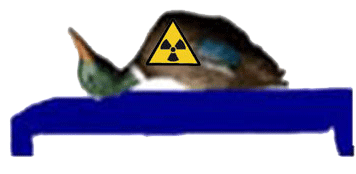
Jeremy Cooper, Apr 5, 2024, https://reneweconomy.com.au/nuclear-energy-is-an-ugly-duckling-in-every-possible-respect-too-late-too-costly-too-toxic/
Twenty-five years ago, Australia banned nuclear energy generation at a Federal, State and Territory level. Partly because of this, Australia would be one of the last places you would invest in nuclear energy, notwithstanding our large uranium deposits.
Australia has no nuclear power industry, so it has multi-level legislative barriers and no social licence. It also has abundant land, sun, and wind (with a vibrant renewables industry) and no obvious need for nuclear power.
On top of all those impediments, renewable sources of power are already profoundly changing how our energy markets and infrastructure operate.
Rooftop solar often accounts for all electricity grid demand and more during the day. This means consumers can use their non-grid (or ‘behind the meter’) electricity for free.
Rooftop solar is expected to increase fourfold over the next 20 years. These changes create further impediments to costly, centralised, slow to build and ‘always on’ nuclear power. Try telling rooftop solar consumers that they’ll have to make way for nuclear power at who knows what cost.
The Clean Energy Council recently reported that renewable energy provided 39.4% of Australia’s total energy generation in 2023, up from just 17% as recently as 2017. Combined large and small-scale additional renewable capacity in Australia reached around 5.9 gigawatts (GW – ie a billion watts) in 2023.
Total investment in large-scale storage was $4.9 billion in 2023, up from $1.9 billion in 2022. Last month, Rio Tinto signed a landmark 25-year renewable energy purchase deal worth billions to power its alumina and aluminium facilities. The large-scale solar and wind farms are the largest of such projects ever financed in Australia.
According to the International Energy Agency, new solar installations globally were 420GW in 2023 and new wind 117GW. New nuclear fell to just 5.5GW.
On a per GW basis, barely 1% of the capital spent globally last year was on nuclear. These data make it abundantly clear that there is no ‘nuclear renaissance’. While many nations promised to invest more in nuclear at COP28 last year, we are yet to see this happen.
Looking at the four big nuclear plants recently completed or nearly finished in the US, UK, France and Finland, cost overruns averaged over 300%, with more bad news to come.
The builders either went bankrupt or were nationalised. Consumers, investors, and taxpayers will be paying for this for a generation. But cost is not the worst drawback.
The more serious problem is that radioactive nuclear waste is extremely toxic and gets air-brushed out of arguments in favour of going nuclear. All the focus is on zero carbon emissions as if the toxic waste didn’t exist. This is disingenuous at best.
Nuclear waste needs to be stored expensively and safely by experts for thousands of years; and longer. Given how things are going in the world (a ‘hot’ war in Europe; unprecedented middle East tensions and Trump Mark II), what confidence could we have in this being delivered?
The risks of storing nuclear waste are imponderable because of the time horizons involved – well beyond our brief Anthropocene era. It is the height of human folly to assume that we can manage these risks.
We have no idea what will happen when distant, future generations are involuntarily charged with looking after waste that they didn’t consent to nor benefit from and, critically, weren’t paid to look after.
Another catchy, but fallacious, argument against renewables revolves around ‘baseload power’. This is the old argument based around the fact that the sun doesn’t shine at night and therefore on-demand power is the only option.
The reality is that Australia is already rapidly moving towards flexible, dispatchable power because of the increasing contribution from rooftop solar and wind backed up by battery (and other storage technologies, including hydro).
Despite comments to the contrary, nuclear power cannot ‘firm up’ renewable power sources; only variable sources of power can do this: batteries; hydro or ‘gas peaking’ – things that can be switched on and off quickly.
This leads to the question of what we expect nuclear energy to do if and when it turns up in the 2040s. AGL’s CEO has already ruled out any nuclear plants being located on its former coal-fired power station sites citing the idea as potentially ‘de-railing’ investment in the energy transition.
If nuclear power does arrive in Australia, it will be an ugly duckling in every possible respect; too late; too costly; too toxic and unable to supply a 21st century power grid that will have moved to flexible power sources. Unlike the famous Danish children’s story, the nuclear duckling will never be recognised as a ‘swan’.
This is not to say that the transition to renewable energy is without challenges, costs, and the potential for delays. There are and will be obstacles, but we cannot afford to wait for nuclear energy while continuing to burn fossil fuels in the meantime.
The risk-free and low-cost renewable alternatives are already here and that is where the market has already decided to allocate its capital.
Jeremy Cooper is Director, Bennelong Funds Management; Chair, Carbon Advisory Board, Future Group; a former Deputy Chair of ASIC and chair of the 2009-10 Super System Review.
China’s quiet energy revolution: the switch from nuclear to renewable energy
By Derek Woolner and David Glynne Jones, Apr 6, 2024 https://johnmenadue.com/chinas-quiet-energy-revolution-the-switch-from-nuclear-to-renewable-energy/
There is now a policy dispute about the roles of nuclear and renewable energy in future Australian low emission energy systems. The experience of China over more than a decade provides compelling evidence on how this debate will be resolved. In December 2011 China’s National Energy Administration announced that China would make nuclear energy the foundation of its electricity generation system in the next “10 to 20 years”. Just over a decade later China has wound back those ambitious targets and reoriented its low emission energy strategy around the rapid deployment of renewable solar and wind energy at unprecedented rates.
Australia has seen a campaign against the use of renewable energy technologies and for the benefits of nuclear energy in developing Australia’s future low emission energy systems. The Federal Opposition has now adopted this position as their policy. The recent experience of China provides a compelling commentary on this decision.
In December 2011 China’s National Energy Administration (NEA) announced that China would make nuclear energy the foundation of its electricity generation system in the next “10 to 20 years”, adding as much as 300 gigawatts (GWe) of nuclear capacity over that period.
This was followed by a period of delay as China undertook a comprehensive review of nuclear safety in the aftermath of the Fukushima nuclear disaster.
Subsequently, moderated nuclear energy targets were established, aiming for a nuclear energy contribution of 15% of China’s total electricity generation by 2035, 20-25% by 2050 and 45% in the second half of the century.
However by 2023 it was becoming clear that China’s nuclear construction program was well behind schedule. The target for 2020 had not been achieved, and targets for subsequent 5-year plans were unlikely to be achieved.
In September 2023 the China Nuclear Energy Association (CNEA) reported that China was now aiming to achieve a nuclear energy contribution of 10% by 2035, increasing to around 18% by 2060.
The CNEA also indicated that ‘greenlighting’ of new construction would now be at the rate of 6-8 large nuclear power reactors per year – not the 10 per year previously targeted for 2020-2035 and beyond. This will result in new nuclear generation increasing by 60-80 terawatt-hours (TWh) annually.
Meanwhile the deployment of renewable energy (primarily solar and wind energy) was dramatically accelerated in 2023, with the installation of 217GWe of new solar capacity and 70GWe of new wind capacity.
This represents an increase of around 400TWh in annual low emission generation – the quantitative equivalent of 40 large nuclear power reactors, or four times the average annual output of the Three Gorges Dam hydroelectric system (the world’s largest power station).
In 2023 energy analysts started reporting that China was now expected to achieve or exceed its 2030 target of 1200GWe for the total installed capacity of solar and wind energy by 2025, and was now planning to triple the 2030 objective, to reach 3900GWe.
Previously China expected that its energy emissions would peak in 2030, but revised forecasts are now indicating that this could happen as early as 2024, 5-6 years ahead of target.
By the end of 2023 it was clear that nuclear energy was no longer going to be the foundation of China’s future electricity generation system, and that this task had shifted to renewable energy.
So what has happened? There’s no single answer, but two key factors appear to be at play.
The first is the emergence of renewable energy technologies at competitive scale and cost since 2011.
Between 2011 and 2022, the cost of solar PV modules declined by 85%, wind energy costs by 60-70%, and battery costs by 90%.
China now dominates the global production of solar PV panels, wind turbines and batteries, with costs expected to continue to decline significantly for the foreseeable future while performance improves.
The consequence is that renewable energy generation can now be deployed economically at rates five to eight times faster than nuclear energy, which is constrained by logistical and regulatory capability, safety, site availability and other factors.
The second is the slow delivery of new nuclear generation which contributed to continued ‘greenlighting’ of new coal-fired generation to underwrite energy security, as it became clear that deployment rates for new low emission electricity generation were insufficient to blunt demand from provincial governments for new coal-fired generators, even though many existing plants are operating at uneconomically low capacity factors
By 2035, under the original plan, combined nuclear, solar and wind generation would have been comparable to current coal generation but insufficient to meet significantly increased new electricity demand.
Under the new plans, combined solar, wind and nuclear generation is likely to match current coal generation and meet new demand, with solar and wind energy contributing around 85% of this low emission generation.
By 2030 another factor will come into play, with China’s battery giant CATL developing long duration utility battery systems that will provide dispatchable electricity from renewable sources at competitive or lower costs than either coal or nuclear generated electricity.
The central message here is that even in China – the world’s largest industrial economy and preeminent builder of advanced civil infrastructure in the 21st century – nuclear energy cannot compete with renewable energy to deliver low emission electricity generation at the deployment rates needed to meet mid-century emission targets.
1
Killing Aid Workers: Australia’s Muddled Policy on Israel
Australian anger at the government level must therefore be severely qualified. Support roles, thereby rendering Australian companies complicit in Israeli’s military efforts, and in ancillary fashion the Australian government, continue to be an important feature. The F-35, a mainstay US-made fighter for the Israeli Air Force, is not manufactured or built in Australia, but is sustained through the supply of spare parts stored in a number of allied countries. According to the Australian Department of Defence, “more than 70 Australian companies have directly shared more than $4.13 billion in global F-35 production and sustainment contracts.”
April 5, 2024, by: Dr Binoy Kampmark, https://theaimn.com/killing-aid-workers-australias-muddled-policy-on-israel/
The Australian Prime Minister, Anthony Albanese, was distraught and testy. It seemed that, on this occasion, Israel had gone too far. Not too far in killing over 32,000 Palestinians in Gaza, a staggering percentage of them being children. Not too far in terms of using starvation as a weapon of war. Not too far in bringing attention to the International Court of Justice that its actions are potentially genocidal.
Israel had overstepped in doing something it has done previously to other nationals: kill humanitarian workers in targeted strikes. The difference for Albanese on this occasion was that one of the individuals among the seven World Central Kitchen charity workers killed during the midnight between April 1 and 2 was Australian national Lalzawmi “Zomi” Frankcom.
Frankcom and her colleagues had unloaded humanitarian food supplies from Cyprus that had been sent via a maritime route before leaving the Deir al-Balah warehouse. The convoy, despite driving in a designated “deconflicted” zone, was subsequently attacked by three missiles fired from a Hermes 450 drone. All vehicles had the WCK logo prominently displayed. WCK had been closely coordinating the movements of their personnel with the IDF.
In a press conference on April 3, Albanese described the actions as “completely unacceptable.” He noted that the Israeli government had accepted responsibility for the strikes, while Israel’s Prime Minister, Benjamin Netanyahu had conveyed his condolences to Frankcom’s family, with assurances that he would be “committed to full transparency”.
The next day, the Australian PM called the slaying of Frankcom a “catastrophic event”, reiterating Netanyahu’s promises from the previous day that he was “committed to a full and proper investigation.” Albanese also wished that these findings be made public, and that accountability be shown for Israel’s actions, including for those directly responsible. “What we know is that there have been too many innocent lives lost in Gaza.”
Australian Foreign Minister, Penny Wong, restated the need for “full accountability and transparency” and Australian cooperation with Israel “on the detail of this investigation.” She further acknowledged the deaths of over 30,000 civilians, with some “half a million Palestinians” starving.
Beyond an investigation, mounted and therefore controlled by the Israeli forces themselves, nothing much else can be hoped for. The Albanese approach has been one of copybook warnings and concerns to an ally it clearly fears affronting. What would a ground invasion of Rafah do to the civilian population? What of the continuing hardships in Gaza? Push for a humanitarian ceasefire, but what else?
Australian anger at the government level must therefore be severely qualified. Support roles, thereby rendering Australian companies complicit in Israeli’s military efforts, and in ancillary fashion the Australian government, continue to be an important feature. The F-35, a mainstay US-made fighter for the Israeli Air Force, is not manufactured or built in Australia, but is sustained through the supply of spare parts stored in a number of allied countries. According to the Australian Department of Defence, “more than 70 Australian companies have directly shared more than $4.13 billion in global F-35 production and sustainment contracts.”
The Australian government has previously stated that all export permit decisions “must assess any relevant human rights risks and Australia’s compliance with its international obligations.” The refusal of a permit would be assured in cases where an exported product “might be used to facilitate human rights abuses.” On paper, this seems solidly reasoned and consistent with international humanitarian law. But Canberra has been a glutton for the Israeli military industry, approving 322 defence exports over the past six years. In 2022, it approved 49 export permits of a military nature bound for Israel; in the first three months of 2023, the number was 23.
The drone used in the strike that killed Frankcom is the pride and joy of Elbit Systems, which boasts a far from negligible presence in Australia. In February, Elbit Systems received a A$917 million contract from the Australian Defence Department, despite previous national security concerns among Australian military personnel regarding its Battle Management System (BMS).
When confronted with the suggestion advanced by the Australian Greens that Australia end arms sales to Israel, given the presence of Australian spare parts in weaponry used by the IDF, Wong displayed her true plumage. The Australian Greens, she sneered, were “trying to make this a partisan political issue.” With weasel-minded persistence, Wong again quibbled that “we are not exporting arms to Israel” and claiming Australian complicity in Israeli actions was “detrimental to the fabric of Australian society.”
The Australian position on supplying Israel remains much like that of the United States, with one fundamental exception. The White House, the Pentagon and the US Congress, despite increasing concerns about the arrangement, continue to bankroll and supply the Israeli war machine even as issue is taken about how that machine works. That much is admitted. The Australian line on this is even weaker.
The feeble argument made by such watery types as Foreign Minister Wong focus on matters of degree and semantics. Israel is not being furnished with weapons; they are merely being furnished with weapon components.
Aside from ending arms sales, there is precedent for Australia taking the bull by the horns and charging into the mist of legal accountability regarding the killing of civilians in war. It proved an enthusiastic participant in the Joint Investigation Team (JIT), charged with combing through the events leading to the downing of the Malaysian Airlines MH17 over Ukraine in July 2014 by a Buk missile, killing all 298 on board.
Any such equivalent investigation into the IDF personnel responsible for the killing of Frankcom and her colleagues is unlikely. When the IDF talks of comprehensive reviews, we know exactly how comprehensively slanted they will be.
Nuclear Power Plants: NRC Should Take Actions to Fully Consider the Potential Effects of Climate Change

GAO-24-106326 Apr 02, 2024
Climate change is likely to exacerbate natural hazards—such as floods and drought. The risks to nuclear power plants from such hazards include damage to systems and equipment that ensure safe operation.
The Nuclear Regulatory Commission’s oversight process includes addressing safety risks at these plants. However, NRC doesn’t fully consider potential increases in risk from climate change. For example, NRC mostly uses historical data to identify and assess safety risks, rather than data from future climate projections.
We recommended that NRC fully address climate risks to nuclear power plants.
What GAO Found
Climate change is expected to exacerbate natural hazards—including heat, drought, wildfires, flooding, hurricanes, and sea level rise. In addition, climate change may affect extreme cold weather events. Risks to nuclear power plants from these hazards include loss of offsite power, damage to systems and equipment, and diminished cooling capacity, potentially resulting in reduced operations or plant shutdowns.
The Nuclear Regulatory Commission (NRC) addresses risks to the safety of nuclear power plants, including risks from natural hazards, in its licensing and oversight processes. Following the tsunami that led to the 2011 accident at Japan’s Fukushima Dai-ichi nuclear power plant, NRC took additional actions to address risks from natural hazards. These include requiring safety margins in reactor designs, measures to prevent radioactive releases should a natural hazard event exceed what a plant was designed to withstand, and maintenance of backup equipment related to safety functions.
However, NRC’s actions to address risks from natural hazards do not fully consider potential climate change effects. For example, NRC primarily uses historical data in its licensing and oversight processes rather than climate projections data. NRC officials GAO interviewed said they believe their current processes provide an adequate margin of safety to address climate risks. However, NRC has not conducted an assessment to demonstrate that this is the case. Assessing its processes to determine whether they adequately address the potential for increased risks from climate change would help ensure NRC fully considers risks to existing and proposed plants. Specifically, identifying any gaps in its processes and developing a plan to address them, including by using climate projections data, would help ensure that NRC adopts a more comprehensive approach for assessing risks and is better able to fulfill its mission to protect public health and safety.
Why GAO Did This Study
NRC licenses and regulates the use of nuclear energy to provide reasonable assurance of adequate protection of public health and safety, to promote the common defense and security, and to protect the environment. Like all energy infrastructure, nuclear power plants can be affected by disruptions from natural hazards, some of which are likely to be exacerbated by climate change. Most commercial nuclear plants in the United States were built in the 1960s and 1970s, and weather patterns and climate-related risks to these plants have changed since their construction.
GAO was asked to review the climate resilience of energy infrastructure. This report examines (1) how climate change is expected to affect nuclear power plants and (2) NRC actions to address risks to nuclear power plants from climate change. GAO analyzed available federal data and reviewed regulations, agency documents, and relevant literature. GAO interviewed officials from federal agencies, including NRC, the Department of Energy, and the National Oceanic and Atmospheric Administration, and knowledgeable stakeholders from industry, academia, and nongovernmental organizations. GAO also conducted site visits to two plants.
Recommendations
GAO is making three recommendations, including that NRC assess whether its existing processes adequately address climate risks and develop and implement a plan to address any gaps identified. NRC said the recommendations are consistent with actions that are either underway or under development.
Recommendations for Executive Action
……………………………………………………………………………more https://www.gao.gov/products/gao-24-106326
Ukrainian military leaders know they can’t win on battlefield – Guardian

https://www.rt.com/russia/595341-ukraine-gur-attacks-guardian/ 5 Apr 24
Their army’s weakness has prompted Kiev’s strikes on Russian infrastructure, senior officers have allegedly told the London newspaper.
Ukraine has no other option but to launch attacks inside Russia, including on its oil infrastructure, because its army faces continued setbacks on the battlefield, The Guardian has reported, citing the leadership of the country’s military intelligence service, the GUR.
Officers who allegedly spoke to the British newspaper were candid about Kiev’s desperate military situation. GUR Brigadier-General Dmitry Timkov said his country was like a patient on life support.
”We are attached to a drip. We have enough drugs to stay alive. But, if the West wants us to win, we need the full treatment,” he admitted, referring to the dwindling quantities of military aid coming from Kiev’s western backers.
Major General Vadim Skibitsky, the deputy head of the GUR, admitted that a Ukrainian victory, widely promised by Kiev, is impossible at the moment. Facing multiple setbacks, the agency had “no choice” but to launch strikes deep inside Russia. He described this as a “NATO-standard procedure, known as center of gravity, or COG.”
The concept was first developed by Carl von Clausewitz, the famous Prussian general and military theorist, and essentially refers to targets that have the most value for the enemy, physically or morally.
GUR officials that spoke to the Guardian claimed credit for a recent string of Ukrainian drone strikes on Russian oil infrastructure. This contradicts public statements by the head of SBU, the Ukrainian civilian security agency, Vasily Maliuk who said it was his agents who were responsible for the operations.
Both branches have been overhauled in the years since the 2014 armed coup in Kiev, with the CIA’s help, according to Western media reports. Both were allegedly involved in targeted assassinations of people deemed enemies of Ukraine, since before the conflict with Russia began in 2022.
The newspaper said GUR intends to launch a new major attack on the Crimean Bridge – and to disable it – “in the first half of 2024.” Ukraine has previously targeted the structure, twice in 2022 and 2023.
READ MORE: West helping Ukraine attack deep inside Russia – CNN
The first plot involved a powerful bomb hidden in a truck, which killed the vehicle’s driver and four other civilians in nearby cars. Moscow said GUR masterminded this attack. The second strike involved naval kamikaze drones that SBU said were deployed by its agents. That bombing killed two civilians.
Moscow has accused Kiev of engaging in terrorism as a method of war. The regime in Kiev has adopted the tactics, Russian officials are claiming, because it is unable to score victories on the battlefield.
1 This month
15 April – Zoom –Nuclear Power is Not the Solution
Apr 15, 2026 01:00 AM in Canberra, Melbourne, Sydney

Join the International Physicians for the Prevention of Nuclear War (IPPNW) on Tuesday, April 14th for a timely webinar exploring the risks associated with nuclear power and challenging the myth that it offers a simple, safe, carbon-free solution to the climate crisis

21 April Webinar: No Nuclear Weapons in Australia
Start: 2026-04-21 18:00:00 UTC Canberra, Melbourne, Sydney (GMT+10:00)
End: 2026-04-21 19:30:00 UTC Canberra, Melbourne, Sydney (GMT+10:00)
Event Type: Virtual
A virtual link will be communicated before the event.
Host Contact Info: australia@icanw.org

of the week – Australians for War Powers Reform (AWPR)
To see nuclear-related stories in greater depth and intensity
 Antinuclear