Aukusing for War: The Real Target Is China
Dr Binoy Kampmark, April 7 2024 https://theaimn.com/aukusing-for-war-the-real-target-is-china/
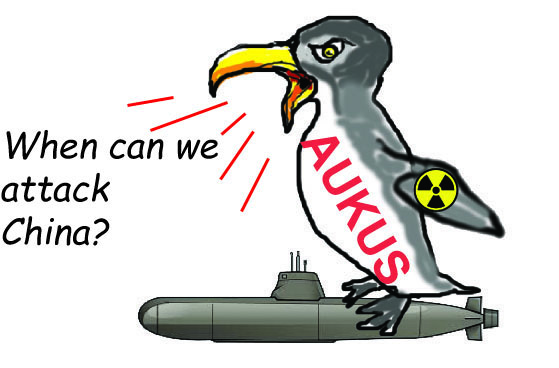
A remarkably perverse reality is in the offing regarding AUKUS. In terms of submarines, it will lag, possibly even sink, leaving the US and, to a lesser extent the UK, operating their fleets as Australians foot the bill and provide the refreshment
Not only is Australia effectively promising to finance and service that particular capacity, it will also do so in the service of a potentially catastrophic conflict which will see its automatic commitment. A truly high price to pay for an abdication of sovereignty for the fiction of regional stability.
The occasional burst of candour from US diplomats provides a striking, air clearing difference to their Australian and British counterparts. Official statements about the AUKUS security pact between Washington, London and Canberra, rarely mention the target in so many words, except on the gossiping fringes. Commentators and think tankers are essentially given free rein to speculate, masticating over such streaky and light terms as “new strategic environment”, “great power competition”, “rules-based order”.
On the occasion of his April 3 visit to Washington’s Center for a New American Security (CNAS), US Deputy Secretary of State Kurt Campbell was refreshingly frank. His presence as an emissary of US power in the Pacific has been notable since the AUKUS announcement in September 2021.
In March last year, Campbell, as Deputy Assistant to the US President and Coordinator for the Indo-Pacific National Security Council, was unfurling the US flag before various Pacific states, adamant that US policy was being reoriented from one of neglect to one of greater attentiveness. The Solomon Islands, given its newly minted security pact with Beijing, was of special concern. “We realise that we have to overcome in certain areas some amounts of distrust and uncertainty about follow through,” he explained to reporters in Wellington, New Zealand. “We’re seeking to gain that trust and confidence as we go forward.”
In Honiara, Campbell conceded that the US had not done “enough before” and had to be “big enough to admit that we need to do more, and we need to do better.” This entailed, in no small part, cornering the Solomon Islands Premier Manasseh Sogavare into affirming that Beijing would not be permitted to establish a military facility capable of supporting “power projection capabilities.”
In his discussion with the CNAS Chief Executive Officer, Richard Fontaine, Campbell did the usual runup, doffing the cap to the stock principles. Banal generalities were discussed, for instance, as to whether the US should be the sole show in projecting power or seek support from like-minded sorts. “I would argue that as the United States and other nations confront a challenging security environment, that the best way to maintain peace and security is to work constructively and deeply with allies and partners.” A less than stealthy rebuke was reserved for those who think “that the best that the United States can do is to act alone and to husband its resources and think about unilateral, individual steps it might take.”
The latter view has always been scorned by those calling themselves multilateralists, a cloaking term for waging war arm-in-arm with satellite states and vassals while ascribing to it peace keeping purposes in the name of stability. Campbell is unsurprising in arguing “that working closely with other nations, not just diplomatically, but in defensive avenues [emphasis added], has the consequence of strengthening peace and stability more generally.” The virtue with the unilateralists is the possibility that war should be resorted to sparingly. If one is taking up arms alone, a sense of caution can moderate the bloodlust.
Campbell revealingly envisages “a number of areas of conflict and in a number of scenarios that countries acting together” in the Indo-Pacific, including Japan, Australia, South Korea and India. “I think that balance, the additional capacity will help strengthen deterrence more general [sic].” The candid admission on the role played by the AUKUS submarines follows, with the boats having “the potential to have submarines from a number of countries operating in close coordination that could deliver conventional ordinance from long distances. Those have enormous implications in a variety of scenarios, including in cross-strait circumstances.” And so, we have the prospect of submarines associated with the AUKUS compact being engaged in a potential war with China over Taiwan.
When asked on what to do about the slow production rate of submarines on the part of the US Navy necessary to keep AUKUS afloat, Campbell acknowledged the constraints – the Covid pandemic, supply chain issues, the number of submarines in dry dock requiring or requiring servicing. But like Don Quixote taking the reins of Rosinante to charge the windmills, he is undeterred in his optimism, insisting that “the urgent security demands in Europe and the Indo-Pacific require much more rapid ability to deliver both ordinance and other capabilities.”
To do so, the military industrial complex needs to be broadened (good news for the defence industry, terrible for the peacemakers). “I think probably there is going to be a need over time for a larger number of vendors, both in the United States in Australia and Great Britain, involved in both AUKUS and other endeavours.”
There was also little by way of peace talk in Campbell’s confidence about the April 11 trilateral Washington summit between the US, Japan and the Philippines, following a bilateral summit to be held between President Joe Biden and Japan’s Prime Minister Fumio Kishida. When terms such as “modernize” and “update” are bandied about in the context of an alliance, notably with an eye towards a rival power’s ambitions, the warring instincts must surely be stirred. In the language of true encirclement, Campbell envisages a cooperative framework that will “help link the Indo-Pacific more effectively to Europe” while underscoring “our commitment to the region as a whole.”
A remarkably perverse reality is in the offing regarding AUKUS. In terms of submarines, it will lag, possibly even sink, leaving the US and, to a lesser extent the UK, operating their fleets as Australians foot the bill and provide the refreshments. Campbell may well mention Australia and the UK in the context of nuclear-powered submarines, but it remains clear where his focus is: the US program “which I would regard as the jewel in the crown of our defense industrial capacity.” Not only is Australia effectively promising to finance and service that particular capacity, it will also do so in the service of a potentially catastrophic conflict which will see its automatic commitment. A truly high price to pay for an abdication of sovereignty for the fiction of regional stability.
The high-stakes power play that will shape our future
April 5, 2024, The Australian, Simon Benson; Political editor
The climate wars may be over but an equally divisive battle is arising out of the nation’s new political consensus. Both sides of politics are locked into a net-zero emissions target by 2050, Labor by choice, the Coalition by the force of political reality. But Peter Dutton’s introduction of the nuclear option creates a stark contest between the main parties on how to get there.
The competing pathways to net zero offer profoundly different outcomes for the nation’s future. They go beyond climate change and raise the fundamental question: what sort of Australia will emerge once a point of no return in the rollout is reached?
…………………………………. a new ideological contest into the debate, reigniting a clash of ideas not only over the future of energy but for the communities that have generational ties to its production.
There are two essential issues at stake.
While the question of energy security has become the axis around which Albanese’s radical transformation of the economy pivots, the economic future of the nation’s coal communities has become the new political frontline between Labor and the Coalition.
In this sense, Australia is not unique. The US is grappling with its own socio-economic dilemma……….
Last week, as the Prime Minister was preparing to fly to the Hunter Valley coalfields to announce a $1bn solar panel scheme to generate jobs as coal exits the community, Dutton was meeting privately with executives from Rolls-Royce for a deep dive into the feasibility of small modular reactors in an Australian context.
This juxtaposition symbolises the chasm of policy approaches to the challenge of decarbonising the economy. Both sides are embarking on equally ambitious road maps. While Albanese has rubbished the idea of an Australian civil nuclear energy program, Dutton is convinced it can work.
In an interview with Inquirer on Wednesday, he pledged that if the Coalition were returned to government at the next election, the first nuclear reactors would be up and running by the mid-2030s.
It is understood Rolls-Royce is confident its small modular reactor technology could be ready for an Australian market in this time-frame with a price tag of $5bn for a 470-megawatt plant. Each plant would take four years to build and have a life-span of 60 years.
Rolls-Royce signed a contract with the Albanese government in February to build the nuclear reactors for the second tranche of AUKUS submarines.
According to this timeline, nuclear power generation could begin being rolled out at about the same time as the first nuclear-powered submarines are delivered. The feasibility of this timeline will be strongly contested.
Social licence is essential to the Coalition’s ambitions…………………..
Under a plan taken to Dutton’s shadow cabinet two weeks ago, seven coal communities were identified as potential locations for coal-to-nuclear transition on or near the sites of exiting coal-fired power stations, with the promise of cheaper electricity for those communities, higher paying jobs and upgraded infrastructure……………………………………
Not all of Dutton’s colleagues are convinced there is enough time in the political cycle to start building the political case for nuclear power……………………..
Both sides are highly alert to the acute political consequences of an ill-managed transition.
What looms is an election battle over energy security set against vastly contrasting ideologies…………………………………………………
The Albanese government’s Net Zero Economy Authority bill passed by the parliament before Easter set out the agency’s purpose as one clearly designed around the transition to renewables. It was unambiguous in its assessment of the cost and scope of Labor’s plan. The bill was equally clear about what is at stake with the exiting of coal-fired power stations across the country and the consequences if steps aren’t taken to protect these communities.
It defines coal-fired power stations and associated thermal coalmines as being located in six regions around Australia: Collie in Western Australia, the Latrobe Valley in Victoria, the Hunter Valley and Lithgow in NSW and three regions in Queensland – the Darling Downs, Gladstone and Central Queensland.
The political expression of this reality is the number of regional seats that will be affected. Some sooner than others. Neither side can claim a monopoly on ownership of these constituencies.
In NSW, Labor is at risk in the Hunter Valley in the seats of Hunter, Shortland and Paterson, while Calare west of Sydney, held by the Nationals until Andrew Gee resigned to sit on the crossbench, covers the coal community of Lithgow.
In Queensland, the LNP has Flynn stretching west from Gladstone to consider with legacy coal community economics also stretching into Capricornia, which takes in Rockhampton up to southern Mackay. Both seats have been in Labor hands before. Nationals leader David Littleproud’s massive Queensland seat of Maranoa is another that takes in coal communities through Queensland’s southern and central west.
In Victoria, coal communities stretch across the Nationals’ seat of Gippsland, which now takes in the industrial region of the Latrobe Valley………………………………………………………………………………..
The day of nuclear Armageddon: Newly declassified documents reveal in macabre minute-by-minute detail what the end of the world would like. And why those vaporised instantly by an atomic bomb will be the lucky ones…

Eventually it reaches the troposphere, higher than commercial flights. Radioactive particles then spew across everything below as fallout, raining back down on the Earth.
A nuclear bomb produces ‘a witch’s brew of radioactive products, which are also entrained in the cloud’, the astrophysicist Carl Sagan warned decades ago.
More than a million people are dead or dying and fewer than two minutes have passed since detonation. Now the inferno begins.
ANNIE JACOBSEN, 7 April 2024, https://www.dailymail.co.uk/news/article-13279197/The-day-nuclear-Armageddon-Newly-declassified-documents-reveal-macabre-minute-minute-end-world-like-vaporised-instantly-atomic-bomb-lucky-ones.html
This story, of what the moments after a nuclear missile launch could look like, is based on facts sourced from exclusive interviews with presidential advisers, cabinet members, nuclear weapons engineers, scientists, soldiers, airmen, special operators, Secret Service, emergency management experts, intelligence analysts, civil servants and others who have worked on these macabre scenarios over decades.
As the plans for General Nuclear War are among the most classified secrets held by the US government, the scenario postulated here takes the reader up to the razor’s edge of what can legally be known. Declassified documents, obfuscated for decades, fill in the details with terrifying clarity.
Because the Pentagon is a top target for a strike by America’s nuclear-armed enemies, in the scenario that follows, Washington DC gets hit first with a one megaton thermo-nuclear bomb. ‘A “Bolt out of the Blue” attack against DC is what everyone in DC fears most,’ says Andrew Weber, former assistant secretary of defence for nuclear, chemical and biological defence programmes. ‘Bolt out of the Blue’ is how US Nuclear Command and Control refers to an ‘unwarned large [nuclear] attack’.
This strike on DC initiates the beginning of an Armageddon-like nuclear war that will almost certainly follow. ‘There is no such thing as a small nuclear war,’ is an oft repeated phrase in Washington.
A nuclear strike on the Pentagon is just the beginning of a scenario the finality of which will be the end of civilisation as we know it.
This is the reality of the world in which we live. The nuclear war scenario proposed in this book could happen tomorrow. Or later today. ‘The world could end in the next couple of hours,’ warns General Robert Kehler, the former commander of the United States Strategic Command.
A one megaton thermonuclear weapon detonation begins with a flash of light and heat so tremendous it is impossible for the human mind to comprehend.
One hundred and eighty million degrees Fahrenheit is four or five times hotter than the temperature at the centre the Sun.
In the first fraction of a milli-second after the bomb strikes the Pentagon outside Washington DC, there is light. Soft X-ray light with a very short wavelength. The light superheats the surrounding air to millions of degrees, creating a massive fireball that expands at millions of miles per hour.
Within a few seconds the fireball has increased to a diameter of a little more than a mile, its heat so intense that concrete explodes, metal melts or evaporates, stone shatters and people instantaneously convert into combusting carbon.
The five-storey, five-sided structure of the Pentagon, and everything inside its 6.5 million sq ft of office space, explodes into superheated dust, all the walls shattering with the near-simultaneous arrival of a shockwave. All 27,000 employees perish instantly.
Not a single thing in the fireball remains. Nothing. Ground zero is zeroed.
Travelling at the speed of light, the radiating heat from the fireball ignites everything flammable several miles in every direction.
Curtains, paper, books, wood fences, clothing and dry leaves explode into flames and become kindling for a great firestorm that begins to consume a 100 or more square mile area that, prior to this flash of light, was the beating heart of American governance and home to six million people.
Several hundred feet north-west of the Pentagon, all 639 acres of Arlington national cemetery –including the 400,000 sets of bones and gravestones honouring the war dead, the 3,800 buried African-American freed people, the visitors paying respects on this late winter afternoon, the groundskeepers mowing lawns, the arborists tending trees, the tour guides touring, the white-gloved members of the Old Guard keeping watch over the Tomb of the Unknowns – they are all instantly transformed into charred human figurines. Into soot.
Those incinerated are spared the horror that begins to be inflicted on the one to two million people gravely injured but not yet dead.
Continue readingUkrainian artillery cuts last backup power line to Zaporozhye Nuclear Power Plant

Steven Starr, April 6, 2024
The fuel rods within the reactor core and in the spent fuel pools will continue to emit a large amount of heat (from the continuous decay of fission products within the fuel) even after the reactors are in a “cold shutdown”. Thus, electric power is required to run the cooling systems in the spent fuel ponds and the pumps that push cooling water through the reactors. If no offsite electricity is available, diesel generators are required to generate electricity to operate the pumps to cool the reactor and the cooling systems that cool the spent fuel pools.
A prolonged failure of the cooling systems (from loss of electric power) to continuously remove heat from the spent fuels will eventually cause the water in the pools to boil off and expose the spent fuel rods to steam and/or air. Exposure of the fuel rods to steam and/or air will cause them to overheat to the point of rupture or ignition, leading to the massive release of radioactivity. (The Soviet-designed reactors have their spent fuel pools inside the primary containment, unlike US reactors that locate spent fuel pools outside primary containment).
The fuel inside the steel reactor containment vessels must also be cooled (by pumping cooling water through the containment vessel). Failure of the cooling pumps to circulate water through the core will lead to the water in the containment vessel to superheat and eventually lead to the damage of the fuel rods, which would release large amounts of highly radioactive fission products.
Offsite power to the Zaporozhye Nuclear Power Plant (ZNPP) has historically been provided by the Zaporozhye Thermal Power Station, which is located several kilometers away from the ZNPP. I think the damage to backup power line from Ukrainian artillery fire refers to the destruction of the power lines and power transformers that connect the Thermal Power Station to ZNPP.
This week – the less positive news about nuclear.

Some bits of good news.
Global Life Expectancy Rises by 6.2 Years After Drop in Deaths from Stroke, Diarrhea, and Respiratory Infections Saving Migratory Fish, One Culvert at a Time.
TOP STORIES. Aukusing for War: The Real Target Is China .
The $97 billion mess – spent nuclear fuel reprocessing in Japan.
Xi Jinping’s Thoughts on China’s Nuclear Weapons.
America’s Nuclear War Plan in the 1960s Was Utter Madness. It Still Is.
Inside Sellafield behind the razor wire gun- toting guards and blast barriers at the toxic nuclear site – also at
Nuclear regulators should weigh climate change risk to power plants, report says.
Spent nuclear fuel mismanagement poses a major threat to the United States. Here’s how..
**************************
AUSTRALIA.
- Nuclear energy is an ugly duckling in every possible respect: Too late, too costly, too toxic.
- Peter Dutton to press ahead with nuclear despite opposition in regional Australia. Australia’s Liberal National Coalition “in a panic” about response to confused and unpopular nuclear power plan. Peter Dutton vows to bring small nuclear reactors online in Australia by mid 2030 if elected. Dutton’s perks for nuclear plan. Coalition to release nuclear incentive package. “No feasible pathway:” Liberal MP Matt Kean quits Coalition-based charity because of its obsession with nuclear. Matt Kean admonished by federal Opposition for criticising nuclear direction. States reject Dutton’s push for nuclear power.
- A hard job for the Australian government to find credible spruikers for a nuclear waste dump.
- ‘Poison portal’: US and UK could send nuclear waste to Australia under Aukus, inquiry told. AUKUS: Perth councils demand public alert of any safety incidents related to nuclear subs at HMAS Stirling.
- Killing Aid Workers: Australia’s Muddled Policy on Israel. Updated Climate Council statement re nuclear power.
Climate. Climate change requires kind of collective effort that British people made during Second World War . ‘Simply mind-boggling’: world record temperature jump in Antarctic raises fears of catastrophe. https://www.youtube.com/watch?v=GXwmCLqQESQ
Nuclear. I find it overwhelming – the enthusiasm of the world’s leaders for ever more deadly nuclear weaponry – in view of The day of nuclear Armageddon.
Noel’s notes. NATO – dancing macabrely to World War 3? Why I am really a CONSERVATIVE, and you should be, too. Ethics, intelligence, literature, and nuclear reprocessing.
NUCLEAR ISSUES.
| CLIMATE. Nuclear energy cannot lead the global energy transition. Portents of a nuclear war on a burning planet. Climate change and nuclear waste are a toxic stew. Nuclear Power Plants: NRC Should Take Actions to Fully Consider the Potential Effects of Climate Change. Nuclear regulator delinquent on climate. | ECONOMICS. Russia’s state-owned energy company Rosatom is drumming up new nuclear business in Africa. United Arab Emirates in talks to invest in European nuclear power infrastructure. The cost of Europe’s new nuclear power plants. |
ENERGY Fukushima City: 100 MW solar farm. China’s quiet energy revolution: the switch from nuclear to renewable energy.
ENVIRONMENT. Ecocide a ‘Critical Dimension of Israel’s Genocidal Campaign’ in Gaza: Probe. 3 B 1 Say no to small modular reactors: Stop normalizing the exploitation of nature. Radiation. Russia declares ‘state of emergency’ after radiation detected in eastern city of Khabarovsk
ETHICS and RELIGION. Holy See: ‘Nuclear deterrence is an illusion’.
EVENTS. 11 April WEBINAR Nuclear exploitation: how uranium mining harms communities. https://us02web.zoom.us/webinar/register/WN_iThP7xYKRVy6XxQ46hOwpA#/registration
| HEALTH. St. Louis-area residents make plea for compensation for illnesses tied to nuclear contamination. | LEGAL UK govt lawyers conclude Israel in breach of humanitarian law. Sprawling Sellafield Nuclear Waste Site Prosecuted for Cybersecurity Failings. Lawsuit challenges $1 billion in federal funding to sustain California’s last nuclear power plant. | MEDIA. An interview with Annie Jacobsen, author of ‘Nuclear War: A Scenario’. ‘Oppenheimer’ finally opens in Japan, the only nation to experience horror of nuclear war |
POLITICS. U.S. government extends key nuclear power subsidy by another 40 years.
Dennis Kucinich: the US engineered a coup to drag Ukraine into a conflict.
| POLITICS INTERNATIONAL and DIPLOMACY. US Secretary of State Blinken says Ukraine will be NATO member. https://www.youtube.com/watch?v=ddI8OJKTWxc Japan confirms experts met in China to ease concerns over discharge of treated radioactive water. The Case for Nuclear Diplomacy (doesn’t mention the Treaty for the Prohibition of Nuclear Weapons!) | SAFETY. M6.0 earthquake hits coast of Japan’s Fukushima: Japan Meteorological Agency. EDF confirms cracks on 1.3 GW Paluel 2 reactor. TEPCO plans new installations at Fukushima nuclear plant, to deal with radioactive leakage. Mystery of America’s first fatal nuclear disaster – explosion of small nuclear reactor. Russia urges IAEA to publicly reveal Ukrainian attacks on nuclear plant. Ukrainian artillery cuts last backup power line to Zaporozhye Nuclear Power Plant. |
SPINBUSTER. Jim Green demolishes Rolls Royce’s claims about so-called “small” and “cheap” nuclear reactors for Australia.
TECHNOLOGY. Not content with nuclear wastes to the seas, the nuclear lobby now wants floating nuclear power – (for the environment! they say).
| WAR and CONFLICT. The day of nuclear Armageddon: Newly declassified documents reveal in macabre minute-by-minute detail what the end of the world would like. And why those vaporised instantly by an atomic bomb will be the lucky ones… The Looming Ukraine Debacle. Ukrainian counteroffensive ‘biggest debacle in modern military history’ – David Sacks. West helping Ukraine attack deep inside Russia – CNN. | WEAPONS and WEAPONS SALES. U.S. Nuclear Weapons Costs, Projections Continue to Rise. ‘Obscene’: Biden Quietly OKs More 2,000-Pound Bombs, Warplanes for Israel. Ukraine aid will bankrupt future US generations – congressman. |
1 This month

of the week – Australians for War Powers Reform (AWPR)
To see nuclear-related stories in greater depth and intensity
 Antinuclear