TODAY. Australia is EVER so grateful to the global nuclear lobby!
First of all, we Australians LOVE spending money! Not on health, education, preserving our unique biodiversity, certainly not on shelter for our growing homeless.
With our relatively small population, we are still delighted to cough up nearly $400billion to buy a second-hand American nuclear submarine and to buy all the USA and UK nuclear submarine wastes that these dear friends vouchsafe to dump on us.
And, it was interesting to read today, that the UK has spurned paying $millions to Rolls Royce as the maker for its proposed fleet of small modular nuclear reactors.
No problem to the nuclear lobby. Rolls Royce now plans to flog them off to Australia instead – Opposition leader Peter Dutton has pledged, if elected, to deliver Rolls Royce small modular reactors into the grid by the mid-2030s.
Any old or useless stuff that the nuclear industry has to get rid of – no probs – Australia will buy it!
‘Simply mind-boggling’: world record temperature jump in Antarctic raises fears of catastrophe
“Essentially, it is a vicious circle of warming oceans and melting of sea ice, though the root cause is humanity and its continuing burning of fossil fuels and its production of greenhouse gases,”
An unprecedented leap of 38.5C in the coldest place on Earth is a harbinger of a disaster for humans and the local ecosystem
Robin McKie Science editor, Sun 7 Apr 2024 , https://www.theguardian.com/environment/2024/apr/06/simply-mind-boggling-world-record-temperature-jump-in-antarctic-raises-fears-of-catastrophe
On 18 March, 2022, scientists at the Concordia research station on the east Antarctic plateau documented a remarkable event. They recorded the largest jump in temperature ever measured at a meteorological centre on Earth. According to their instruments, the region that day experienced a rise of 38.5C above its seasonal average: a world record.
This startling leap – in the coldest place on the planet – left polar researchers struggling for words to describe it. “It is simply mind-boggling,” said Prof Michael Meredith, science leader at the British Antarctic Survey. “In sub-zero temperatures such a massive leap is tolerable but if we had a 40C rise in the UK now that would take temperatures for a spring day to over 50C – and that would be deadly for the population.”
This amazement was shared by glaciologist Prof Martin Siegert, of the University of Exeter. “No one in our community thought that anything like this could ever happen. It is extraordinary and a real concern,” he told the Observer. “We are now having to wrestle with something that is completely unprecedented.”
Poleward winds, which previously made few inroads into the atmosphere above Antarctica, are now carrying more and more warm, moist air from lower latitudes – including Australia – deep into the continent, say scientists, and these have been blamed for the dramatic polar “heatwave” that hit Concordia. Exactly why these currents are now able to plunge so deep into the continent’s air space is not yet clear, however.
Nor has this huge temperature hike turned out to be an isolated event, scientists have discovered. For the past two years they have been inundated with rising numbers of reports of disturbing meteorological anomalies on the continent. Glaciers bordering the west Antarctic ice-sheet are losing mass to the ocean at an increasing rate, while levels of sea ice, which float on the oceans around the continent, have plunged dramatically, having remained stable for more than a century.https://interactive.guim.co.uk/uploader/embed/2024/04/archive-zip/giv-13425WC79HMmcEe8y/
These events have raised fears that the Antarctic, once thought to be too cold to experience the early impacts of global warming, is now succumbing dramatically and rapidly to the swelling levels of greenhouse gases that humans continue to pump into the atmosphere.
These dangers were highlighted by a team of scientists, led by Will Hobbs of the University of Tasmania, in a paper that was published last week in the Journal of Climate. After examining recent changes in sea ice coverage in Antarctica, the group concluded there had been an “abrupt critical transition” in the continent’s climate that could have repercussions for both local Antarctic ecosystems and the global climate system.
“The extreme lows in Antarctic sea ice have led researchers to suggest that a regime shift is under way in the Southern Ocean, and we found multiple lines of evidence that support such a shift to a new sea ice state,” said Hobbs.https://interactive.guim.co.uk/uploader/embed/2024/04/archive-2-zip/giv-13425x5sm3FJkGC7J/
The dramatic nature of this transformation was emphasised by Meredith. “Antarctic sea ice coverage actually increased slightly in the late 20th and early 21st century. However, in the middle of the last decade it fell off a cliff. It is a harbinger of the new ground with the Antarctic climate system, and that could be very troubling for the region and for the rest of the planet.”
The continent is now catching up with the Arctic, where the impacts of global warming have, until now, been the most intense experienced across the planet, added Siegert. “The Arctic is currently warming at four times the rate experienced by the rest of the planet. But the Antarctic has started to catch up, so that it is already warming twice as quickly as the planet overall.”
A key reason for the Arctic and Antarctic to be taking disproportionate hits from global warming is because the Earth’s oceans – warmed by fossil-fuel burning – are losing their sea ice at their polar extremities. The dark waters that used to lie below the ice are being exposed and solar radiation is no longer reflected back into space. Instead, it is being absorbed by the sea, further heating the oceans there.
“Essentially, it is a vicious circle of warming oceans and melting of sea ice, though the root cause is humanity and its continuing burning of fossil fuels and its production of greenhouse gases,” said Meredith. “This whole business has to be laid at our door.”
As to the consequences of this meteorological metamorphosis, these could be devastating, researchers warn. If all the ice on Antarctica were to melt, this would raise sea levels around the globe by more than 60 metres. Islands and coastal zones where much of the world’s population now have homes would be inundated.
Such an apocalypse is unlikely to occur for some time, however. Antarctica’s ice sheet covers 14m square kilometres (about 5.4m square miles), roughly the area of the United States and Mexico combined, and contains about 30m cubic kilometres (7.2m cubic miles) of ice – about 60% of the world’s fresh water. This vast covering hides a mountain range that is nearly as high as the Alps, so it will take a very long time for that to melt completely, say scientists.
Nevertheless, there is now a real danger that some significant sea level rises will occur in the next few decades as the ice sheets and glaciers of west Antarctica continue to shrink. These are being eroded at their bases by warming ocean water and could disintegrate in a few decades. If they disappear entirely, that would raise sea levels by 5m – sufficient to cause damage to coastal populations around the world. How quickly that will happen is difficult to assess. The Intergovernmental Panel on Climate Change has said that sea levels are likely to rise between 0.3m to 1.1m by the end of the century. Many experts now fear this is a dangerous underestimate. In the past, climate change deniers accused scientists of exaggerating the threat of global warming. However, the evidence that is now emerging from Antarctica and other parts of the world makes it very clear that scientists did not exaggerate. Indeed, they very probably underrated by a considerable degree the threat that now faces humanity.
“The picture is further confused in Antarctica because, historically, we have had problems getting data,” added Meredith. “We have never had the information about weather and ecosystem, compared with the data we get from the rest of the world, because the continent is so remote and so hostile. Our records are comparatively short and that means that the climate models we have created, although very capable, are based on sparse data. They cannot capture all of the physics, chemistry and biology. They can make predictions that are coherent but they cannot capture the sort of extremes that we’re now beginning to observe.”
The woes facing Antarctica are not merely of human concern, however. “We are already seeing serious ecological impacts that threaten to spread through the food chain,” said Prof Kate Hendry, a chemical oceanographer based at the British Antarctic Survey.
A critical example is provided by the algae which grow under and around sea ice in west Antarctica. This is starting to disappear, with very serious implications, added Hendry. Algae is eaten by krill, the tiny marine crustaceans that are one of the most abundant animals on Earth and which provide food for predators that include fish, penguins, seals and whales. “If krill starts to disappear in the wake of algae, then all sorts of disruption to the food chain will occur,” said Hendry.
The threat posed by the disappearance of krill goes deeper, however. They play a key role in limiting global warming. Algae absorb carbon dioxide. Krill then eat them and excrete it, the faeces sinking to the seabed and staying there. Decreased levels of algae and krill would then mean less carbon from the atmosphere would be deposited on the ocean floor and would instead remain near the sea surface, where it would return to the atmosphere.
“They act like a conveyor belt that takes carbon out of the atmosphere and carries it down to the deep ocean floor where it can be locked away. So if we start messing with that system, there could be all sorts of other knock-on effects for our attempts to cope with the impact of global warming,” added Hendry. “It is a scary scenario. Nevertheless that, unfortunately, is what we are now facing.”
Another victim of the sudden, catastrophic warming that has gripped the continent is its most famous resident: the emperor penguin. Last year the species, which is found only in Antarctica, suffered a catastrophic breeding failure because the platforms of sea ice on which they are born started to break up long before the young penguins could grow waterproof feathers.
“We have never seen emperor penguins fail to breed, at this scale, in a single season,” said Peter Fretwell, of the British Antarctic Survey. “The loss of sea ice in this region during the Antarctic summer made it very unlikely that displaced chicks would survive.”
Researchers say that the discovery of the loss of emperor penguins suggests that more than 90% of colonies will be wiped out by the end of the century, if global warming trends continue at their current disastrous rate. “The chicks cannot live on sea ice until they have fledged,” said Meredith. “After that, they can look after themselves. But the sea ice is breaking up before they reach that stage and mass drowning events are now happening. Colonies of penguins are being wiped out. And that’s a tragedy. This is an iconic species, one that is emblematic of Antarctica and the new vulnerability of its ecosystems.”
The crisis facing the continent has widespread implications. More than 40 nations are signatories of the Antarctic Treaty’s environmental protocol, which is supposed to shield it from a host of different threats, with habitat degradation being one of the most important. The fact that the continent is now undergoing alarming shifts in its ice covering, eco-systems and climate is a clear sign that this protection is no longer being provided.
“The cause of this ecological and meteorological change lies outside the continent,” added Siegert. “It is being caused because the rest of the world is continuing to emit vast amounts carbon dioxide.
“Nevertheless, there is a good case for arguing that if countries are knowingly polluting the atmosphere with greenhouse gases, and Antarctica is being affected as a consequence, then the treaty protocol is being breached by its signatories and their behaviour could be challenged on legal and political grounds. It should certainly make for some challenging meetings at the UN in the coming years.”
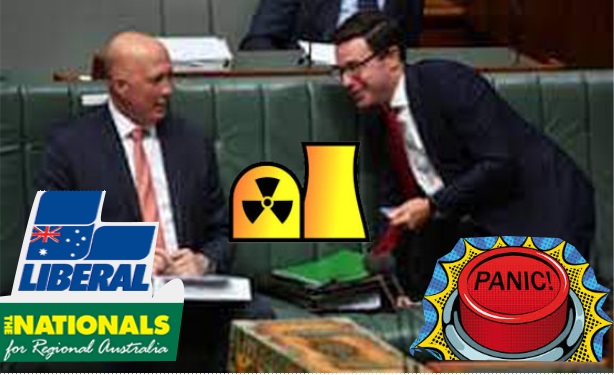
Coalition “in a panic” about response to confused and unpopular nuclear power plan
The Australian noted the Australian Workers Union’s support for nuclear power but didn’t mention the opposition of the Australian Council of Trade Unions, Australian Education Union, Australian Manufacturing Workers Union, Australian Nursing and Midwifery Federation, Australian Services Union, Communication Workers Union, Electrical Trades Union, Independent Education Union (Vic – Tas), Maritime Union of Australia, National Union of Workers, Tasmanian Unions, Unions ACT, Unions WA, Unions SA, Unions NT, United Voice, United Firefighters Union, and the Victorian Trades Hall Council.
Jim Green, Apr 8, 2024, https://reneweconomy.com.au/coalition-in-a-panic-about-response-to-confused-and-unpopular-nuclear-power-plan/
The Coalition’s nuclear power policy is being released in instalments in the Australian newspaper ahead of its formal release sometime before the May budget.
Under a plan taken to the Coalition shadow cabinet in March, seven coal regions have been identified as potential locations for nuclear power plants, the Australian reports.
Presumably those regions are Collie in WA, the Latrobe Valley in Victoria, the Hunter Valley and Lithgow in NSW, and three regions in Queensland — the Darling Downs, Gladstone and Central Queensland.
The Australian reports that a shadow cabinet subcommittee will produce ‘economic impact statements’ to promote the potential economic benefits in the seven regions.
The Coalition will try to win local support by using taxpayer funds to reduce power bills for people living near the proposed nuclear plants. Workers will be offered higher-paid jobs, presumably at taxpayers’ expense. And taxpayers will be on the hook for workforce training, regulation, waste disposal and much more.
The plan “will involve the creation of new precincts for advanced manufacturing centred on cheap energy from small nuclear reactors”, the Australian reports. Cheap nuclear power will attract heavy industry, adding to the high-paid jobs bonanza.
A “community engagement process” would be rolled out once the coal sites had been identified, opposition leader Peter Dutton says.
But just like everything else associated with the Coalition’s nuclear policy, the plan to win over communities in coal regions has hit a snag.
The Murdoch press reported on April 7 that focus group research carried out in the Hunter Valley in NSW and the Latrobe Valley in Victoria found that voters are “hostile” to plans for reactors in their own areas.
An unnamed Coalition MP said of the Liberal and National Party rooms: “My read is they’re in a panic about it. They don’t know what to do.” A Coalition frontbencher said Dutton is “obsessed with this nuclear thing — obsessed with it.”
Rolls-Royce reactors

“There is every reason to be optimistic about bringing small modular net-zero emission nuclear into the power mix in the 2030s,” Dutton told the Australian.
Indeed he has “pledged” that if the Coalition were returned to government at the next election, the first nuclear reactors would be up and running by the mid-2030s. That’s a big pledge since there is zero chance of reactors operating in Australia by the mid-2030s.
Dutton recently met privately with executives from Rolls-Royce to discuss “the pursuit of low-cost small modular reactor technology for Australia”, the Australian reports.
Rolls-Royce claims it could build a reactor in Australia in just four years (once licensing and a myriad of other issues were sorted). Let’s compare that speculation with real world experience:
Continue readingWhat are the risks at Zaporizhzhia nuclear power plant after drone attack?

By Guy Faulconbridge and Francois Murphy, April 8, 2024, https://www.reuters.com/world/europe/nuclear-power-plant-eye-ukraine-war-2024-04-08/
MOSCOW/VIENNA, – Russia said Ukraine struck the Zaporizhzhia nuclear power station controlled by Russian forces three times on Sunday and demanded the West respond, though Kyiv said it had nothing to do with the attacks.
The International Atomic Energy Agency (IAEA) has long warned of the risks of a disaster at Zaporizhzhia, Europe’s largest nuclear plant, and urged an end to fighting in the area.
The plant is just 500 km (300 miles) from the site of the world’s worst nuclear accident, the 1986 Chornobyl disaster.
What nuclear material is at the Zaporizhzhia plant, what are the risks and why are Russia and Ukraine fighting over it?
WHAT IS IT AND WHAT WAS ITS CAPACITY?
The Zaporizhzhia nuclear power plant has six Soviet-designed VVER-1000 V-320 water-cooled and water-moderated reactors containing Uranium 235. They were all built in the 1980s, though the sixth only came online in the mid-1990s after the collapse of the Soviet Union.
All but one of the reactors are in cold shutdown. Reactor unit 4 is in “hot shutdown”, mainly for heating purposes.
IAEA Director General Rafael Grossi says that fighting a war around a nuclear plant has put nuclear safety and security in “constant jeopardy”.
WHAT HAPPENED ON APRIL 7?
Russia’s state nuclear corporation, Rosatom, said Ukraine attacked the plant three times on Sunday with drones, first injuring three near a canteen, then attacking a cargo area and then the dome above reactor No. 6.
IAEA experts at the site went to the three locations of the attacks and confirmed there had been an attack.
“Russian troops engaged what appeared to be an approaching drone,” the IAEA said. “This was followed by an explosion near the reactor building.”
“While the team so far has not observed any structural damage to systems, structures, and components important to nuclear safety or security of the plant, they reported observing minor superficial scorching to the top of the reactor dome roof of Unit 6 and scoring of a concrete slab supporting the primary make-up water storage tanks,” the IAEA said.
The IAEA did not say directly who was to blame for the attacks.
A Ukrainian intelligence official said Kyiv had nothing to do with any strikes on the station and suggested they were the work of Russians themselves.
WHAT ARE THE RISKS?
Russian forces took control of the plant in early March 2022, weeks after invading Ukraine. Special Russian military units guard the facility and a unit of Russia’s state nuclear company, Rosatom, runs the plant.
Nuclear reactors’ containment structures like Zaporizhzhia’s are made of steel-lined reinforced concrete designed to withstand the impact of a small plane crash so there is little immediate risk from a minor attack on those structures.
A 1989 study by the U.S. Department of Energy found that the model of containment structure used in Zaporizhzia “exhibits vulnerabilities to the effects of an aircraft crash” and a fighter jet crashing downwards into the dome, where the structure is thinner, could penetrate it, causing concrete chunks and aircraft engine parts to fall inside.
External power lines essential to cooling nuclear fuel in the reactors are a softer potential target. Cooling fuel even in reactors in cold shutdown is necessary to prevent a nuclear meltdown.
Since the war began the plant has lost all external power eight times, most recently in December last year, forcing it to rely on emergency diesel generators for power. Water is also needed to cool fuel.
Pressurised water is used to transfer heat away from the reactors even when they are shut down, and pumped water is also used to cool down removed spent nuclear fuel from the reactors.
Without enough water, or power to pump the water, the fuel could melt down and the zirconium cladding could release hydrogen, which can explode.
WHAT ABOUT THE SPENT FUEL?

Besides the reactors, there is also a dry spent fuel storage facility at the site for used nuclear fuel assemblies, and spent fuel pools at each reactor site that are used to cool down the used nuclear fuel.
Without water supply to the pools, the water evaporates and the temperatures increase, risking a fire that could release a number of radioactive isotopes.
An emission of hydrogen from a spent fuel pool caused an explosion at reactor 4 in Japan’s Fukushima nuclear disaster in 2011.
WHAT HAPPENS IN A MELTDOWN?
A meltdown of the fuel could trigger a fire or explosion that could release a plume of radionuclides into the air which could then spread over a large area.
The Chornobyl accident spread Iodine-131, Caesium-134, Strontium-90 and Caesium-137 across parts of northern Ukraine, Belarus, Russia, northern and central Europe.
Nearly 8.4 million people in Belarus, Russia and Ukraine were exposed to radiation, according to the United Nations. Around 50 deaths are directly attributed to the disaster itself.
But 600,000 “liquidators”, involved in fire-fighting and clean-up operations, were exposed to high doses of radiation. Hundreds of thousands were resettled.
There is mounting evidence that the health impact of the Chornobyl disaster was much more serious than initially presented at the time and in the years following the accident.
Incidence of thyroid cancer in children across swathes of Belarus, Russia and Ukraine increased after the accident. There was a much higher incidence of endocrine disorders, anaemia and respiratory diseases among children in contaminated areas.
Brutal, chaotic war – norms, conventions and laws of conduct are being erased

Alastair Crooke, April 8, 2024, https://strategic-culture.su/news/2024/04/08/brutal-chaotic-war-norms-conventions-and-laws-of-conduct-are-being-erased/—
We stand on the cusp of what might be termed Chaotic War. Not the formula often used by Israel to intimidate adversaries; this is different.
Israeli reporter Eddie Cohen said, in the wake of the attack on the Iranian Consulate: “We are very clear that we want to start a war with Iran and Hezbollah. Do you still not understand?”
“Israel wants to drag Iran into a full-scale war in order to be able to strike at Iran’s nuclear facilities”, though these facilities are beyond American and Israeli reach, buried beneath mountains.
Cohen, and of course, Israel’s military leadership, will know that; but Israel nonetheless is locking itself into a logic that can only lead to defeat. Iran’s nuclear facilities are safe from Israeli assault. The destruction of civilian Iranian infrastructure, which is out in the open, may kill many, but will not, per se, collapse the Iranian state.
Trita Parsi places Israel’s objective in attacking the Iranian Consulate in Damascus in a different context:
“An important aspect of Israel’s conduct – and Biden’s acquiescence to it – is that Israel is engaged in a deliberate and systematic effort to destroy existing laws and norms around warfare.
Even during wartime, embassies are off-limits [yet] Israel just bombed an Iranian diplomatic compound in Damascus.
Bombing hospitals is a war crime, [yet] Israel has bombed EVERY hospital in Gaza. It has even assassinated doctors and patients inside hospitals.
The ICJ obligated Israel to allow the delivery of humanitarian aid to Gaza. Israel actively prevents aid from coming in.
Starvation of civilians as a method of warfare is prohibited under international humanitarian law. Israel has deliberately created a famine in Gaza.
Indiscriminate bombings are illegal under international humanitarian law. Biden himself admits that Israel is bombing Gaza indiscriminately”.
The list goes on and on … However, Israel’s breach of Vienna Convention immunity accorded to diplomatic premises – plus the stature of those killed – is highly significant. It is a major signal: Israel wants war – but with U.S. support, of course.
Israel’s aim, firstly, is to destroy the norms, conventions and laws of warfare; to create geo-political anarchy in which anything goes, and by which, with the White House frustrated, yet acquiescing to each norm of conduct obtrusively trodden underfoot, allows Netanyahu to grip the U.S. bridle and lead the White House horse to water – towards his regional End of Times ‘Great Victory’; a necessarily brutal war – beyond existing red lines and devoid of limits.
As symbolically significant as the Damascus attack is that the U.S., France and Britain – after a brief ‘hat tip’ to the Vienna Convention – refused to condemn the levelling of the Iranian Consulate, thus placing the shadow of doubt over the Vienna Convention’s immunity for diplomatic premises.
Implicitly, this refusal to condemn will be widely understood as a soft condoning of Israel’s first tentative step towards war with Hizbullah and Iran.
This Israeli chaotic ‘Biblical’ nihilism, however, bears no relationship in purely rational terms to Netanyahu’s aspiration for a ‘Great Victory’. The reality is that Israel has lost its deterrence. It won’t return; the deep anger across the Islamic world generated by Israel through its massacres in Gaza during the last six months precludes it.
Yet, there is a second, adjunct reason why Israel is set on deliberately flouting humanitarian law and norms: Israeli journalist, Yuval Abraham reports in +972 Magazine in great depth how Israel has developed a AI machine (called ‘Lavender’) to generate kill lists in Gaza – with almost no human verification; only a “rubber stamp” check of about “20 seconds” to make sure the AI target is male (as no females are known to belong to the Resistance’s military).
The blatant extra-legality behind the Gaza ‘kill list’ methodology, as reported by Abraham’s various sources, can only be immunised and sheltered through normalising them as but one amongst a general pattern of illegalities – and in effect, claiming sovereign exceptionalism:
“[T]he Israeli army systematically attacks the targeted individual whilst in their homes — usually at night whilst the whole family is present — rather than during the course of military activity … Additional automated systems, including one, [callously] called “Where’s Daddy?” were used – specifically to track targets when they had entered their family’s residences… However, when a home was struck, usually at night, the individual target was sometimes not inside at all”.
“The result is that thousands of Palestinians — most of them women and children or people who were not involved in the fighting — were wiped out by Israeli airstrikes, especially during the first weeks of the war, because of the AI program’s decisions”.
“”We were not interested in killing [Hamas] operatives when they were in a military building … or engaged in a military activity,” A., an intelligence officer, told +972 and Local Call. “On the contrary, the IDF bombed them in homes without hesitation – as a first option. It’s much easier to bomb a family’s home. The system is built to look for them in these situations”.
In addition … when it came to targeting alleged junior militants marked by Lavender, the army preferred to only use unguided missiles, commonly known as “dumb” bombs (in contrast to “smart” precision bombs) which can destroy entire buildings on top of their occupants and cause significant casualties. “You don’t want to waste expensive bombs on unimportant people — it’s very expensive for the country and there’s a shortage [of those bombs]”.
“… The army also decided during the first weeks of the war that, for every junior Hamas operative that Lavender marked, it was permissible to kill up to 15 or 20 civilians … in the event that the target was a senior Hamas official with the rank of battalion or brigade commander – the army on several occasions authorized the killing of more than 100 civilians in the assassination of a single commander”.
“Lavender — which was developed to create human targets in the current war — has marked some 37,000 Palestinians as suspected “Hamas militants”, most of them junior, for assassination (the IDF Spokesperson denied the existence of such a kill list in a statement to +972 and Local Call)”.
So, there it is – no wonder Israel might seek to camouflage the details within a normalised general array of transgressions against humanitarian law: “They wanted to allow us to attack [the junior operatives] automatically. That’s the Holy Grail. Once you go automatic, target generation goes crazy”.
it is not difficult to speculate what the ICJ might determine …
Does anyone imagine that this flawed Lavender AI machine would not be asked to churn out its kill lists, were Israel to decide to surge into Lebanon? (Another reason for normalising the procedures first in Gaza).
The key point made in the +972 Magazine report (with multiple sourcing) is that the IDF were not focussed on pin-point elimination of Hamas’ Qassam Brigades (as claimed):
“It was very surprising for me that we were asked to bomb a house to kill a ground soldier, whose importance in the fighting was so low”, said one source about the use of AI to mark alleged low-ranking militants:
“I nicknamed those targets ‘garbage targets.’ Still, I found them more ethical than the targets that we bombed just for ‘deterrence’ — high-rises that are evacuated and toppled just to cause destruction”.
This report makes clear nonsense of Israel’s claims to have dismantled 19 out of 24 Hamas Battalions: One source, critical of Lavender’s inaccuracy, points out the obvious flaw: “It’s a vague boundary”; How to tell a Hamas fighter from any other Gazan civilian male?
“At its peak, the system managed to generate 37,000 people as potential human targets”, said B. “But the numbers changed all the time, because it depends on where you set the bar of what a Hamas operative is. There were times when a Hamas operative was defined more broadly, and then the machine started bringing us all kinds of civil defence personnel, police officers, on whom it would be a shame to waste bombs”.
Just last week, War Cabinet member and Minister Ron Dermer, was delegated to travel to Washington to plead that the IDF success in dismantling 19 Hamas battalions justified an incursion into Rafah to dismantle the 4 to 5 battalions that Israel claims still remain in Rafah.
What is clear is that AI was a key Israeli tool to its Gaza ‘Victory’. Israel was going to sell a ‘smoke and mirrors story’ based on ‘Lavender’.
By contrast, Palestinians, who are aware of their quantitative inferiority, have a very different outlook: they switched to a new way of thinking that gives the simple act of resisting a civilisational meaning – a path to metaphysical victory (and quite possibly a kind of military victory), if not in their lifetimes, then for the Palestinian People, thereafter. This constitutes the asymmetrical nature of the conflict that Israel has never managed to understand.
Israel wants to be feared, believing this will restore its deterrence. Amira Hass writes that regardless of any revulsion for this government and its members: “The vast majority [of Israelis] still believe that war is the solution”. And Mairav Zonszein writing in Foreign Policy, notes that “The Problem Isn’t Just Netanyahu, It’s Israeli Society”:
“The focus on Netanyahu is a convenient distraction from the fact that the war in Gaza is not Netanyahu’s war, it is Israel’s war—and the problem isn’t only Netanyahu; it’s the Israeli electorate … A large majority—88 percent—of Jewish Israelis polled in January believe the astounding number of Palestinian deaths, which had surpassed 25,000 at the time, is justified. A large majority of the Jewish public also thinks that the [IDF] is using adequate or even too little force in Gaza … Putting all the blame on the prime minister misses the point. It disregards the fact that Israelis have long advanced, enabled, or come to terms with their country’s system of military occupation and dehumanization of Palestinians”.
Yet neither Israel, nor the U.S., has a comprehensive strategy for this mooted war. Israel’s approach is all tactical – claiming to have degraded Hamas; turning Gaza into a humanitarian hellscape and setting the scene for the “decisive plan” devised by Bezalel Smotrich for the Palestinians. Amira Hass again:
“Either agree to an inferior status, emigrate and be uprooted ostensibly voluntarily, or face defeat and death in a war. This is the plan now being carried out in Gaza and the West Bank – with most Israelis serving as active and enthusiastic accomplices, or passively acquiescing in its realisation”.
The U.S. ‘vision’ is also tactical (and far removed from reality) – Imagining the transformation of Gaza into a ‘Vichy collaborator’ statelet; imagining that political pressure by the French in Lebanon will force Hizbullah’s retreat from its ancestral lands in south Lebanon; and imagining that the Biden White House is able to achieve politically through pressure what Israel cannot do militarily.
The paradox is that, with Israel and the U.S. being dependent on an ‘image’ that has been confused with reality, this too works to Iran’s and the Resistance Front’s advantage. (As the old adage goes, ‘do not disturb an adversary who is making mistakes’).
1 This month

of the week – Australians for War Powers Reform (AWPR)
To see nuclear-related stories in greater depth and intensity
 Antinuclear