TODAY. The nuclear lobby’s new “prime wheeze” – Community Interest Companies

The UK, famous for comedy, had a great character, Bertie Wooster, who kept thinking up wonderful (useless and silly) new ideas, that he called “Prime Wheezes”. In true Bertie Wooster tradition, the nuclear lobby does the same.
They usually go for “registered charities” – and there’s any number of these, that the industry creates, really nuclear front groups, that pose as genuinely working for the public good.
So why is the nuclear lobby now going for the non-profit Community Interest Companies (CICs)?
Some of the reasons:
- The nuclear industry can get approval and respectability, “piggy-back” on a lot of genuinely positive and popular businesses in an existing CIC.
- The CIC business model can incorporate a wider range of social aims than are allowed for charities. This is because the definition of community interest within the test applied to a CIC is broader than the Public Benefit Test for charities.
- easier to set up than is a charity..
- murkiness of funding – relatively easy from private donors, grants or community development finance
- can more easily buy and sell commercially.
- It is a lightweight structure, it is unencumbered by bureaucracy. It can be set up in a couple of days
- it is like a standard profit-making company then, but with social objectives supposedly built in.
- it avoids the accountability mechanisms that charities have, e.g a CIC can have just one director. It does have a (poorly funded) government regulator, Office of the Regulator of Community Interest Companies, but there appears to be no pro-active monitoring of whether CICs are operating for community benefit.
- Directors and functioning can change overtime, not encumbered by rules that ensure its social aims. The directors of a CIC can pay themselves whatever they can argue could reasonably be seen as necessary.
- any money in the organisation can very easily be siphoned out to profit-making enterprises.
- No legal requirement to have a democratic structure
In Somerset UK, where there is community anxiety about the development of Hinkley Point C nuclear station, and its effect on the environment – what better prime wheeze for the nuclear lobby, than to join an existing reputable Community Interest Company?
Hinkley Point C, has teamed up with the CIC Passion for Somerset. as a principal partner.
Dutton’s decaying nuclear energy plans have the briefest half-life
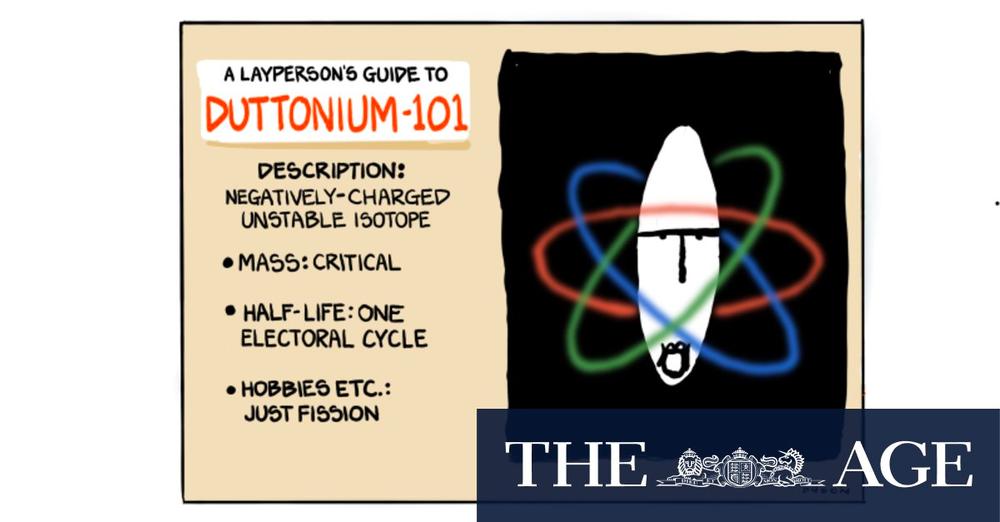
Every time the opposition leader starts down the nuclear path, he hits another dead end.
JOHN QUIGGIN, APR 13, 2024, https://johnquigginblog.substack.com/p/duttons-decaying-nuclear-energy-plans?utm_source=post-email-title&publication_id=806934&post_id=143441241&utm_campaign=email-post-title&isFreemail=true&r=1ise1&triedRedirect=true&utm_medium=email
Peter Dutton can’t seem to take a trick on nuclear power. Any option he puts forward seems to vanish as soon as he makes a commitment.
Since Dutton became opposition leader, he’s pushed the idea of small modular reactors (SMRs). At least in their original concept, these were reactors small enough (say 50-to-70MW capacity) to be built in a factory and shipped to sites where they could be installed in whatever number was required. The leading candidate was NuScale, a US firm that had contracted with a group of utilities in Utah to develop a pilot project of 12 (later reduced to six) SMRs.

The idea had the enthusiastic backing of the Australian Nuclear Science and Technology Organisation (ANSTO), the government’s official adviser on nuclear technology. The ANSTO website includes information on how SMRs can be constructed in three to five years, and that the US will have them operational by 2026.
That sounded too good to be true, and sadly, it was — NuScale abandoned its project late last year. After a bit of prodding, ANSTO added a disclaimer and a note that the “three to five year estimate” came from a research paper by the University of Leeds, which in turn could be traced to a dodgy consulting report from 2014.
On nuclear, Coalition prefers the optimism of misleading, decade-old, unverified claims Read More
Having given up hope on NuScale, Dutton needed an alternative.
He settled on Rolls-Royce, a reassuringly familiar name with a long track record of engineering excellence, not always matched by its financial success (it was famously nationalised and broken up by the Conservative UK government in the 1970s). It produces the nuclear reactors to be used in the submarines we will acquire under the AUKUS deal.
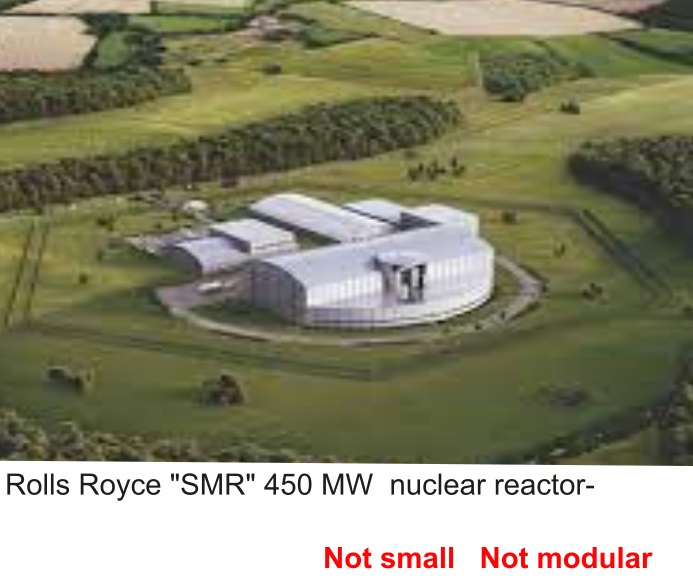
Rolls-Royce also offers what it calls an SMR, though this is something of a misnomer. At 470MWe, the reactor scarcely qualifies as small. It’s far too big to be built in a factory and shipped to its installation site. The “modular” description refers to the fact that the design uses 1,500 “modular components”, which are to be produced in a factory then assembled on site.
This is precisely the approach that was attempted, unsuccessfully, in the Westinghouse AP1000 design. Of four AP1000 reactors started in the US, two were abandoned with a loss of billions of dollars while the other two (at Vogtle in Georgia) have finally been completed, years late and billions over budget.
Despite these concerns, Rolls-Royce looked like a frontrunner, at least in the UK. Its design was the first to enter the Office for Nuclear Regulation approval process in 2021, with a target delivery date of 2030. The UK government provided £210 million (about A$400 million) in funding to support the project.
So, late last week, Dutton briefed Simon Benson at The Australian on a plan to deliver Rolls-Royce reactors into the grid by the mid-2030s.
What could go wrong? Plenty it seems. Just as The Australian story appeared, the UK government announced the winners of a grant to build SMRs in County Durham, and Rolls-Royce was not among them. UK deployment of the Rolls-Royce design now seems unlikely.
Rolls-Royce is now talking about building its first plants overseas. Poland has been mentioned as a possibility, but that’s a furphy. Under the now-departed Law and Justice government, Poland announced deals involving a string of different reactor designs: the AP1000, the GE Hitachi Nuclear Energy’s BWRX-300 (a direct competitor for Rolls-Royce), Last Energy microreactors, and even NuScale. Few if any will actually be built.
So, if Dutton goes ahead with Rolls-Royce, Australia could be in the unenviable situation of building “first of a kind” (FOAK) reactors with an untested design. Even more than nuclear plants in general, FOAK projects are notorious for delays and cost overruns. For a country like Australia, with no established nuclear industry or regulatory structure, it would be madness to try such a thing.
What next for Dutton’s nuclear policy? There’s still time for a climbdown before the policy is officially announced, but it’s unclear that the nuclear true believers in the LNP would accept such a thing. He could switch to a design with slightly better chances, such as the BWRX-300, but that would risk a third embarrassment if the design failed. So he has little choice but to press ahead with the Rolls-Royce dream and hope that it is not finally dispelled before the 2025 election.
Former PM Paul Keating on a craven acceptance of US strategic hegemony in Asia
By Paul Keating, Apr 11, 2024 https://johnmenadue.com/a-craven-acceptance-of-us-strategic-hegemony-in-asia/
The Financial Review, if it wishes to remain relevant, requires a monster dose of reality – a de-lousing of its misplaced strategic ideology and its craven acceptance of US strategic hegemony in Asia, a region where not one US state resides.
In the mid-1980s, a young and enthusiastic Michael Stutchbury was a permanent attendee at my often two-hour press conferences as treasurer, drumming into the Canberra press gallery that the presence of large economic forces was more important and more newsworthy than the gallery’s normal diet of election speculation, leadership changes, tax cuts and cigarette prices.
And Michael lapped it up. He was an early graduate of my school of advanced economic and entrepreneurial thinking. And while he has become more conservative as he has become older, his stewardship of The Australian Financial Review provides an attestation that those economic lessons were an anchor, a ballast, for the wider presentation and contemporary dissertation of economic news and events.
In short, Michael’s close proximity to and at the reformation of the Australian economy in the 1980s and early 1990s has made his views and leadership on economic issues today to be of substantial national value. But economic insight is where Michael’s experience shutters. On foreign policy, as in The AFR View ‘‘JAUKUS shows Australia seeks security in Asia’’ (April 9), Michael is away with the pixies
– a sugar plum fairy in the Australian strategic fantasy.
And that fantasy goes to asserting that an Atlantic power, the United States, along with other Anglos, Britain and Australia, but topped up with some resentment sauce from Japan, in some way fashions a new Asia construct – a construct in which Australia is or can be part. Distorting my policy that Australia could find its security in Asia by being tied up and indentured to a particularly un-Asian bunch.
Unlike Europe, which after the Thirty Years’ War hit upon the Westphalian model of collective security among states of roughly equal size, Asia has always been a hierarchy of countries with China at its top. This remains the case today.
So, the policy of any nation, particularly a Pacific one, thinking it can deal with Asia by ignoring China or pretending it doesn’t exist or that it is in some way illegitimate, is a policy of fantasy. A policy of fools.
But if you are a sugar plum fairy, as in foreign policy Michael seems happy to be, you will believe almost anything. Like AUKUS nuclear subs will belong to Australia and be sovereign to it, despite US Deputy Secretary of State Kurt Campbell’s regular and blatant assertions that he expects the subs to be at the beck and call of the United States whenever it wishes to hop into China over Taiwan.
The Financial Review, if it wishes to remain relevant, requires a monster dose of reality – a de-lousing of its misplaced strategic ideology and its craven acceptance of US strategic hegemony in Asia, a region where not one US state resides.
First published in the Australian Financial Review, April 10, 2024.
What’s Inside the President’s Nuclear Football

the creation of the Football, the president’s emergency satchel. But what about the nuclear war plans inside? And what about the Black Book? As surprising as this now seems, until 1960, several of the U.S. military branches had their own individual plans for nuclear war. What this meant was that the Army, Navy, and Air Force chiefs each had authority over a uniquely designated stockpile of nuclear weapons—including the delivery systems for those weapons and lists of targets to strike—for them to use at their own discretion in the event of nuclear war. When incoming Secretary of Defense Robert McNamara learned about these multiple, competing nuclear war plans, he ordered them integrated into a single plan. This is how the Single Integrated Operational Plan, or SIOP, got its name.
What began as the Single Integrated Operational Plan is now the Operational Plan, or OPLAN.
The Operation Plan for nuclear war is a colossal and cumbersome set of documents, too large to be carried around in the Football. Parsed down to a more manageable size, the plans become nuclear strike options as delineated in the Black Book.
plan for “mass extermination.” “evil beyond any human project ever,” “the destruction of most cities and people in the northern hemisphere.”
BY ANNIE JACOBSEN, APRIL 11, 2024 https://time.com/6965539/u-s-presidents-nuclear-footb
Jacobsen’s new book is Nuclear War: A Scenario
Nuclear threats have reemerged on the world stage. Frequently, Vladimir Putin warns the West that Russia is ready for nuclear war. “Weapons exits in order to use them,” Putin says. North Korea accuses the U.S. of having, “a sinister intention to provoke a nuclear war.” Entwined with the rising rhetoric, one physical object stands alone—the president’s emergency satchel, also known as the nuclear Football.
This bulging leather briefcase remains with the president at all times, carried by a military aide, and never more than an arm’s length away. It’s an iconic reminder of preeminent power and national mystery. A “nominally secret command-and-control system used to assure presidential control of nuclear use decisions,” historian William Burr says of the Football. Items located inside the president’s emergency satchel confirm his identity and connect him, as commander in chief, to the National Military Command Center, a nuclear bunker located beneath the Pentagon.
Also inside the Football is the Black Book. This cryptic set of documents, parsed down from a much larger operational plan for nuclear war, provides the commander in chief with nuclear launch options should policy dictate the president needs to act. This includes which targets to strike, which delivery systems to use, and the timing of action. “It’s called the Black Book because it involves so much death,” says Dr. Glen McDuff, a nuclear weapons engineer who served as the classified museum historian at Los Alamos National Laboratory in New Mexico.
The Football is with the president at all times. The first publicly-released photograph of the Football is from May 1963, at the Kennedy Family Compound in Hyannis Port, Massachusetts. It can be seen swinging from the military aide’s hand as he walks directly behind the president. The Football accompanied President Regan to the Red Square in Moscow, in 1988. When President George H.W. Bush was photographed out on jog, his military aide—also in running shorts and sneakers—can be seen just a few steps behind, carrying the iconic briefcase in her left hand.
The Football is always within a few feet of the president of the U.S. Once, when President Clinton was visiting Syria, President Hafez al-Assad’s handlers tried to prevent Clinton’s military aide from riding in an elevator with him. “We could not let that happen, and did not let that happen,” former Secret Service director Lewis Merletti says. Merletti was the special agent in charge of President Clinton’s detail at that time. “The Football must always be with the president,” he asserts. “There are no exceptions.” How the Football came to be has long been shrouded in mystery. “Its origins remain highly classified,” journalist Michael Dobbs wrote in Smithsonian Magazine in 2014. And then, just a few months ago, Los Alamos National Laboratory finally declassified the Football’s origin story. It goes like this.
One day in December 1959, a small group of officials from the Joint Committee on Atomic Energy visited a NATO base in Europe to examine joint-custody nuclear bomb protocols. The NATO pilots stationed there flew Republic F84F jets, the first U.S. Air Force fighter-bomber aircraft designed to carry nuclear bombs. Operation Reflex Action was in effect, air crews were trained and ready to strike predetermined targets in the Soviet Union in less than fifteen minutes from the call to nuclear war. One of the men on this visit was Harold Agnew, a Los Alamos scientist with a unique history.
Agnew was one of the three physicists assigned to fly on the Hiroshima bombing mission as a scientific observer. He carried a movie camera with him and took the only existing film footage of the atomic bombing of Hiroshima, as seen from the air. Now, in 1959, Agnew was at Los Alamos overseeing thermonuclear bomb tests; he later became the lab’s director. During the trip to the NATO base, Agnew noticed something that made him wary. “I observed four F84F aircraft . . . sitting on the end of a runway, each was carrying two MK 7 [nuclear] gravity bombs,” he wrote in a document declassified in 2023. What this meant was that “custody of the MK 7s was under the watchful eye of one very young U.S. Army private armed with a M1 rifle with 8 rounds of ammunition.” Agnew told his colleagues: “The only safeguard against unauthorized use of an atomic bomb was this single G.I. surrounded by a large number of foreign troops on foreign territory with thousands of Soviet troops just miles away.”
Back in the U.S., Agnew contacted a project engineer at Sandia Laboratories named Don Cotter and asked “if we could insert an electronic ‘lock’ in the [bomb’s] firing circuit that could prevent just any passerby from arming the MK 7.” Cotter got to work. He put together a demonstration of a device, a lock and coded switch, that functioned as follows: “[a] 3-digit code would be entered, a switch was thrown, the green light extinguished, and the red light illuminated indicating the arming circuit was live.”
Agnew and Cotter went to Washington, D.C., to demonstrate this locking device—first to the Joint Committee on Atomic Energy, then to the president’s top science advisor and finally to the president himself. “We presented it to President Kennedy, who ordered it be done,” Agnew recalled. The military objected. The man in charge of nuclear weapons at the time, General Alfred D. Starbird, opposed the idea. Glen McDuff, who coauthored (with Agnew) the now declassified paper on the subject, summed up the general’s documented concerns. “How is a pilot, U.S. or foreign, somewhere around the world, going to get a code from the President of the United States to arm a nuclear weapon before being overrun by a massively superior number of Soviet troops?” For the U.S. military, the locking device issue opened Pandora’s box. “If gravity bombs were coded,” McDuff explains, “why not all nuclear weapons including missile warheads, atomic demolition munitions, torpedoes, all of them.” The president decided they needed to be.
The answer came in the creation of the Football, the president’s emergency satchel. But what about the nuclear war plans inside? And what about the Black Book? As surprising as this now seems, until 1960, several of the U.S. military branches had their own individual plans for nuclear war. What this meant was that the Army, Navy, and Air Force chiefs each had authority over a uniquely designated stockpile of nuclear weapons—including the delivery systems for those weapons and lists of targets to strike—for them to use at their own discretion in the event of nuclear war. When incoming Secretary of Defense Robert McNamara learned about these multiple, competing nuclear war plans, he ordered them integrated into a single plan. This is how the Single Integrated Operational Plan, or SIOP, got its name.
Starting in December 1960, for the first time in the nuclear age, the SIOP gave the president, not the military, control of America’s nuclear arsenal. This new locking device designed by Agnew and Cotter, called a Permissive Action Link, or PAL, became an integral part of this new system. Only with the invention of the Football would the order to launch nuclear weapons—and the ability to physically arm them—come from the president alone. “This is how the president got the Football,” writes Agnew.
Over the years, the name for the nuclear war plan has changed. What began as the Single Integrated Operational Plan is now the Operational Plan, or OPLAN. For the Nuclear Information Project, in consort with the Federation of American Scientists, project director Hans Kristensen and senior researcher Matt Korda have identified the current Operational Plan as OPLAN 8010-12. It consists of “‘a family of plans’ directed against four identified adversaries: Russia, China, North Korea, and Iran,” the authors write. The Operation Plan for nuclear war is a colossal and cumbersome set of documents, too large to be carried around in the Football. Parsed down to a more manageable size, the plans become nuclear strike options as delineated in the Black Book.
The number of individuals who have written out their first-hand impressions of the SIOP is extremely limited. John Rubel, an avionics expert who served as an assistant secretary of defense under President Kennedy, wrote about the SIOP in his 2008 memoir, Doomsday Delayed. He liked it to a plan for “mass extermination.” Daniel Ellsberg reflected on the SIOP in his 2017 memoir, The Doomsday Machine: Confessions of a Nuclear War Planner. “It depicted evil beyond any human project ever,” Ellsberg wrote. A plan that calls for “the destruction of most cities and people in the northern hemisphere.”
As for the Black Book, few details exist on the public record. In 2015, U.S. Strategic Command battle watch commander Colonel Carolyn Bird shared with CNN previously unreported details. An identical Football resides inside the Stratcom nuclear bunker, viewers learned, locked in a safe beneath Offutt Air Force Base in Nebraska. “The [Black Book inside the] president’s football and our black book are duplicates,” Bird told CNN. “They contain the same information in the same way so that we are talking off the same documents when we are discussing nuclear options.”
In an interview with the History Channel, President Clinton’s former military aide, a colonel named Robert “Buzz” Patterson, likened the Black Book to a “Denny’s breakfast menu.” He made the analogy that choosing retaliatory targets from a predetermined nuclear strike list was as simple as deciding on a combination of food items at a restaurant. “It’s like picking one out of Column A and two out of Column B,” Patterson said.
Dr. Theodore Postol has seen the contents of the Black Book. His thoughts provide unsettling context to Patterson’s observations. From 1982 to 1984 Postol served as the assistant for weapons technology to the chief of naval operations. In this capacity, he worked on technical details regarding submarine launched ballistic missiles, or SLBMs. “Nitty gritty features,” Postol generalizes.
“Seeing the contents of the Black Book,” he recalls, “I was freaked out beyond belief.” Not for reasons he expected; as a weapons technologist Postol was familiar with the mass carnage involved. Instead of being confronted with a succinct summary of these horrifying facts—the targeting of cities, the death tolls in the millions—
Postol found the contents of the Black Book to be an obfuscation of the facts. The nuclear launch plans, he says, “had been sterilized down to military terminology designed to remove you from the reality of what would be happening.” An attempt at sanitizing nuclear war into a seemingly more palatable event. “My first thought,” Postol remembers, was “how would a president understand what these attack options actually mean?” This censoring of grim truths about nuclear war extends to the public as well, Postal contends. “You don’t want your population to know you’re planning genocide.”
What, if any, is the solution to this madness? Between the saber rattling and the secrecy, nuclear matters can present themselves as intractable. And yet, in reporting this story I witnessed a change in attitude from an unlikely source: the Los Alamos National Laboratory, a federal government organization that I’ve covered as a reporter for fifteen years.
“It’s the Oppenheimer effect,” Dr. Glen McDuff told me of this new attitude, “as in Oppenheimer the film.” Ever since the release of Christopher Nolan’s 2023 feature film, “the lab has been inundated with public curiosity about the bomb,” McDuff clarifies. “With requests about nuclear weapons.” And, he says, the lab has done its best to respond. The popularity of the film has renewed dialogue about the existential dangers nuclear weapons pose. And it led to the declassification (at this reporter’s behest) to one of the laboratory’s long-held secrets—the origin story of the Football.
Were the President of the United States to be called upon to open the Football, the situation that would follow would almost certainly spiral out of control. “The world could end in the next couple of hours,” former Stratcom commander General C. Robert Kehler (ret) says of nuclear war.
Nuclear war is the only scenario other than an asteroid strike that could end civilization in a matter hours. The soot from burning cities and forests will blot out the sun and cause a nuclear winter. State-of the art climate modeling predicts five billion humans will die. In the words of Nikita Khrushchev, “the survivors will envy the dead.”
And yet, threats abound. Vladimir Putin insists he is “not bluffing” about the possibility of using weapons of mass destruction. North Korea has test launched more than 100 missiles since January 2022, including nuclear-capable weapons that can hit the U.S. United Nations Secretary General António Guterres warns the world, “Humanity is one misunderstanding, one miscalculation away from nuclear annihilation.” The world balances on the razor’s edge. “This is madness,” Guterres says, “we must reverse course.” Change is possible. Help reverse course. “A nuclear war cannot be won and must never be fought,” President Ronald Reagan and Soviet General Secretary Mikhail Gorbachev cautioned the world in a joint statement in 1985. Conversations between these two leaders led to the reduction in nuclear weapons from an all-time high of 70,481 warheads, to some 12,500 today. Dialogue matters. Join the conversation about nuclear weapons now, while we are all still able to have one.
Flicker of Hope: Biden’s Throwaway Lines on Assange
April 12, 2024 by: Dr Binoy Kampmark, https://theaimn.com/flicker-of-hope-bidens-throwaway-lines-on-assange/
Walking stiffly, largely distracted, and struggling to focus on the bare essentials, US President Joe Biden was keeping company with his Japanese counterpart, Prime Minister Fumio Kishida, when asked the question. It concerned what he was doing regarding Australia’s request that the WikiLeaks founder Julian Assange be returned to Australia.
Assange, who has spent five tormenting years in Belmarsh Prison in London, is battling extradition to the US on 18 charges, 17 tenuously and dangerously based on the US Espionage Act of 1917.
The words that followed from the near mummified defender of the Free World were short, yet bright enough for the publisher’s supporters. “We’re considering it.” No details were supplied.
To these barest of crumbs came this reaction from from Australian Prime Minister Anthony Albanese on ABC’s News Breakfast: “We have raised on behalf of Mr Assange, Australia’s national interest, that enough is enough, that this needs to be brought to a conclusion, and we’ve raised it at each level of government in every possible way.” When pressed on whether this was merely an afterthought from the president, Albanese responded with the usual acknowledgments: the case was complex, and responsibility lay with the US Department of Justice.
One of Assange’s lawyers, the relentless Jennifer Robinson, told Sky News Australia of her encouragement at Biden’s “response, this is what we have been asking for over five years. Since 2010 we’ve been saying this is a dangerous precedent that’s being set. So, we certainly hope it was a serious remark and the US will act on it.” Assange’s brother, Gabriel Shipton, also told Sky News that the statement was significant while WikiLeaks editor-in-chief, Kristinn Hrafnsson thought the utterance “extraordinary”, cautiously hoping “to see in the coming days” whether “clarification of what this means” would be offered by “those in power” and the press corps.
The campaign to free Assange has burgeoned with admirable ferocity. The transformation of the WikiLeaks founder from eccentric, renegade cyber thief deserving punishment to prosecuted and persecuted scribbler and political prisoner has been astonishing.
The boggling legal process has also been shown up as woefully inadequate and scandalous, a form of long-term torture via judicial torment and deprivation. The current ludicrous pitstop entails waiting for a UK Court of Appeal decision as to whether Assange will be granted leave for a full reconsideration of his case, including the merits of the extradition order itself.
The March 26 Court of Appeal decision refused to entertain the glaringly obvious features of the case: that Assange is being prosecuted for his political views, that due process is bound to be denied in a country whose authorities have contemplated his abduction and murder, and that he risks being sentenced for conduct he is not charged with “based on evidence he will not see and which may have been unlawfully obtained.” The refusal to entertain such material as the Yahoo News article from September 2021 outlining the views of intelligence officials on kidnapping and assassination options again cast the entire affair in a poor light.
Even if Assange is granted a full hearing, it is not clear whether the court will go so far as to accept the arguments. The judges have already nobbled the case by offering US prosecutors the chance to offer undertakings, none of which would or could be binding on the DOJ or any US judge hearing the case. Extradition, in other words, is likely to be approved if Assange is “permitted to rely on the First Amendment”, “is not prejudiced at trial (including sentence) by reason of his nationality” and that he “is afforded the same First Amendment protection as a United States citizen, and that the death penalty not be imposed.” These conditions, on the face of it, look absurd in their naïve presumption.
Whether Biden’s latest casual spray lends any credibility to a change of heart remains to be seen. In December 2010, when Vice President in the Obama administration, Biden described Assange as a “high-tech terrorist” for disclosing State Department cables. He failed to identify any parallels with previous cases of disclosures such as the Pentagon papers.
Craig Murray, former British diplomat and Assange confidant, adds a note of cautious sobriety to the recent offering from the president: “I’m not going to get too hopeful immediately on a few words out of the mouth of Biden, because there has been no previous indication, nothing from the Justice Department so far to indicate any easing up.”
For all that, it may well be that the current administration, facing a relentless publicity campaign from human rights organisations, newspapers, legal and medical professionals, not to mention pressure from both his own party in Congress and Republicans, is finally yielding. Caution, however, is the order of the day, and nothing should be read or considered in earnest till signatures are inked and dried. We are quite a way off from that.
Ukraine fatigue: Kiev and the West are tiring of war and each other
The idea of some form of compromise solution to Kiev-Moscow conflict is creeping up on foreign hawks and on more and more locals
Tarik Cyril Amar, https://www.sott.net/article/490581-Ukraine-fatigue-Kiev-and-the-West-are-tiring-of-war-and-each-other 12 Apr 24
What a small band of objective-though-long-disparaged observers in the West have long warned about is now happening: Ukraine and the West are losing their war against Russia. The strategy of using Ukraine to either isolate and slowly suffocate Russia or to defeat and degrade it in a proxy war is coming to its predictable catastrophic end.
This reality is now being acknowledged even by key media and high officials that used to be uncompromising about pursuing the extremely ill-advised aim of military victory over Russia. A Washington Post article has explained that with ”no way out of a worsening war,”
Ukrainian President Zelensky’s options ”look bad or worse.” NATO General Secretary Jens Stoltenberg has discovered the option of ending wars by concessions – Ukraine’s concessions, that is. The sturdy old hardliner Edward Luttwak warns of a ”catastrophic defeat” – for the West and Ukraine. True, Luttwak is still spreading desperate illusions about a direct NATO deployment to avert the worst. In reality, it would, of course, only make things much, much worse again, as in World War III worse. But his fear, not to say panic, is palpable.
The fast-approaching outcome will be a disaster for Ukraine, even if Moscow should be generous regarding the terms of a postwar settlement (not a given, after the costs that Russia has incurred). Ukraine has already been ruined in terms of its demography, territory, economy, and, last but not least, political future. The damage incurred cannot simply be undone and will have long-lasting consequences.
For the West, this war will also mark a dismal turning point, in four main ways that can only be sketched here:
First, the US will have to absorb its worst defeat since Vietnam. Arguably, this latest fiasco is even worse because, even during the Vietnam War, America did not try to attack Russia (then, of course, leading the Soviet Union) as head-on as it does now. Washington’s most over-confident attempt ever to take Moscow off the “grand chessboard” once and for all has backfired perfectly. In general, that will diminish America’s capacity to impress and cajole globally. In particular, the goal of preventing the rise of regional hegemons in Eurasia, the holy grail of US geopolitics, is even farther out of reach than before. The “unipolar” moment and its illusions were passing anyhow, but the US leadership has added a textbook illustration of the West’s limits.
Second, the EU and its individual members – especially myopic warmongers such as Germany, Poland, and France – are far worse off again: Their foolish abandoning of geopolitically imperative caution and balancing (remember: location, location, location) will cost them dearly.
Third, in their own, different ways, cases such as Britain (not even an EU member anymore) and the Baltics (very exposed and very bellicose, a shortsighted combination) are in a class of their own: damage there will be galore. Damage control? The options are paltry.
And, finally, there is, of course, NATO: Over-extended, self-depleted, and having gratuitously exposed itself as much weaker than it would like to seem. Its defeat by Russia in Ukraine will trigger centrifugal tendencies and blame games. Not to speak of the special potential for tension between the US and its clients/vassals in Europe, especially if Donald Trump wins the presidency again, as is likely. And, by the way, he can only thank NATO for proving his point about what a dubious proposition it has become. If you believe that having added more territory on the map (Sweden and Finland) was a “win,” just remember what has happened to the mistaken celebrations of Ukraine’s territorial advances in 2022. Territory may be a price; it is not a reliable indicator of strength.
Yet what about Ukrainians? They have been used as pawns by their Western friends from hell. They are still living under a regime that has just decided to mobilize even more of them for a hopeless meatgrinder, while Zelensky is admitting that Ukraine is on the verge of defeat.
Some Western media are still telling a simplistic and false story about Ukrainians’ unflagging and united will to hold out for victory, as if every single one owed the West to play a Marvel hero to the bitter end. But in reality Ukraine is a normal, if badly misled country. Many of its citizens have long shown what they really think about dying for a toxic combination of Western geopolitics and the narcissism of a megalomanic comedian: by evading the draft, either by hiding in Ukraine or fleeing abroad. In addition, a recent poll shows that almost 54 percent of Ukrainians find the motives of the draft dodgers at least understandable. Kiev’s push for increased mobilization will not go smoothly.
But there is more evidence of the fact that Ukraine’s society is not united behind a Kamikaze strategy of “no compromise.” Indeed, under the title “The Line of Compromise,” Strana.ua, one of Ukraine’s most important and popular news sites, has just published a long, detailed article about three recent and methodologically sound polls.
They all bear on Ukrainians’ evolving attitudes to the war and in particular the question of seeking a compromise peace. In addition, Strana offers a rich sample of comments by Ukrainian sociologists and political scientists. It is no exaggeration to say that the mere appearance of this article is a sign that the times are changing: Under the subtitle “How and why attitudes to the war differ in the East and the West of Ukraine,” it even highlights “substantial” regional differences and, really, suppressed divisions. If you know anything about the extreme political – even historical – sensitivity of such divergences in Ukraine, then you will agree that this framing alone is a small sensation.
But that is not all. The article, in effect, dwells on ending the war by concessions – because that is what any compromise necessarily will take. Readers learn, for instance, that, according to the ‘Reiting’ agency polling on commission of Ukraine’s Veterans’ Affairs Ministry, in Ukraine’s West, farthest removed from the current front lines, 50% of poll respondents are against any compromise, while no less than 42% are in favor of compromise solutions as long as other countries (other than Ukraine and Russia, that is) are involved in finding them. For a region that, traditionally, has been the center of Ukrainian nationalism, that is, actually, a remarkably high share of those siding with compromise.
If you move east and south over the map, the compromise faction gets stronger. In the East, the proportions are almost exactly reversed: 41% against compromise and 51% in favor. In the South, it’s a perfect tie: 47% for both sides.
On the whole, Ukrainian sociologists are finding a “gradual increase” of those supporting a “compromise peace” in “one form or the other.” Even if, as one researcher plausibly cautions, this increase displays different rates in different regions, it still adds up to the national trend. One of its causes is “disappointment,” the loss of faith in victory, as the political scientist Ruslan Bortnik observes. In other words, the Zelensky regime is losing the information war on the home front. Notwithstanding its mix of censorship and showmanship.
The compromises imagined by Ukrainians include all conceivable solutions that do not foresee a return to the 1991 borders. In other words, there are ever more Ukrainians who are ready to trade territory for peace. How much territory, that is, of course, a different question. But it is clear that the maximalist and counter-productive aim of “getting everything back,” the all-or-nothing delusion, imposed for so long on Ukrainian society, is losing its grip.
The agency Socis, for instance, counts a total of almost 45% of respondents ready for compromise, while only 33% want to continue the war until the 1991 borders are re-established. But there are also 11% who still favor fighting on until all territories lost after February 2022 are recovered. That, as well, is now an unrealistic aim. It may have been closer to reality when Kiev dismissed an almost finished peace deal in the spring of 2022, on awful Western advice. That ship has sailed.
Polling results, it is important to note, do not all point in the same direction. The KMIS agency has produced results that show 58% of respondents who want to continue the war “under any circumstances” and only 32% who would prefer a “freeze,” if Western security guarantees are given. Such a freeze, while a favorite pipedream of some Western commentators, is unlikely to be an option now, if it ever was. Why should Moscow agree? But that is less relevant here than the fact that KMIS, for one, seems to have found a massive bedrock of pro-war sentiment.
And yet, even here, the picture is more complicated once we look closer. For one thing, the KMIS poll is comparatively old, conducted in November and December of last year. Given how quickly things have been developing on the battlefield since then – the key town and fortress of Avdeevka, for instance, finally fell only in February 2024 – that makes its data very dated.
KMIS also had interesting comments to offer: The agency notes that respondents’ proximity to the front lines plays an “important role” in shaping their opinions about the war. In other words, when the fighting gets close enough to hear the artillery boom, it concentrates the mind on finding a way to end it, even by concessions. As one Ukrainian sociologist has put it, “in the East and South … one of people’s main concerns is that the war must not reach their own home, their own home town.”
In addition, the executive director of KMIS has observed that the number of compromise advocates also grows when Western aid declines.
It remains difficult to draw robust conclusions from these trends, for several reasons: First, as some Ukrainian observers point out, the number of compromise supporters may be even higher – personally, I am sure it is – because the Zelensky regime has stigmatized any appeal to diplomacy and negotiations as “treason” for so long. Many Ukrainians are virtually certain to be afraid to speak their mind on this issue.
Second, what exactly the compromise camp understands by compromise is bound to be diverse. This camp may still include quite a few citizens who harbor illusions about what kind of compromise is available at this point.
Third, the current regime – which is de-facto authoritarian – is not answerable to society, at least not in a way that would make it easy to predict how shifts in the national mood translate into regime policies, or not.
And yet: There is no doubt that there is a groundswell in favor of ending the war even at the cost of concessions. Add the clear evidence of Western Ukraine fatigue – even a growing readiness to cut Ukraine loose – and the facts that the Russian military is creating on the ground, and it becomes hard to see how this basal shift in the Ukrainian mood could not become an important factor of Ukrainian – and international – politics
1 This month

of the week – Australians for War Powers Reform (AWPR)
To see nuclear-related stories in greater depth and intensity
 Antinuclear