Five Years At Belmarsh: A Chronicle Of Julian Assange’s Imprisonment

Kevin Gosztola, Apr 11, 2024, https://scheerpost.com/2024/04/12/five-years-at-belmarsh-a-chronicle-of-julian-assanges-imprisonment/
Calls for Assange’s freedom are renewed as the WikiLeaks founder marks five years in Belmarsh prison.
At the behest of the United States government, the British government has detained WikiLeaks founder Julian Assange in His Majesty’s Prison Belmarsh for five years.
Assange is one of the only journalists to be jailed by a Western country, making the treatment that he has endured extraordinary. He has spent more time in prison than most individuals charged with similar acts.
Since December 2010, Assange has lived under some form of arbitrary detention.
He was expelled from Ecuador’s London embassy on April 11, 2019, and British police immediately arrested him. Police transported Assange to Belmarsh, a maximum-security facility often referred to as “Britain’s Guantanamo.”
Around the same time, the U.S. Justice Department unsealed an indictment that alleged that Assange had conspired with U.S. Army whistleblower Chelsea Manning to commit a “computer intrusion.” The following month the DOJ issued another indictment with 17 additional Espionage Act charges.
2019
On May 1, Assange was sentenced by a British court to 50 weeks in prison as punishment for seeking political asylum from Ecuador while Sweden was attempting to extradite him. His sentence was longer than the six-month sentence that Jack Shepherd, the “speedboat killer” received for “breaching bail.”
Continue readingCoalition nuclear plan flips back to SMRs after latest meeting with lobbyists

Giles Parkinson, Apr 12, 2024, https://reneweconomy.com.au/coalition-nuclear-plan-flips-back-to-smrs-after-latest-meeting-with-lobbyists/
And then, in a single bound, it was back to small modular reactors. The federal Coalition’s confused nuclear power policy has lurched from SMRs to large scale nuclear and back again to SMRs. It’s as if the policy is decided by the nuclear lobbyist most recently consulted.

Coalition leader Peter Dutton’s latest thought bubble on nuclear, dutifully reported in The Australian newspaper last weekend, is that Australia should sign up to SMRs, and should be able to build the first of them by the middle of the 2030s – faster than even most of the technology’s boosters admit is possible.
And then, in a single bound, it was back to small modular reactors. The federal Coalition’s confused nuclear power policy has lurched from SMRs to large scale nuclear and back again to SMRs. It’s as if the policy is decided by the nuclear lobbyist most recently consulted.
Coalition leader Peter Dutton’s latest thought bubble on nuclear, dutifully reported in The Australian newspaper last weekend, is that Australia should sign up to SMRs, and should be able to build the first of them by the middle of the 2030s – faster than even most of the technology’s boosters admit is possible.
Dutton says the new plan will be fully sketched out before the federal Labor government’s budget in early May – and according to The Australian this latest plan follows meetings last week with executives of Rolls Royce SMR and its Australian partner Penske.
Renew Economy decided to check all this out with Rolls Royce SMR itself, and got some surprising answers.
“It wasn’t a representative of ours (who met with Peter Dutton),” a company spokeswoman said by email. “I believe it was a potential partner of ours that met with Peter Dutton who spoke about RR SMR on our behalf.”
Dutton and other Coalition boosters like to talk about SMRs in the present tense, and most mainstream media dutifully follow suit, as if they are already operating.
This is deception. A group of my friends chatting over coffee this week was stunned to hear that SMRs are not actually a thing, despite what they read in the press. A few smaller nuclear reactors exist, such as in China and Russia, but they are in no way modular, which is the supposed key selling point of this new technology.
“One of the biggest problems for SMRs is that they don’t exist,” Allison Macfarlane, director of the school of public policy and global affairs at the University of British Columbia and a former chair of the US Nuclear Regulatory Commission, told the Financial Times this week.
“We’re still at the paper stage, the computer model stage. To get to demonstration models and then a full-scale model when you are ready to commercialise will take billions of dollars,” she added.
Rolls Royce SMR is still at least two years away from obtaining a licence, and the spokesperson told Renew Economy this week that the company is hopeful that the first SMR can be completed “in the early 2030s.”
However, Simon Bowen, the chair of Great British Nuclear, the government agency that is trying to lead the technology’s revival and find ways to replace its existing ageing fleet, told the FT this week the first SMR won’t likely be seen until the mid 2030s.
That time line is important, because it goes to the fantasy nature of the Coalition’s nuclear policy. Is Dutton seriously suggesting that Australia, with no civil nuclear power industry, can match the UK on timing on their proprietary nuclear technology.
And first-of-their-kind technologies are always considerably more expensive than those that follow. But more on the timing later, because that goes to the heart of what the Coalition is trying to do – not so much build nuclear, but to stop renewables in their tracks.
But it is impossible to think that Australia would commit to an SMR before it is built in its host country, with all the embedded infrastructure and know-how. And no country is going to commit to more SMRs until the first one is built, and can prove itself. Which straightaway pushes the Coalition timeline back into the 2040s.
On costs, Dutton is trying to convince everyone that nuclear – contrary to all available evidence – is low cost, which The Australian, unsurprisingly, reported as a matter of fact.
The Coalition’s energy spokesman Ted O’Brien engages in some impressive verbal calisthenics by claiming that they might be expensive for investors, but are low cost for consumers.
But if new-build nuclear is to be low cost to consumers it will be the result, as it is in France, of massive government subsidies. And given the Coalition’s horrified reaction to Labor’s “Made in Australia” green manufacturing plan, they are definitely not in favour of government subsidies.
The Australian reported that the Rolls Royce SMR is priced at around $5 billion for a 470 MW facility, which appears an heroic assumption given it is less than one third of the price of the only SMR to actually obtain a licence to date, the NuScale project in the US that was cancelled last year because it was too expensive for consumers.
Rolls Royce SMR’s own web page describes a study produced last year that claimed its technology could reduce wholesale prices in the UK by between three per cent and 13 per cent, depending on how many SMRs were rolled out.
Curiously, the study – according to the detailed Rolls Royce summary of it – arrives at these numbers by comparing SMRs to the cost of peaking gas plants, the most expensive generation on the grid, and which – in reality – is rarely used. They are only switched on around 1 to 2 per cent of the time.
These peaking gas plants are not seen as the usual competitor to nuclear or SMRs, because nuclear is designed to be baseload, not the fast response and flexible capacity needed to fill in the gaps of a grid dominated by wind and solar.
And, it should be noted, nuclear itself is highly dependent on fast-response capacity – peaking gas and pumped hydro – to make up for its own lack of flexibility.
The Rolls Royce spokesperson told Renew Economy that this analysis was conducted in the winter of 2022/23, when the energy crisis was at its worst, gas prices had soared, and energy consumers were being hit by huge bills.
It begs a question, which Rolls Royce didn’t answer: If SMRs are only able to undercut peaking gas power plant prices by a small amount, what does that imply when those costs are spread across the whole day?
The spokesperson confirmed that Rolls Royce SMRs will indeed be focused on “baseload” power, and its SMRs are designed not to displace renewables, but replace “the loss in low-carbon electricity … caused by our ageing existing reactor fleet going offline in the years ahead.”
The spokesperson said SMRs do have a degree of flexibility to load follow and respond “when the wind doesn’t blow and the sun doesn’t shine,” and can use its thermal output to produce hydrogen or process heat, which might be attractive in the northern hemisphere.
But they have little ability to ramp up to fill in gaps of wind and solar because, as the spokesperson told Renew Economy in their email: “SMRs work most cost-effectively when ‘always on’.”
And this is important because it goes to the heart of why the Coalition nuclear plan makes absolutely no sense and is more about destruction of one industry, rather than construction of another.
Australia is heading towards 82 per cent renewables by 2030, and even if it doesn’t meet that deadline, it will be above 90 per cent by the mid 2030s, and likely close to 100 per cent.
A fleet of “always on” nuclear power plants will struggle to find a role in that scenario, particularly as daytime demand will be almost entirely met by the anticipated ongoing boom in small-scale solar on the roofs of household and business consumers.
But the Coalition policy, and it makes no secret of this, is not about compatibility. O’Brien’s own energy advisor admits that nuclear and renewables are effectively an “either-or” because the system is either going to be baseload or renewables and storage.
And the Coalition’s fundamental stand is that it refuses to believe that wind and solar can power a modern economy. “The lights will go out,” says Dutton, or “your fridge goes off at home” he added this week.
Which is why they are calling for a moratorium on the roll out of wind, solar, battery storage and transmission, and why they want coal-fired power stations to stay open until nuclear can arrive.
And it’s why their proxies in the mainstream and social media – and so-called think tanks and ginger groups backed by billionaires such as Gina Rinehart and Trevor St Baker – spend so much time demonising the technologies that are currently available, and which can do the job, such as solar, wind, battery storage and electric vehicles.
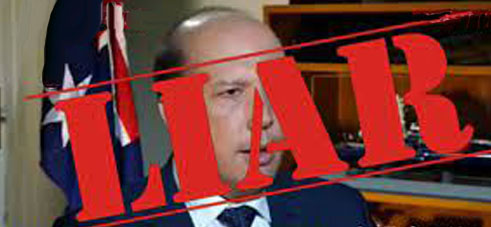
Dutton’s rhetoric is also liberally splattered with outright falsehoods. A check of his media transcripts this week reveals a number of common false statements.
The first is the claim that Australia is the only OECD country not to have or want nuclear. Not true. Germany closed down the last of its nuclear generators a year ago, and Italy voted against the technology in a referendum a decade ago after shutting down the last of its reactors. A number of other EU countries are following suit.
Dutton also claims that the federal government is planning “28,000 kms of new transmission lines by 2030.” Again, not true. The Australian Energy Market Operator’s Integrated System Plan models 10,000km by 2030 in its core step change plan. That’s still a lot, but little more than one third of what Dutton claims.
The 28,000km number is a 2050 target, not 2030, and only in the scenario where Australia becomes a renewable energy superpower by exporting green hydrogen and other green products, most likely from vast wind and solar projects in the middle of the country that will need to link into the grids or production facilities.
Dutton says he wants to have a “mature” discussion about the energy mix. But that can’t happen if his rhetoric is based around obvious lies.
Cook by-election candidate Simon Kennedy says locals are ‘comfortable’ living near nuclear reactors
ABC News, By Ethan Rix 13 Apr 24
The by-election for former prime minister Scott Morrison’s southern Sydney seat has not garnered national fanfare the way other by-elections have in the past.
And as voters head to the polls today, you can count the apathy being felt in the electorate of Cook — with early voting down by about 11 per cent compared to the 2022 federal election and nearly 13 per cent lower than the Voice referendum late last year, according to the Australian Electoral Commission.
Even the Liberals’ candidate, Simon Kennedy, won’t be able to personally boost voter turnout as his team confirmed he didn’t move into the electorate in time to meet the registration deadline — denying him an opportunity to pose for the cameras as he votes for himself.
Perhaps the lack of enthusiasm is because the Liberals look set to comfortably hold a seat they have held for half a century, or maybe it’s because the Labor Party has opted not to put a horse in the race, diminishing any usual analysis the result could be a “test” of Anthony Albanese’s leadership.
But for people who are eligible to cast a ballot today, what are they really voting for?
A nuclear reactor in Cook’s backyard
Former McKinsey consultant Simon Kennedy has openly backed his party’s push to introduce nuclear power to the national energy grid, with the opposition preparing to announce up to six possible sites for nuclear plants.
When asked whether he would oppose a nuclear power reactor being built in the electorate of Cook, Mr Kennedy said locals were “comfortable” with the concept because there was already one positioned on its “doorstep” in Lucas Heights.
“People are comfortable with where Lucas Heights is, they’ve been comfortable with that concept,” he said.
“I haven’t heard any fear or worries about that at all.”
Lucas Heights, which is located on the outskirts of the Sutherland Shire, is home to Australia’s only nuclear reactor, which is not used to produce electricity.
It instead produces medical and industrial isotopes and stores low-level waste and a small amount of intermediate-level waste on-site.
“They’re [voters] not looking for people pushing clean or coal or one over the other, they’re looking for cheap, reliable and clean power,” Mr Kennedy said.
Looking at getting more female candidates
The number of female MPs in the Coalition has also been a key question in the lead-up to this by-election.
Mr Kennedy comfortably defeated the only female candidate to put her hand up for Liberal pre-selection, Veteran Family Advocate Commissioner Gwen Cherne, who received 35 votes to his 158.
The result was said to have upset those within the party pushing for more females to be preselected to safe Liberal seats……………….
Who else is running?
…………… The Australian Greens have put up Martin Moore, who has a Fine Arts Degree with a Masters in Social Ecology and ran for the local seat of Miranda at the 2023 NSW election.
Mr Moore disagreed with Mr Kennedy that locals would be comfortable living next to a nuclear reactor.
“I feel that people are really concerned that we’re being dragged into a nuclear wasteland with the AUKUS deal … and the opposition’s ideas of reactors,” he said……………………………… https://www.abc.net.au/news/2024-04-13/cook-byelection-simon-kennedy-nuclear-reactors/103696760—
Annie Jacobsen: ‘What if we had a nuclear war?’

The author and Pulitzer prize finalist, who has written the latest pick for the New Scientist Book Club, Nuclear War: A scenario, on the “shocking truths” about a nuclear attack
By Annie Jacobsen, 12 April 2024, https://www.newscientist.com/article/2426579-annie-jacobsen-what-if-we-had-a-nuclear-war/
Not long after the last world war, the historian William L. Shirer had this to say about the next world war. It “will be launched by suicidal little madmen pressing an electronic button. Such a war will not last long and none will ever follow it. There will be no conquers and no conquests, but only the charred bones of the dead on an uninhabited planet.”
As an investigative journalist, I write about war, weapons, national security and government secrets. I’ve previously written six books about US military and intelligence programmes – at the CIA, The Pentagon, Defense Advanced Research Projects Agency– all designed to prevent, or deter, nuclear world war III. In the course of my work, countless people in the upper echelons of US government have told me, proudly, that they’ve dedicated their lives to making sure the US never has a nuclear war. But what if it did?
“Every capability in the [Department of Defense] is underpinned by the fact that strategic deterrence will hold,” US Strategic Command (STRATCOM), which is responsible for nuclear deterrence, insists publicly. Until the autumn of 2022, this promise was pinned on STRATCOM’s public Twitter feed. But to a private audience at Sandia National Laboratories later that same year, STRATCOM’s Thomas Bussiere admitted the existential danger inherent to deterrence. “Everything unravels itself if those things are not true.”
If deterrence fails – what exactly would that unravelling look like? To write Nuclear War: A scenario, I put this question to scores of former nuclear command and control authorities. To the military and civilian experts who’ve built the weapon systems, been privy to the response plans and been responsible for advising the US president on nuclear counterstrike decisions should they have to be made. What I learned terrified me. Here are just a few of the shocking truths about nuclear war.
The US maintains a nuclear launch policy called Launch on Warning. This means that if a military satellite indicates the nation is under nuclear attack and a second early-warning radar confirms that information, the president launches nuclear missiles in response. Former secretary of defense William Perry told me: “Once we are warned of a nuclear attack, we prepare to launch. This is policy. We do not wait.”
The US president has sole authority to launch nuclear weapons. He asks permission of no one. Not the secretary of defense, not the chairman of the joint chief of staff, not the US Congress. “The authority is inherent in his role as commander in chief,” the Congressional Research Service confirms. The president “does not need the concurrence of either his [or her] military advisors or the US Congress to order the launch of nuclear weapons”.
When the president learns he must respond to a nuclear attack, he has just 6 minutes to do so. Six minutes is an irrational amount of time to “decide whether to release Armageddon”, President Ronald Reagan lamented in his memoirs. “Six minutes to decide how to respond to a blip on a radar scope… How could anyone apply reason at a time like that?” And yet, the president must respond. This is because it takes roughly just 30 minutes for an intercontinental ballistic missile to get from a launch pad in Russia, North Korea or China to any city in the US, and vice versa. Nuclear-armed submarines can cut that launch-to-target time to 10 minutes, or less.
Today, there are nine nuclear powers, with a combined total of more than 12,500 nuclear weapons ready to be used. The US and Russia each have some 1700 nuclear weapons deployed – weapons that can be launched in seconds or minutes after their respective president gives the command. This is what Shirer meant when he said: “Such a war will not last long and none will ever follow it.”
Nuclear war is the only scenario other than an asteroid strike that could end civilisation in a matter of hours. The soot from burning cities and forests will blot out the sun and cause nuclear winter. Agriculture will fail. Some 5 billion people will die. In the words of former Soviet leader Nikita Khrushchev, “the survivors will envy the dead”.
I wrote Nuclear War: A scenario to demonstrate – in appalling, minute-by-minute detail – just how horrifying a nuclear war would be. “Humanity is one misunderstanding, one miscalculation away from nuclear annihilation,” UN secretary-general António Guterres warned the world in 2022. “This is madness. We must reverse course.”
How true.
Nuclear War: A Scenario by Annie Jacobsen, published by Torva (£20.00), is available now. It is the latest pick for the New Scientist Book Club: sign up here to read along with our members
Getting bigger but not safer or cheaper – the myth of Rolls Royce and its very big non-modular reactor

By David Toke, April 2024, https://100percentrenewableuk.org/getting-bigger-but-not-safer-or-cheaper-the-myth-of-rolls-royce-and-its-very-big-non-modular-reactor
Rolls Royce’s so-called small modular reactor (SMR) is getting bigger, but is likely to have fewer special safety features compared to EDF’s increasingly pricey design for Hinkley C.
In 2017 Rolls Royce said that its small modular reactor would be between 220 and 440 MW, but the latest design is bigger, at 470 MW. It is strange to call this small. Reactors in service at the moment (the so-called AGR reactors) were around the 600 MW size for each unit and, strange as it might seem, most of the first generation of so-called ‘Magnox’ nuclear reactors built in the UK were actually smaller than 470 MW. They were not called ‘small’. So why is Rolls Royce calling this a SMR? There’s no reason for this other than public relations.
Rolls Royce claim that the parts will be mainly built in factories. Well, of course they will, that’s always the case with nuclear power plant. The difference with building a relatively smaller plant of course is that you get less of the economies of scale in doing this. That is why nuclear power plant have got bigger.
So the fact that the Rolls Royce unit will be about a third the size of the EPR is likely to make them cost more. But there is one way that Rolls Royce will be able to economise compared to the European Pressurised Reactor (EPR) being built at Hinkley C, and that is because I have seen no sign that Rolls Royce will include some special safety features that have been included in the EPR.
The best known of these safety features are a) a ‘double containment’ feature that is designed to stop material from the inside getting out (as well as another external shell to shield from aircraft) and b) a ‘core catcher’ to stop a melting core eating its way into the ground and potentially contaminating water courses. I am assuming Rolls Royce will not be including either of these features, although it will have to satisfy the Office for Nuclear Regulation (ONR) that it has other ways of stopping radioactive releases from accidents.
Rolls Royce are now starting a ‘Generic Design Assessment’ (GDA) process with the ONR which will take around 5 years. After then they will be asking the UK Government for a blank cheque for a project.
Of course there is another factor and that is that EDF have some experience (admittedly not very successful of late) of building nuclear power plant. Rolls Royce do not have experience of building large nuclear power plant (which is what they are really hoping to do). Producing small (and, it must be said extremely expensive) genuinely small reactors for nuclear submarines is not the same thing at all! So Rolls Royce are likely not to have the skills to build large nuclear power plant. That is a bad sign!
The so-called SMRs proferred by Rolls Royce will just be the latest in a long line of very expensive, very lately delivered nuclear power stations in the UK. It is unlikely to be any cheaper than the reactor that EDF is building at Hinkley C (becoming more expensive as time goes on). But it will have fewer safety features.
Sign the petition for mandatory solar panels on buildings , and for fossil fuels to be banned in new buildings. See the petition page here.
Please share the petition page link as widely as you can on social media. Please write to you MP asking for solar pv to be mandatory on all new buildings and for fossil fuel boilers to be banned in them.
1 This month
7 April – WEBINAR – Australia and the Doomsday Clock – Preventing nuclear war through NoFirstUse and other policies
Online | Tuesday April 7, 4:00-5:30pm, Australian Eastern Time / 8:00-9:30am Central Europe Time
– Access the registration link
15 April – Zoom –Nuclear Power is Not the Solution
Apr 15, 2026 01:00 AM in Canberra, Melbourne, Sydney

Join the International Physicians for the Prevention of Nuclear War (IPPNW) on Tuesday, April 14th for a timely webinar exploring the risks associated with nuclear power and challenging the myth that it offers a simple, safe, carbon-free solution to the climate crisis

21 April Webinar: No Nuclear Weapons in Australia
Start: 2026-04-21 18:00:00 UTC Canberra, Melbourne, Sydney (GMT+10:00)
End: 2026-04-21 19:30:00 UTC Canberra, Melbourne, Sydney (GMT+10:00)
Event Type: Virtual
A virtual link will be communicated before the event.
Host Contact Info: australia@icanw.org

of the week – Australians for War Powers Reform (AWPR)
To see nuclear-related stories in greater depth and intensity
 Antinuclear