“An Awkward Problem”: Julian Assange and the Australian dog that didn’t bark
a clear Australian Government policy to limit direct engagement on the Assange case until after he has been extradited to the United States, put to trial, convicted, sentenced and exhausted all appeal rights.
by Philip Dorling and Rex Patrick | Apr 13, 2024, https://michaelwest.com.au/julian-assange-an-awkward-problem-for-albanese/?utm_source=newsletter&utm_medium=email&utm_term=2024-04-18&utm_campaign=Michael+West+Media+Weekly+Update
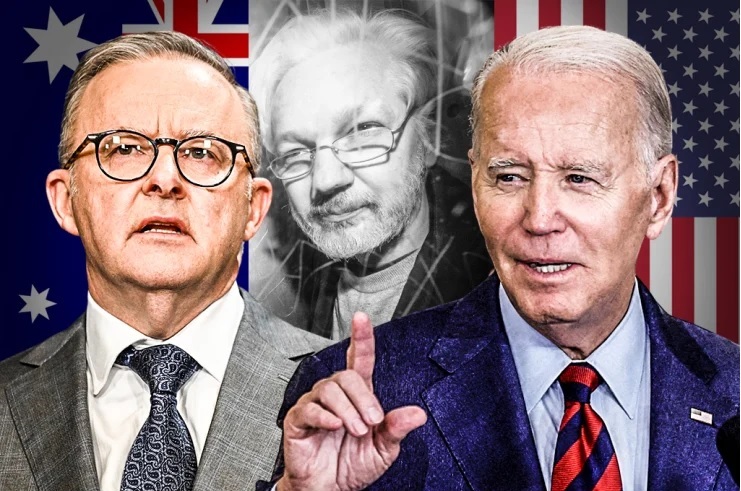
Joe Biden says he’s “considering” an end to the prosecution of Julian Assange. Anthony Albanese says, “enough is enough,” but not much else. Rex Patrick and Philip Dorling discuss the latest developments in the Assange case.
That’s the position behind the Government’s careful words about bringing the matter to a close.
At no point has the Australian Government called publicly for the espionage charges to be dropped and the extradition process to be ended.
A plea deal?
Last month, the Wall Street Journal reported the US Justice Department has been considering a proposed plea deal with Assange, dropping the espionage charges and allowing him to admit to a misdemeanour concerning the mishandling of classified documents.
According to the Journal the Justice Department was exploring ways to end the long London court battle as Assange continues to fight against extradition. It isn’t clear whether the move for a plea deal has come from Justice or Assange’s legal team. In any case, Assange’s lawyers said they’d been “given no indication” of any change in the US position.
President Biden may have been referring to the question of a plea deal as much as any representations from the Australian Parliament.
A plea deal might well be under consideration, but it’s clearly not a done deal yet, and a radical reduction in the charges, with Assange walking free in London and his time in His Majesty’s Prison Belmarsh taken into account, sounds like a big ask.
That dog ain’t barking…
One thing’s clear, however, Albanese hasn’t followed up on the parliamentary resolution with any personal diplomatic push on the Assange case.
One might have thought that Albanese would have directly engaged President Biden or else directed new representations across the top levels of the US Administration.
If that were the case, one would expect Albanese’s own Department to be closely engaged, working with DFAT and the Australian Embassy in Washington. Albanese is a careful, process-driven prime minister, so one would expect there to be PM&C briefing papers and correspondence. If absolutely nothing else one would expect there to be a Parliamentary Question Time Brief.
With such expectations, on March 7, 2024, Rex Patrick submitted a new FOI application for access to “PM&C submissions, talking points or other documents provided to Prime Minister Albanese between 1 February 2024 and 29 February 2024 that refer or relate to Julian Assange”.
Yesterday, the same day as Albanese’s latest comments that his government was using “all of our diplomatic efforts at every level”, PM&C provided their FOI response.
Dave Titheridge, head of the Department’s Global Interests Branch, advised: “I am refusing your request for access … as the documents you have requested do not exist”.
PM&C conducted an extensive search, including through its email system, Parliamentary Document Management System and electronic records repository and turned up nothing.
Nothing happening here – either before or after the parliamentary resolution.
Zero, zip, zilch, nada.
What’s next?
So, where does this leave Assange? His appeal options in London are nearly at an end. Perhaps his lawyers will finally get lucky. Perhaps President Biden is “considering” his case. Perhaps there will be a plea deal.
But Assange may well be extradited and spend decades rotting in a US maximum security prison. He might die there. He could also eventually come home, but as a prisoner in shackles, not as a free man.
Whatever happens, however, it won’t be down to a big effort – or barking – from the Albanese Government.
Supporters of Julian Assange were encouraged on Thursday by US President Joe Biden’s off-the-cuff- remark that his administration was “considering” an Australian request to end the espionage prosecution of the WikiLeaks founder.
Assange’s spouse, Stella Assange, called on Biden to “do the right thing” and “drop the charges”. Prime Minister Anthony Albanese said Australia was using “diplomatic efforts at every level to communicate that it is time that this was brought to a close, enough is enough.”
However, getting to the bottom of what governments do in the secretive world of diplomacy can often be akin to investigating a murder mystery. The clues are elusive and fragmentary. In the case of imprisoned Australian journalist Julian Assange, it’s a case of a dog that didn’t bark.
Parliamentary action
Media reports attributed the apparent shift in the US position to Albanese’s support for a parliamentary motion moved by independent MP Andrew Wilkie on February 14 that declared the Assange extradition proceedings have “gone on for too long” and “underline[d] the importance of the UK and USA bringing the matter to a close so that Mr Assange can return home to his family in Australia”.
Albanese said his government had supported the motion “because it is the right thing to do.” He added that he had raised the Assange case “at the highest levels” with the US and UK with “a calibrated and deliberate approach” that included discussions with Assange’s lawyers. In that context, the parliamentary resolution was “important… it’s important to send that message.”
Quiet diplomacy
It’s one thing to express support for “bringing the matter to a close”; but what does that mean in practice? For Assange supporters, it means the US dropping the prosecution and Assange returning to Australia as a free man.
However, the Albanese Government’s understanding and expectations are likely rather different.
FOI inquiries by Rex Patrick over the past eighteen months have shown that the Albanese Government’s track record on the Assange case has been patchy at best. The government’s “quiet diplomacy” has been minimalist. FOI applications directed toward the Department of Foreign Affairs and Trade, including Australia’s Embassy in Washington, have revealed little evidence of concerted diplomatic activity,
This isn’t to say that Albanese hasn’t raised the Assange case at the “highest levels.” He undoubtedly has, but it’s likely involved mentioning it as a politically awkward problem rather than a push to secure Assange’s freedom.
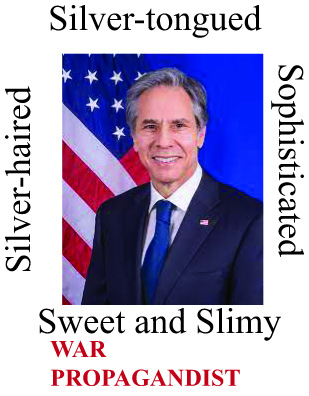
In response Secretary of State Antony Blinken made it publicly clear the US Government was most reluctant to intervene in the Justice Department’s prosecutorial process – an issue of obvious political sensitivity given the criminal charges brought against former president Donald Trump.
FOI inquiries also unearthed briefings for Attorney-General Mark Dreyfus that revealed a clear Australian Government policy to limit direct engagement on the Assange case until after he has been extradited to the United States, put to trial, convicted, sentenced and exhausted all appeal rights. Only then could Assange apply under the International Transfer of Prisoners scheme to serve a sentence of imprisonment in Australia. Only then would the Attorney-General formally consider that possibility,
Assange Extradition Case Moves Forward While The CIA Covers Its Tracks

CAITLIN JOHNSTONE, APR 17, 2024 https://www.caitlinjohnst.one/p/assange-extradition-case-moves-forward?utm_source=post-email-title&publication_id=82124&post_id=143660864&utm_campaign=email-post-title&isFreemail=true&r=1ise1&triedRedirect=true&utm_medium=email
So they’re really doing it. The Biden administration is really ignoring Australia’s request to end the case against Julian Assange, and they’re proceeding with their campaign to extradite a journalist for telling the truth about US war crimes.
In order to move the extradition case forward, per a British high court ruling US prosecutors needed to provide “assurances” that the US would not seek the death penalty and would not deprive Assange of his human right to free speech because of his nationality. The US provided the assurance against the death penalty (which they’d previously opposed doing), and for the free speech assurance they said only that Assange will be able to “raise and seek to rely upon” US First Amendment rights, adding, “A decision as to the applicability of the First Amendment is exclusively within the purview of the U.S. Courts.”
Which is basically just saying “I mean, you’re welcome to TRY to have free speech protections?”
At the same time, CIA Director William Burns has filed a State Secrets Privilege demand to withhold information in a lawsuit against the agency by four American journalists and attorneys who were spied on during their visits to Assange at the Ecuadorian embassy in London. State secrets privilege is a US evidentiary rule designed to prevent courts from revealing state secrets during civil litigation; the CIA began invoking it with the Assange lawsuit earlier this year.
Burns argues:
“I am asserting the state secrets and statutory privileges in this case as I have determined that either admitting or denying that CIA has information implicated by the remaining allegations in the Amended Complaint reasonably could be expected to cause serious — and in some cases, exceptionally grave — damage to the national security of the United States. After deliberation and personal consideration, I have determined that the complete factual bases for my privilege assertions cannot be set forth on the public record without confirming or denying whether CIA has information relating to this matter and therefore risking the very harm to U.S. national security that I seek to protect.”
Which is obviously a load of horse shit. As Assange himself tweeted in 2017, “The overwhelming majority of information is classified to protect political security, not national security.” Burns isn’t worried about damaging “the national security of the United States,” he’s worried about the potential political fallout from information about the CIA spying on American lawyers and journalists while visiting a journalist who was being actively targeted by the legal arm of the US government.
Political security is also why the US is working to punish Julian Assange for publishing inconvenient facts about US war crimes. The Pentagon already acknowledged years ago that the Chelsea Manning leaks for which Assange is being prosecuted didn’t get anyone killed and had no strategic impact on US war efforts, so plainly this isn’t about national security. It’s just politically damaging for the criminality of the US government to be made public for all to see.
They’re just squeezing and squeezing this man as hard as they can for as long as they can get away with to keep him silent and make an example of him to show what happens when journalists reveal unauthorized information about the empire. Just like Gaza, the persecution of Julian Assange makes a lie of everything the US and its western allies claim to stand for, and reveals the cruel face of tyranny beneath the mask of liberal democracy.
Iran Closes Nuclear Sites Fearing Israeli Attack: IAEA Chief
Tuesday, 04/16/2024 Iran International Newsroom, https://www.iranintl.com/en/202404162504
Iran shut down its nuclear facilities last Sunday over “security considerations,” UN nuclear chief Rafael Grossi has said, expressing concern over the “possibility” of an Israeli attack on Iran’s nuclear sites.
Speaking to reporters in New York on Monday, IAEA Director General confirmed that the facilities had reopened within 24 hours, but with no IAEA supervision, as the agency has decided to keep its inspectors away until the situation is “completely calm.”
Grossi was referring to rising tensions between Israel and Iran, which many fear may lead to an all-out war between the two countries and potentially engulf the whole Middle East.
Israel bombed Iran’s consulate in Damascus on 1 April, killing seven members of the Islamic Revolution’s Guards Corpse (IRGC), including a high-ranking commander and his deputy. Iran retaliated on 13 April, launching more than 300 missiles and drones towards Israel –all but a few of which were intercepted by Israel and its allies.
On Monday, Israeli officials vowed to respond to the attack. When asked about the possibility of Israel hitting Iran’s nuclear sites, Grossi said, “We are always concerned about this possibility.” He urged both sides to show “extreme restraint”.
Grossi also reiterated the IAEA’s concerns about Iran’s nuclear program.
“A bit more than a year ago, I went to Tehran and signed a joint declaration with the Iranian government indicating a number of actions that we will be taking together with Iran,” Grossi said. “We started that process and that process was interrupted. And I have been insisting that we need to go back to that understanding that we had in March 2023.”
In September 2023, Iran withdrew the designation of several inspectors assigned to conduct verification activities in Iran under the Non-Proliferation Treaty Safeguards Agreement. Iran’s nuclear chief Mohammad Eslami later claimed that those expelled had had a history of “extremist political behavior”.
“We are always urging, asking and requiring Iran to cooperate with us in full,” Grossi told Iran International’s Maryam Rahmati. “It’s not that we are not there, but we are not there at the level that we consider we should be.”
The IAEA reported in February that Iran is enriching and stockpiling near-weapons-grade uranium, warning that such elevated purity cannot be explained by civilian applications.
When asked about Iran’s enrichment levels by Iran International, Grossi siad, “the fact that there is an accumulation of uranium enriched at very, very high levels does not automatically mean you’re having a weapon…but it raises questions in the international community.”
Iran has always denied seeking nuclear weapons, but no other state has enriched to that level without producing them.
A report published last month by the Institute for Science and International Security claimed that Iran is moving ahead with building a nuclear site deep underground near Natanz.
“This Iranian nuclear weapons-making facility could be impervious to Israeli and perhaps even American bombs,” Foundation for Defense of Democracies CEO Mark Dubowitz said at the time. “Time is quickly running out, as Iran moves into a zone of nuclear immunity, to deny the regime permanent use of this deadly site.”
Iran President Warns of ‘Massive’ Response if Israel Launches ‘Tiniest Invasion’
Rex Patrick has dug into how Pistol Pete Dutton reached his nuclear conclusions.
In September 2020, the Morrison Government released a Low Emissions Technology Statement that placed Small Modular Reactors (SMR) on a list of watching brief technologies. SMR developments were to be monitored to see if they might play a part in Australia’s energy future.
Iranian President Ebrahim Raisi warned on Wednesday that the “tiniest invasion” by Israel would bring a “massive and harsh” response, as the region braces for potential Israeli retaliation after Iran’s attack over the weekend.
Raisi spoke at an annual army parade that was relocated to a barracks north of the capital, Tehran, from its usual venue on a highway in the city’s southern outskirts. Iranian authorities gave no explanation for its relocation, and state TV did not broadcast it live, as it has in previous years.
Iran launched hundreds of missiles and drones at Israel over the weekend in response to an Israeli strike on Iran’s embassy compound in Syria on April 1 that killed 12 people, including two Iranian generals.
Israel successfully intercepted nearly all the missiles and drones.
It has vowed to respond, without saying when or how, while its allies have urged all sides to avoid further escalation.
Raisi said Saturday’s attack was a limited one, and that if Iran had wanted to carry out a bigger attack, “nothing would remain from the Zionist regime.” His remarks were carried by the official IRNA news agency.
1 This month

of the week – Australians for War Powers Reform (AWPR)
To see nuclear-related stories in greater depth and intensity
 Antinuclear