Ukraine war – the changing face of weaponry
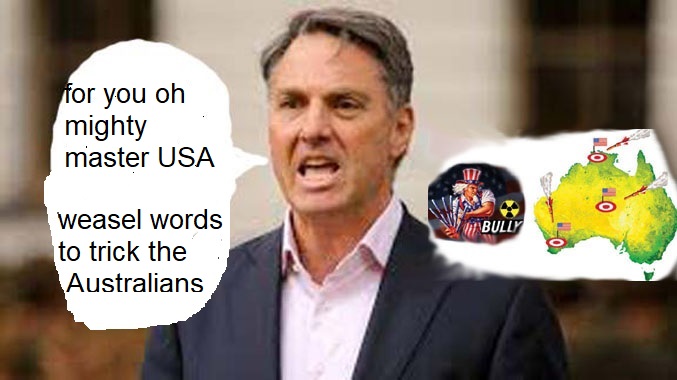
I mused today on the lovely words of the lovely war-mongering Australian Minister for Defence – Richard Marles. He’s nearly as good as that USA smarm master Antony Blinken – in choosing the nicest words to cover nasty stuff.
Today he was talking about Australia sending $millions to Ukraine – for:
uncrewed aerial systems air-to-ground precision munitions spurring on competition among Western nations to harness technology and drive down the equipment’s production cost.
All these weasel words sort of obscure the reality that one big goal is to support the American, Australian, and even Israeli weapons companies. Yes – Israel. In February, the Israeli company Elbit Systems received a A$917 million contract from the Australian Defence Department.
The other goal is to be part of American militarism and its experimental work in Ukraine.
You see – the beauty of the Ukraine war, for America, is that there should be no American lives at risk. Tough about the Ukrainian lives, (and of course the thousands more Russian soldiers’ lives don’t count).
But this is a sort of experimental interim-type war – between having troops of soldiers getting killed and just having heaps of civilians getting killed, (and seeing if America can win by having no persons at risk in it).
World War 1 was the classic – the ultimate war for killing soldiers. – estimated 9.7 million and also 10 million civilians
World War 2 an even bigger killer of soldiers – 20 million, but also 40 million civilians – an “improvement” in killing civilians.
The “in-between” wars – Korea, Vietnam, Iraq, Afghanistan – have still been a mixture of killing soldiers and civilians – but especially with the Afghanistan war – the emphasis shifted towards drone killings, with the officer directing the killing from the distant comfort of an office in USA.
So – getting back to the lovely Marles – he avoided words like “drones” and “missiles” – thus sort of obscuring the fact that Australian weapons are headed right into Russian territory as part of an American long distance attack. Of course, it is called defence – though it is not at all clear that Australia is under military threat from Russia.
Anyway, Ukraine is a good practise ground for deploying weapons that can kill civilians of another country. The weapons-makers are getting better and better at this. The Biden administration last month secretly shipped long-range missiles to Ukraine. The newest 1$billion package will include additional long-range ATACMS. Nuclear weapons might be deployed in Poland. Biden administration’s $850 billion defense budget request for fiscal year 2025 includes $69 billion for nuclear weapons.
It’s all great fun. USA will be able to more or less comfortably fight another country (? China) without putting any “boots on the ground”, (except perhaps a few Taiwanese boots – but after all, they’re not even being worn by white feet, so – no matter, really)
The only fly in the ointment is that American militarism is causing a reaction in other countries. They have populations and leaders who feel that they will have to reciprocate. And they too have gee-whiz clever men with little-boy minds who devise killing machines.
It is truly a vicious circle. There’s a lack of leaders with wisdom. But no shortage of the mealy-mouthed Marles and Blinkens who make it sound as if everything is OK.
Dutton’s nuclear policy backfires
Mike Seccombe The Saturday Paper, 27 Apr 24
This much can be said for Colin Boyce: he is not one of the federal Coalition’s nuclear nimbys. He would, if necessary, agree to have a nuclear power station in his electorate…………………………………………………..
Opposition Leader Peter Dutton’s announcement on March 12 that the Coalition would “shortly” announce about six sites across the country where nuclear reactors could be built forced the issue. Dutton’s plan would put them in places where coal-fired power stations were closing down.
The promised announcement of potential nuclear sites has been pushed progressively further into the future. Initially it was expected within a couple of weeks, then before the federal budget on May 14. Last Sunday, on the ABC’s Insiders program, Dutton would not commit to a pre-budget announcement, improbably blaming the recent stabbing incidents in Sydney for the delay.
On Tuesday this week, Nationals leader David Littleproud told Sky News the Coalition parties were “not going to be bullied into putting this at any time line, but you will see it before the election”.
Whenever the announcement does eventually come, Boyce’s central Queensland electorate, Flynn, is likely to be on the list.
Boyce’s acceptance of nuclear power in his electorate is not so much an endorsement of the policy being pushed by his leaders as an acceptance that he has no other choice.
Flynn, twice the size of Tasmania and dotted with coalmines and gas wells, produces vast amounts of energy, most of which is shipped overseas.
………………………………………………………………….. Boyce says, probably correctly, “ there will be no coal-firedpower stations in Queensland operational after 2035”.
He is not happy about that and is even less happy that the state opposition supported the government’s legislated target, for he has never accepted the need to stop burning fossil fuels.
Before his election to federal parliament, Boyce served five years in the Queensland parliament, representing the coal seat of Callide. There, he argued for the construction of more coal-fired power stations. He denied the reality of human-induced climate change.
Opposition to fossil fuels, he told state parliament on June 17, 2021, was “driven by the mind-numbing, eco-Marxist Millennials and upper middle-class ‘wokes’ who have been indoctrinated with some quasi-religious belief that coal is bad and carbon dioxide is poisoning the planet”.
……………………………………………………………………. Even within the Coalition’s ranks there are some who see the move as being at least as much an attempt to address a political problem as to address the climate crisis, although most will not say so publicly.
Bridget Archer will, however. The Tasmanian MP – one among a much-depleted cohort of moderate Liberals after the 2022 election – issued a warning to her colleagues via the pages of the Nine newspapers last month that nuclear energy should not be put forward as an alternative to wind and solar.
“There is no point even having a nuclear discussion if you don’t accept a need to decarbonise, to transition away from coal and gas,” she said. “There only is a case for nuclear if there is a fairly rapid transition to large-scale renewables, otherwise why are you doing it?”
She then answered her own question: “I think part of the reason for having the discussion is to keep people in the tent on net zero.”
Others privately assess the motivations of the federal Coalition leadership more harshly. They suggest it’s not primarily about getting nuclear up but about slowing the transition to wind and solar and thereby extending the life of fossil fuels in power generation.
Certainly, the chances of getting the federal parliament to greenlight a domestic nuclear industry are remote. For about 25 years, nuclear power has been prohibited by law in Australia, and it was the Howard Coalition government that banned it, under a 1998 deal with the Greens to get other legislation through the Senate.
Given the ever-growing proclivity of Australian electors to give their votes to progressive independent candidates and Greens, there is a good chance neither major party will win majority government at the next election. Even if the Coalition did win the House of Representatives, it almost certainly would not gain a majority in the Senate. Unless Labor recanted on its vehement opposition to nuclear power, Dutton’s plan would fall at the first hurdle.
……………………………………. the available evidence suggests even those members of the federal Coalition parties who publicly spruik the Dutton policy lack the courage of their convictions.
Last month, shortly after Dutton made his big announcement, reporters for the Nine papers contacted a dozen of them.
“Twelve opposition MPs have publicly backed lifting the moratorium on nuclear power in Australia but will not commit to hosting a nuclear power plant in their own electorate,” their story began
……………………………………………….. Two points. First, the Coalition plan no longer involves small modular nuclear reactors, but instead would rely on building traditional large plants. Second, the polling to which Littleproud referred actually showed a lot of people were woefully misinformed about the cost of nuclear power.
When asked to rank sources of energy “in terms of total cost including infrastructure and household price”, 40 per cent of respondents thought solar and wind power were the most expensive, compared with 36 per cent who thought nuclear was, and 24 who picked coal and gas. Fully one third of respondents thought nuclear was the cheapest option.
They are spectacularly wrong. According to the most recent GenCost report – the annual collaboration between the Australian science agency CSIRO and the Australian Energy Market Operator (AEMO) – SMRs are by far the most expensive way of generating electricity. The “levelised cost” of power from an SMR would be $382 to $636 per megawatt hour, while solar and wind would cost between $91 and $130 per MWh.
The Dutton response was to attack the experts. He claimed GenCost underestimated the cost of renewables because it did not include expenditure on the transmission infrastructure required to integrate them into the grid.
This was untrue, as the report’s authors promptly made clear. Dutton was undeterred, however, which in turn saw the chief executive of the CSIRO, Douglas Hilton, release an open letter defending the importance of independent scientific endeavour.
Last Tuesday, the same day as Littleproud went on Sky News and maintained the falsehood that nuclear power was cheaper than wind and solar, another report was released, further confirming more wind and solar energy was simultaneously lowering both prices and emissions from the electricity sector.
The quarterly Energy Dynamics report from the energy market operator showed that in the first three months of this year, renewables provided 39 per cent of power in the east coast power grid, almost 2 per cent more than in the corresponding period last year.
……………………………..“We are increasingly seeing renewable energy records being set which is a good thing for Australian consumers as it is key in driving prices down and NEM [National Electricity Market] emissions intensity to new record lows,” AEMO’s executive general manager of reform delivery, Violette Mouchaileh, said in a media release accompanying the report…………………………………………………………………………………… more https://www.thesaturdaypaper.com.au/news/politics/2024/04/27/duttons-nuclear-policy-backfires
How much will the UK’s new nuclear submarines really cost?

The terrible truth is that nobody knows how much this will cost.
25th April
What does it cost, and how many jobs does it actually create? This is
especially important now with the next generation of nuclear-powered
submarines, the “Dreadnought” class, starting construction.
When the UK Government announced the programme to replace the current Valiant class
boats, the cost they announced in Parliament, £31 billion, was to build
four submarines.
This is as disingenuous as announcing the cost of a
revamped NHS as the cost to build four hospitals. The total cost of
ownership over the projected 30-year lifespan is much larger.
We have reached a figure of over £600bn. Shocking? Indeed. Surprising? Compared to
what, the HS2 rail link? The terrible truth is that nobody knows how much
this will cost. The annual report of the government’s own
“Infrastructure and Projects” authority has a lot of bad news,
including a “red” score for the development of the Dreadnought boats’
new engines. In short, this means it can’t be done. Sounds expensive.
The National 25th April 2024
https://www.thenational.scot/politics/24277002.much-will-uks-new-nuclear-submarines-really-cost
Nuclear Power’s Lethal, Larcenous End Game

BY HARVEY WASSERMAN 26 Apr 24
For the first time since 1954, no large new atomic reactors are under construction or on order in the United States.
On March 1, 2024, Vogtle Unit 4 connected to the Georgia grid …years behind schedule and billions over budget. Once hyped as “too cheap to meter,” America’s last large light-water reactor thus forever froze the “Peaceful Atom” in financial failure.
Despite enormous public hype and subsidies, ZERO new US atomic reactors—large or small— are likely to become significantly available here for at least a decade.
The first will likely be an unproven “Small Modular Reactor” prototype already leaning toward a trillion-dollar failure.
***
When it comes to the myth of nuke power helping to fight global warming…there’s no there there.
Atomic reactors cause climate chaos. Some 415 reactors directly heat our air and water in concert with mega-explosions like Chernobyl and Fukushima. All pour radioactive carbon 14 into a lethal brew of filth and wastes.
Despite the latest round of “Nuclear Renaissance” hype, the US lacks the industrial capacity to produce impactful new reactors—large or small— before 2030, if then.
The void comes when we most desperately need to reduce carbon emissions. The mega-grift for unproven new nukes cripples the vital transition to renewables, multiplying the planet-killing impacts of fossil fuels…and of decrepit old reactors whose average age is now over 40.
The original fantasy that the “Peaceful Atom” would be “too cheap to meter” came from Atomic Energy Commission Chair Lewis Strauss, played by Robert Downey, Jr., in “Oppenheimer.”
Harry Truman’s 1952 Paley Commission Report on the future of energy had predicted an epic boom in renewables, including 15,000,000 solar heated US homes by 1975.
But in December, 1953, President Eisenhower—in a remarkably war-like speech—told the United Nations that “Atoms for Peace” would limitlessly power the planet.
On September 6, 1954, the Navy and Westinghouse began building the first US commercial reactor, which opened at Shippingport, Pennsylvania, on May 26, 1958.
In 1974 Richard Nixon promised a thousand US reactors by the year 2000. There were in fact 104. With Vogtle 4’s opening, there are now 94—and none on order or under construction.
Atomic power has become what Forbes Magazine called in 1985 “the largest managerial disaster in business history, a disaster on a monumental scale.”
A 2014 study of 180 nukes worldwide said 175 of them cost 117% more than promised, while going 64% beyond schedule.
Despite the early hype, the Peaceful Atom’s financial catastrophes are too frequent to count, and with price tags too huge to compile, including…
X the 1966 “We Almost Lost Detroit” accident at Michigan’s Fermi I, costing at least $100 million;
X the 1979 Meltdown at Three Mile Island, which—aside from killing innumerable downwinders—converted a $900 million asset to a $2 billion liability;
X the 1983 Washington Public Power System’s $2 billion pubic bond default, the first of its kind, killing four reactors then under construction;
X Sacramento’s 1989 landslide vote to shut the municipal utility’s money-losing Rancho Seco reactor, where surrounding solar panels (unlike the dead nuke) still produce juice;
X the Public Service of New Hampshire’s 1988 dump of Seabrook Unit Two, fueling the first investor-owned utility bankruptcy since the Great Depression;
X the 1998 failure of New York’s never-to-operate $7 billion Shoreham, which shattered the Long Island Lighting Company;
X the 2017 collapse of South Carolina’s VC Summer, whose $9 billion dead loss joined Vogtle’s $20 billion cost overrun to bankrupt Westinghouse;
X NuScale’s 2023 SMR collapse in Idaho, fusing into financial failure the industry’s ever-escalating crises in safety, seismic instability, un-insurabililty, heat and radiation emissions, terrorism, war.
Massive explosions at Russia’s Kyshtym and New Mexico’s Waste Isolation Pilot Project underscore the industry’s unsolved waste management problem. So does radioactive devastation at California’s Santa Susanna and the Hanford Nuclear Reservation in Washington State.
After seven decades of experience, massive 21st century catastrophes continue in the US, Finland, France, England.
Westinghouse’s Summer/Vogtle bankruptcy follows 70 years of a “negative learning curve.”
Finland’s Olkiluoto, France’s Flamanville and England’s double reactor project at Hinckley Point are all hugely over budget and years behind schedule. Olkiluoto has occasionally shut to make way for cheaper wind and hydro.
Many of France’s flagship 56 reactors regularly curtail their output for generic repairs…or as rivers become too global-heated to cool the cores without serious downstream eco-damage.
But Germany’s 2023 final reactor closures allow more than half its power to come more cheaply and reliably from renewables.
California’s similar-sized economy now often gets 100+% of its power from renewables, dwarfing remnant double reactors at Diablo Canyon, now costing $1+ billion/year over market.
Undaunted, Brussels’ World Nuclear Summit just hyped a tripled global fleet, calling for investments beyond $5 trillion to fund a production schedule than many believe is simply impossible.
The international banking response has been a grim “Just Say No”…accompanied by a vote of confidence in a renewable future.
But most terrifying is the demand that decrepit reactors (average age 42+) operate without meaningful inspections or insurance…………………………………………. https://www.counterpunch.org/2024/04/26/nuclear-powers-lethal-larcenous-end-game/
1 This month
15 April – Zoom –Nuclear Power is Not the Solution
Apr 15, 2026 01:00 AM in Canberra, Melbourne, Sydney

Join the International Physicians for the Prevention of Nuclear War (IPPNW) on Tuesday, April 14th for a timely webinar exploring the risks associated with nuclear power and challenging the myth that it offers a simple, safe, carbon-free solution to the climate crisis

of the week – Australians for War Powers Reform (AWPR)
To see nuclear-related stories in greater depth and intensity
 Antinuclear