TODAY. What is special about “Turning Point -The Bomb and Cold War”?

“This is the most important turning point of the human race.“
EPISODE 1 – The Sun Came Up Tremendous
This Netflix series is well researched, and visually brilliant. What makes it so different, and remarkable, is its study of the psychological aspect, especially the powerful effect of mass psychology.
Like all historical documentaries, it’s all about the men. However, Ironically, Lisa Meitner, discoverer of nuclear fission, does get a mention. But still they don’t mention that this illustrious nuclear physicist was invited to join the Manhatton Project, but refused – “would have nothing to do with a bomb”
By the way – this documentary uses authentic film and dialogue. I was impressed to see how accurately the ‘”fictionalised” version – the film “Oppenheimer”, had portrayed the people and the events – uncanny likenesses in several cases.
**********************************************
Cold war – it’s a state of conflict with a nuclear-armed opponent, functionally hostile to each other where you can’t get at each other. We’re in a new cold war with the Russians.
The Ukraine war brings the return of the cold war.
*************************************
Cold war at its peak, touched every country. The Cold War set off an arms race, for the first war that could destroy civilisation. The Bomb disrupted international relationships. It brought new scale of awfulness. There have been close shaves – we were lucky.
“once humans stop seeing each other as humans, the most horrific acts are possible”
This episode covers the history of the bomb, from the discovery of nuclear fission by Lisa Meitner and Otto Hahn 1938. That lead to Oppenheimer forming the idea of the bomb
With the rise of Hitler came the fear of a 1000 year Reich armed with atomic bombs? Einstein was alarmed and encouraged Roosevelt to develop the atomic bomb. Germany and Russia formed a non aggression pact. Then the Japan dictatorship joined them.
The 1941 Japanese attack on Pearl Harbour hastened the Manhattan Project in USA to build the bomb Russia joins Britain, France and USA – as Germany invades Russia. The USA sends weapons to Russia.
In 1942 control of Manhattan Project was turned over from the scientists to the military . General Groves picks Oppenheimer. Secrecy ++. Aim was to beat Hitler
Roosevelt dies April 1945. Truman knows nothing about the Manhattan Project. Henfy Stimson, Secretary of war warns President Truman in a ‘memo – “What is the world going to look like, after an atomic bomb is used?”
This is the most important turning point of the human race.
Truman’s next task :- the war against Japan could last for months, years, How to galvanise public opinion – the enormous task of making the Americans hate the Japanese enough. to fight them in a war. Germans were depicted as sinister enemies – but they were still seen as icy human beings- but the Japanese were portrayed as a sub-species.
Leading up to the bomb- USA fire-bombed Tokyo – 87000 killed -people burned like matchsticks. Then Battle of Okinawaa – 12000 US soldiers killed
Truman needed to find a way to end a war without an invasion – at the lowest cost to American lives. Already there’d been 65 million deaths in WW2. People thought of a quick ending as a deliverance. The hastily tested the atomic bomb in the Mexican desert -Trinity test. New Mexicans werecnot evacuated, At a girls’ dance camp 40 mikes away- white ash – “hot snow” – their health seriously affected;
There was general relief that the bomb worked.
Oppenheimer reacted – “We knew the world would never be the same – I am become death – the destroyer of worlds”.
The Potsdam conference brought up the idea of the arrangements for the end of the war in Japan. Following the division of Berlin., Truman didn’t want division of Japan, was keen to get the war over. Churchill said, on hearing of the atomic bomb – “Now we can tell the Russians where to get off”
Truman sought unconditional surrender from Japan. There was a prevailing hatred between the US and Japan.
We see and hear the tragic personal stories of Japanese-Americans – in concentration camps – the racial factor against Japan
Atomic bomb was aimed to convince the Japanese to surrender. Hiroshima was not a military site – 90% civilians.
Here again -compelling Personal stories. Excellent film footage of the bombing and its results. The fireball had a core temperature of several million degrees – ferocious heat unleashed on the city – survivors burnt – severe burns. Rivers littered with corpses. horrendous injuries due to black rain.
Nagasaki Fat Man was a plutonium bomb. Again – Fearful shots of injuries.
Truman initially was thrilled – but learning of reports from Hiroshima and Nagasaki, changed – ordered no further bombs with president’s authorisation.
The dispute over Truman’s choice to use the atomic bomb. Truman’s advisor Stimson wrote that Japan was effectively beaten. No need to use the atomic bomb.
It was dropped in non-military cities The atom bomb was the first strike in the cold war? When the Russians came in, that would end the war. It was not a question of ending the war. It’s a brutal question of ending the war without the Russians The USA desperately wanted to end the war before the Russians got to Japan.
That is certainly not the dominant point of view. There was overwhelming support, especially in the USA for the use of the bomb. A strong feeling of vengeance,
But then – from 1946, there were voices, including senior military voices, that the use of the bomb was not necessary
The wartime alliance with the Soviet Union broke down quickly
The Soviet Union now controlled half of Europe. In a strong position? The bomb introduces a whole new element of uncertainty into the balance of power. Stalin’s decree: 2 weeks after the Hiroshima bombing Stalin signs a decree “Build the bomb as soon as possible”
USA, Europe Russia lurch towards the cold war – A cold war, not a hot one, because these weapons could never be used
Now instead of direct war – there would be economic rivalry, and proxy wars across the world. The driving force became fear.
How long does it take to build a nuclear reactor? We ask France

Sophie Vorrath, May 8, 2024, https://reneweconomy.com.au/how-long-does-it-take-to-build-a-nuclear-reactor-we-ask-france/
A short answer to this question might be, it depends who you ask. Ask Opposition leader Peter Dutton, for instance, and he will tell you a federal Coalition government under his leadership could have a nuclear power plant up and running in Australia within a decade.
Ask the highly experienced French state-owned nuclear power giant EDF, which manages 56 reactors in the world’s most nuclear dependent country, and you would get rather a different answer.
Bloomberg reports that EDF this week got regulatory approval to start up its newest nuclear reactor, the 1.6GW Flamanville plant in France’s north west – a milestone that is 12 years behind schedule and more than four times over budget, thanks to a range of construction problems including concrete weakness and faulty pipe welds.
The green light allows EDF to load the fuel in the reactor, proceed with trials, then begin operations, the Autorite de Surete Nucleaire said in a statement on Tuesday. Further approvals will be needed upon reaching key milestones during the trial phase, the regulator said.
According to other reports, EDF said last month it hoped to connect the Flamanville pressurised reactor to the national grid by the European summer and reach full power by the end of the year.
But it will not be smooth sailing from there. A faulty vessel cover still needs replacing at the plant, with reports suggesting this has been pushed out to 2026, when the plant would be shut down for up to a year.
Meanwhile, EDF in March raised its cost estimate for the construction of six new nuclear reactors to €67.4 billion ($A102.5 billion), Reuters has reported, up from the company’s first estimated their cost of €51.7 billion.
So, how long does it take to build a nuclear reactor?
Kobad Bhavnagri, Bloomberg New Energy Finance’s energy expert and global head of strategy says the long delay and cost blowout at Flamanville 3 is not an isolated incident.
“Very similar delays and multifold cost blowouts have occurred with recent reactor builds in the UK, Finland and USA,” Bhavnagri writes on LinkedIn.
“Countries with well established nuclear industries.
“The lesson here? Don’t believe anyone who says they know how much it will cost and how long it will take to build a new nuclear plant (unless they are in China).”
Radiation Protection Agency to Decide on Facility Licence Soon
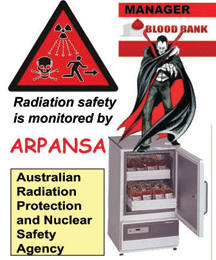
https://www.miragenews.com/agency-to-decide-on-facility-licence-soon-1231158/ 8 May 24
Australian Radiation Protection and Nuclear Safety Act 1998
Australian Radiation Protection and Nuclear Safety Regulations 2018
As required by subsection 48(2) of the Australian Radiation Protection and Nuclear Safety Regulations 2018, the CEO of ARPANSA gives notice that she intends to make a decision under section 32 of the Australian Radiation Protection and Nuclear Safety Act 1998 regarding the following application for a facility licence:
Application No A0346 by the Australian Submarine Agency to prepare a site for a prescribed radiation facility (namely a low level waste management and maintenance facility) to be known as the ‘Controlled Industrial Facility’ at the existing HMAS Stirling site, at Garden Island, Rockingham in Western Australia.
ARPANSA regulates Commonwealth entities that use or produce radiation and is responsible for regulation of relevant activities undertaken by the Australian Submarine Agency until a dedicated naval nuclear power safety regulator is established.
An overview of this licence application is now available for public comment through our Consultation Hub. Submissions close at 11:59pm on 7 June 2024.
Have your say by completing the online survey or visit the ARPANSA Consultation Hub
12 years behind schedule, France’s Flamanville 3 nuclear plant gets regulatory approval for trial period

Electricite de France SA got regulatory approval to start up its new
nuclear reactor 12 years behind schedule after the utility faced
construction problems ranging from concrete weakness to faulty pipe welds.
The green light for commissioning of the Flamanville 3 nuclear plant
located in Northwestern France allows EDF to load the fuel in the reactor,
proceed with trials, then begin operations, the Autorite de Surete
Nucleaire said in a statement on Tuesday.
Further approvals will be
required when reaching key milestones during the trial phase, the regulator
added said. Once connected to the grid, the 1.6-gigawatt plant called a
European Pressurized Reactor will join EDF’s fleet of 56 reactors in
France, which accounted for about two-thirds of the country’s power
production last year.
Bloomberg 7th May 2024
NATO escalation in Ukraine threatens nuclear war with Russia
Now, however, Macron says NATO aims not to seek a negotiated peace, but to force the Russian military to assume that NATO may adopt the most aggressive possible policy. This includes possibly launching not only a large-scale land invasion of Russia, but also—since France, Britain and the United States all refuse to rule out initiating the use of nuclear weapons in a war—a pre-emptive nuclear strike on Russian forces in Ukraine or on Russian cities.
It is high time for Biden and his NATO colleagues to tell the people that their pursuit of “victory in Ukraine” means risking nuclear war
Alex Lantier, 6 May 2024 https://www.wsws.org/en/articles/2024/05/07/qtgn-m07.html
There are growing indications that NATO’s war against Russia is entering a new stage of escalation that threatens to lead to the use of nuclear weapons. Top NATO officials are publicly talking about resorting to missile strikes and ground war against Russia, while Russian officials are warning they may launch counter-strikes on NATO countries.
Last week, 100 artillerymen and surveillance specialists of the French Foreign Legion were deployed to the front lines at Slavyansk in Ukraine, according to a report by former US Undersecretary for Defense Stephen Bryen in the Asia Times. Bryen said a further 1,500 French Foreign Legionnaires could soon deploy to Ukraine. He wrote that one consequence of this is “potentially triggering a pan-European war.”
While the French Foreign Ministry denied Bryen’s report, it is in line with President Emmanuel Macron’s previous calls for a ground war with Russia. Macron and other top NATO officials are now reasserting these comments in an aggressive press campaign. Last week, in The Economist, Macron again demanded that NATO be ready to send ground troops to Ukraine:
If the Russians were to break through the front lines, if there were a Ukrainian request—which is not the case today—we would legitimately have to ask ourselves this question.
This weekend, the Italian daily La Repubblica reported on further NATO war plans. It cited secret NATO agreements allegedly defining two “red lines,” Belarus’ entry into the war and a Russian “provocation” targeting Poland, Hungary or the Baltic States. If either of these “red lines” were crossed, NATO would mobilize 100,000 troops across Eastern Europe, from the Baltic states to Romania.
Also, last Thursday, UK Foreign Minister David Cameron went to Kiev, where he said Ukraine has the “absolute right” to use British long-range missiles to bomb Russia.
This weekend, Macron told the French financial newspaper La Tribune that NATO must create total uncertainty about its actions in Russia’s military command:
President Putin has constantly brandished the nuclear threat. Faced with such an adversary, it is such an act of weakness to give a priori limits on one’s own actions! We must on the contrary deny him any idea of what we might do. This is how we can deter him from taking action.
Macron’s statements illustrate the mood of utter recklessness prevailing in ruling circles. During the Cold War, US and Soviet officials installed an emergency hotline between the White House and the Kremlin, fearing that nuclear war could erupt accidentally if one side misread the intentions of the other and believed the opponent had launched a nuclear strike. On September 26, 1983, this nearly occurred, when Soviet early warning systems falsely indicated that US forces had launched nuclear missiles at the Soviet Union.
Now, however, Macron says NATO aims not to seek a negotiated peace, but to force the Russian military to assume that NATO may adopt the most aggressive possible policy. This includes possibly launching not only a large-scale land invasion of Russia, but also—since France, Britain and the United States all refuse to rule out initiating the use of nuclear weapons in a war—a pre-emptive nuclear strike on Russian forces in Ukraine or on Russian cities.
Whether or not French troops are already deployed in Ukraine, the Kremlin is clearly taking these reports seriously. The “strategic ambiguity” Macron said he wanted to build in NATO relations with Russia has been established. Increasingly convinced that NATO may catastrophically escalate the conflict, Russian officials are calling to prepare the most drastic measures in response, creating conditions for a disastrous escalatory spiral in the war.
Yesterday, the Kremlin announced that it would hold military exercises simulating the use of nuclear weapons. Kremlin spokesman Dmitri Peskov called the nuclear exercises a response to an “unprecedented stage in the escalation of tensions initiated by the French president and the British foreign secretary,” including “an intention to send armed contingents to Ukraine—that is, to actually put NATO soldiers in front of Russian troops.”
Extraordinary warnings emerged after the Russian foreign ministry summoned the British and French ambassadors yesterday to protest the statements of Cameron and Macron.
It warned UK Ambassador to Russia Nigel Casey that Cameron’s statements made Britain “a de facto party to the conflict” between Ukraine and Russia, the Guardian wrote. “Casey was told that in response to Ukrainian attacks on Russian territory with British weapons, any British military facilities and equipment on the territory of Ukraine and abroad could be targeted,” the Russian Foreign Ministry said.
Yesterday, on his Telegram channel, former Russian President Dmitri Medvedev bluntly stated that if NATO continues on its course, Russia could bomb Washington, Paris and London amid a “world catastrophe.” Medvedev wrote:
There is some kind of total degradation of the ruling class in the West. This class really does not want to logically connect elementary things. Sending your troops to the territory of Ukraine will entail the direct entry of their countries into the war, to which we will have to respond. And, alas, not only in the territory of Ukraine.
In this case, none of them will be able to hide either on Capitol Hill, or in the Elysée Palace, or in 10 Downing Street. A world catastrophe will come.
On May 4, introducing the International Committee of the Fourth International’s (ICFI) May Day online rally, David North warned of the danger that the NATO war against Russia in Ukraine could escalate into a nuclear world war. Citing US-UK pledges to arm NATO’s Ukrainian puppet regime with long-range missiles that can strike major Russian cities, North said:
But what if Putin, invoking the precedent set by President John F. Kennedy during the Cuban missile crisis in 1962, declares, paraphrasing Kennedy’s warning, that attacks on Russian territory by Ukraine with missiles supplied by NATO “will be regarded as an attack” by NATO upon Russia, “requiring a full retaliatory response” upon NATO countries?
It is high time for Biden and his NATO colleagues to tell the people that their pursuit of “victory in Ukraine” means risking nuclear war and describe in necessary detail what will happen to their countries and the world if the confrontation with Russia goes nuclear.
There was no trace of exaggeration in this warning, which has been confirmed in barely three days.
The strongest possible appeal must be made to workers and youth around the world: If the working class does not intervene against the capitalist governments to stop this escalation, one or another confrontation will ultimately escalate into nuclear war.
The greatest danger is that masses of workers and youth are not fully aware of the urgency of the risk of a catastrophic global war. They must be alerted and mobilized through an international movement of meetings, protests and strikes, aiming to build a mass, socialist anti-war movement in the international working class.
Fusion reactors could create ingredients for a nuclear weapon in weeks

Concern over the risks of enabling nuclear weapons development is usually focused on nuclear fission reactors, but the potential harm from more advanced fusion reactors has been underappreciated
By Alex Wilkins, 8 May 2024
Fusion reactors could allow a country to accelerate its development of nuclear weapons, producing the necessary radioactive ingredients in as little as a few weeks.
Nuclear weapons need specific radioactive isotopes, normally uranium-235 or plutonium-239, that can be easily split and start a chain reaction. This so-called fissile material is rare in nature, but can be produced artificially by a source that produces a lot of neutrons, such as a nuclear fission reactor of the kind in use today.… (Subscribers only) more https://www.newscientist.com/article/2430012-fusion-reactors-could-create-ingredients-for-a-nuclear-weapon-in-weeks/
Students Demanding Divestment: You’re on the Right Side of History
SCHEERPOST, By Marjorie Cohn, May 7, 2024
Note: The following are remarks I delivered on Saturday, May 4, 2024 at the 55-year reunion of the Stanford University antiwar movement, in which I participated. On April 3, 1969, an estimated 700 Stanford students voted to occupy the Applied Electronics Laboratory (AEL), where classified research on electronic warfare was being conducted at Stanford. That spawned the April Third Movement (A3M), which holds reunions every five to 10 years. The sit-in at AEL, supported by a majority of Stanford students, lasted nine days. Stanford moved the objectionable research off campus, but the A3M continued with sit-ins, teach-ins and confrontations with police in the Stanford Industrial Park.
his reunion comes at an auspicious time, with college campuses erupting all over the country in solidarity with the Palestinian people. Once again, 55 years later, Stanford students are rising up for peace and justice. They have established a “People’s University” encampment and they are demanding that Stanford: (1) explicitly condemn Israel’s genocide and apartheid; (2) call for an immediate ceasefire, and for Israel and Egypt to allow humanitarian aid into Gaza; (3) immediately divest from the consumer brands identified by the Palestinian BDS National Committee and all firms in Stanford’s investment portfolio that are complicit in Israeli war crimes, apartheid and genocide.
At this moment in history, there are two related military occupations occurring simultaneously – 5,675 miles apart. One is Israel’s ongoing 57-year occupation of Palestinian territory, which is now taking the form of a full-fledged genocide that has killed more than 34,000 Palestinians. The other is at Columbia University, where the administration has asked the New York Police Department to occupy the school until May 17. Both occupations are fueled by the Zionist power structure. Both have weaponized antisemitism to rationalize their brutality.
The students at Columbia are demanding that the university end its investments in companies and funds that are profiting from Israel’s war against the Palestinians. They want financial transparency and amnesty for students and faculty involved in the demonstration. Most protesters throughout the country are demanding an immediate ceasefire and divestment from companies with interests in Israel. More than 2,300 people have been arrested or detained on U.S. college campuses.
Israel has damaged or destroyed every university in Gaza. But no university president has denounced Israel’s genocide or supported the call for divestment.
The Boycott, Divestment and Sanctions movement was launched in 2005 by 170 Palestinian civil society organizations who described BDS as “non-violent punitive measures” to last until Israel fully complies with international law………………………………………………………………………………………………………………………………………………..
On April 3, 1969, 700 Stanford students voted to occupy the Applied Electronics Laboratory (AEL), where classified research on electronic warfare was being conducted at Stanford. That spawned the April Third Movement (A3M), which holds reunions every five to 10 years. The sit-in at AEL, supported by a majority of Stanford students, lasted nine days. Stanford moved the objectionable research off campus, but the A3M continued with sit-ins, teach-ins and confrontations with police in the Stanford Industrial Park. https://scheerpost.com/2024/05/07/students-demanding-divestment-youre-on-the-right-side-of-history/
1 This month
7 April – WEBINAR – Australia and the Doomsday Clock – Preventing nuclear war through NoFirstUse and other policies
Online | Tuesday April 7, 4:00-5:30pm, Australian Eastern Time / 8:00-9:30am Central Europe Time
– Access the registration link
15 April – Zoom –Nuclear Power is Not the Solution
Apr 15, 2026 01:00 AM in Canberra, Melbourne, Sydney

Join the International Physicians for the Prevention of Nuclear War (IPPNW) on Tuesday, April 14th for a timely webinar exploring the risks associated with nuclear power and challenging the myth that it offers a simple, safe, carbon-free solution to the climate crisis

21 April Webinar: No Nuclear Weapons in Australia
Start: 2026-04-21 18:00:00 UTC Canberra, Melbourne, Sydney (GMT+10:00)
End: 2026-04-21 19:30:00 UTC Canberra, Melbourne, Sydney (GMT+10:00)
Event Type: Virtual
A virtual link will be communicated before the event.
Host Contact Info: australia@icanw.org

of the week – Australians for War Powers Reform (AWPR)
To see nuclear-related stories in greater depth and intensity
 Antinuclear