‘Hugely expensive’ nuclear a ‘Trojan horse’ for coal, NSW Liberal says as energy policy rift exposed
Q & A By Jason Whittaker,14 May 24
- In short: NSW shadow minister Matt Kean told Q+A his assessment of nuclear energy didn’t “meet the threshold” on supply and affordability.
- He joins his leader, Mark Speakman, who says nuclear won’t deliver lower power prices in the short term.
- What’s next? The federal opposition is expected to unveil a new energy policy soon putting nuclear on the table.
A senior NSW Liberal Party figure says nuclear power generation is too expensive and a “Trojan horse” for the coal industry in his state, prompting the former state government to reject it.
Matt Kean, a former NSW treasurer and energy minister, told the ABC’s Q+A on Monday that nuclear failed his assessment on cost and supply, comments which put him at odds with federal colleagues pushing the technology.
On the program, he asked: “Is it going to drive down electricity bills? Is it going to ensure the system remains reliable? Is it going to set us up for a more prosperous future?
“On all of those three questions, nuclear did not meet the threshold for us in New South Wales.”
The comments expose a rift in the party on the issue, with federal leader Peter Dutton signalling nuclear will be a central plank in the opposition’s energy policy.
On Sunday, shadow treasurer Angus Taylor told the ABC’s Insiders that nuclear energy production was capable of delivering a return on government investment.
But multiple state Liberal figures have argued against removing bans on nuclear mining and nuclear enrichment facilities.
A fortnight ago, NSW opposition leader Mark Speakman told Q+A that investing in nuclear energy was not a path to lowering costs or securing electricity supply in the short term.
“We can’t wait for nuclear,” he said.
“We should be going ahead with our electricity road map, which will have heavy reliance on renewables.”
‘Trojan horse for coal’
On Monday, Mr Kean described nuclear as “hugely costly” and a front for those against renewable energy.
“As we looked more into it, we found nuclear was a Trojan horse for the coal industry, wanting to keep coal going, and it denied transition to an industry that allowed lower bills,” he said.
Mr Kean, now serving as a shadow minister for health, says federal Liberal policy “is a matter for them”, but “I think they need to explain” the viability of nuclear power.
“In New South Wales, there were three tests we applied for our energy policy and nuclear did not meet those tests,” he said.
Mr Kean has long been a champion of renewable alternatives like solar and wind power, often putting him at odds with some in the party.
Last month, he quit Coalition for Conservation, a group he launched with other conservatives to promote action on climate change, when he says it became “singularly focused on nuclear energy”.
Labor divisions over gas
The Labor Party also exposed divisions last week over energy after the federal government launched a new gas policy backing domestic production until at least 2050………………………………………………………………………..
Australia risks being ‘world’s nuclear waste dump’ unless Aukus laws changed, critics say
Labor-chaired inquiry calls for legislation to rule out accepting high-level nuclear waste from US and UK submarines among other recommendations
Daniel Hurst Foreign affairs and defence correspondent, https://www.theguardian.com/world/article/2024/may/13/australia-aukus-deal-submarines-critics-nuclear-waste
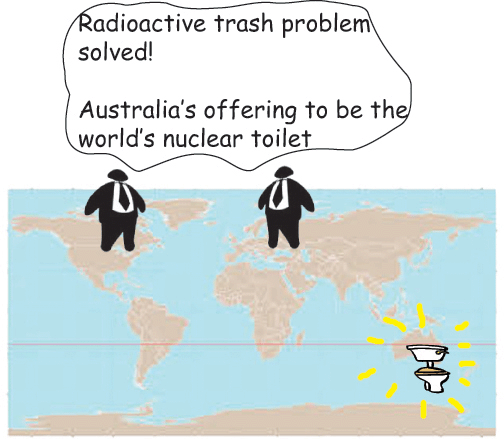
Australia risks becoming the “world’s nuclear waste dump” unless the Albanese government moves to rewrite its proposed Aukus laws, critics say.
A Labor-chaired inquiry has called for the legislative safeguard to specifically rule out accepting high-level nuclear waste from the US and the UK. One of the members of a Senate committee that reviewed the draft laws, independent senator Lidia Thorpe, said the legislation “should be setting off alarm bells” because “it could mean that Australia becomes the world’s nuclear waste dump”.
The government’s bill for regulating nuclear safety talks about “managing, storing or disposing of radioactive waste from an Aukus submarine”, which it defines broadly as Australia, UK or US submarines.
In a report published on Monday, the Senate’s foreign affairs, defence and trade legislation committee said this wording did not reflect the government’s promise not to accept high-level nuclear waste.
It recommended that the government consider “amending the bill so that a distinction is made between Australia’s acceptance of low-level nuclear waste from Aukus partners, but non-acceptance of high-level nuclear waste”.
The government has left the door open to accepting low-level waste from US and UK nuclear-powered submarines when they conduct rotational visits to Western Australia in the first phase of the Aukus plan. Low-level waste contains small amounts of radioactivity and include items such as personal protective equipment, gloves and wipes.
“According to the Australian Submarine Agency, nuclear-powered submarines only generate around a ‘small skip bin’ of low-level naval nuclear waste per submarine per year and that intermediate- and high-level waste will not become a concern until the first naval nuclear reactor requires disposal in the mid-2050s,” the Senate committee report said.
The government has yet to decide on the location for the disposal of radioactive waste from the submarines.
But infrastructure works proposed for HMAS Stirling – the naval base in Western Australia – to support the increased rotational visits are expected to include an operational waste storage facility for low-level radioactive waste.
The Department of Defence has argued any changes to the definitions should not prevent “regulatory control of the management of low-level radioactive waste from UK or US submarines” as part of those rotational visits.
Thorpe, an independent senator, said the call to prohibit high-level nuclear waste from being stored in Australia was “backed by experts in the field and was one of the major concerns raised during the inquiry into the bill”.
“The government claims it has no intention to take Aukus nuclear waste beyond that of Australian submarines, so they should have no reason not to close this loophole,” Thorpe said.
“They also need to stop future governments from deciding otherwise. We can’t risk our future generations with this.”
The government’s proposed legislation would set up an Australian naval nuclear power safety regulator to oversee the safety of the nuclear-powered submarines.
The committee made eight recommendations, including setting “a suitable minimum period of separation” to prevent a revolving door from the Australian Defence Force or Department of Defence to the new regulator.
The main committee report acknowledged concerns in the community that Australia might become a “dumping ground” for the Aukus countries, but it said the term was “not helpful in discussing the very serious question of national responsibility for nuclear waste”.
It also said the bill should be amended to ensure the regulator was transparent about “any accidents or incidents” with the soon-to-be-established parliamentary oversight committee on defence.
The Labor chair of the committee, Raff Ciccone, said the recommendations would “further strengthen the bill” and help “ensure Australia maintains the highest standards of nuclear safety”.
In a dissenting report, the Greens senator David Shoebridge said the legislation was “deeply flawed”, including because the regulator would report to the defence minister.
“The proposed regulator lacks genuine independence, the process for dealing with nuclear waste is recklessly indifferent to community or First Nations interests and the level of secrecy is a threat to both the environment and the public interest,” Shoebridge said.
The defence minister, Richard Marles, was contacted for comment.
Nuclear power and nuclear weapons – two sides of the same coin

In March 2024, Prime Minister Rishi Sunak explicitly linked nuclear weapons production capability with civil nuclear power generation development. This is because nuclear reactors are used to create tritium – the radioactive isotope of hydrogen – necessary for nuclear weapons.
The government has admitted its push for nuclear energy expansion is linked to its strategic military interests
by Peter Wilkinson, 12 May 2024, o https://eastangliabylines.co.uk/nuclear-power-and-nuclear-weapons-two-sides-of-the-same-coin/
The government’s apparent answer to climate change and Russia’s invasion of Ukraine is to triple the amount of nuclear generated electricity in the belief that it generates ‘low carbon’ electricity. But a recent admission by Prime Minister Rishi Sunak suggests there is a strong military component to what looks on the surface to be a civil matter.
The UK review of the energy sector, prompted by the invasion of Ukraine, offered a golden opportunity to address the need to drive down demand for electricity and energy more generally. This could be achieved by retrofitting insulation to the housing stock and buildings, mandating solar panel use for all new homes, investing heavily in renewables, in emerging battery technology and in decentralisation. Instead, the government has focused on a massive expansion of nuclear-generated electricity.
The dual nuclear agenda
Now the reason has finally been openly admitted. Maintaining and improving the supply chain and the knowledge and skills base in the workforce for the UK’s £100bn Trident nuclear weapons renewal programme relies on the civil nuclear sector.
While this claim has been regularly made by anti-nuclear campaigners – and just as regularly denied by minister after minister – it is now openly acknowledged. The Roadmap states quite clearly that it is important to align civil and military nuclear ambitions across government, to strengthen the interconnections between civil and military industries’ research and development, and thereby reduce costs for both the weapons and power sectors.
In March 2024, Prime Minister Rishi Sunak explicitly linked nuclear weapons production capability with civil nuclear power generation development. This is because nuclear reactors are used to create tritium – the radioactive isotope of hydrogen – necessary for nuclear weapons.
The cat which was so carefully and fraudulently hidden for decades is finally out of the bag: ministers now have to acknowledge that the civil nuclear programme owes more to maintaining weapons of mass destruction – weapons that were outlawed by the Treaty on the Prohibition of Nuclear Weapons which entered into force in January 2021 – than it has to do with salvation from the existential crisis that is climate change.
Debunking myths: the truth behind nuclear ambitions
Its brave new world aims for a nuclear sector generating upto 24 Gigawatts of electricity by 2050. That’s comparable to seven new 3.2 Gw capacity Hinkley Point Cs or Sizewell Cs or forty-eight Sizewell A-size reactors at around half a Megawatt output.
The locations for a proposed ‘mix’ of ‘gigawatt-sized reactors’ such as the European Pressurised Reactor (EPR) planned for Sizewell C, and ‘small modular’ and ‘advanced modular’ reactors (SMRs and AMRs respectively) is the subject of the government’s ‘Nuclear Road Map’.
It is, necessarily, largely a work of fiction laced with eulogies to nuclear power and liberally interspersed with admissions of hope over expectations. The truth is that Hinkley Point C is now expected to cost an eye-watering £40+bn from its original £20bn, and Sizewell C has already cost the taxpayer £2.4bn in sweeteners to the private sector.
Commercial SMRs don’t yet exist, and they are not small, unless you consider that Sizewell A falls into that category. AMRs have remained a fantasy for decades and are likely to remain so. Mention them to a nuclear regulator, and you’ll probably get a raised eyebrow in response.
Nuclear revival: promises vs reality
The Sizewell project has yet to be granted multiple construction and operating permits and licences and no final investment decision has been made. Other issues which make Sizewell C a terrible idea include:
- A multi-billion hole existing in its finances
- There is no reliable and guaranteed supply of potable water – of which an average of 2.2 million litres a day are required in the country’s most water-scarce area
- It is situated in a flood zone
- It is in an Area of Outstanding Natural Beauty
- It sits on the fastest-eroding coastline in northern Europe
- An estimated 46 hectares of woodland have already been flattened
- The Environment Agency (EA) has authorised the dumping of 1,590 tonnes of dead and dying fish back into the North Sea each year as a consequence of the Sizewell C cooling water intake (not to mention the 100s of millions of fish, fish larvae and other marine biota)
- In addition, there will be an estimated 171 million sacrificial sand goby, none of which are acknowledged by the EA.
- Radiological discharges from Sizewell C to the sea and air have contested health impacts
EDF ploughs on
The Supreme Court is still considering the merits of a judicial review appeal against the original planning approval. None of these uncertainties and deficiencies have stopped EDF devastating the areas around the development with the sanction of the local planning authority.
The tragedy is that nuclear is now a redundant technology which takes too long to come to our climate-change rescue and is not fit to be in the front-line of defence against climate change. It does not represent a plan of great urgency to meet the accelerating existential threats of climate change.
It has a rapidly narrowing window in which to contribute its electricity to the job of reducing climate change risks. When compared to renewables and conservation measures, nuclear is slow, costly and unreliable in terms of the new technology embodied in the EPR design. The Flamanville project in France, using a Sizewell EPR-type reactor, is still offline, is twelve years late and will cost four times the original budget.
The government has been in thrall to nuclear power for a long time. Perhaps with the admission of its connection to its strategic miliary goals, we can now better understand why that is. But the knowledge only deepens and entrenches the divide between the hawks and the doves.
Amidst genocide and war, anti-Zionism protesters are demonised as ‘extremists’
Independent Australia, By Martin Hirst | 13 May 2024
As human rights experts warn of an ongoing genocide in Gaza, any opposition to Zionism is being egregiously labelled as extremism, Dr Martin Hirst writes.
STUDENT PROTESTERS around the world are being demonised by politicians, bureaucrats and the news media for taking a stand against genocide.
This is just an updated version of the moral panic playbook that conservatives use to demonise young people who don’t toe the establishment line.
In the last six weeks, student protests have exploded around the world on a scale not seen since the Vietnam Moratorium almost 60 years ago. These students are protesting against what human rights experts are not hesitating to call a genocide in Gaza.
This reporter knows some of the Australian leaders of these protests quite well, organising politically with them as a long-term member of Left-wing group Socialist Alternative and a writer for its newspaper, Red Flag.
We know that none of these outstanding young activists are antisemitic. We know they are better educated about Palestine from a contemporary and historical perspective than our Prime Minister and most politicians…………………………………………………
We know that these young people are on the right side of history.
We also know that attempts by political leaders, intelligence agencies, Zionist hacks, the police and some university administrators to brand these brave students as violent, dangerous and antisemitic is a bald lie.
It is the lie itself that is dangerous because it actually emboldens Zionist thugs to launch ever-more violent attacks on student encampments, causing injury and mayhem.
It is also dangerous because it is a serious attempt – carried out with planning and intent – to criminalise anti-genocide activists and to criminalise their right to political speech.
What is happening in Australia, across Europe and in the United States is the creation of a state of emergency based on these dangerous lies. Right in front of our eyes, pro-Israel elements of the ruling class are establishing the conditions for a new wave of moral panic.
Students are being demonised as the 21st-Century version of the “folk devil“. The protests are being compared to 1930s Germany – which most people who make this comparison know absolutely fuck-all about – and they are being used to launch a McCarthyite witch hunt against students and academics who stand up for Palestine.
There’s nothing new about moral panics — the phrase was coined by British sociologist Stanley Cohen in the 1970s to describe the clamour for the state to take action against “Mods” and “Rockers” — two rival youth subcultures that enjoyed different types of music.
Interestingly, the Pogroms against Jews that swept Europe in the 1920s were a form of moral panic…………………………………………………………………………………………………
A moral panic only works when those in power – who feel threatened by resistance from below – can enlist loyal handmaidens in the media to prosecute their case and amplify their fear-mongering. Now, these tactics of intimidation are aimed at silencing dissent and any vocal opposition to the Israeli slaughter in Gaza.
Make no mistake, it is happening. Take it seriously because the Zionists and the political establishment are taking it seriously……………………………………………………
Failed Liberal Minister Josh Frydenberg helped to produce a “documentary” helpfully explaining to Sky News audiences how Australia is sliding into Nazi-era pogroms because of the threat to civil order posed by the student encampments and the wider anti-genocide movement.
In the last week alone, there has been a slew of opinion columns and news pieces in The Australian slandering student encampments while ignoring the attacks mounted on them by Zionist thugs.
Andrew Bolt and the usual list of suspects are apoplectic with rage that university administrators haven’t (yet) moved to shut down the protests.
However, the universities are beginning to move. The administration at Monash University in Melbourne is demanding students remove ‘Zionists not welcome’ signs from around their encampment because of some spurious “legal advice” that it is vilification.
Police have been allowed to install surveillance cameras overlooking the Monash encampment. Vice Chancellors from the Group of Eight — Australia’s richest universities — have asked Attorney-General Mark Dreyfus to advise them if the slogans used in the encampments are “hate speech”.
This is particularly egregious because Dreyfus himself is a Zionist. Dreyfus declined to provide legal advice but urged people who feel offended to lodge complaints under Section 18a of the Racial Discrimination Act. …………………………………………………..
It is too early to tell where all of this will end, but we can confidently predict that the Labor Party will support Sarah Henderson’s call for a Senate inquiry.
Anthony Albanese is fuelling the moral panic with apparent joy. He is reported to have told a room full of senior Zionist elders and student leaders that he believes the campus protests are led by outside agitators.
Helpfully, he was able to name them too. It’s all “the Trots‘ fault”.
This is deeply ironic for two reasons:
Russian revolutionary leader Leon Trotsky was a Jew and when he fell foul of the Stalinist regime, his Jewish heritage was used against him to launch a moral panic that even spread to Australia and poisoned the minds of many good Communist Party members, including the artist Noel Counihan who famously called Trotsky a “fascist gangster”.
Albanese has also been demonised as a Trotskyist by Murdoch hacks and (former Liberal MP Bronwyn Bishop) “Kerosene Bronny“…………….. https://independentaustralia.net/politics/politics-display/amidst-genocide-and-war-anti-zionism-protesters-are-demonised-as-extremists,18594
1 This month

of the week – Australians for War Powers Reform (AWPR)
To see nuclear-related stories in greater depth and intensity
 Antinuclear