How the media facilitates Dutton’s nuclear lies
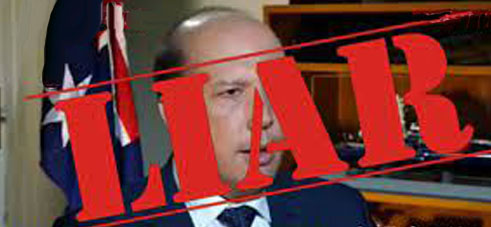
The fault is the media’s also. It entertains the nonsense, repeats it until it is real. It pretends there is debate where there is none. It leans too heavily on conflict. It mistakes credulity for balance.
It is in these false equivalences that Peter Dutton finds his purpose. Here, on these glib plains, he is reinvented as a politician. His lone policy announcement is given the status once reserved for an alternative government.
In journalism, the answer to any question in a headline is almost always no. The hope is that a reader might settle for maybe. The question mark itself bends over in embarrassment.
Last week, the ABC used its leading news podcast to ask: “Could nuclear power really lead to cheaper bills?” Similar questions have been asked across the media. The answer is no, but the headline has already done its work. It has already lent credibility to a fantasy.
According to the latest Lowy polling, two thirds of Australians now support the use of nuclear power. As many as 27 per cent support it strongly. A decade ago the opposite was true: 62 per cent did not want nuclear as part of the energy mix.
The difference is not science. It is mischief. The case for nuclear has not grown stronger. The cost argument has not been won. Uranium has become no safer or less finite. All that has changed is the desperateness of the Coalition and the fecklessness of the press.
Peter Dutton cannot name the experts who advised on his policy. This is most likely because they do not exist. Imaginary reactors are the preserve of imaginary scientists. The policy is not costed and relies on developments that are presently illegal.
Findings from the Australian Energy Market Operator, published this week, make clear that the power grid would fail before even the most optimistic projections of when these reactors might be operational. They are not a solution. They are a distraction.
Cost is another lie. The Commonwealth Scientific and Industrial Research Organisation notes that nuclear power is twice as expensive to produce as renewables. These figures don’t allow for blowouts in construction and time, which are almost inevitable. If everything went right, the answer would still be wrong.
Dutton knows all this. So does the media that asks fallaciously if nuclear power could lead to cheaper bills. They have conspired to solve a problem that exists now with a solution that is never coming.
There is little enough being debated that this is taking up all the space. It is interrupting the inevitable shift to renewables. That is its sole intention.
Once again investment is being slowed. Once again the obvious is being treated as uncertain. This is played out as if it were a game, but it is not: the world is being pushed closer to catastrophe.
No wonder the question marks cower in their headlines, ashamed of their role in this whole sordid scam.
This article was first published in the print edition of The Saturday Paper on June 29, 2024 as “The nuclear question mark”.
No comments yet.
1 This month

of the week – Australians for War Powers Reform (AWPR)
To see nuclear-related stories in greater depth and intensity
 Antinuclear
Leave a comment